
Delaware LMFT Requirements: Hours, Exams & Step-by-Step Guide
Stop guessing if your categories match Delaware requirements. License Trail checks your direct, indirect, and supervision hours against LMFT requirements continuously and flags mismatches before you submit.
No credit card required · Free plan available
Quick Requirements Overview
- Two-step path: Earn LAMFT first, then complete required post‑master’s experience to apply for LMFT (DE Board of Mental Health & Chemical Dependency Professionals).
- Education: Graduate degree in MFT (COAMFTE or Board-acceptable) or allied field with MFT-equivalent coursework (~45 semester credits).
- Practicum/internship (pre‑grad): 300 direct client hours, including 150 with couples/families.
- Exam: Pass AMFTRB (Board approval to sit; score transfer used later for LMFT).
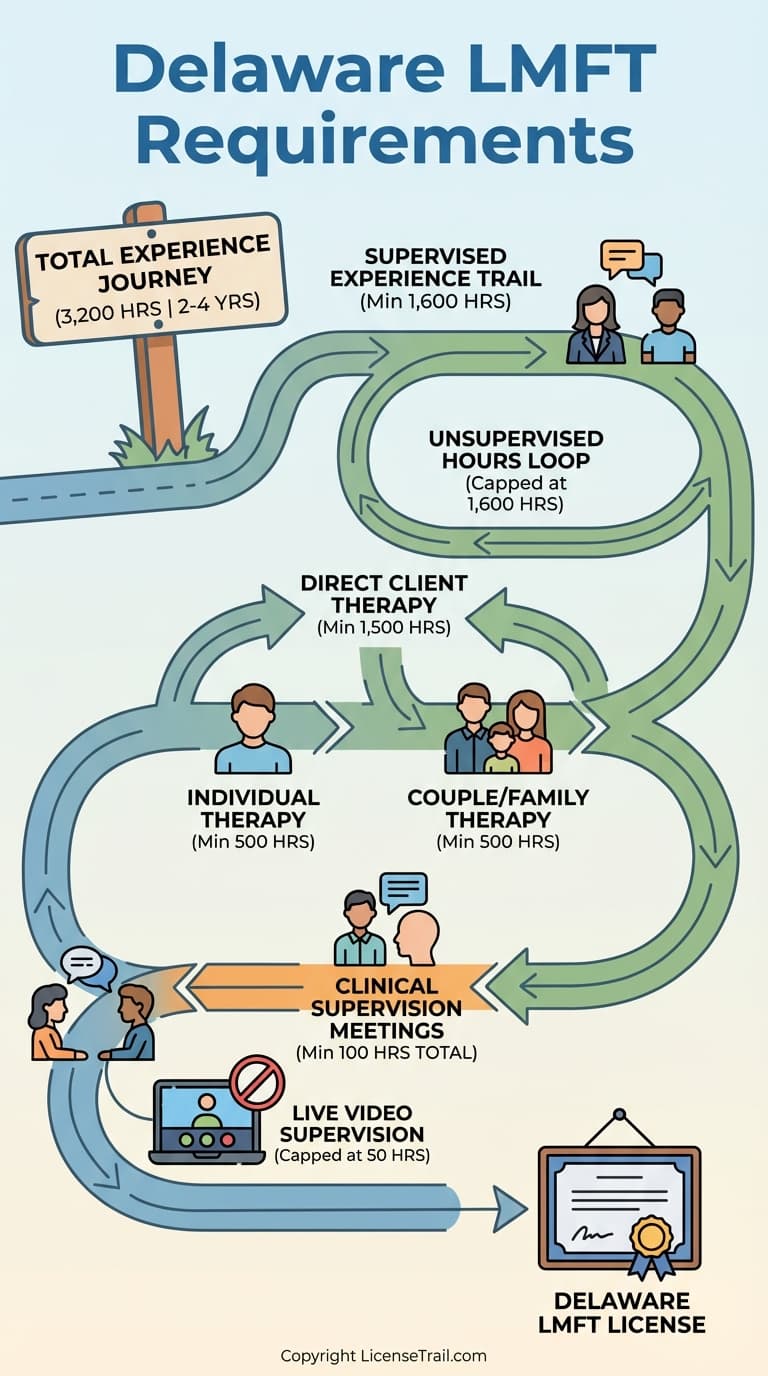
- Post‑master’s experience window: 3,200 hours over 2–4 consecutive years.
- Supervised clinical portion (within 3,200): 1,600 supervised clinical hours including 500 couple/family, 500 individual, 500 either, plus 100 hours face‑to‑face supervision (≤ 50 via live video).
- Other experience portion: Remaining 1,600 hours are additional MFT services (not required to be supervised).
- Supervisor rules/documentation: Supervised hours must be under Board-acceptable supervisors (DE LMFT, AAMFT Approved Supervisor/Candidate, or qualifying out‑of‑state LMFT; other licensed clinicians only if Board-approved); submit Board-approved plan and Verification of Supervision forms.
License Details
Procedures
Becoming a Licensed Marriage and Family Therapist (LMFT) in Delaware is structured around two licenses—associate (LAMFT) and full LMFT—and a very specific set of post‑master’s hours defined by the Delaware Board of Mental Health and Chemical Dependency Professionals.
Below is a concise, step‑by‑step description focused on the hour types, supervision, and key board terminology.
1. Licensure structure and oversight
Delaware regulates LMFTs under Title 24, Chapter 30, Subchapter IV (“Marriage and Family Therapists”) of the Delaware Code, administered by the Board of Mental Health and Chemical Dependency Professionals. (delcode.delaware.gov)
The Board recognizes:
- Licensed Associate Marriage and Family Therapist (LAMFT) – an individual “obtaining experience under professional direct supervision for the purpose of becoming licensed as a marriage and family therapist.” (delcode.delaware.gov)
- Licensed Marriage and Family Therapist (LMFT) – an individual who offers “professional marriage and family services” to individuals, couples, families, or groups. (delcode.delaware.gov)
In practice, you obtain the LAMFT first, complete all Board‑required post‑master’s hours under supervision, then apply for LMFT.
2. Educational foundation (for LAMFT and ultimately LMFT)
To enter the LMFT pathway, Delaware requires a graduate degree and specific clinical training:
-
Degree
- A graduate degree in marriage and family therapy (MFT) from a COAMFTE‑accredited program; or (law.cornell.edu)
- A graduate degree in MFT from a non‑COAMFTE program acceptable to the Board; or
- A graduate degree in an allied field (counseling, social work, psychology, or psychiatry) from a nationally accredited institution, with MFT‑equivalent coursework as defined by Board rules (minimum 45 semester credits, with specific content areas and clinical training). (law.cornell.edu)
-
Graduate internship/practicum (part of education, not the post‑master’s hours)
For LAMFT eligibility, Board regulations require an internship that includes at least 300 hours of direct client counseling, of which 150 hours must be with couples and families. (law.cornell.edu)
3. Associate license (LAMFT): gateway to LMFT hours
Delaware uses the associate license as the supervised experience stage.
Key LAMFT requirements (summarized from statute and Board rules):
- Education as above, documented by official transcript. (law.cornell.edu)
- Pass the AMFTRB national MFT exam – LAMFT applicants must obtain Board approval to sit for the exam, then achieve at least the passing score set by AMFTRB. (law.cornell.edu)
- Written plan to acquire LMFT experience – LAMFT applicants must submit a Board‑approved plan describing how they will complete the LMFT hours in Section 5.1.2 of the Board’s Rules and Regulations, signed by the proposed supervisor(s). (law.cornell.edu)
AAMFT’s summary (based on Delaware board materials) notes that you must be licensed as an associate (LAMFT) to complete the supervised experience required for full LMFT licensure. (aamft.org)
Once you hold an LAMFT and have an approved plan and supervisor, you can begin counting post‑master’s hours toward the LMFT.
4. Core LMFT requirement: post‑master’s experience hours
4.1 Overall statutory requirement
Delaware law requires, after the master’s degree:
- “2 years of supervised marriage and family therapy experience,”
- consisting of at least 3,200 total hours of experience,
- obtained over a period of no more than four (4) consecutive years,
- of which at least 1,600 hours must be supervised clinical experience acceptable to the Board. (law.justia.com)
The Board’s website and regulations add that these hours must be accumulated over at least two, but not more than four, years. (dpr.delaware.gov)
Put plainly, Delaware’s LMFT experience requirement is:
3,200 hours of post‑master’s marriage and family therapy services over 2–4 consecutive years, including 1,600 hours of supervised clinical experience and 1,600 additional hours of MFT experience (not required to be supervised).
4.2 How the 3,200 hours are split
The Board’s rules and Division of Professional Regulation (DPR) guidance give a detailed breakdown of the 3,200 hours: (dpr.delaware.gov)
A. Supervised clinical experience – 1,600 hours
Within the 3,200 total hours, 1,600 hours must be completed under “professional direct supervision” acceptable to the Board. These 1,600 supervised hours must include all of the following: (dpr.delaware.gov)
- 500 hours of couple and family therapy
- 500 hours of individual therapy
- 500 hours of either couple/family or individual therapy (any combination)
- 100 hours of face‑to‑face clinical supervision with the approved supervisor(s)
Regulations specify that “face‑to‑face” supervision can include live video conferencing, but supervision delivered by live video may not exceed 50% (50 hours) of the required 100 supervision hours. (archive.regulations.delaware.gov)
The supervised hours must themselves span at least two and no more than four consecutive years when all approved supervisors’ hours are combined. (dpr.delaware.gov)
B. Additional MFT experience – 1,600 hours
The remaining 1,600 hours (to reach the total 3,200) are marriage and family therapy services that are not required to be supervised, though they may include additional supervised hours beyond the 1,600 minimum.
Key points from the Board’s materials and statute:
- All 3,200 hours must be “marriage and family therapy services” as defined by Delaware law—i.e., diagnosis and treatment of mental and emotional disorders in the context of interpersonal relationships, involving psychotherapy, assessment, counseling, consultation, treatment planning, and supervision delivered to individuals, couples, and families. (delcode.delaware.gov)
- Hours under a supervisor who is not Board‑acceptable may count toward this 1,600 “other” experience, but do not count toward the 1,600 supervised hours (see below under “Who can supervise”). (dpr.delaware.gov)
So in the format you requested, Delaware’s LMFT requirement functions as:
- 3,200 total post‑master’s MFT experience hours, obtained in 2–4 consecutive years, made up of:
- 1,600 hours of supervised clinical experience, broken down into specific therapy and supervision hour types; and
- 1,600 additional hours of MFT experience (not required to be supervised), still within marriage and family therapy as legally defined.
5. What “professional direct supervision” means
Delaware’s statute and Board rules define “professional direct supervision” (sometimes just “direct supervision”) as:
- Face‑to‑face consultation, on a regularly scheduled basis, between the supervisee and a qualified LMFT or other Board‑approved behavioral health professional; and
- The supervisor is responsible for ensuring the “extent, kind and quality” of services are consistent with the supervisee’s education, training, and experience. (delcode.delaware.gov)
Board guidance for LMFT applicants emphasizes that this supervision is specifically tied to the 1,600 hours of supervised experience; hours under non‑qualifying supervisors cannot be counted toward those 1,600 hours, though they may still count toward the unsupervised portion of the 3,200. (dpr.delaware.gov)
6. Who can supervise your LMFT hours
The Board is precise about who qualifies as an acceptable supervisor for LMFT experience.
6.1 Primary acceptable supervisors
For the 1,600 supervised hours to count, your supervisor must be one of the following: (dpr.delaware.gov)
- A Delaware‑licensed Marriage and Family Therapist, or
- An AAMFT “Approved Supervisor”, or
- An AAMFT Approved Supervisor Candidate acceptable to the Board, or
- A licensed marriage and family therapist from another state who:
- Has held an LMFT license in good standing there for at least five years, and
- Has passed the AMFTRB examination.
If none of the above is available, the Board may approve one of the following as a supervisor, provided they have training in marriage and family therapy supervision: (dpr.delaware.gov)
- Licensed clinical social worker
- Licensed psychologist
- Licensed professional counselor of mental health
- Licensed physician specializing in psychiatry
Board regulations add that supervision by a non‑LMFT must be justified as coming from a behavioral health professional with a specific clinical competency essential to your training; approval is at the Board’s discretion. (law.cornell.edu)
6.2 Effect of a non‑qualifying supervisor
- Hours under non‑approved supervisors: These do not count toward the 1,600 supervised hours, but may count toward the other 1,600 hours of experience that are not required to be supervised. (dpr.delaware.gov)
6.3 Documentation
For LMFT application “by examination” (i.e., not via reciprocity), you must submit:
- A Verification of Supervision form from each approved supervisor showing the number of hours of supervised MFT experience, and (if applicable) proof the supervisor passed the AMFTRB exam and held an LMFT license in good standing for at least five years if they were not Delaware‑licensed. (dpr.delaware.gov)
7. Exam requirement (AMFTRB)
Delaware ties the national exam to the LAMFT license:
- LAMFT stage: You must pass the Association of Marital and Family Therapy Regulatory Boards (AMFTRB) exam with a passing score set by AMFTRB in order to receive the LAMFT. (law.cornell.edu)
- LMFT stage: When applying for LMFT, if you have already passed the AMFTRB exam, you arrange an official score transfer from AMFTRB/Interstate Reporting Service to the Board. (dpr.delaware.gov)
The LMFT statute itself lists passing the AMFTRB (or another Board‑acceptable exam) as one of the necessary qualifications. (law.justia.com)
8. Other statutory fitness requirements
Beyond hours and education, the LMFT statute requires that an applicant: (law.justia.com)
- Not have certain types of unresolved administrative penalties or serious disciplinary history (e.g., license suspensions, revocations, or consent agreements with ongoing conditions), and
- Meet any other character and fitness standards set out in the Board’s rules.
9. Continuing education after licensure (briefly)
Once licensed as an LMFT:
- You must complete 40 contact hours of continuing education every two years, by September 30 of even‑numbered years, to renew your license. (aamft.org)
10. Summary of Delaware LMFT hour requirements in board terms
Putting the Board’s statutory and regulatory language together, the LMFT experience requirement in Delaware can be summarized as:
-
Total post‑master’s experience:
- 3,200 hours of “marriage and family therapy” services (as defined in §3051(d)) (delcode.delaware.gov)
- Completed after the qualifying master’s degree
- Spanning no less than two and no more than four consecutive years (dpr.delaware.gov)
-
Within those 3,200 hours:
- 1,600 hours of supervised clinical experience acceptable to the Board, consisting of: (law.justia.com)
- 500 hours – couple and family therapy
- 500 hours – individual therapy
- 500 hours – either couple/family or individual therapy in any combination
- 100 hours – face‑to‑face clinical supervision (no more than 50 hours via live video)
- 1,600 additional hours of marriage and family therapy services that are not required to be supervised (but must still meet the statutory definition of MFT practice and occur within the same 2–4‑year window). (law.justia.com)
- 1,600 hours of supervised clinical experience acceptable to the Board, consisting of: (law.justia.com)
All of this experience must be gained under a plan and supervisors that the Board has approved, and documented to the Board’s satisfaction at the time of LMFT application.
Because statutes and regulations can change, the safest approach is always to confirm these requirements directly on the Delaware Division of Professional Regulation’s Marriage and Family Therapy and LAMFT pages and in the most current version of Title 24, Chapter 30, and the Board’s Rules and Regulations before making training or employment commitments.
Track your LMFT hours with confidence
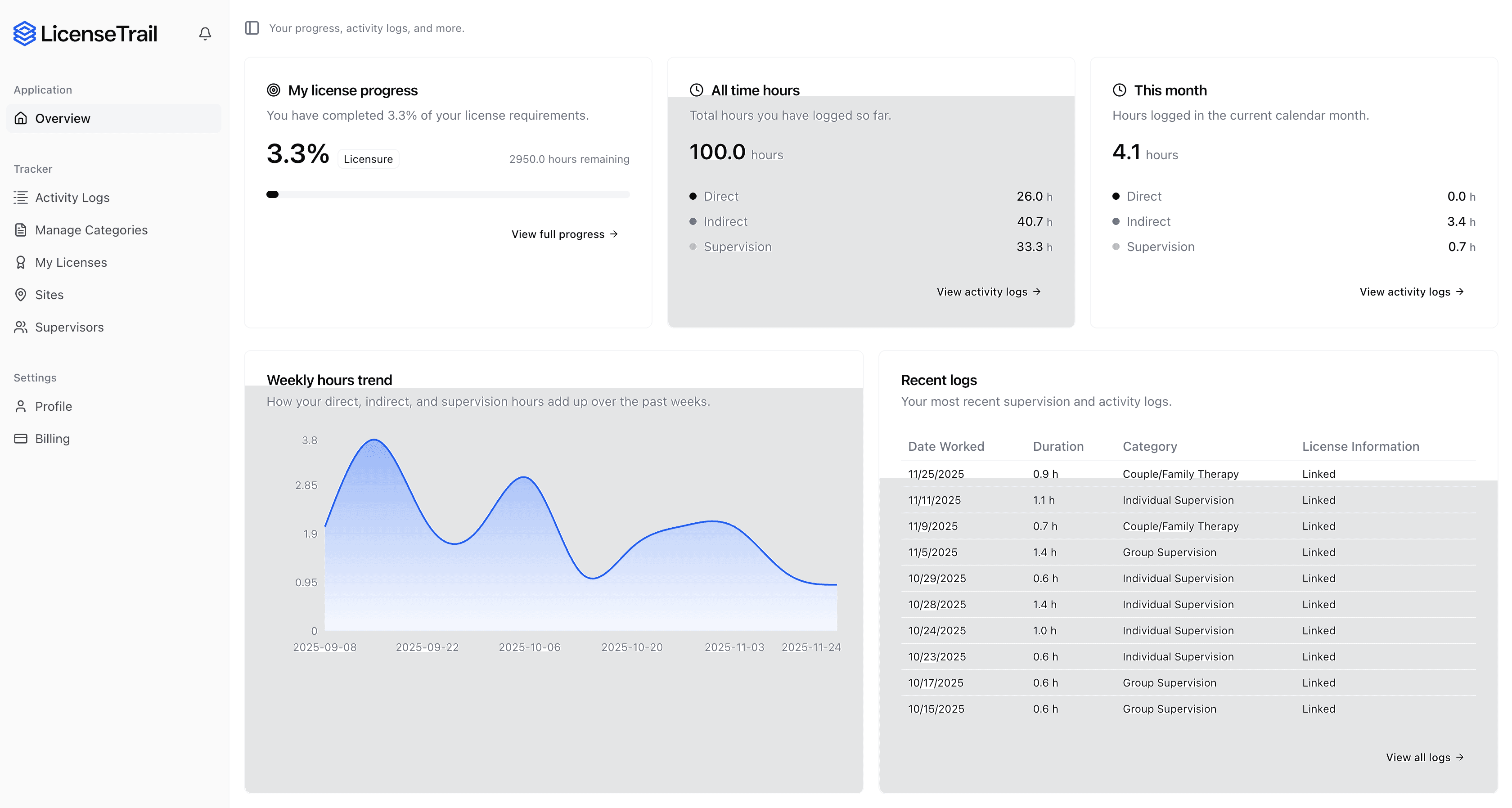
License Trail checks your direct, indirect, and supervision hours against Delaware LMFT requirements continuously and flags mismatches before you submit.
 Start Tracking for Free
No credit card required · Free plan available
Is your spreadsheet hiding Delaware LMFT risks?
Stop guessing if your categories match Delaware Board of Mental Health and Chemical Dependency Professionals requirements. License Trail checks your direct, indirect, and supervision hours continuously and flags mismatches before you submit.
Import or log
Bring your spreadsheet or start fresh
Upload your existing tracking spreadsheet and we'll map every hour into the right Delaware Board of Mental Health and Chemical Dependency Professionals categories automatically.
Verify against Delaware
Catch mismatches before the board does
License Trail checks your direct, indirect, and supervision hours against Delaware LMFT requirements continuously.
Export board-ready
One-click clean reports
Generate professional, board-ready reports for supervision meetings and Delaware Board of Mental Health and Chemical Dependency Professionals submissions in seconds.
No credit card required · Free plan available