
Delaware LPAT Requirements: Hours, Exams & Step-by-Step Guide
Stop guessing if your categories match Delaware requirements. License Trail checks your direct, indirect, and supervision hours against LPAT requirements continuously and flags mismatches before you submit.
No credit card required · Free plan available
Quick Requirements Overview
- Degree: Master’s/Doctoral in Art Therapy (≥60 grad credits; AATA/CAAHEP-approved/accredited) or allied graduate degree + Board-determined equivalent art therapy coursework
- Exam: Pass the national Art Therapy Credentials Board (ATCB) exam
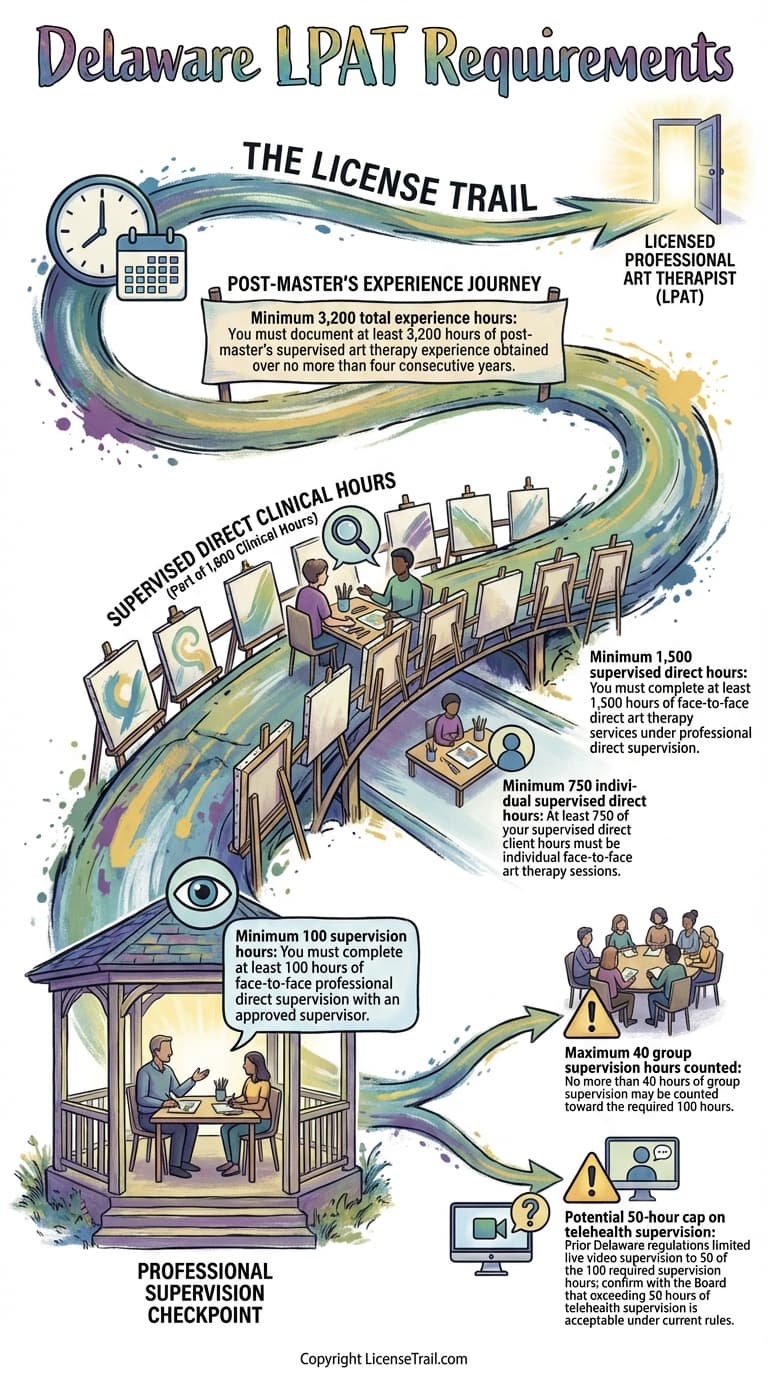
- Experience (post‑master’s only): 3,200 hours supervised art therapy over 2–4 consecutive years
- Clinical portion: 1,600 hours under professional direct supervision, including 1,500 face‑to‑face direct art therapy services (≥750 must be individual sessions; remaining may be individual/group/couple/family)
- Supervision hours: ≥100 hours face‑to‑face direct supervision (in-person or live video); ≤40 hours may be group (max 6 supervisees)
- Additional experience: Remaining 1,600 hours art-therapy-related experience verified by supervisor(s); not all must be under “professional direct supervision”
- Supervisor rules: Acceptable supervisors include licensed Professional Art Therapist (any state/territory) or ATR‑BC/ATCS; certain other Board-approved behavioral health professionals may qualify; supervisor must be ≥2 years post-licensure, no discipline; max 10 supervisees
- Limits/setting: Must be clinical art therapy treatment; art teaching does not count; you may not represent yourself as LPAT/LAAT without Delaware licensure (LAAT available while accruing hours)
License Details
Procedures
Licensing Requirements for a Licensed Professional Art Therapist (LPAT) in Delaware
The Delaware Board of Mental Health and Chemical Dependency Professionals regulates both Licensed Professional Art Therapists (LPAT) and Licensed Associate Art Therapists (LAAT) under Title 24, Chapter 30, Subchapter V of the Delaware Code. You may not hold yourself out as a LPAT or LAAT unless you are licensed under this subchapter. (delcode.delaware.gov)
Becoming a LPAT by examination in Delaware involves three main components:
- Meeting the education requirement.
- Passing the national Art Therapy Credentials Board (ATCB) exam.
- Completing 3,200 hours of post‑master’s supervised art therapy experience, with a very specific breakdown of the types of hours and supervision.
Below is a step‑by‑step guide focused on the hour requirements and the exact categories defined by the Board.
1. Education and Examination Prerequisites
Before any hours can count toward LPAT licensure, you must:
-
Hold either:
- A master’s or doctoral degree in art therapy from an accredited institution with at least 60 graduate credits in an art therapy program approved/accredited by AATA or CAAHEP at the time of conferral, or (delcode.delaware.gov)
- A graduate degree in an allied field plus graduate‑level work equivalent to a master’s in art therapy, as determined by the Board. (delcode.delaware.gov)
-
Pass the board examination of the Art Therapy Credentials Board (ATCB). (regulations.justia.com)
Only post‑master’s experience counts toward the required 3,200 hours.
2. The Core Experience Requirement: 3,200 Hours of Supervised Art Therapy
Under Delaware law and Board regulations, after completing the master’s degree you must complete: (regulations.justia.com)
-
Total hours:
3,200 hours of supervised art therapy experience -
Timeframe:
- Not less than 2 years and
- Not more than 4 consecutive years
The Board regulations describe this as “3,200 hours of supervised art therapy acceptable to the Board”, with at least 1,600 hours designated as “supervised clinical experience acceptable to the Board.” (regulations.justia.com)
What “supervised art therapy” must involve
The Board’s guidance for Professional Art Therapist applicants specifies that supervised art therapy experience must:
- Involve face‑to‑face art therapy services with clients and
- Include other matters directly related to the treatment of clients
- Occur in a setting clearly designated to provide opportunities for clinical treatment through art therapy as defined in 24 Del. C. §§ 3061–3062. (dpr.delaware.gov)
The regulations add that art teaching is not considered art therapy and may not be used toward the supervised experience. (regulations.justia.com)
3. How the 3,200 Hours Are Broken Down
The 3,200 hours are divided into two major categories:
- 1,600 hours of supervised clinical experience under professional direct supervision
- 1,600 hours of additional supervised art therapy experience (not required to be “professional direct supervision”)
3.1. 1,600 Hours of Supervised Clinical Experience (Under Professional Direct Supervision)
Of the 3,200 hours, the regulations state that 1,600 hours must be completed under “professional direct supervision” by an acceptable supervisor. (regulations.justia.com)
The Board calls this 1,600‑hour portion “supervised clinical experience” and breaks it down as follows: (regulations.justia.com)
(a) 1,500 Hours of Face‑to‑Face Direct Art Therapy Services
Within the 1,600 supervised clinical hours, at least 1,500 hours must be provision of face‑to‑face direct art therapy services to clients. (regulations.justia.com)
These 1,500 direct service hours must include:
- At least 750 hours of individual face‑to‑face client sessions that include direct art therapy services.
- The remaining 750 hours may be any combination of:
- Individual art therapy
- Group art therapy
- Couple art therapy
- Family art therapy (regulations.justia.com)
In other words, for the direct client work portion:
- 1,500 total direct service hours, of which
- ≥ 750 hours must be individual face‑to‑face art therapy
- ≤ 750 hours can be individual, group, couple, or family art therapy (any mix)
(b) 100 Hours of Face‑to‑Face Professional Direct Supervision
The remaining portion of the 1,600 supervised clinical hours is at least 100 hours of face‑to‑face professional direct supervision with your supervisor. (regulations.justia.com)
The regulations and Board guidance further define this:
-
Individual direct supervision
- One‑to‑one, face‑to‑face meetings between supervisor and supervisee.
- You may fulfill the entire 100‑hour requirement using only individual supervision. (regulations.justia.com)
-
Group supervision
- Face‑to‑face meetings between a supervisor and no more than six supervisees.
- No more than 40 of the 100 supervision hours may be in group supervision; the rest must be individual. (regulations.justia.com)
-
Face‑to‑face format
- The regulations specify that “face‑to‑face” includes both in‑person and live video conferencing. (regulations.justia.com)
Summarized numerically, for the 1,600 supervised clinical hours:
- 1,500 hours – direct art therapy services (≥ 750 individual sessions)
- 100 hours – face‑to‑face professional direct supervision
- Total supervised clinical experience under professional direct supervision:
1,600 hours
3.2. 1,600 Additional Hours of Supervised Art Therapy Experience
After accounting for the 1,600 supervised clinical hours, you still need an additional 1,600 hours of post‑master’s art therapy experience to reach the 3,200‑hour total.
The Board’s post‑master’s guidance for Professional Art Therapists explains that: (dpr.delaware.gov)
- Your clinical or administrative supervisor(s) must verify any additional hours of post‑master’s art therapy experience not completed under direct supervision.
- These additional hours, when combined with the 1,600+ hours of professional direct supervision, must total at least 3,200 hours.
- All 3,200 hours must fall within a period of not less than two years and not more than four years.
The regulations clarify that hours completed under a supervisor who does not meet the Board’s requirements cannot be counted toward the required 1,600 hours of supervised clinical experience, but may count toward the other 1,600 hours of experience that is not required to be under professional direct supervision. (regulations.justia.com)
These additional hours still must qualify as “art therapy”/“art therapy services” and occur in appropriate clinical treatment settings, but they do not all have to be counted as direct client contact or professional direct supervision. (delcode.delaware.gov)
4. How Delaware Defines Key Supervision Terms
To apply the hour requirements correctly, it helps to understand the Board’s specific terminology.
4.1. “Supervised experience”
The statute defines supervised experience as face‑to‑face consultation on a regularly scheduled basis between a supervisee and a LPAT or another Board‑approved behavioral health professional, with the supervisor responsible for ensuring the services rendered fit the supervisee’s education, training, and experience. (delcode.delaware.gov)
4.2. “Supervised art therapy experience”
For LPAT applicants by examination, the Board’s guidance states that supervised art therapy experience must:
- Involve face‑to‑face art therapy services with clients, and
- Include work directly related to client treatment,
- In settings clearly designated to provide clinical treatment through art therapy. (dpr.delaware.gov)
4.3. “Direct supervised experience”
The Board further defines direct supervised experience as regular, face‑to‑face consultation between a supervisee and a LPAT or other Board‑approved behavioral health professional. The supervisor is responsible for the extent, kind, and quality of the services the supervisee provides. (dpr.delaware.gov)
This “direct supervised experience” is the type required for the 1,600 hours of supervised clinical experience discussed above.
5. Who Qualifies as an Approved Clinical Supervisor
The regulations and Board guidance specify who can supervise the required hours: (regulations.justia.com)
-
Automatically acceptable supervisors:
- A Professional Art Therapist licensed in any U.S. state or territory (not just Delaware), or
- An individual holding either:
- Registered and Board Certified Art Therapist (ATR‑BC), or
- Art Therapy Certified Supervisor (ATCS) credentials from the Art Therapy Credentials Board (ATCB).
-
Other Board‑approved behavioral health professionals, if the applicant can show the supervisor has a specialty or expertise in a clinical competency essential to the applicant’s training. Examples in the regulations include:
- Licensed marriage and family therapists
- Licensed professional counselors of mental health
- Psychologists
- Licensed clinical social workers
- Physicians
- Advanced practice registered nurses (regulations.justia.com)
Additional supervision rules:
- Supervisors must have been in practice at least 2 years post‑licensure (if licensed in another state) without discipline.
- A supervisor may have no more than 10 supervisees at a time.
- You may have more than one supervisor, and hours from all acceptable supervisors can be combined. (regulations.justia.com)
6. Relationship Between LAAT and LPAT
The Licensed Associate Art Therapist (LAAT) credential exists for individuals who have met education requirements but are still completing their supervised experience: (delcode.delaware.gov)
- A LAAT:
- Has met all LPAT requirements except experience and national certification.
- Must submit a Board‑approved plan for supervised experience before acquiring hours.
- Holds a license that is initially valid for 2 years and may be renewed up to two times.
- A LAAT may apply for LPAT once the full 3,200 hours and all other requirements are met.
While your question focuses on LPAT, in practice many applicants complete their 3,200 hours while licensed as a LAAT.
7. Putting the Hour Requirements Together
To summarize the Board’s structure in the type of breakdown you requested:
-
Total post‑master’s supervised art therapy experience required:
3,200 hours over 2–4 consecutive years (regulations.justia.com)Within that 3,200‑hour total:
-
1,600 hours of supervised clinical experience under professional direct supervision, consisting of:
- 1,500 hours of face‑to‑face direct art therapy services, including:
- At least 750 hours of individual face‑to‑face client sessions with direct art therapy
- Up to 750 hours of additional individual, group, couple, or family art therapy
- At least 100 hours of face‑to‑face professional direct supervision:
- Entire 100 hours may be individual supervision
- No more than 40 hours may be group supervision
- 1,500 hours of face‑to‑face direct art therapy services, including:
-
1,600 additional hours of supervised art therapy experience:
- Also post‑master’s art therapy in acceptable settings
- Verified by clinical or administrative supervisor(s)
- Not required to be “professional direct supervision,” but still art‑therapy‑related and within the same 2–4 year window
- Some of these hours may be under supervisors who do not meet the “acceptable supervisor” definition, but those hours cannot be counted toward the 1,600 supervised clinical hours. (regulations.justia.com)
-
Along with the education requirement and the ATCB exam, this 3,200‑hour supervised experience structure is the core of what Delaware requires to become licensed as a Licensed Professional Art Therapist (LPAT).
Track your LPAT hours with confidence
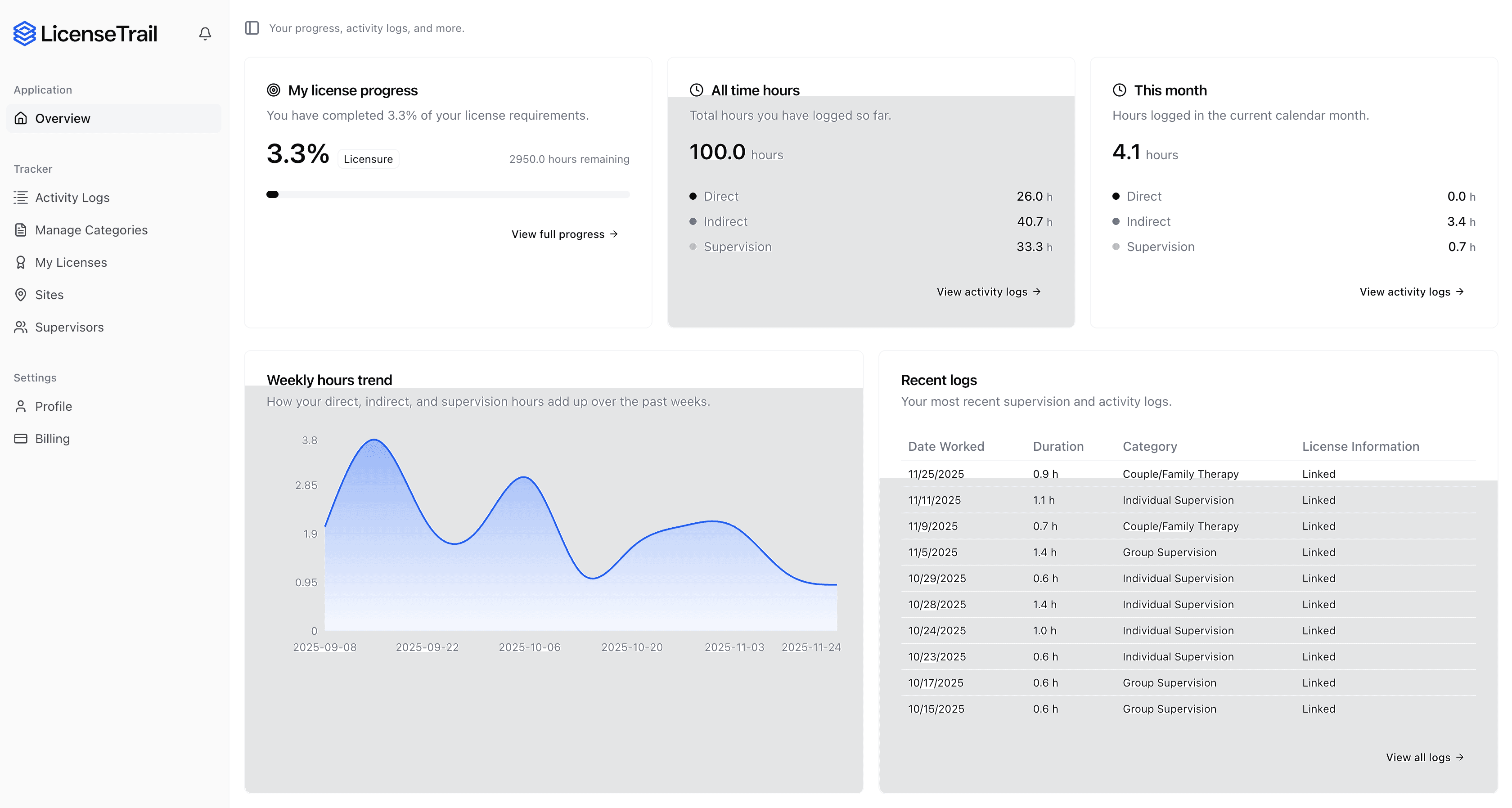
License Trail checks your direct, indirect, and supervision hours against Delaware LPAT requirements continuously and flags mismatches before you submit.
 Start Tracking for Free
No credit card required · Free plan available
Is your spreadsheet hiding Delaware LPAT risks?
Stop guessing if your categories match Delaware Board of Mental Health and Chemical Dependency Professionals requirements. License Trail checks your direct, indirect, and supervision hours continuously and flags mismatches before you submit.
Import or log
Bring your spreadsheet or start fresh
Upload your existing tracking spreadsheet and we'll map every hour into the right Delaware Board of Mental Health and Chemical Dependency Professionals categories automatically.
Verify against Delaware
Catch mismatches before the board does
License Trail checks your direct, indirect, and supervision hours against Delaware LPAT requirements continuously.
Export board-ready
One-click clean reports
Generate professional, board-ready reports for supervision meetings and Delaware Board of Mental Health and Chemical Dependency Professionals submissions in seconds.
No credit card required · Free plan available