
Delaware LPCMH Requirements: Hours, Exams & Step-by-Step Guide
Stop guessing if your categories match Delaware requirements. License Trail checks your direct, indirect, and supervision hours against LPCMH requirements continuously and flags mismatches before you submit.
No credit card required · Free plan available
Quick Requirements Overview
- Master’s (or Board‑determined equivalent) with ≥60 graduate semester hours aligned to CACREP CMHC standards (incl. practicum/internship); course evaluation if degree title differs
- Pass NCE (or other Board‑accepted exam)
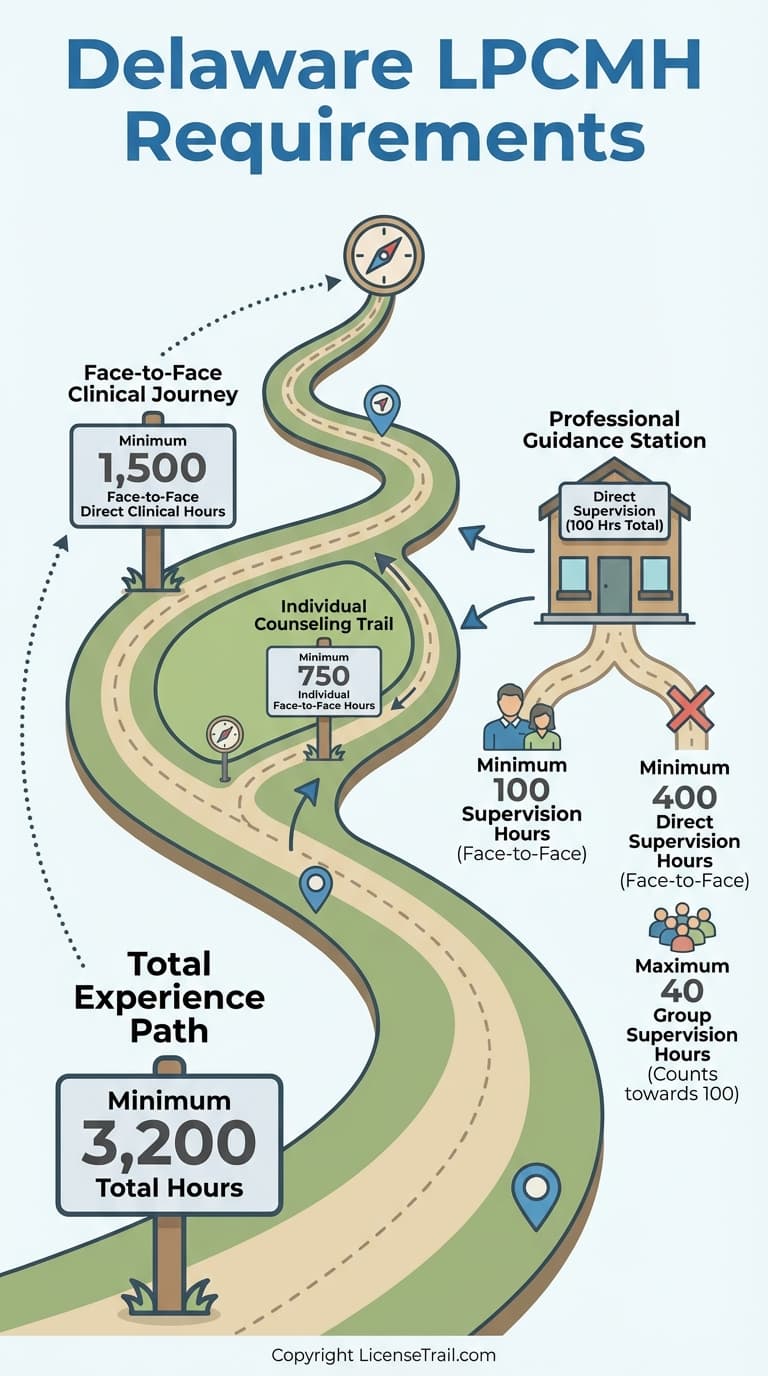
- Complete 3,200 post‑master’s hours of supervised mental health counseling over 2–4 consecutive years
- Of the 3,200: ≥1,600 hours must be supervised clinical experience under an approved/acceptable supervisor
- Within the 1,600: ≥1,500 face‑to‑face direct client hours (includes live video); ≥750 must be individual sessions; remaining may be individual/group/couple/family
- Within the 1,600: ≥100 hours face‑to‑face direct supervision; ≤50 hours via live video; ≤40 hours group supervision (max 6 supervisees)
- Hours must be clinical diagnosis/treatment in a HIPAA‑covered clinical setting; educational/guidance counseling doesn’t count (limited school‑based exceptions via MH org)
- Supervisor: typically an LPCMH (any state/territory); non‑LPCMH allowed only with Board approval/attestation; school counselors/psychologists not approved; background/character requirements incl. fingerprints/CBC apply
License Details
Procedures
Becoming a Licensed Professional Counselor of Mental Health (LPCMH) in Delaware is tightly defined in both statute (Title 24, Chapter 30 of the Delaware Code) and the Board’s regulations (24 Del. Admin. Code 3000-2.0), as well as Board guidance on post‑master’s experience. Below is a step‑by‑step outline focused on the hour requirements and the Board’s own terminology.
1. Baseline eligibility: education and exam
Graduate degree
Delaware law requires that an LPCMH applicant:
- “Has received a master’s degree from a regionally accredited institution of higher education with a minimum of 60 graduate semester hours in clinical mental health counseling or received a graduate degree equivalent to clinical mental health counseling from a recognized institution as determined by the Board.” (delcode.delaware.gov)
The Board’s regulations further specify that if your degree is not literally in clinical mental health counseling, you must have at least 60 graduate semester hours that cover current CACREP clinical mental health counseling standards (including practicum and internship) and submit a course evaluation with your application. (law.cornell.edu)
Required examination
All applicants must have:
- Passed the National Counselor Examination (NCE) or another examination acceptable to the Board. (law.cornell.edu)
2. How Delaware defines the key concepts
Before looking at hours, the Board and statute define what “counts”:
-
Professional mental health counseling is “the application of clinical counseling principles, methods or procedures including the diagnosis and treatment of mental and emotional disorders to assist individuals in achieving more effective personal and social adjustment.” (delcode.delaware.gov)
-
Professional direct supervision is “face‑to‑face consultation, on a regularly scheduled basis, between a supervisee and a licensed professional counselor of mental health (LPCMH) or other behavioral health professional approved by the Board,” and the supervisor is responsible for ensuring services are consistent with the supervisee’s education, training, and experience. (delcode.delaware.gov)
-
The Board’s regulations clarify that professional counseling experience means hours spent providing face‑to‑face professional mental health clinical counseling services with clients and related treatment activities, in a setting clearly designated for professional mental health clinical counseling and subject to HIPAA. Educational or guidance counseling is explicitly not considered clinical mental health counseling, though some contracted school‑based work through a mental health organization may be acceptable. (archive.regulations.delaware.gov)
These definitions are important because your hours must fit within them to be accepted.
3. Core experience requirement: 3,200 hours post‑master’s
Total required hours and time frame
Both statute and regulation require that LPCMH applicants complete:
- 3,200 hours of supervised professional mental health counseling
- Accumulated over not less than 2 years and not more than 4 consecutive years after the qualifying degree. (delcode.delaware.gov)
The Board’s official “Post‑Masters Mental Health Counseling Experience Requirements” guidance repeats this:
- “You must complete at least 3,200 hours of mental health counseling services over a period of at least two but not more than four consecutive years.” (dpr.delaware.gov)
4. Breakdown of the 3,200 hours
Delaware then subdivides those 3,200 hours into specific types and supervision levels.
A. Minimum supervised clinical experience: 1,600 hours
Out of the 3,200 hours, statute and regulation require:
- At least 1,600 hours must be supervised clinical experience acceptable to the Board. (delcode.delaware.gov)
The Board’s post‑master’s guidance summarizes this as:
- “Of the required 3,200 hours of total experience, at least 1,600 hours must be completed under the direct clinical supervision of an approved or acceptable supervisor.” (dpr.delaware.gov)
These 1,600 supervised clinical hours are then broken down further.
B. Within the 1,600 supervised clinical hours
Regulation 24 Del. Admin. Code 3000-2.0 requires that the 1,600 hours of supervised clinical experience be fulfilled as follows: (law.cornell.edu)
-
Direct client work: at least 1,500 hours
- At least 1,500 of the 1,600 hours must be actual provision of face‑to‑face direct mental health counseling services.
- Of those 1,500 hours:
- At least 750 hours must be individual, face‑to‑face client sessions involving direct mental health counseling.
- The remaining 750 hours may be any combination of individual, group, couple, or family counseling services, as long as they are face‑to‑face and meet the Board’s definition of professional mental health counseling. (law.cornell.edu)
“Face‑to‑face” explicitly includes both in‑person and live video conferencing when delivering services. (law.cornell.edu)
-
Supervision meetings: at least 100 hours
Within the same 1,600 supervised clinical hours, the Board requires:
- At least 100 hours of face‑to‑face professional direct supervision with your supervisor. (law.cornell.edu)
The regulations and the DPR guidance further specify:
- Face‑to‑face supervision can be in person or by live video conferencing, but live video may not exceed 50% of the 100 hours (i.e., no more than 50 hours via video). (archive.regulations.delaware.gov)
- Individual supervision is one‑to‑one, face‑to‑face meetings between supervisor and supervisee. The Board allows the entire 100 hours to be fulfilled via individual supervision. (law.cornell.edu)
- Group supervision is face‑to‑face meetings between the supervisor and no more than six supervisees, and no more than 40 hours of group supervision may count toward the 100‑hour direct supervision requirement. (law.cornell.edu)
Because of the 40‑hour cap on group supervision, at least 60 of the 100 hours will necessarily be individual supervision.
C. The other 1,600 hours (of the 3,200 total)
The remaining approximately 1,600 hours (3,200 total minus the 1,600 supervised clinical hours) still must be mental health counseling services as defined by statute and regulation, but they:
- Do not all have to meet the narrow definition of “professional direct supervision” (i.e., they need not all be under formal, scheduled face‑to‑face supervision with an approved supervisor). (law.cornell.edu)
- Must still occur in settings and roles that qualify as professional mental health counseling (clinical diagnosis/treatment, HIPAA‑covered settings, not purely educational/guidance counseling). (archive.regulations.delaware.gov)
In practice, applicants often earn all 3,200 hours while licensed as a Licensed Associate Counselor of Mental Health (LACMH) working under an approved supervision plan, but the legal requirement for LPCMH focuses on the totals and breakdown above. (delcode.delaware.gov)
5. Who can supervise: “approved” and “acceptable” supervisors
The Board is specific about who may provide the required professional direct supervision:
-
Approved supervisor: A Licensed Professional Counselor of Mental Health (LPCMH) licensed in any state or U.S. territory is acceptable. (law.cornell.edu)
-
Acceptable (non‑LPCMH) supervisor: The Board may approve a licensed behavioral health professional with a specialty or expertise in a clinical competency essential to your training. Examples include:
- Licensed marriage and family therapist
- Licensed clinical social worker
- Licensed psychologist
- Physician (especially psychiatry)
- Advanced practice registered nurse with appropriate behavioral health training (law.cornell.edu)
For a non‑LPCMH supervisor, the Board requires:
- A “compelling clinical reason” for using that supervisor
- An attestation (on Board forms) that the supervisor understands Delaware’s LPCMH requirements and is trained to provide clinical supervision (law.cornell.edu)
-
The Board’s guidance explicitly notes that certified school counselors and certified school psychologists are not approved clinical supervisors for these hours. (dpr.delaware.gov)
Additionally, supervisors must meet regulatory standards, including at least two years of post‑licensure practice without discipline, specific continuing education in clinical supervision, and a limit on how many supervisees they may have at one time. (law.cornell.edu)
6. Other statutory qualifications beyond hours
Along with the education, exam, and hour requirements, §3032 of the Delaware Code requires that an LPCMH applicant also: (delcode.delaware.gov)
- Has no disqualifying administrative penalties as a mental health provider, or the Board determines after hearing that past penalties are not a bar to licensure.
- Does not have a substance‑related or mental impairment that would limit safe practice.
- Has no criminal conviction or pending charge for an offense substantially related to mental health counseling, unless the Board grants a waiver following statutory criteria (no waiver for felony sexual offenses).
- Submits to state and federal criminal background checks (fingerprinting).
Failure to meet these character and fitness requirements can result in denial of licensure regardless of hours.
7. Typical sequence to LPCMH in Delaware
Putting the requirements together, the usual path looks like this:
-
Complete a qualifying graduate degree
- Master’s (or equivalent) with at least 60 graduate semester hours in clinical mental health counseling or Board‑determined equivalent.
-
Pass the NCE (or other Board‑accepted exam).
-
Obtain an LACMH license (associate) and submit a Board‑approved supervision plan (this is how you legally practice while accruing hours). (delcode.delaware.gov)
-
Accrue post‑master’s experience over 2–4 years that meets all of the following:
- 3,200 total hours of mental health counseling services.
- Within that, 1,600 hours of supervised clinical experience, including:
- 1,500+ hours of face‑to‑face direct mental health counseling (≥750 individual sessions; up to 750 group/couple/family or additional individual).
- 100+ hours of face‑to‑face professional direct supervision (no more than 40 hours group; no more than 50 hours by live video). (law.cornell.edu)
-
Apply for LPCMH licensure through DELPROS, ensuring documentation of:
- Graduate education (transcripts)
- Exam passage
- Supervised experience (Board forms such as the Direct Supervision Reference Form)
- Criminal background checks and any required character disclosures. (law.cornell.edu)
This combination of education, exam, and precisely defined clinical and supervision hours is what the Delaware Board of Mental Health and Chemical Dependency Professionals currently requires to be licensed as an LPCMH.
Track your LPCMH hours with confidence
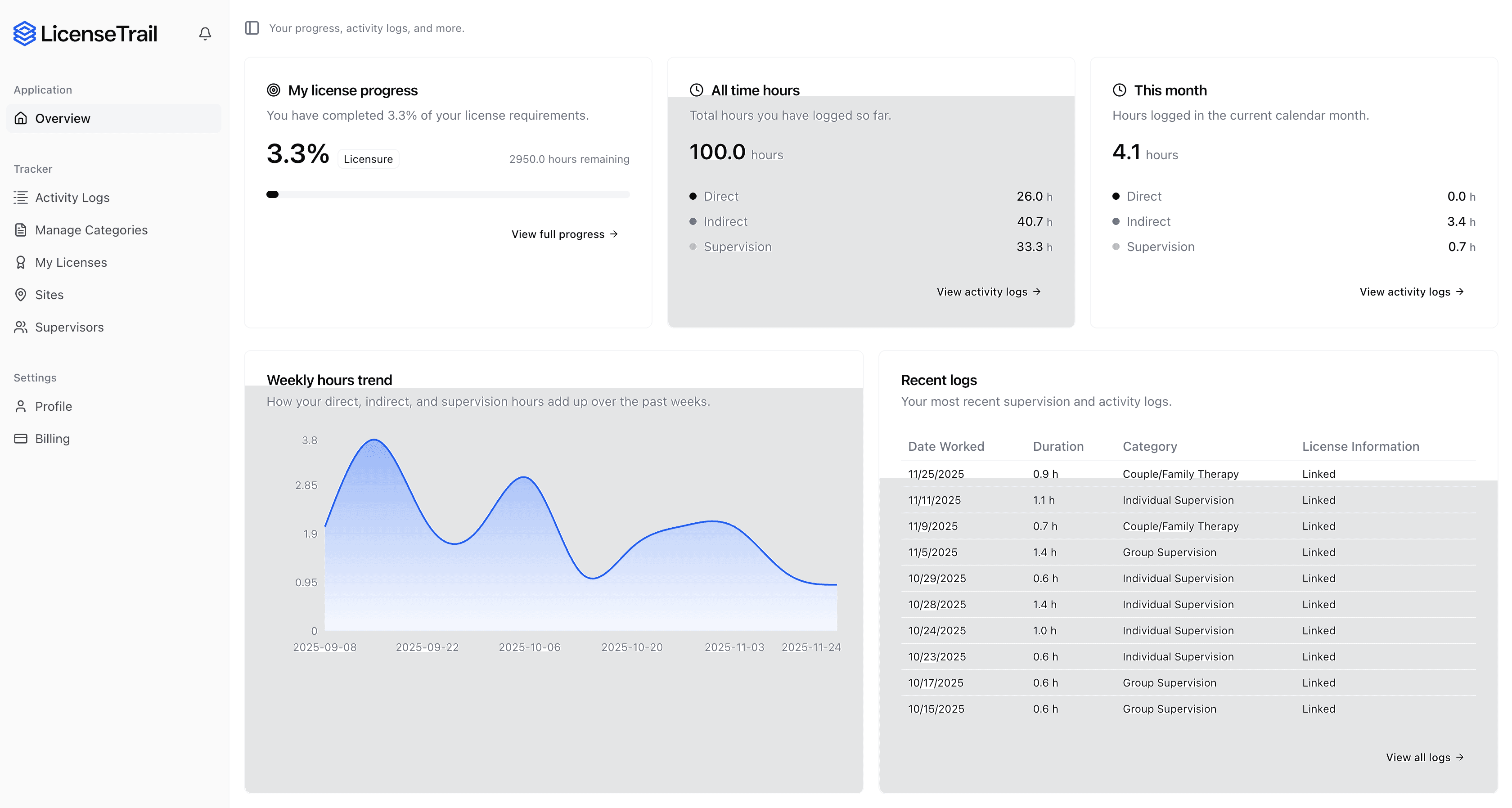
License Trail checks your direct, indirect, and supervision hours against Delaware LPCMH requirements continuously and flags mismatches before you submit.
 Start Tracking for Free
No credit card required · Free plan available
Is your spreadsheet hiding Delaware LPCMH risks?
Stop guessing if your categories match Delaware Board of Mental Health and Chemical Dependency Professionals requirements. License Trail checks your direct, indirect, and supervision hours continuously and flags mismatches before you submit.
Import or log
Bring your spreadsheet or start fresh
Upload your existing tracking spreadsheet and we'll map every hour into the right Delaware Board of Mental Health and Chemical Dependency Professionals categories automatically.
Verify against Delaware
Catch mismatches before the board does
License Trail checks your direct, indirect, and supervision hours against Delaware LPCMH requirements continuously.
Export board-ready
One-click clean reports
Generate professional, board-ready reports for supervision meetings and Delaware Board of Mental Health and Chemical Dependency Professionals submissions in seconds.
No credit card required · Free plan available