
District-of-columbia CAC-II Requirements: Hours, Exams & Step-by-Step Guide
Stop guessing if your categories match District-of-columbia requirements. License Trail checks your direct, indirect, and supervision hours against CAC-II requirements continuously and flags mismatches before you submit.
No credit card required · Free plan available
Quick Requirements Overview
- Degree: Bachelor’s in a health/human services field from a US Dept. of Education–recognized accredited program
- Coursework: Degree (or supplemental NAADAC‑approved/USDE‑recognized coursework) must cover 12 required content areas with specified hours (incl. ethics, crisis, MI/counseling skills, co‑occurring, diagnostics, psychopharmacology, cultural competency, etc.)
- Supervised experience: 180 hours supervised addiction‑counseling experience
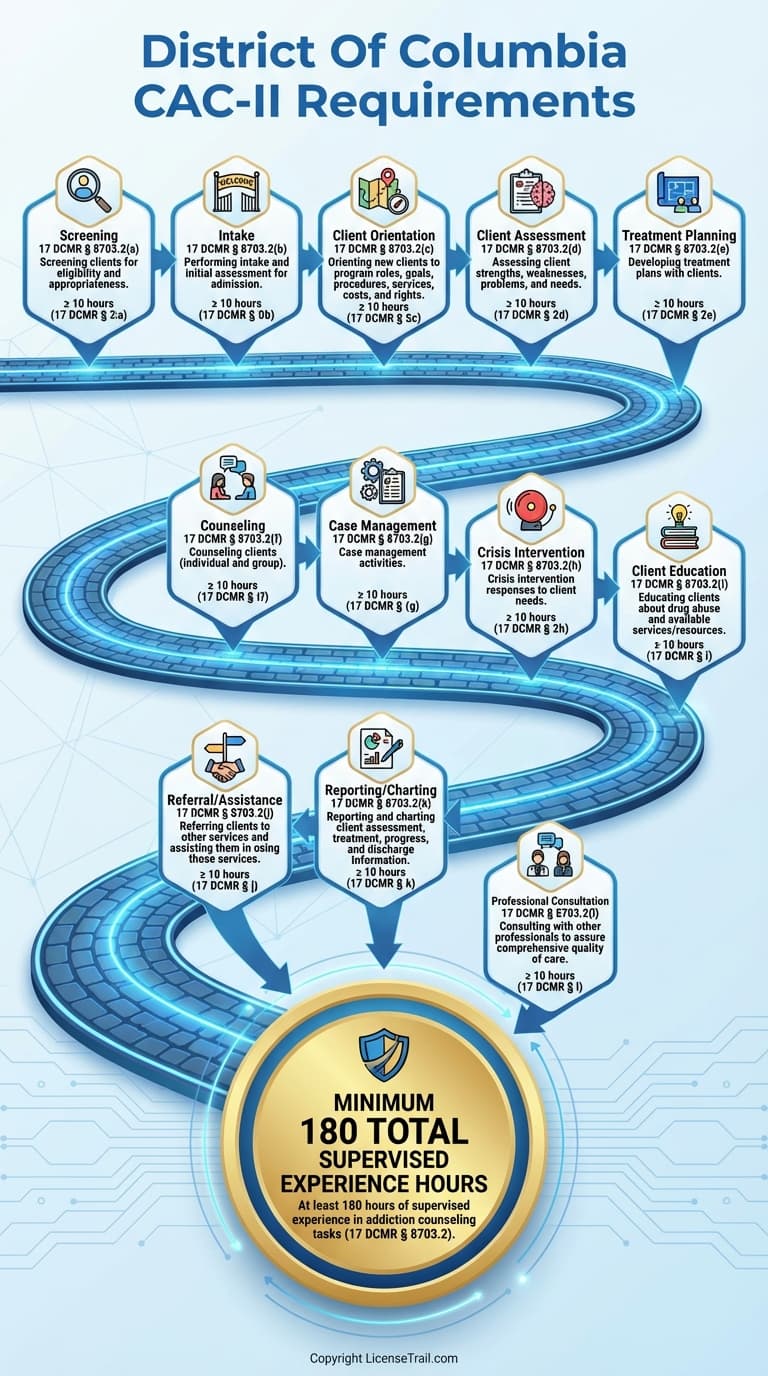
- Task-area minimums: Within supervised hours, ≥10 hours in each of 12 core functions (screening, intake, orientation, assessment, tx planning, counseling, case mgmt, crisis, client ed, referral, records, consultation)
- Exams: Pass NAADAC NCAC Level II + DC jurisprudence exam
- Application items: Online application + official transcripts + experience verification + fingerprinting/background check + required fees
- Practice limits/labeling: Must practice under supervision; cannot perform psychotherapy/diagnose other mental disorders unless separately licensed; must identify as “under the supervision of [supervisor]”
License Details
Procedures
Certified Addiction Counselor II (CAC‑II) is one of two addiction‑counselor credentials issued by the District of Columbia Board of Professional Counseling (under DC Health’s Health Regulation and Licensing Administration). The Board certifies counselors who hold a qualifying degree, have the required supervised experience in addiction counseling, and pass the required exams. (dchealth.dc.gov)
Below is a step‑by‑step outline of what DC actually requires for CAC‑II, with language and structure drawn from the District of Columbia Municipal Regulations (DCMR) and Board‑aligned guidance.
1. Understand the Two DC Credentials (CAC I vs. CAC II)
DC offers:
- Certified Addiction Counselor I (CAC I) – typically associate‑degree level
- Certified Addiction Counselor II (CAC II) – bachelor’s‑degree level
The regulations for both are in Title 17, Chapter 87: Certified Addiction Counselor I and II of the DCMR. (dcrules.elaws.us)
The Board’s own overview states that addiction counselors must have:
- “an associate or bachelor’s degree in a health or human services related field,”
- “the required number of supervised experience hours in the addiction field,” and
- successful completion of the “required examinations.” (dchealth.dc.gov)
CAC‑II is the higher of the two credentials and requires a bachelor’s degree, specific coursework, and at least 180 hours of supervised experience in defined task areas, plus passing the NAADAC NCAC Level II and DC jurisprudence exams. (dcrules.elaws.us)
2. Educational Requirements for CAC‑II
2.1. Degree level and field
For CAC‑II, DC regulations say that, “as part of the certification process for an addiction counselor II, an applicant shall present proof to the Board” of having at least a bachelor’s degree in a health or human services field, such as registered nursing, aging studies, criminal justice, health education, or mental health, from an accredited program recognized by the U.S. Department of Education. (dcrules.elaws.us)
2.2. Required coursework (Board language & hours)
The same section then states that the bachelor’s degree “shall include the following coursework” for an addiction counselor II, with specific hour requirements in each content area: (dcrules.elaws.us)
- Understanding the dynamics of human behavior and family systems – 3 hours
- Signs and symptoms of substance abuse – 3 hours
- Recovery process, stages of change, relapse prevention, treatment approaches, group dynamics and other adjunctive treatment recovery support groups, motivational interviewing, and models and theories of addiction – 9 hours
- Ethics, rules and regulations – 3 hours
- Professional identity in the provision of substance abuse services – 3 hours
- Crisis intervention – 3 hours
- Substance abuse counseling treatment planning and research – 3 hours
- Counseling skills for individual and group, motivational interviewing – 3 hours
- Cultural factors and competencies in addiction – 3 hours
- Co‑occurring disorders in interdisciplinary treatment – 3 hours
- Diagnostic and screening criteria in addictions – 3 hours
- Psychopharmacology resources in the treatment of addictions – 3 hours (dcrules.elaws.us)
If any of this coursework was not done inside the degree program, DC requires that it be taken either through a NAADAC‑approved program or through a college/university accredited by an entity recognized by the U.S. Department of Education. (dcrules.elaws.us)
3. Supervised Experience Requirements
Unlike some states that separate “direct client contact hours” from “supervised hours” as two distinct tallies, DC sets one total of supervised work‑experience hours that must be performed under qualified supervision and divided across specific functional domains.
3.1. CAC I (for context)
Most Board‑aligned guidance describes CAC I as requiring: (counselingdegreeguide.org)
- 500 hours of supervised work experience in addiction counseling,
- with at least 40 hours in each of 12 domain areas tied to the CAC I coursework (human behavior & family systems, signs and symptoms, ethics, crisis, cultural factors, etc.).
These are all supervised practice hours in addiction counseling functions. DC regulations define “direct supervision” (for addiction counselors generally) as supervision where a supervisor is physically present or immediately available (for example, on the same floor) and able to respond to the needs of the counselor or client. (dcrules.elaws.us)
3.2. CAC II supervised experience – core requirement
For CAC II, you must complete at least 180 hours of supervised experience in addiction counseling. DC‑aligned sources specify that: (substanceabusecounselor.org)
-
Total supervised experience:
- 180 hours of supervised work experience in addiction counseling.
-
Minimum hours by domain:
- At least 10 hours in each of 12 specified task areas.
Those 12 areas mirror the classic “twelve core functions” of addiction counseling and are described in DC‑aligned guidance as including: (substanceabusecounselor.org)
- Screening – determining eligibility and appropriateness for admission into a particular program.
- Intake – performing administrative and initial assessment tasks necessary for admission.
- Orientation – explaining program rules, goals, procedures, services, costs, and client rights.
- Assessment – evaluating client strengths, weaknesses, problems, and needs for treatment planning.
- Treatment planning – identifying and prioritizing problems, establishing goals, and agreeing on treatment processes.
- Counseling (individual and group) – using specialized skills to help clients achieve treatment goals.
- Case management – coordinating services, providers, and resources in a planned framework of care.
- Crisis intervention – responding to acute mental, emotional, or physical distress.
- Client education – providing information about substance use and available services/resources.
- Referral – linking clients to services the counselor cannot provide and helping them use those services.
- Reporting and record‑keeping – charting assessments, treatment plans, progress notes, discharge summaries, and related data.
- Consultation with other professionals – coordinating with other providers to ensure comprehensive care.
Board‑aligned descriptions for CAC‑II say “you must also complete at least 180 hours of supervised experience,” and of those hours “at least 120 must consist of performing at least 10 hours in each” of the above 12 tasks; the remaining hours can be in any combination of the same functions. (substanceabusecounselor.org)
Type of hours, in the language you asked for:
-
CAC I:
- 500 hours of supervised experience in addiction counseling,
- including 40 hours in each of the Board’s domain areas (not a separate quota of “supervision hours” on top of this; these are supervised client‑service hours). (addiction-counselors.com)
-
CAC II:
- 180 hours of supervised experience in addiction counseling,
- including at least 10 hours in each of 12 task areas (screening, intake, orientation, assessment, treatment planning, counseling, case management, crisis intervention, client education, referral, reporting/record‑keeping, consultation). (substanceabusecounselor.org)
The regulations also define “direct supervision” so that these supervised hours occur with the supervisor physically present or immediately available to respond to counselor or client needs, rather than at a remote distance. (dcrules.elaws.us)
4. Exams Required for CAC‑II
To be certified as a CAC II, DC requires you to pass:
- NAADAC – National Certified Addiction Counselor, Level II (NCAC II) exam. (counselingschools.com)
- District of Columbia Jurisprudence Exam, which tests knowledge of DC’s addiction‑counselor laws and rules. (counselingschools.com)
For CAC I, the parallel exam is the NAADAC NCAC Level I, but for CAC‑II the Board‑aligned guidance consistently specifies Level II. (counselingschools.com)
5. Application, Background Check, and Fees
Board‑aligned licensing guides and the DC Health site indicate that both CAC I and CAC II applicants must: (counselingdegreeguide.org)
- Submit an online application through the DC Health licensing portal.
- Provide official transcripts documenting the required degree and coursework.
- Document supervised experience hours, broken down by domain or task area, on Board forms.
- Undergo a criminal background check and fingerprinting.
- Pay required fees. A commonly cited breakdown (which can change) is:
- about $240 for application, initial certification, and criminal background check;
- about $125 for the jurisprudence exam. (counselingschools.com)
The Board’s addiction‑counselor licensing page confirms that supplemental documents can be mailed or emailed to the Board and that addiction counselors are certified via this process. (dchealth.dc.gov)
6. Ongoing Supervision and Scope of Practice Once Certified
DC law makes clear that a person “certified…solely as an addiction counselor I or II” and not also licensed as a physician, psychologist, LPC, APRN, or independent clinical social worker “shall not perform psychotherapy or engage in the diagnosis or treatment of other mental health disorders.” (dcrules.elaws.us)
The same section requires that a CAC I or II:
- Refer to themselves as an “addiction counselor under the supervision of (name and license number of supervisor)” in all written and oral communications related to addiction counseling. (dcrules.elaws.us)
- Not give the appearance of practicing independently of the supervisor. (dcrules.elaws.us)
Practically, that means even as a CAC‑II you are not an independent clinician in DC; you practice under supervision of a Board‑qualified licensed professional.
7. Continuing Education (for context after you’re certified)
For renewal (every two years, tied to license cycles), DC requires 40 hours of approved continuing education, including: (addictioncounselorce.com)
- 6 hours in ethics
- 3 hours in trauma counseling
- 2 hours in LGBTQ cultural competency or specialized clinical training
- At least 10% of the total hours in subjects designated as public‑health priorities by DC Health
Many Board‑approved CE providers explicitly list these requirements for both CAC I and CAC II counselors.
8. Putting It Together: Snapshot of CAC‑II Requirements in DC
To summarize the DC Board’s requirements to become a Certified Addiction Counselor II (CAC‑II):
-
Education
- Bachelor’s degree in a health or human services field from a program recognized by the U.S. Department of Education.
- Degree must include specific coursework totaling 36+ hours across 12 clearly defined content areas (human behavior/family systems; signs and symptoms; ethics; crisis; substance‑use theory and treatment; counseling skills; treatment planning and research; cultural competence; co‑occurring disorders; diagnostics/screening; psychopharmacology; professional identity). (dcrules.elaws.us)
-
Supervised Experience
- 180 hours of supervised work experience in addiction counseling,
- including at least 10 hours in each of 12 core task areas (screening, intake, orientation, assessment, treatment planning, counseling, case management, crisis intervention, client education, referral, reporting/record‑keeping, and consultation). (substanceabusecounselor.org)
-
Exams
- Pass the NAADAC NCAC Level II examination.
- Pass the DC jurisprudence exam covering DC addiction‑counselor laws and rules. (counselingschools.com)
-
Application & Background Check
- Apply through DC Health’s online portal.
- Submit transcripts and supervised‑experience documentation.
- Complete fingerprinting and a criminal‑background check.
- Pay the Board’s application, certification, and exam fees. (counselingschools.com)
-
Post‑Certification Conditions
- Practice under supervision of a Board‑qualified licensed professional.
- Do not diagnose or treat non‑substance‑related mental disorders unless separately licensed for that scope.
- Clearly identify yourself as an “addiction counselor under the supervision of [supervisor].” (dcrules.elaws.us)
These are the key, Board‑based requirements that DC uses for CAC‑II certification, including the specific hours and functional areas the state expects you to complete under supervision.
Track your CAC-II hours with confidence
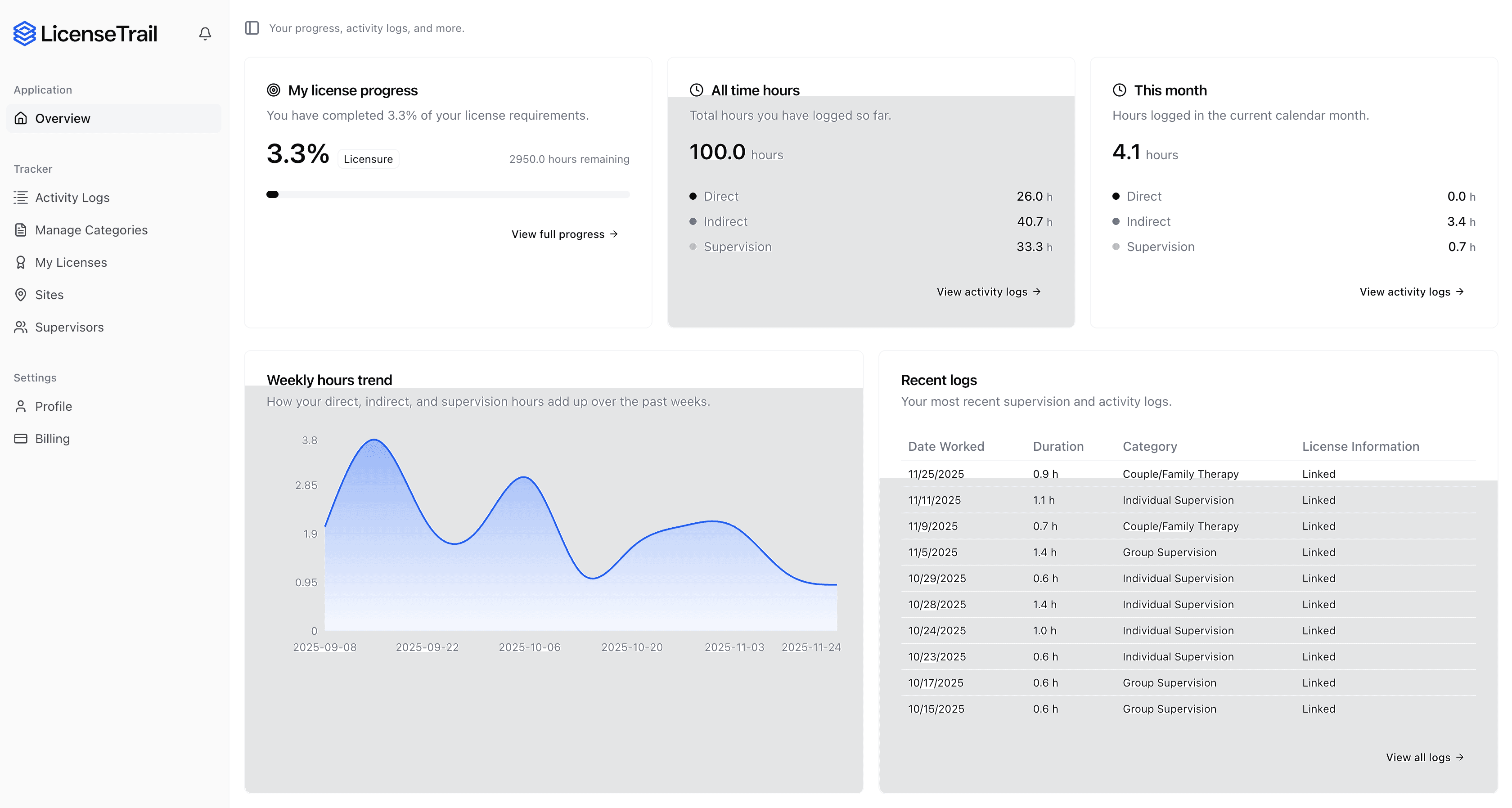
License Trail checks your direct, indirect, and supervision hours against District-of-columbia CAC-II requirements continuously and flags mismatches before you submit.
 Start Tracking for Free
No credit card required · Free plan available
Is your spreadsheet hiding District-of-columbia CAC-II risks?
Stop guessing if your categories match District of Columbia Board of Professional Counseling requirements. License Trail checks your direct, indirect, and supervision hours continuously and flags mismatches before you submit.
Import or log
Bring your spreadsheet or start fresh
Upload your existing tracking spreadsheet and we'll map every hour into the right District of Columbia Board of Professional Counseling categories automatically.
Verify against District-of-columbia
Catch mismatches before the board does
License Trail checks your direct, indirect, and supervision hours against District-of-columbia CAC-II requirements continuously.
Export board-ready
One-click clean reports
Generate professional, board-ready reports for supervision meetings and District of Columbia Board of Professional Counseling submissions in seconds.
No credit card required · Free plan available