
District-of-columbia LPAT Requirements: Hours, Exams & Step-by-Step Guide
Stop guessing if your categories match District-of-columbia requirements. License Trail checks your direct, indirect, and supervision hours against LPAT requirements continuously and flags mismatches before you submit.
No credit card required · Free plan available
Quick Requirements Overview
- Governed by DC Health’s Board of Professional Counseling under Health Occupations Revision Act (D.C. Code § 3‑1208.71)
- Education: Master’s in Art Therapy from AATA-approved or CAAHEP-accredited program (or “substantially equivalent” as determined by the Board)
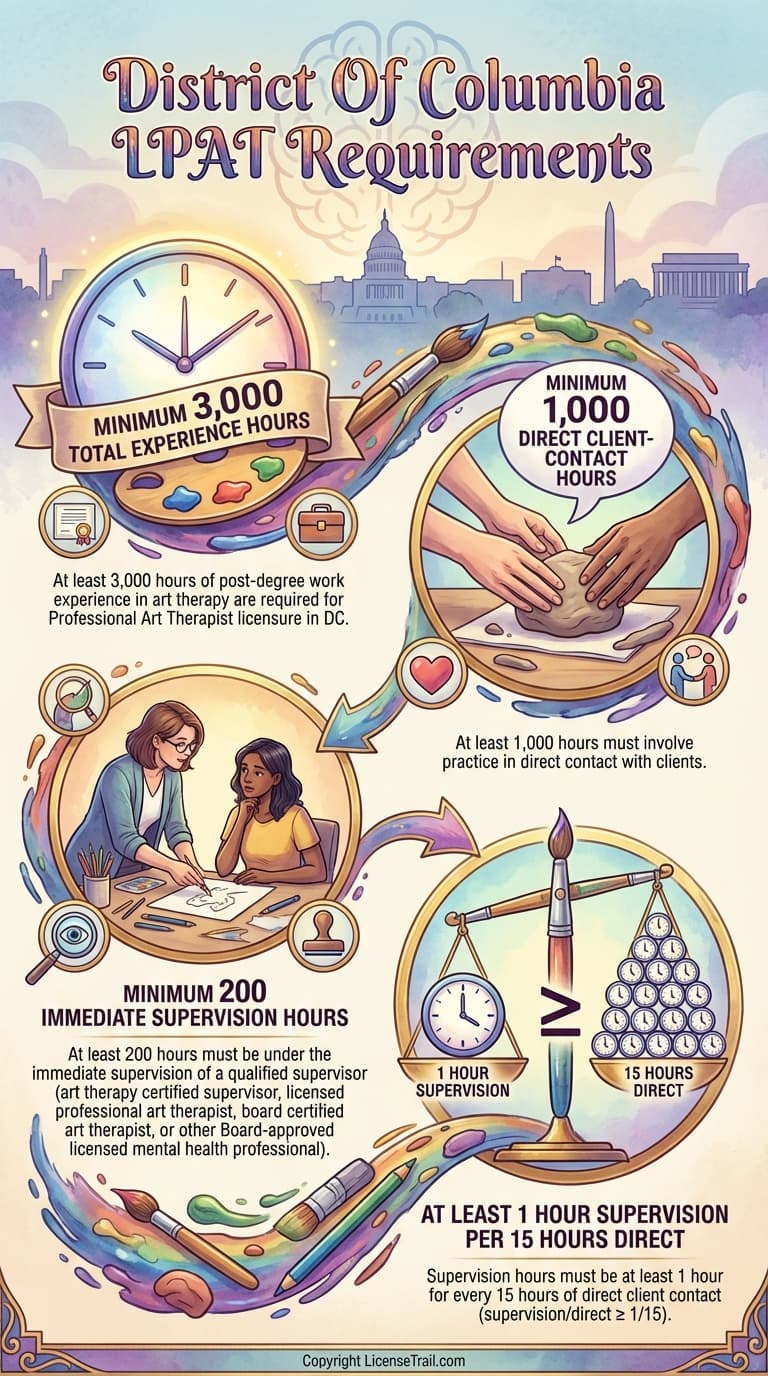
- Post-degree experience: minimum 2 years and 3,000 hours of art therapy work experience
- Direct client contact: at least 1,000 hours within the 3,000 hours
- Supervision: at least 200 hours under “immediate supervision” by an approved qualified supervisor
- Supervision ratio: at least 1 hour immediate supervision per 15 hours of direct client contact
- Exam: pass the Art Therapy Credentials Board Examination (or successor exam)
- Endorsement: eligible if licensed and in good standing in another state with equivalent or higher requirements
License Details
Procedures
Licensure as a Licensed Professional Art Therapist (LPAT) in the District of Columbia is governed by the District’s Health Occupations Revision Act and implemented by the Board of Professional Counseling within DC Health. The controlling statutory section for qualifications is D.C. Code § 3‑1208.71, “Qualifications for licensure,” which sets out the education, experience, and examination requirements for professional art therapists and graduate professional art therapists. (code.dccouncil.gov)
The Board of Professional Counseling is explicitly charged with regulating “the practices of professional counseling, professional art therapy, addiction counseling, dance therapy, and marriage and family therapy.” (code.dccouncil.gov)
Below is a streamlined guide to what the District of Columbia requires for full LPAT licensure, with attention to how the law itself describes the different categories of hours.
1. Legal definition of the practice
The “practice of professional art therapy” in D.C. is defined in statute as the integrative application of psychotherapeutic principles with specialized training in art media and art‑based assessment to help individuals or groups improve functioning, cope with trauma and grief, and address developmental, behavioral, cognitive, and emotional needs. The definition highlights art‑based therapeutic interventions and evaluation/assessment as core functions of the profession. (code.dccouncil.gov)
This definition is important because your required experience hours must be in art therapy, not art education or general creative activities, and must fall within that therapeutic scope.
2. Core LPAT requirements at a glance
For full licensure as a Licensed Professional Art Therapist (professional art therapist), the Board “shall license” an applicant who: (code.dccouncil.gov)
- Meets the general requirements of subchapter V / Title V of the Health Occupations Revision Act (e.g., application, fees, good standing).
- Has completed the required graduate degree in art therapy (or equivalent).
- Has completed a minimum of 2 years of work experience in art therapy after the graduate degree, totaling:
- At least 3,000 hours of work experience in art therapy.
- Of those hours, at least 1,000 hours must involve “practice in direct contact with clients.”
- At least 200 hours of that experience must be “under the immediate supervision” of a qualified supervisor.
- There must be “at least one hour of immediate supervision provided per 15 hours of practice in direct contact with clients.”
- Has achieved a passing score on the Art Therapy Credentials Board Examination or its successor exam.
Those bullets directly track the structure and language of D.C. Code § 3‑1208.71(a). (code.dccouncil.gov)
3. Education requirement
Acceptable degrees
The statute requires that a professional art therapist must have satisfactorily completed one of the following: (code.dccouncil.gov)
-
Master’s degree
- From an accredited college or university.
- In a program in art therapy that was either:
- Approved by the American Art Therapy Association (AATA), or
- Accredited by the Commission on Accreditation of Allied Health Education Programs (CAAHEP) at the time the degree was conferred,
- Or a “substantially equivalent” program as determined by the Board.
-
(Earlier versions allowed a qualifying doctoral pathway; the current D.C. Code text leaves only subsection (A) and marks (B) as repealed.) (code.dccouncil.gov)
For the Graduate Professional Art Therapist license (the pre‑independent level), the statute requires the same kind of qualifying Master’s program (or, under earlier text, a board‑approved doctoral program), but does not impose the 3,000‑hour post‑degree experience requirement. (code.dccouncil.gov)
4. Experience hours: exact categories and statutory language
Once the qualifying degree is completed, D.C. law requires post‑graduate experience. The statute states that the applicant must have: (code.dccouncil.gov)
“Successfully completed a minimum of 2 years of work experience in art therapy following completion of the graduate degree consisting of at least 3,000 hours, of which at least 1,000 hours involve practice in direct contact with clients and at least 200 hours were under the immediate supervision of an art therapy certified supervisor, licensed professional art therapist, board certified art therapist, or other licensed mental health professional approved by the Board, with at least one hour of immediate supervision provided per 15 hours of practice in direct contact with clients.”
Broken down into the types of hours and supervision:
4.1 Total work experience in art therapy
- Minimum duration: “a minimum of 2 years of work experience in art therapy” after the graduate degree.
- Total hours: “at least 3,000 hours” of that work experience.
These 3,000 hours are all expected to be art therapy practice, understood in light of the statutory definition of “practice of professional art therapy” (psychotherapeutic use of art media, art‑based assessment, and treatment planning to address cognitive, emotional, behavioral, and social needs). (code.dccouncil.gov)
4.2 Direct client contact hours
- Of the 3,000 hours, “at least 1,000 hours involve practice in direct contact with clients.” (code.dccouncil.gov)
“Practice in direct contact with clients” means your time providing art therapy services directly to clients (individuals, families, or groups) where you are actively engaged in assessment, intervention, and/or treatment—rather than administrative tasks, research, or non‑clinical activities.
Key point:
These 1,000+ hours are a subset of the 3,000 total work experience hours and must reflect actual therapeutic encounters.
4.3 Hours under immediate supervision
The statute specifies an additional subset of the 3,000 hours: (code.dccouncil.gov)
- “At least 200 hours were under the immediate supervision” of a qualified supervisor.
The law also defines who can serve as these supervisors:
- An art therapy certified supervisor,
- A licensed professional art therapist,
- A board certified art therapist, or
- “Other licensed mental health professional approved by the Board.”
The phrase “under the immediate supervision” indicates that during those 200+ hours of practice, your supervisor is closely overseeing your work—often in real time or through structured, frequent review consistent with clinical supervision standards, rather than only doing occasional file reviews.
4.4 Required intensity of supervision (1:15 ratio)
In addition to the 200 supervised practice hours, the statute imposes a supervision ratio for direct client work:
- There must be “at least one hour of immediate supervision provided per 15 hours of practice in direct contact with clients.” (code.dccouncil.gov)
In practical terms:
- If you complete the minimum 1,000 direct client contact hours, you must have at least about 67 hours of immediate supervision (1,000 ÷ 15 ≈ 66.7), in addition to ensuring that at least 200 of your total 3,000 practice hours are carried out under immediate supervision.
The statute does not prescribe an exact weekly or monthly cap, but you would be expected to structure supervision so that it is ongoing and proportionate across your direct client work, not bunched at the end.
5. Licensure levels and pathways
5.1 Graduate Professional Art Therapist (pre‑independent license)
The law creates a Graduate Professional Art Therapist category. To be licensed at this level, a person must: (code.dccouncil.gov)
- Meet the general Title V / subchapter V requirements, and
- Have satisfactorily completed a qualifying Master’s (or, in earlier text, Doctoral) degree in art therapy or a substantially equivalent program as described in Section 3 above.
The statute does not attach the 3,000‑hour experience requirement to the graduate level license; that requirement is specific to full professional art therapist licensure. The Graduate Professional Art Therapist license is typically used while accruing your supervised post‑degree hours toward LPAT.
5.2 Full Licensed Professional Art Therapist (LPAT)
To hold yourself out as a professional art therapist and use the protected title (LPAT), you must satisfy all of the following statutory elements: (code.dccouncil.gov)
- Qualifying graduate degree in art therapy (Board‑approved program).
- Minimum 2 years and at least 3,000 hours of post‑degree work experience in art therapy.
- Within those 3,000 hours:
- At least 1,000 hours of practice in direct contact with clients.
- At least 200 hours of practice under the immediate supervision of a qualified supervisor.
- Supervision at a minimum ratio of 1 hour of immediate supervision for every 15 hours of direct client contact.
- Passing score on the Art Therapy Credentials Board Examination or its successor.
Only individuals who are licensed (including graduate licensees acting within their authorized scope) may lawfully use the professional art therapist titles in the District. (code.dccouncil.gov)
5.3 Licensure by endorsement (for out‑of‑state LPATs)
D.C. also allows licensure by endorsement. The Board “shall license as a professional art therapist by endorsement” any person who: (code.dccouncil.gov)
- Meets the general Title V / subchapter V requirements, and
- Is currently licensed in good standing in another state that has licensing requirements “equivalent to or [that] exceed” those in D.C. for LPATs.
If you already hold an LPAT‑type license elsewhere, your path may be via endorsement rather than re‑documenting every individual hour, but the other state’s requirements must be at least as stringent as D.C.’s.
5.4 Historical waiver window (now closed)
When D.C. first created LPAT licensure, it included a temporary “waiver of requirements” for experienced, board‑certified art therapists. Under D.C. Code § 3‑1208.72, the Board was directed to waive the degree and experience requirements of § 3‑1208.71(a)(1) and (2) for applicants who: (code.dccouncil.gov)
- Held a Board Certified Art Therapist (ATR‑BC) credential in good standing,
- Had been in active practice of art therapy for at least 3 of the previous 5 years prior to June 24, 2020, and
- Applied for licensure within 24 months of June 24, 2020.
That grandparenting period ended in June 2022, so it is no longer available to new applicants.
6. Examination requirement
Finally, D.C. law requires that an applicant for LPAT:
- “Achieved a passing score on the Art Therapy Credentials Board Examination or its successor exam.” (code.dccouncil.gov)
The Art Therapy Credentials Board (ATCB) examination is the national board exam used in multiple states that license art therapists and is recognized by the American Art Therapy Association as the standard licensing exam. (arttherapy.org)
You will need to:
- Register for and pass the ATCB exam (or whatever successor exam is in effect at the time you apply).
- Have official verification of your passing score sent to the D.C. Board of Professional Counseling as part of your application package.
7. Application and documentation in practice
While the statute sets the legal minimums, the Board of Professional Counseling—through DC Health—handles actual applications, evaluates whether your degree is “substantially equivalent” if not AATA/CAAHEP‑approved, and verifies your hours and supervision history. The Board’s role includes evaluating applicants’ qualifications and issuing licenses. (dchealth.dc.gov)
In practical terms, to seek LPAT licensure you should be prepared to document:
-
Education
- Official transcripts showing completion of the required art therapy graduate program and accreditation/approval status at the time of your degree.
-
Experience hours
- Detailed logs of:
- Total art therapy work hours (aiming well beyond the 3,000 minimum to provide a margin).
- Direct client contact hours (clearly distinguished).
- Hours conducted “under the immediate supervision” of a qualified supervisor.
- Supervision sessions, with dates and durations, to demonstrate at least the 1:15 supervision ratio for your direct client hours.
- Detailed logs of:
-
Supervision
- Supervisor credentials (showing they are an art therapy certified supervisor, LPAT, board certified art therapist, or another licensed mental health professional approved by the Board).
- Letters or forms signed by supervisors attesting to your hours and the nature of your work.
-
Examination
- Official proof of passing the Art Therapy Credentials Board Examination (or successor exam).
Because the Board can issue additional rules and may update application procedures, it is wise to cross‑check current forms and instructions on the D.C. professional counseling licensing page when you are ready to apply. (dchealth.dc.gov)
Summary of the hour requirements in D.C. for LPAT
- 3,000 hours minimum post‑graduate work experience in art therapy over at least 2 years.
- Within those 3,000 hours:
- 1,000+ hours must be “practice in direct contact with clients.”
- 200+ hours must be “under the immediate supervision” of a qualified supervisor.
- Supervision must occur at a minimum ratio of 1 hour of immediate supervision per 15 hours of direct client contact. (code.dccouncil.gov)
Those are the specific numerical and categorical experience requirements set out by the District of Columbia for licensure as a Licensed Professional Art Therapist under the Board of Professional Counseling.
Track your LPAT hours with confidence
License Trail checks your direct, indirect, and supervision hours against District-of-columbia LPAT requirements continuously and flags mismatches before you submit.
 Start Tracking for Free
No credit card required · Free plan available
Is your spreadsheet hiding District-of-columbia LPAT risks?
Stop guessing if your categories match District of Columbia Board of Professional Counseling requirements. License Trail checks your direct, indirect, and supervision hours continuously and flags mismatches before you submit.
Import or log
Bring your spreadsheet or start fresh
Upload your existing tracking spreadsheet and we'll map every hour into the right District of Columbia Board of Professional Counseling categories automatically.
Verify against District-of-columbia
Catch mismatches before the board does
License Trail checks your direct, indirect, and supervision hours against District-of-columbia LPAT requirements continuously.
Export board-ready
One-click clean reports
Generate professional, board-ready reports for supervision meetings and District of Columbia Board of Professional Counseling submissions in seconds.
No credit card required · Free plan available