
District-of-columbia LPC Requirements: Hours, Exams & Step-by-Step Guide
Stop guessing if your categories match District-of-columbia requirements. License Trail checks your direct, indirect, and supervision hours against LPC requirements continuously and flags mismatches before you submit.
No credit card required · Free plan available
Quick Requirements Overview
- Education (LPC): Master’s (or higher) with 60 graduate semester hours in counseling/related field (accredited institution)
- Exam: Pass a Board‑approved national exam (NCE, NCMHCE, or CRC)
- Degree practicum: 100 hours total, incl. 40 direct client; weekly supervision 1 hr individual/triadic + 1.5 hrs group
- Degree internship: 600 hours total, incl. 240 direct client; weekly supervision 1 hr individual/triadic + 1.5 hrs group
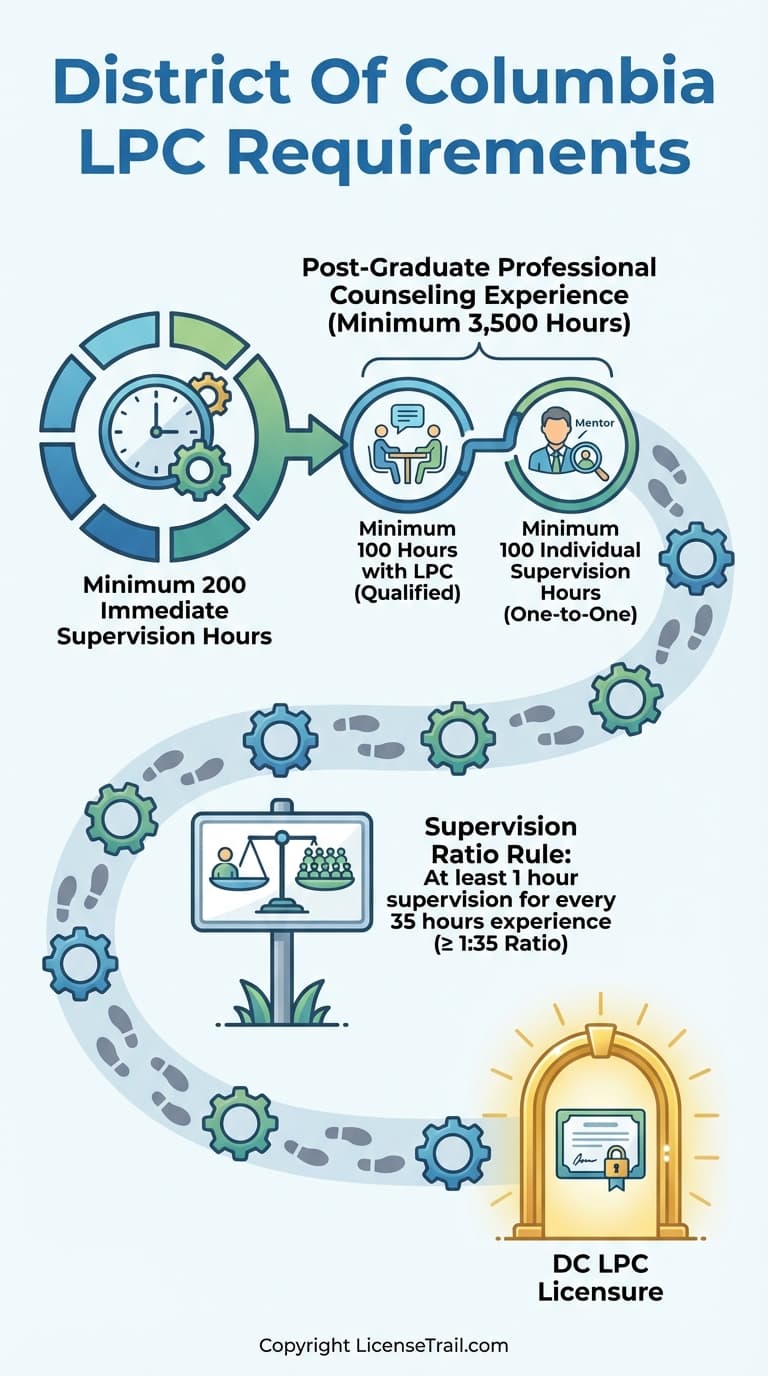
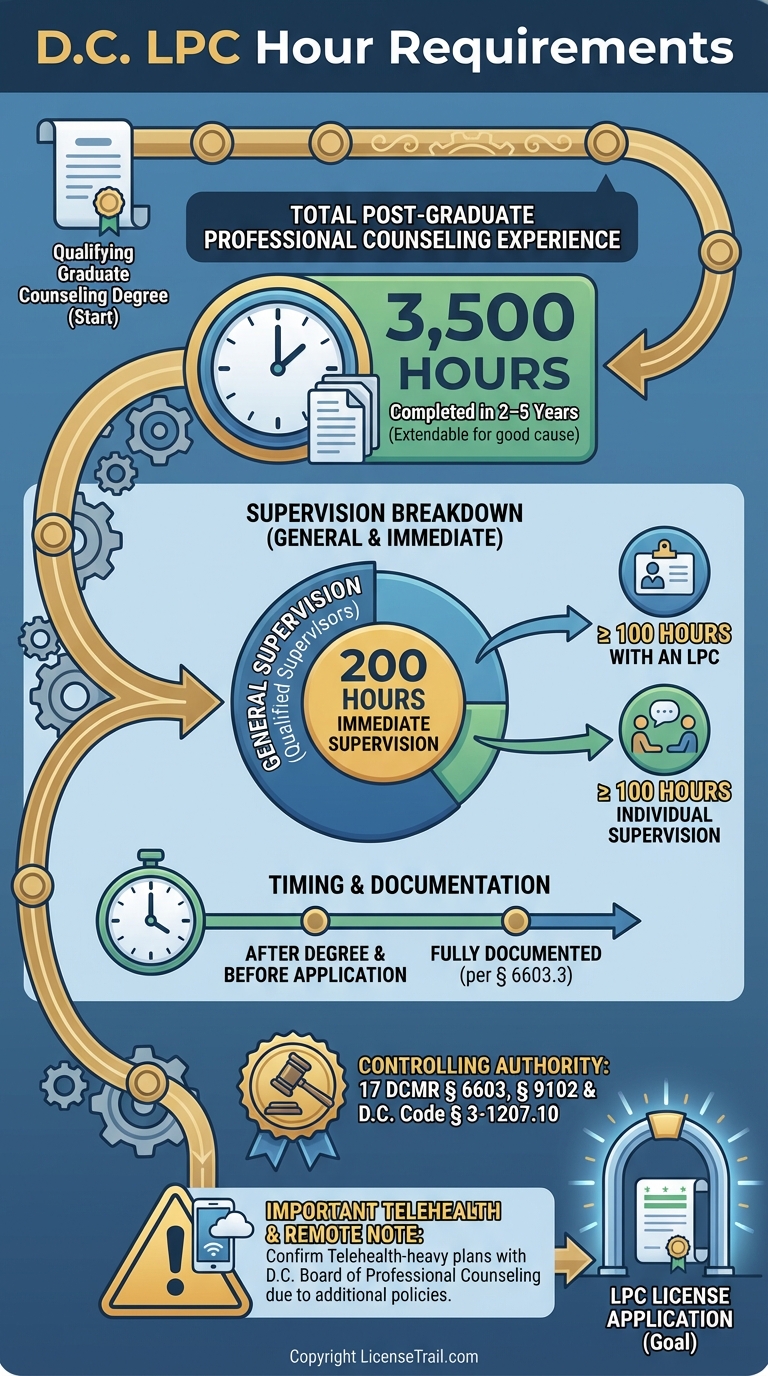
- Post‑master experience: 3,500 hours supervised counseling experience completed in 2–5 years
- Post‑master supervision: 200 hours clinical/immediate supervision, incl. ≥100 hours individual and ≥100 hours provided by an LPC (remaining may be other Board‑approved clinicians)
- Supervision compliance: Aim for at least 1 hour supervision per 35 hours practice and file the DC supervised practice form within 2 weeks of starting supervision
- Practice restriction pre‑LPC: Must hold LGPC while accruing hours; no independent practice until LPC is granted
License Details
Procedures
Licensure as a Licensed Professional Counselor (LPC) in the District of Columbia is regulated by the DC Board of Professional Counseling under the Health Occupations Revision Act and Title 17 of the D.C. Municipal Regulations. The process is essentially two-tiered:
- Licensed Graduate Professional Counselor (LGPC) – the supervised, post‑master level.
- Licensed Professional Counselor (LPC) – the independent practice level.
Below is a step‑by‑step, board‑based summary with specific hour requirements and the way DC actually defines them.
1. Degree and coursework requirements
LPC (independent license)
The DC Code requires that the Board license as a professional counselor an applicant who:
- Has “completed 60 hours of postgraduate education in counseling or a related subject from an accredited college or university,” leading to a master’s degree or higher. (codes.findlaw.com)
- Has “completed 2 years of supervised counseling experience” (those two years are further defined in regulation as 3,500 hours; see Section 4 below). (codes.findlaw.com)
- Has satisfactorily completed the Board‑approved national examination (NCE, NCMHCE, or CRC). (codes.findlaw.com)
LGPC (graduate‑level license)
The statute also creates a graduate‑level counseling license. A Graduate Professional Counselor must:
- Complete at least 48 graduate semester hours leading to a master’s degree in counseling or a related subject from an accredited institution. (code.dccouncil.gov)
- Pass a Board‑approved national counseling exam (NCE, NCMHCE, or CRC) and meet general licensure prerequisites (application, background check, fees, etc.). (counselingschools.com)
Most people complete 60 credits from the start so that the same degree satisfies both LGPC and LPC requirements.
2. Required practicum and internship (during the degree)
Before you can count any post‑master supervised hours, the Board requires a structured practicum and internship in your graduate program. These requirements are spelled out in 17 DCMR § 9105:
Practicum
- 100 hours in a “face‑to‑face supervised practicum” in a university‑approved counseling setting. (dcrules.elaws.us)
- At least 40 hours of those 100 must be direct service to clients (live clinical work). (dcrules.elaws.us)
- Weekly supervision during practicum must include:
- 1 hour per week of individual or triadic face‑to‑face supervision, and
- 1.5 hours per week of group supervision by a faculty member or student supervisor. (dcrules.elaws.us)
Internship
- 600 hours in a face‑to‑face supervised internship in an approved setting. (dcrules.elaws.us)
- At least 240 hours must be direct service to clients. (dcrules.elaws.us)
- Weekly supervision during internship must include:
- 1 hour per week of individual or triadic face‑to‑face supervision by an on‑site supervisor, and
- 1.5 hours per week of group supervision by a program faculty member. (dcrules.elaws.us)
These practicum/internship hours are in addition to the post‑master supervised hours described below.
3. Transition to supervised practice: becoming an LGPC
Once you have:
- Completed the master’s degree and required practicum/internship, and
- Passed a Board‑approved national counseling exam,
you apply to DC Health for the Licensed Graduate Professional Counselor (LGPC) credential.
Key points from the Board’s rules and guidance:
- While accruing post‑master supervised experience, you must identify yourself as a “graduate professional counselor under supervision” whenever you practice professional counseling. (dcrules.elaws.us)
- Within two weeks of commencing supervision, your supervisor or you must submit a “supervised practice form” to the Board with:
- Supervisor’s name, address, license state and number
- Supervisee’s name
- Expected period of supervision (start and end dates)
- Nature and location of supervision. (dcrules.elaws.us)
- An LGPC may not engage in independent practice. The regulations specify that only an LPC may engage in “independent practice,” which is defined to include rendering services on one’s own responsibility, directly collecting fees as the payee, or maintaining one’s own office advertised as independent. (dcrules.elaws.us)
The LGPC is the license you hold while accumulating the post‑degree hours needed for full LPC licensure.
4. Post‑master supervised experience: required hours and breakdown
DC’s statute only says “2 years of supervised counseling experience,” but Board interpretations and published licensure summaries flesh this out as a quantitative requirement. To qualify for LPC, the Board expects:
Total post‑master experience
- 3,500 hours of post‑master’s supervised professional counseling experience, obtained in no fewer than 2 and no more than 5 years. (worldpopulationreview.com)
This 3,500‑hour figure is how DC operationalizes the statutory “2 years of supervised counseling experience.” (codes.findlaw.com)
Supervision hours within the 3,500
Within those 3,500 hours, the Board requires formal clinical supervision, often referred to in the regulations as “immediate supervision” or “clinical supervision.” Current summaries of DC rules converge on:
-
200 hours of clinical/immediate supervision total. (counselingschools.com)
Within these 200 hours:
- At least 100 hours must be individual supervision (one‑on‑one, not group). (onlinecounselingprograms.com)
- At least 100 hours must be provided by a Licensed Professional Counselor (LPC); the remaining supervision hours may be provided by other Board‑approved mental health professionals such as licensed psychologists, psychiatrists, or licensed independent clinical social workers. (counselingschools.com)
-
Supervision ratio / frequency. DC applies a minimum ratio of 1 hour of immediate supervision for every 35 hours of practice, which aligns with the 3,500 total hours and 200 supervision hours requirement (3,500 ÷ 35 = 100; the rule, together with additional requirements, results in at least 200 total supervision hours when individual and other kinds of supervision are counted). (counselingschools.com)
In practice, supervisors and LGPCs typically schedule supervision weekly (or more often) to satisfy both the numeric requirement and the ratio across different settings.
Who can supervise
DC sources consistently describe supervision as needing to be under “a qualified supervisor” approved by the Board, which may include: (counselingschools.com)
- Licensed Professional Counselor (LPC) – must provide a substantial portion of supervision (at least 100 hours);
- Licensed Psychologist;
- Psychiatrist;
- Licensed Independent Clinical Social Worker (LICSW) – some guidance indicates an LICSW may provide up to 100 of the supervision hours;
- Other mental health professionals specifically approved by the Board.
Supervisors must hold an active, unencumbered license and meet any additional Board criteria for being an approved supervisor.
Types of experience hours
The regulations and Board‑aligned summaries characterize the 3,500 hours as “professional counseling” or “clinical counseling” experience. While DC does not currently publish a detailed direct/indirect split for the post‑master hours comparable to some other states, the activities expected to count include: (counselingschools.com)
- Direct assessment, diagnosis, and psychotherapy/counseling with individuals, couples, families, and groups;
- Treatment planning, case conceptualization, and crisis intervention;
- Related clinical duties such as documentation, case consultation, and treatment team collaboration, when performed in the role of a counselor under supervision.
Because the Board relies on supervisors to attest that hours reflect the practice of professional counseling as defined in DC law, your supervisor’s documentation and the supervised practice form are critical.
5. Examination requirement
For both LGPC and LPC:
- You must pass a Board‑approved national examination, typically one of:
- National Counselor Examination (NCE)
- National Clinical Mental Health Counseling Examination (NCMHCE)
- Certified Rehabilitation Counselor (CRC) exam in some pathways. (codes.findlaw.com)
Official score verification must be sent directly from the exam body to DC Health.
6. Applying for full LPC licensure
Once you have:
- A qualifying master’s degree with 60 graduate semester hours in counseling or a related field; (codes.findlaw.com)
- Completed the Board‑required practicum (100 hours, 40 direct) and internship (600 hours, 240 direct) with specified supervision; (dcrules.elaws.us)
- Accrued 3,500 hours of post‑master supervised professional counseling experience:
- Over 2–5 years,
- Including 200 hours of clinical/immediate supervision,
- Meeting the Board’s distribution of individual vs. group and LPC vs. other qualified supervisors; (counselingschools.com)
- Passed a Board‑approved national exam; (codes.findlaw.com)
you may apply to DC Health for Licensed Professional Counselor (LPC) status. Your supervisor(s) will need to verify your hours and supervision on Board forms.
At that point, you may practice independently—that is, you can render counseling services on your own clinical responsibility, bill under your own name, and maintain your own office, all of which are explicitly prohibited to LGPCs in the regulations. (dcrules.elaws.us)
7. Licensure by endorsement (coming from another state)
DC also has a statutory route for counselors already licensed elsewhere. Under D.C. Code § 3‑1207.10(c), the Board may license by endorsement a professional counselor licensed in another state who meets the American Association of State Counseling Boards (AASCB) Tier II criteria, which include: (codes.findlaw.com)
- At least 60 hours of postgraduate counseling education leading to a master’s degree;
- Supervised counseling consisting of:
- At least 2 years of post‑master counseling experience with a minimum of 4,000 total hours;
- 2,500 hours of direct client contact within those 4,000 hours;
- 100 hours of clinical supervision, post‑master’s, up to 50 of which may be in group supervision;
- Five years of post‑licensure experience in independent clinical counseling.
This endorsement pathway is slightly different from the in‑District 3,500‑hour route, but it shows the Board’s expectations when evaluating out‑of‑state licenses—particularly the emphasis on direct client contact hours and documented clinical supervision.
8. Continuing education (after you are licensed)
For context once you are licensed:
- LPCs in DC renew biennially (licenses expire December 31 of even‑numbered years). (dchealth.dc.gov)
- Current requirements include 40 hours of continuing education per renewal cycle, with specified content areas (e.g., ethics, trauma, LGBTQ+ cultural competence, and public health priorities). (counselingschools.com)
Summary of key hour requirements in DC
-
Practicum (during degree):
- 100 total hours; 40 direct client contact
- Weekly: 1 hour individual/triadic + 1.5 hours group supervision (dcrules.elaws.us)
-
Internship (during degree):
- 600 total hours; 240 direct client contact
- Weekly: 1 hour individual/triadic + 1.5 hours group supervision (dcrules.elaws.us)
-
Post‑master supervised experience for LPC (in‑District route):
- 3,500 total hours of professional counseling experience over 2–5 years
- 200 hours of clinical/immediate supervision, including:
- At least 100 hours individual supervision
- At least 100 hours provided by an LPC; remaining hours may be by other Board‑approved mental health professionals
- Practical minimum of 1 hour of immediate supervision per 35 hours of practice (counselingschools.com)
-
Endorsement (Tier II standard for out‑of‑state licensees):
- 4,000 total hours post‑master;
- 2,500 hours of direct client contact;
- 100 hours of clinical supervision, with up to 50 in group supervision;
- 5 years of post‑licensure independent practice. (codes.findlaw.com)
Because DC relies on both statute and detailed Board rule for these requirements—and because they do occasionally update rules or interpretations—applicants planning a specific licensure strategy should cross‑check their plans against:
- The current text of D.C. Code § 3‑1207.10;
- Title 17 DCMR, Chapter 91 (Graduate Professional Counselor); and
- The DC Health – Professional Counseling Licensing page. (codes.findlaw.com)
Track your LPC hours with confidence
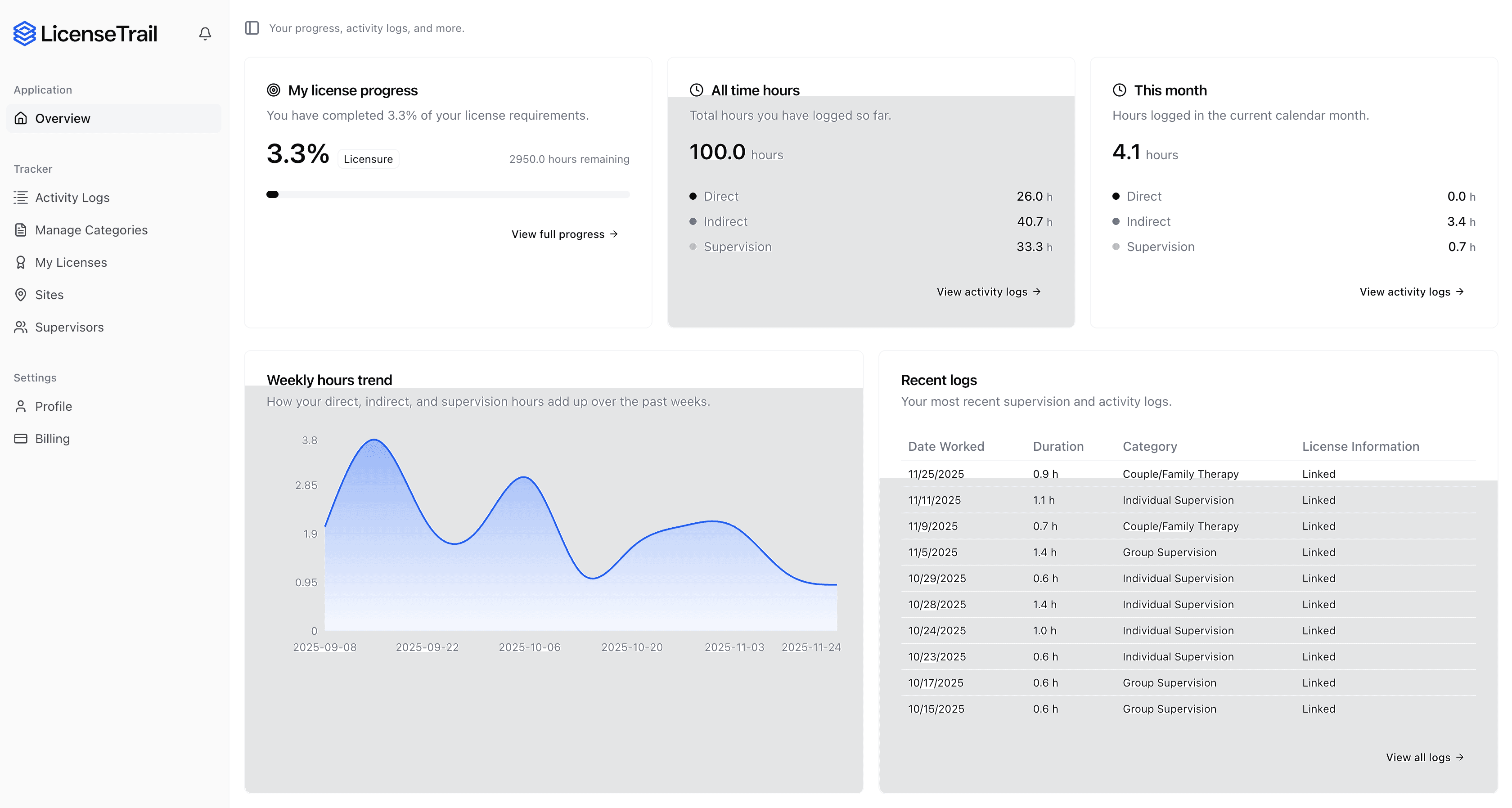
License Trail checks your direct, indirect, and supervision hours against District-of-columbia LPC requirements continuously and flags mismatches before you submit.
 Start Tracking for Free
No credit card required · Free plan available
Is your spreadsheet hiding District-of-columbia LPC risks?
Stop guessing if your categories match District of Columbia Board of Professional Counseling requirements. License Trail checks your direct, indirect, and supervision hours continuously and flags mismatches before you submit.
Import or log
Bring your spreadsheet or start fresh
Upload your existing tracking spreadsheet and we'll map every hour into the right District of Columbia Board of Professional Counseling categories automatically.
Verify against District-of-columbia
Catch mismatches before the board does
License Trail checks your direct, indirect, and supervision hours against District-of-columbia LPC requirements continuously.
Export board-ready
One-click clean reports
Generate professional, board-ready reports for supervision meetings and District of Columbia Board of Professional Counseling submissions in seconds.
No credit card required · Free plan available