
District-of-columbia PAR Requirements: Hours, Exams & Step-by-Step Guide
Stop guessing if your categories match District-of-columbia requirements. License Trail checks your direct, indirect, and supervision hours against PAR requirements continuously and flags mismatches before you submit.
No credit card required · Free plan available
Quick Requirements Overview
- Purpose: DC Psychology Associate Registration (PAR) allows psychology practice only under supervision while accruing Psychological Practice Experience (PPE) toward psychologist licensure.
- Education: Master’s degree (or higher) in psychology from an accredited school, or Board‑deemed substantially equivalent program.
- Supervision required: Practice only under a primary supervisor who is a DC‑licensed health services psychologist (may delegate limited supervision, but remains responsible).
- Hours to get PAR: No specific hour minimum required to register as a psychology associate.
- Accruing DC‑counted hours: If not a student, must hold PAR before accruing PPE in DC.
- Immediate supervision rule: ≥10% of accrued supervised hours must be under immediate, in‑person supervision by the primary supervisor.
- Supervisor capacity: One supervisor may oversee no more than 5 psychology associates at a time.
- Compensation/billing: May be paid by an employer but not directly by patients; cannot bill independently and records must distinguish supervisor vs. associate services.
License Details
Procedures
In the District of Columbia, a Psychology Associate Registration (often abbreviated informally as PAR) is the credential that allows a master’s‑ or doctoral‑level psychology graduate to practice psychology only under supervision while accruing the “psychological practice experience” required for full psychologist licensure.
Because DC restructured its psychology law in 2024, it now distinguishes clearly between:
- Licenses (e.g., health services psychologist, general applied psychologist) and
- Registrations (school psychologist and psychology associate). (code.dccouncil.gov)
Below is a step‑by‑step guide centered on what the Board and regulations actually say, with special attention to hours and supervision requirements.
1. What a DC Psychology Associate (PAR) is allowed to do
Under DC law, a person registered as a psychology associate:
- Is authorized to practice psychology within the same “health services” scope of practice as a licensed psychologist, but
- Only under the supervision of a licensed health services psychologist. (code.dccouncil.gov)
The registration is not an independent license. It is the formal status you must hold if you are no longer a student and you want to accrue supervised experience hours in DC toward eventual psychologist licensure. The regulations call these hours “Psychological Practice Experience (PPE)”. (dchealth.dc.gov)
2. Baseline eligibility to register as a Psychology Associate
2.1 Education
DC law now provides that an applicant for registration as a psychology associate must have:
- Graduated from an accredited college or university with at least a master’s degree based on a program of studies focusing on psychology, or
- A program judged by the Board to be “substantially equivalent” in subject matter and training to a master’s or doctoral degree in psychology. (code.dccouncil.gov)
(There is no statutory requirement for a specific number of practicum or internship hours just to obtain the associate registration.)
2.2 Supervision arrangement
To use the psychology associate registration for accruing hours, you must have an approved supervision plan:
- You may practice only under the primary supervision of a DC‑licensed psychologist, and
- That primary supervisor may delegate some supervision to another licensed psychologist, psychiatrist, or independent clinical social worker, but remains fully responsible for your work and for ensuring compliance with DC law and regulations. (dchealth.dc.gov)
For purposes of hours, this is crucial: you cannot accrue the DC‑recognized supervised experience in the District unless you are either (a) a student in qualifying training or (b) registered as a psychology associate. (dchealth.dc.gov)
3. Application package and administrative requirements
DC Health’s Board of Psychology lists a specific set of documents for a Psychology Associate application: (dchealth.dc.gov)
- Online application (through DC Health portal)
- Psychology Associate Checklist – By Examination (or By Endorsement, if coming from another jurisdiction)
- Character reference form
- Criminal background check
- Additional items (e.g., Supervised Practice Form, Authorization to Release Information) as indicated
These checklists and forms do not themselves create new hour requirements; they operationalize the education and supervised‑practice rules found in statute and regulation.
4. Hour and supervision requirements that matter for a PAR
The District does not set a fixed minimum of pre‑registration hours (for example, “1,500 direct + 1,500 supervised”) to obtain the psychology associate registration itself. Instead, the hours come into play in two linked ways:
- The 4,000‑hour “Psychological Practice Experience” requirement for full psychologist licensure, and
- The conditions under which students and psychology associates are allowed to accrue those hours.
4.1 Hours required for full psychologist licensure (PPE)
For a doctoral‑level psychologist license in DC, the Board requires: (dchealth.dc.gov)
-
Total required supervised psychological practice experience:
- 4,000 hours of “psychological practice experience (PPE).”
-
Distribution of those hours:
- Up to 2,000 of the 4,000 hours may be obtained during a pre‑doctoral internship; and
- The remaining hours must be obtained after the doctoral degree is conferred, typically within two years after the degree if you use the internship option; or
- If you choose to complete all 4,000 hours post‑doctorally, the hours must be completed over no fewer than two and no more than three years after degree conferral (extensions are possible “for good cause”).
-
Acceptable settings for PPE:
- An APA‑accredited or APPIC‑member internship,
- An APA‑accredited or APPIC‑member postdoctoral program, or
- A non‑accredited supervised practice that meets detailed criteria (supervision, documentation, and evaluation standards) spelled out in the regulations (17 DCMR § 6902.4–.5). (dchealth.dc.gov)
These 4,000 hours are not a requirement to become a psychology associate. Rather, they are the hours a student or psychology associate is typically accruing while in that status in order to ultimately qualify for a full psychologist license.
4.2 How hours must be supervised when you’re a Psychology Associate
The 2019 Psychology regulations devote a separate section to “Practice of Psychology by Students or Psychology Associates Accruing Hours to Qualify for Licensure” and to “Supervision of Psychology Associates.” (dchealth.dc.gov)
Key hour‑related rules while you are a psychology associate:
-
Registration prerequisite to accrue hours in DC (if you’re not a student)
- Anyone not currently an enrolled student who wants to accrue PPE in DC “shall first obtain registration as a psychology associate” under Chapter 86 of Title 17. (dchealth.dc.gov)
-
Scope and supervision requirement
- You are allowed to provide psychological services only under the primary supervision of a DC‑licensed psychologist.
- The primary supervisor may delegate some supervisory duties, but remains fully responsible for ensuring your practice complies with all laws and regulations. (dchealth.dc.gov)
-
Minimum proportion of hours under “immediate” supervision
- At least 10% of your total supervised practice hours must be performed under “immediate supervision of the primary supervisor”—defined as in‑person, face‑to‑face observation or physical proximity to the person being supervised. (dchealth.dc.gov)
In other words, there is no fixed total‑hours requirement imposed on associates, but whatever hours you accrue must include at least a 10% subset where your primary supervisor is observing you directly or is physically present.
-
Limit on how many associates a supervisor can oversee
- A single supervisor may supervise no more than five psychology associates at any one time. (dchealth.dc.gov)
-
Compensation rules
- A psychology associate may not receive any compensation directly from a patient but may receive a salary or similar compensation from an employer based on hours worked in the training program. (dchealth.dc.gov)
-
Billing and records
- Records and financial documents must clearly distinguish what work was done by the supervisor vs. the supervisee, and the supervisee’s services cannot be invoiced as if they were provided independently by the supervisor. The supervisee may not bill independently. (dchealth.dc.gov)
-
Identification to clients
- You must identify yourself to clients specifically as a student or psychology associate, and the supervisor must inform clients that you will be providing services and obtain client consent before you do so. (dchealth.dc.gov)
Taken together, those rules define how your hours must be structured (supervised, with 10% immediate supervision, clear billing and documentation, etc.), even though the Board does not say “you must complete exactly 1,500 direct hours and 1,500 supervision hours” at the associate level.
5. How PAR status fits into the path to full licensure
Putting the statutes and regulations together:
-
Complete qualifying education
- At minimum, earn a master’s degree with a primary focus on psychology (or a substantially equivalent degree). (code.dccouncil.gov)
-
Obtain a supervised position
- Secure a DC‑licensed health services psychologist willing to act as primary supervisor and sign DC Health’s supervision or supervised‑practice documentation.
-
Apply for Psychology Associate Registration (PAR)
- Submit the online application, appropriate Psychology Associate Checklist (by exam or by endorsement), character references, background check, and any requested supervised practice forms. (dchealth.dc.gov)
-
Begin accruing psychological practice experience
- Once registered (and if you are not already a qualifying student), you may begin accruing the supervised hours that can count toward the 4,000‑hour PPE requirement for psychologist licensure, so long as:
- The practice setting and duties meet the criteria for PPE (as defined in 17 DCMR § 6902), and
- Your supervision structure complies with the 10% immediate supervision rule, supervision‑ratio limit, and documentation requirements in §§ 6911–6912. (dchealth.dc.gov)
- Once registered (and if you are not already a qualifying student), you may begin accruing the supervised hours that can count toward the 4,000‑hour PPE requirement for psychologist licensure, so long as:
-
Apply later for a psychologist license
- Once you meet the doctoral education requirements, pass the EPPP and DC jurisprudence exam, and document 4,000 PPE hours, you can apply for full licensure as a health services psychologist (under the new 2024 category system). (dchealth.dc.gov)
6. Summary of “type of hours” for a DC PAR
To answer your example format explicitly:
-
Hours required to register as a DC Psychology Associate (PAR):
- The statutes and regulations do not specify a numerical hour minimum (such as “1,500 direct” or “1,500 supervised”) purely for the registration.
- Instead, they require the qualifying degree plus a proper supervision arrangement under a licensed psychologist.
-
Hours you will accrue while registered as a Psychology Associate in order to reach full licensure:
- 4,000 total hours of Psychological Practice Experience (PPE) are required for eventual psychologist licensure.
- Up to 2,000 hours may come from a pre‑doctoral internship; the rest must be post‑doctoral within defined timeframes, or all 4,000 hours post‑doctoral over 2–3 years. (dchealth.dc.gov)
- At least 10% of your supervised practice hours must be under “immediate supervision”—live, in‑person observation or direct physical proximity by the primary supervisor. (dchealth.dc.gov)
So, in DC, the psychology associate (PAR) status is not tied to a fixed quota of hours for the credential itself, but it is the legally required framework under which you accrue Board‑recognized supervised experience toward the 4,000‑hour requirement for full psychologist licensure, with specific rules governing supervision intensity, supervisory responsibility, and billing.
Track your PAR hours with confidence
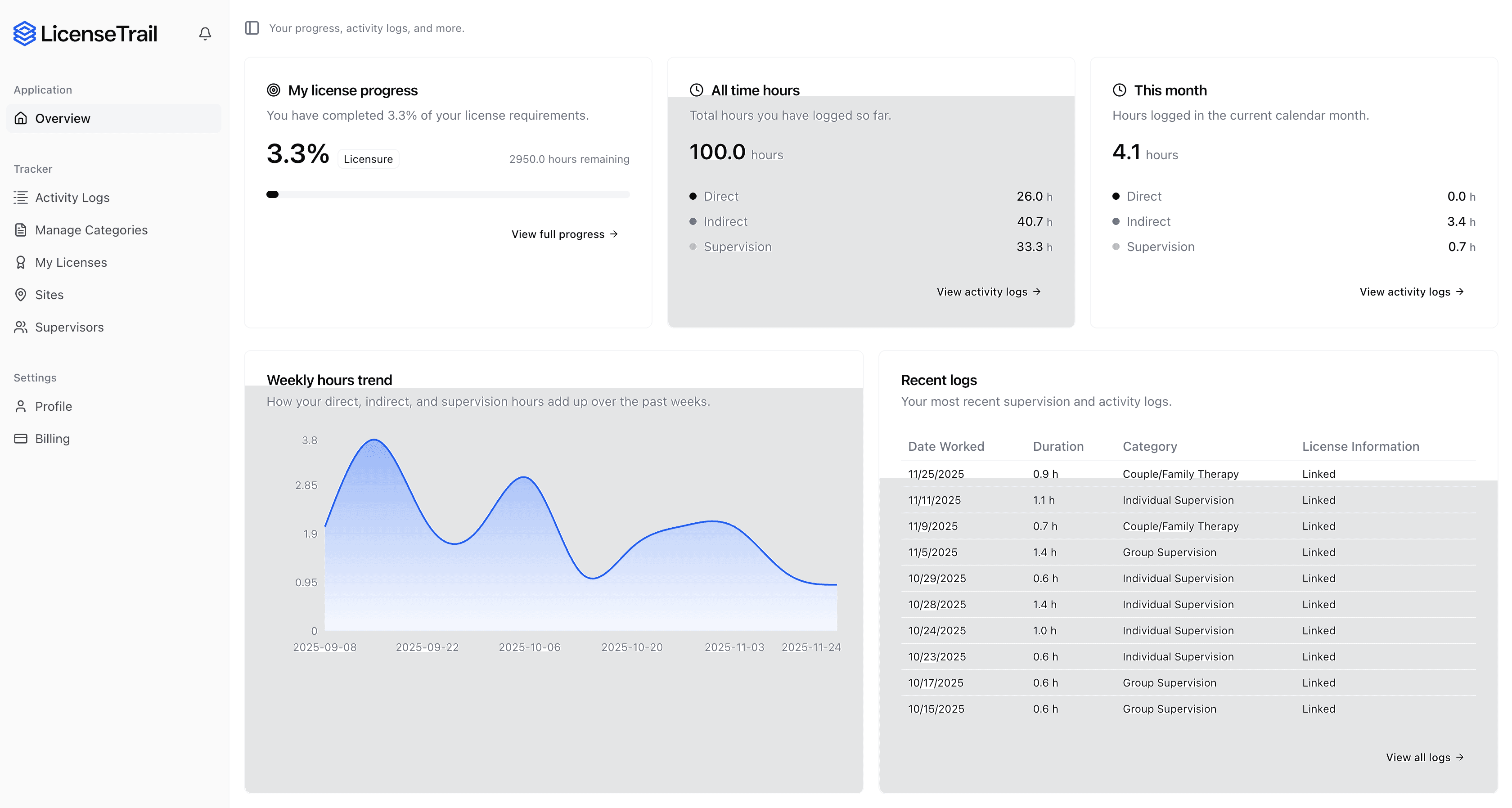
License Trail checks your direct, indirect, and supervision hours against District-of-columbia PAR requirements continuously and flags mismatches before you submit.
 Start Tracking for Free
No credit card required · Free plan available
Is your spreadsheet hiding District-of-columbia PAR risks?
Stop guessing if your categories match District of Columbia Board of Psychology requirements. License Trail checks your direct, indirect, and supervision hours continuously and flags mismatches before you submit.
Import or log
Bring your spreadsheet or start fresh
Upload your existing tracking spreadsheet and we'll map every hour into the right District of Columbia Board of Psychology categories automatically.
Verify against District-of-columbia
Catch mismatches before the board does
License Trail checks your direct, indirect, and supervision hours against District-of-columbia PAR requirements continuously.
Export board-ready
One-click clean reports
Generate professional, board-ready reports for supervision meetings and District of Columbia Board of Psychology submissions in seconds.
No credit card required · Free plan available