
Idaho LAMFT Requirements: Hours, Exams & Step-by-Step Guide
Stop guessing if your categories match Idaho requirements. License Trail checks your direct, indirect, and supervision hours against LAMFT requirements continuously and flags mismatches before you submit.
No credit card required · Free plan available
Quick Requirements Overview
- Practice authority: entry-level LAMFT may only practice MFT under supervision (no independent practice).
- Education: approved graduate program in MFT or related field (COAMFTE or CACREP-MCFC accredited, or Board-approved “substantially similar”).
- Practicum (pre-LAMFT): 12+ months including 300 direct client contact hours, with 100+ hours conjoint (two or more with an ongoing relationship).
- Exam: pass the AMFTRB National Marital & Family Therapy Examination (or Board-approved equivalent).
- Supervisor eligibility (general): supervisor must be licensed/active/in good standing (e.g., LPC, LMFT, psychologist, CSW, psychiatrist); Idaho “approved supervisor” typically CPC or LMFT with 15 hours supervisor training and no discipline in past 5 years (LPC allowed until 7/1/2026).
- Client disclosure: informed consent must identify associate status, license number, and supervisor name/contact.
- Path to full LMFT (postgrad): 2,000 direct client hours over 2+ years incl. 1,000 conjoint, plus 200 supervision hours (≥100 individual, ≥100 by an LMFT).
License Details
Procedures
In Idaho, the Licensed Associate Marriage and Family Therapist (LAMFT) credential is the entry‑level license on the marriage and family therapy pathway. It allows you to practice marriage and family therapy only under supervision while you accumulate the post‑graduate hours needed for full LMFT licensure. (law.justia.com)
Below is a structured, step‑by‑step guide based on the current Idaho Administrative Code (IDAPA 24.15.01, effective July 1, 2024) and Idaho Code Title 54, Chapter 34. (adminrules.idaho.gov)
1. How Idaho Law Defines the LAMFT
Idaho statute defines a “licensed associate marriage and family therapist” as a person licensed under Chapter 34 “to practice marriage and family therapy under supervision.” It also states that a licensed associate may only practice MFT under supervision as established in the chapter and Board rules. (law.justia.com)
The rules chapter that implements these laws is IDAPA 24.15.01 – Rules of the Idaho Licensing Board of Professional Counselors and Marriage and Family Therapists, which explicitly applies to Associate Marriage and Family Therapists as one of the regulated license types. (adminrules.idaho.gov)
2. Governing Board and Rule Set
- Board: Idaho Licensing Board of Professional Counselors and Marriage and Family Therapists. (law.justia.com)
- Primary authorities:
- Idaho Code Title 54, Chapter 34 (Counselors and Therapists). (law.justia.com)
- IDAPA 24.15.01 (Rules of the Board, updated 7‑1‑2024). (adminrules.idaho.gov)
These rules spell out what counts as an approved degree, required practicum, required exam, supervised experience for LMFT, supervision standards, and fees.
3. Educational Requirements for LAMFT
3.1 Approved Graduate Program
To qualify as an Associate Marriage and Family Therapist, you must complete an approved graduate program:
- A graduate program in marriage and family therapy or a related field, and
- Accredited by COAMFTE or the CACREP Marriage, Couple, and Family Counseling (MCFC) specialty, or “substantially similar and approved by the Board.” (adminrules.idaho.gov)
The rules do not prescribe a specific degree title (e.g., “MMFT” vs “MA in Counseling”) so long as the program meets this “approved graduate program” definition.
4. Practicum / Field Experience Hours Required for LAMFT
The only numeric hour requirement that must be completed before LAMFT licensure is the graduate‑level practicum described in Rule 100.03.b. (adminrules.idaho.gov)
4.1 Board‑Defined Practicum Requirements
The Board’s rule states that an Associate MFT’s required practicum must:
- Span at least 12 months.
- Include 300 hours of “direct client contact.”
- Of those 300 hours, at least 100 hours must be with “two or more individuals conjointly who share an ongoing relationship beyond that which occurs in the therapeutic experience itself.” (adminrules.idaho.gov)
Key points about this language:
- “Direct client contact” is not separately defined in the rule, but by standard Board usage it means face‑to‑face (in person or live video) therapeutic services provided directly to clients, not indirect activities like charting or staff meetings.
- The phrase “two or more individuals conjointly who share an ongoing relationship” is the Board’s way of specifying conjoint couple and family work (partners, spouses, family members, etc.), not simply multiple unrelated individuals seen in a group. (adminrules.idaho.gov)
4.2 Where These Hours Can Be Earned
The 300 hours and 100 conjoint hours may be accumulated in any of the following, as long as supervision and structure meet Board expectations:
- A graduate practicum or internship,
- Registered intern supervised experience in Idaho,
- Supervised experience in another jurisdiction that meets equivalent standards. (adminrules.idaho.gov)
5. Examination Requirement for LAMFT
To be licensed as a LAMFT, you must pass the National Marital and Family Therapy Examination:
- The rules specify that an Associate Marriage and Family Therapist must pass the National Marital and Family Therapy Examination as approved by the Association of Marital and Family Therapy Regulatory Boards (AMFTRB), or another Board‑approved competency exam in MFT. (adminrules.idaho.gov)
The Board requires you to submit an “Intent to Sit for the National Marriage and Family Therapy Examination” application with fee and transcripts at least two weeks before the AMFTRB registration deadline. (dopl.idaho.gov)
6. Supervision Structure for LAMFT Practice
Because an LAMFT is, by definition, a therapist who must practice under supervision, understanding how Idaho defines supervisors is crucial.
6.1 Who Can Be a Supervisor
Under Rule 003 and Rule 200: (adminrules.idaho.gov)
-
A “supervisor” is a:
- Clinical professional counselor,
- Marriage and family therapist,
- Psychologist,
- Clinical social worker, or
- Psychiatrist
whose license is active, current, and in good standing and, when applicable, approved as a supervisor in the state where the supervisee is practicing.
-
To be an approved supervisor for Idaho interns/associates, a person must:
- Be licensed as a clinical professional counselor or licensed marriage and family therapist,
- Document at least 15 contact hours of education in supervisor training, and
- Have no discipline for the past five years (with a limited exception for CE‑related discipline). (adminrules.idaho.gov)
Rule 200.02 also allows a licensed professional counselor to serve as an approved supervisor until July 1, 2026, as part of a transition period. (adminrules.idaho.gov)
6.2 Supervision Expectations for Associates
Idaho law explicitly states that a licensed associate marriage and family therapist may only practice MFT under supervision as set out in the chapter and Board rules. (law.justia.com)
Practically, that means:
- All of your clinical work as a LAMFT must be tied to an ongoing supervisory relationship with a Board‑qualified supervisor.
- You must disclose your supervisee status to clients. Rule 200.03 requires informed consent documents to identify:
- Your name, license type, and license number;
- Your supervisor’s name and contact information;
- A statement that you are practicing under supervision. (adminrules.idaho.gov)
The Board’s rules for registered post‑graduate interns (Rule 100.06) similarly require designation of an approved supervisor and limit intern practice to four years from initial registration. While “MFT intern” is a separate designation from LAMFT, both statuses are meant to ensure supervised practice while hours are being accrued. (adminrules.idaho.gov)
7. Post‑LAMFT Hours Required Later for LMFT Licensure
Although your question is specifically about the LAMFT, Idaho structures the path so that once you hold a LAMFT license you typically begin accumulating the post‑master supervised hours needed for the full LMFT license.
Under Rule 100.04.c, a Licensed Marriage and Family Therapist must document: (adminrules.idaho.gov)
- 2,000 hours of direct client contact
- These hours must be postgraduate and spread over at least two years.
- Within those 2,000 hours, at least 1,000 hours of direct client contact with “two or more individuals conjointly who share an ongoing relationship beyond that which occurs in the therapeutic experience itself.”
- Functionally, this is 1,000 hours of couple and family (relational) work, not just individual therapy.
- 200 hours of supervision, with these sub‑requirements:
- At least 100 hours must be individual supervision (no more than two supervisees per supervisor).
- The remaining hours may be group supervision.
- At least 100 hours of supervision must be provided by a licensed marriage and family therapist.
- The remaining 100 supervision hours must be provided by a supervisor with at least two years’ experience practicing marriage and family therapy (which could be an LMFT or other qualified MHP meeting the supervisor definition).
Note that:
- The rule does not now state a 3,000‑hour total, nor does it divide hours into “direct” vs “other supervised experience” beyond these specific thresholds. Some secondary sites still reference older standards (e.g., 3,000 total hours with 2,000 direct), but the current Idaho rule text specifies 2,000 direct client hours plus 200 hours of supervision as the minimum quantified requirements. (adminrules.idaho.gov)
Most associates accumulate these hours while licensed as LAMFTs (or MFT interns) under continuous supervision.
8. Application and Administrative Details
From the Board’s rules and website: (dopl.idaho.gov)
- Application category: “APPLICANT: ASSOCIATE MFT & LICENSED MFT.”
- Fees:
- Application fee (set by rule), plus
- Initial license fee, and then renewal fees on an annual or biennial schedule (Idaho is currently transitioning to biennial licensure).
- Supporting documents:
- Official transcripts showing your qualifying graduate degree and practicum,
- Proof of passing the National MFT exam,
- Any additional documentation the Board requests (e.g., explanations of non‑standard programs).
Because fee amounts and some procedural steps can change, the Board directs applicants to its “Apply for or Renew a License” portal and current rule 400 for the latest figures. (dopl.idaho.gov)
9. Hour Requirements at a Glance
For LAMFT (entry‑level license)
- Graduate program: “Approved graduate program” in MFT or a related field (COAMFTE, CACREP‑MCFC, or substantially similar and Board‑approved). (adminrules.idaho.gov)
- Practicum hours (pre‑licensure):
- 300 hours of direct client contact,
- Of which at least 100 hours are conjoint couple/family work (two or more individuals with an ongoing relationship),
- Practicum must span 12 months or longer. (adminrules.idaho.gov)
- Exam: National Marital and Family Therapy Examination (AMFTRB or other Board‑approved equivalent). (adminrules.idaho.gov)
- Supervision condition: All practice as a LAMFT must be under ongoing supervision in accordance with statute and Board rules. (law.justia.com)
For eventual LMFT (full license, typically after time in LAMFT/intern status)
- Post‑graduate supervised experience (Board‑defined minimums):
- 2,000 hours of direct client contact over at least two years,
- Within that, 1,000 hours of conjoint couple/family work,
- 200 hours of supervision, including at least 100 hours individual, at least 100 hours with an LMFT, and remaining hours with a supervisor having ≥2 years MFT practice experience. (adminrules.idaho.gov)
Together, these requirements describe Idaho’s official pathway into practice as a Licensed Associate Marriage and Family Therapist (LAMFT) and onward to full LMFT licensure, with the exact hour categories and Board language anchored in current state rules rather than secondary summaries.
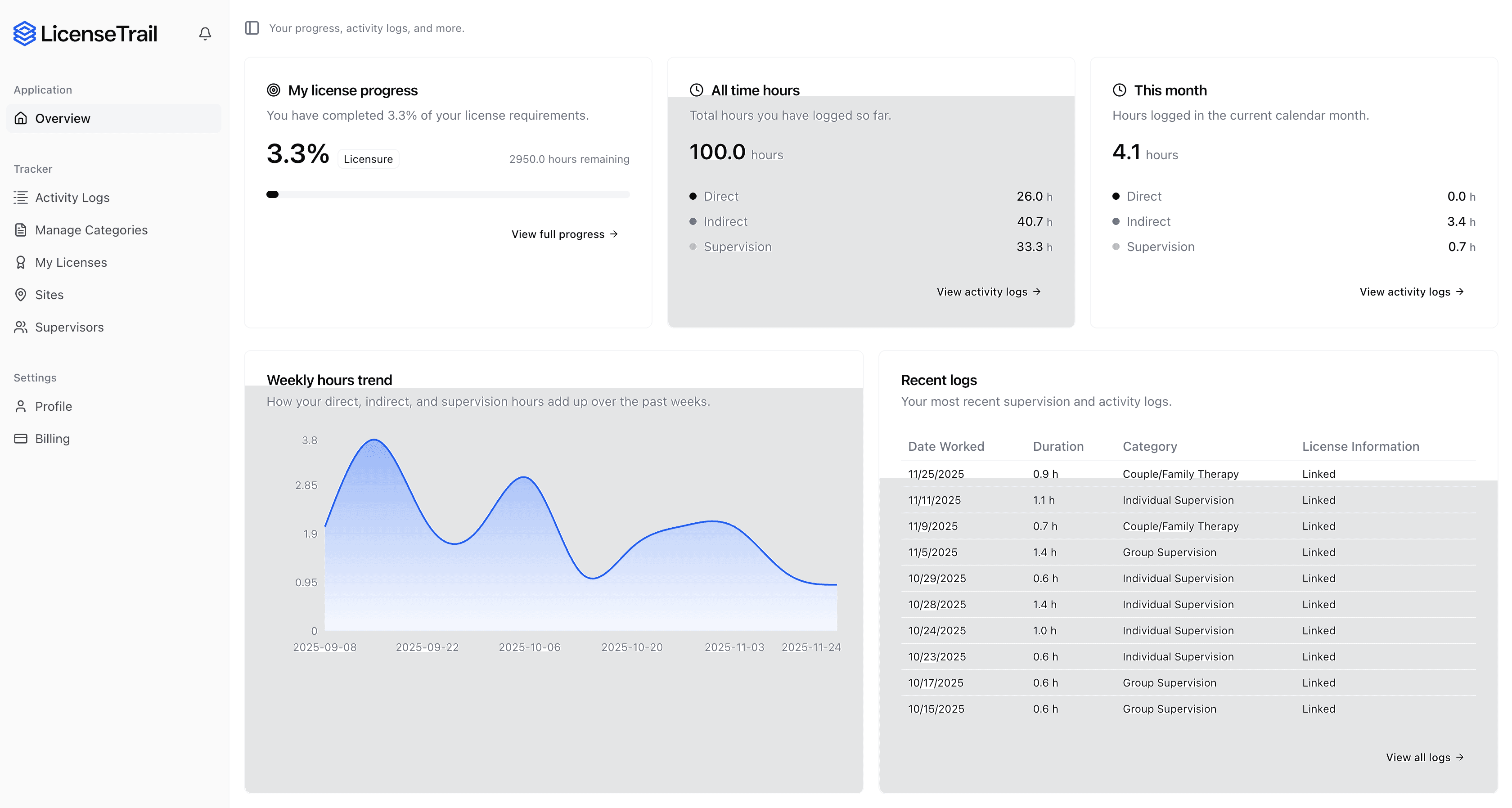
Track your LAMFT hours with confidence
License Trail checks your direct, indirect, and supervision hours against Idaho LAMFT requirements continuously and flags mismatches before you submit.
 Start Tracking for Free
No credit card required · Free plan available
Is your spreadsheet hiding Idaho LAMFT risks?
Stop guessing if your categories match Idaho Board ofPC, MFT and Professional Counselors requirements. License Trail checks your direct, indirect, and supervision hours continuously and flags mismatches before you submit.
Import or log
Bring your spreadsheet or start fresh
Upload your existing tracking spreadsheet and we'll map every hour into the right Idaho Board ofPC, MFT and Professional Counselors categories automatically.
Verify against Idaho
Catch mismatches before the board does
License Trail checks your direct, indirect, and supervision hours against Idaho LAMFT requirements continuously.
Export board-ready
One-click clean reports
Generate professional, board-ready reports for supervision meetings and Idaho Board ofPC, MFT and Professional Counselors submissions in seconds.
No credit card required · Free plan available