
Massachusetts LABA Requirements: Hours, Exams & Step-by-Step Guide
Stop guessing if your categories match Massachusetts requirements. License Trail checks your direct, indirect, and supervision hours against LABA requirements continuously and flags mismatches before you submit.
No credit card required · Free plan available
Quick Requirements Overview
- Protected title; regulated by MA Board of Registration of Allied Mental Health & Human Services Professions (262 CMR 10.00; M.G.L. c.112 §§163–172)
- Eligibility: good moral character; no disqualifying conduct under M.G.L. c.112 §169
- Education: master’s or doctoral in ABA meeting 262 CMR 10.03(3) credit-hour content requirements or master’s/doctoral in human services + Board‑approved ABA certificate/course sequence (10.03(4))
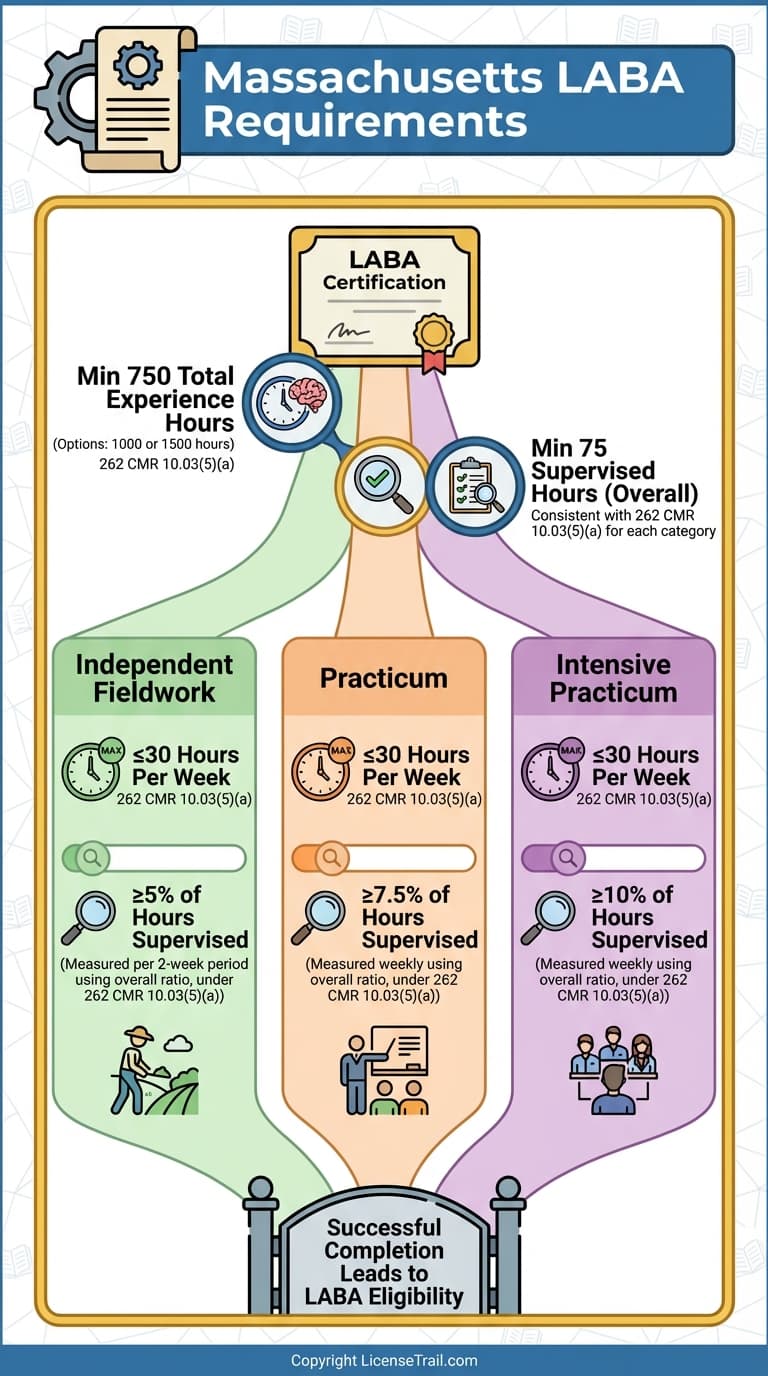
- Experience (start only after beginning required ABA coursework): complete one structure—Independent Fieldwork 1,500 hrs; Practicum 1,000 hrs; Intensive Practicum 750 hrs (10.03(5))
- Supervision minimums: ≥75 supervised hours; plus required supervision ratios/frequency—Fieldwork ≥5% per 2‑week period (supervision at least biweekly); Practicum ≥7.5% weekly; Intensive Practicum ≥10% weekly; 10–30 hrs/week average
- Supervisor rules (current MA): supervision must be by a MA LABA who is BACB‑qualified to supervise; relationship limits apply (not related/subordinate/employed by supervisee)
- Examination: pass Board‑approved examination(s) (10.03(2)(e))
- Reciprocity option: may be licensed without exam if licensed in another state with substantially equivalent/higher standards and in good standing (10.03(7))
License Details
Procedures
Licensure as a Licensed Applied Behavior Analyst (LABA) in Massachusetts
In Massachusetts, “Licensed Applied Behavior Analyst” (LABA) is a protected professional title regulated by the Board of Registration of Allied Mental Health and Human Services Professions under 262 CMR 10.00 and M.G.L. c. 112, §§163–172.(mass.gov)
The regulation that directly controls LABA requirements is 262 CMR 10.03 – Applied Behavior Analyst Application and Licensure.(regulations.justia.com)
Below is a structured guide based on that regulation, with close attention to how the Board itself describes the education and experience requirements.
1. Core statutory and regulatory criteria
Under 262 CMR 10.03(2), in order to be licensed as an applied behavior analyst, an applicant for an original LABA license must demonstrate that they:(regulations.justia.com)
- Are “of good moral character.”
- “Has not engaged or is not engaging in any practice or conduct” that would be grounds for refusing a license under M.G.L. c. 112, §169.
- Education requirement – has successfully completed:
- A Doctoral Degree Program or Master’s Degree Program that meets 262 CMR 10.03(3); or
- A doctoral or master’s degree in another field of human services plus additional behavior analysis coursework per 262 CMR 10.03(4).(regulations.justia.com)
- Experience requirement – has successfully completed a “Practicum or Supervised Experience in the practice of behavior analysis” that meets 262 CMR 10.03(5).(regulations.justia.com)
- Has successfully completed the Board‑approved examination(s).(regulations.justia.com)
The rest of this guide unpacks items 3–5, with particular focus on the hours and supervision structure under 10.03(5).
2. Education requirement (degree and ABA coursework)
2.1. Acceptable doctoral or master’s degree programs
The Board distinguishes between:(regulations.justia.com)
- Doctoral Degree Programs in applied behavior analysis that include 60 graduate credit hours in specified content areas (ethics, concepts and principles, research methods, and applied behavior analysis content), plus discretionary ABA‑related coursework.
- Master’s Degree Programs in applied behavior analysis that include 30 graduate credit hours in specified content areas, plus discretionary ABA‑related coursework.
The exact required credit‑hour breakdown in ethics, concepts and principles, research methods, behavioral assessment, intervention, measurement, and behavior‑change procedures is spelled out in 262 CMR 10.03(3) and varies slightly depending on whether the degree was awarded before or on/after January 1, 2015.(regulations.justia.com)
2.2. Degrees in another human services field
If your doctoral or master’s degree is in another “field of human services”, you may still qualify if you also complete a “board‑approved certificate program in behavior analysis with an approved course sequence formally approved by the Board.”(regulations.justia.com)
This pathway is contained in 262 CMR 10.03(4) and is explicitly for applicants whose degrees do not themselves meet the ABA‑specific credit‑hour structure in 10.03(3).(regulations.justia.com)
3. Practicum and supervised experience requirements (hours and supervision)
From the Board’s perspective, all of your pre‑licensure hours fall under “Practicum or Supervised Experience in the practice of behavior analysis” as defined in 262 CMR 10.03(5).(regulations.justia.com)
You do not complete separate “direct experience hours” and “supervised experience hours” as two independent totals. Instead:
- You complete a single body of experience hours in one or more experience categories; and
- Within those hours, a certain minimum amount must consist of supervision, and supervision must represent at least a specified percentage of your total experience hours.(regulations.justia.com)
3.1. Experience categories accepted by the Board
262 CMR 10.03(5)(a) sets out three acceptable categories (you can use one, or a combination):(regulations.justia.com)
- Independent Fieldwork
- Practicum
- Intensive Practicum
You may use one or combine more than one type, but “may accrue experience in only one of the three experience categories at a time.”(regulations.justia.com)
You also “may not begin accumulating Supervised Independent Fieldwork, Practicum, or Intensive Practicum hours” until you have started the ABA coursework required for licensure.(regulations.justia.com)
3.2. Independent Fieldwork route
Under Independent Fieldwork, the Board requires:(regulations.justia.com)
- Total experience hours:
- 1,500 hours of independent fieldwork in behavior analysis.
- Minimum supervised portion:
- At least 75 hours must be supervised (i.e., one‑to‑one or small‑group supervisory meetings focused on your work).
- Weekly hour limits:
- You must average “no fewer than ten hours but no more than 30 hours per week” of independent fieldwork experience.
- Required supervision percentage and frequency:
- You must be supervised at least once every two‑week period, and supervision must total at least 5% of all independent fieldwork hours during each two‑week period.
In practice, this means:
- For 1,500 total hours, you must have at least 75 hours of supervision (5% of 1,500), spread across your fieldwork in a way that meets the bi‑weekly contact rule and 5% minimum in each two‑week window.
3.3. Practicum route
Under Practicum (usually a university‑based practicum for graduate credit at a “Recognized Educational Institution Practicum program”):(regulations.justia.com)
- Total experience hours:
- 1,000 hours of practicum experience in behavior analysis, completed with a passing grade in the practicum course(s).
- Minimum supervised portion:
- At least 75 hours must be supervised.
- Weekly hour limits:
- You must average 10–30 hours per week of practicum experience.
- Required supervision percentage and frequency:
- You must be supervised at least once per week, and supervision must total at least 7.5% of all practicum hours each week.
So for 1,000 total practicum hours:
- You need at least 75 supervised hours (7.5% of 1,000), and your weekly breakdown must maintain at least 7.5% supervision in every week where you accrue hours.
3.4. Intensive Practicum route
Under Intensive Practicum (also a university‑based practicum but with more frequent supervision):(regulations.justia.com)
- Total experience hours:
- 750 hours of intensive practicum experience in behavior analysis, completed with a passing grade in the intensive practicum course(s).
- Minimum supervised portion:
- At least 75 hours must be supervised.
- Weekly hour limits:
- You must average 10–30 hours per week of intensive practicum experience.
- Required supervision percentage and frequency:
- You must be supervised at least once per week, and supervision must total at least 10% of all intensive practicum hours each week.
Thus, for 750 total intensive practicum hours:
- You must obtain at least 75 supervised hours (10% of 750 is 75), and every week in which you accrue hours must maintain at least a 10% supervision ratio.
3.5. Combining experience categories
The Board explicitly allows “combined experience”:(regulations.justia.com)
- You may elect to combine Independent Fieldwork, Practicum, and Intensive Practicum,
- But at any given time you can only accrue hours in one category (you can switch later, but you cannot count the same calendar hours simultaneously as, for example, both fieldwork and practicum).
Whatever combination you use, you must still:
- Meet the minimum total hour requirement for the chosen categories,
- Satisfy the minimum supervised‑hour requirement for each category you use (75 supervised hours per category used to fulfill the requirement), and
- Follow the weekly or bi‑weekly supervision percentages for each category during the periods when you are accruing those hours.
4. Who may supervise your experience
262 CMR 10.03(5)(e)–(f) addresses supervision providers and distinguishes Massachusetts from other states and time periods.(regulations.justia.com)
4.1. Supervision within Massachusetts
For supervised experience in Massachusetts, the regulations specify:
- Prior to January 1, 2015 – supervision could be provided by a licensed applied behavior analyst or a BCBA.
- From January 1, 2015 through December 31, 2017 – supervision could be provided by a licensed applied behavior analyst or a BCBA qualified to supervise by the BACB.
- On or after January 1, 2018 – supervision must be provided only by a licensed applied behavior analyst who is also qualified to supervise by the BACB.
For experience you are accruing now for an initial LABA, this last condition is the operative one.
4.2. Supervision outside Massachusetts
For supervised experience outside Massachusetts:(regulations.justia.com)
- Prior to January 1, 2015 – supervision must be by an applied behavior analyst licensed in that state, or, if that state does not license ABAs, by a BCBA.
- On or after January 1, 2015 – supervision must be by an AB‑licensed analyst in that state, or, if that state does not license ABAs, by a BCBA who is qualified to supervise by the BACB.
4.3. Relationship restrictions
Your supervisor “may not be related to, subordinate to, or employed by the supervisee during the Supervised Experience period.” The regulation clarifies that this does not prohibit paying your supervisor for supervision services.(regulations.justia.com)
5. Examination requirement
Under 262 CMR 10.03(2)(e), a LABA applicant must have “successfully completed the Board‑approved examination(s).”(regulations.justia.com)
In practice, the Board contracts with test vendors and recognizes the national applied behavior analysis examination (i.e., the BCBA exam) as the qualifying exam, but the regulation itself is worded broadly as “Board‑approved examination(s)” to allow for changes in vendors or exam formats over time.
6. Alternative and historical routes (grandfathering and reciprocity)
6.1. Grandfathering route (now time‑limited)
262 CMR 10.03(6) contains a special route for applicants whose applications were received prior to June 5, 2017 pursuant to St. 2012, c. 429. Those applicants could qualify if they were of good moral character and met one of several conditions (e.g., BCBA, completion of a qualifying Doctoral or Master’s Degree Program, or certain long‑term practice with a certificate program).(regulations.justia.com)
Because that date has passed, this route is now historical only and not available for new applicants.
6.2. Licensure by reciprocal recognition
Under 262 CMR 10.03(7), the Board may issue a license “without examination and by reciprocal recognition” to someone already licensed as an applied behavior analyst (or equivalent) in another state, if:(regulations.justia.com)
- The applicant is of good moral character;
- The other jurisdiction’s standards are “substantially equivalent to or exceeds” Massachusetts standards; and
- The applicant holds a current license in good standing in that jurisdiction.
This is the main path for experienced ABAs licensed in other states to obtain a Massachusetts LABA without re‑testing, subject to Board review.
7. Putting it together: what the hours requirement really looks like
Translating the Board’s terminology into plain language while preserving its structure:
-
You must complete one of the following (or an approved combination that meets or exceeds these minima) as your pre‑licensure ABA experience:(regulations.justia.com)
-
Independent Fieldwork route
- 1,500 total hours of applied behavior analysis experience (fieldwork).
- At least 75 of those hours are supervision meetings.
- Supervision every two weeks, totaling at least 5% of hours in each two‑week period.
- 10–30 fieldwork hours per week.
-
Practicum route
- 1,000 total hours of practicum experience in behavior analysis in a recognized university practicum program, for graduate credit and passed.
- At least 75 supervised hours.
- Weekly supervision at or above 7.5% of hours; 10–30 practicum hours per week.
-
Intensive Practicum route
- 750 total hours of intensive practicum in behavior analysis in a recognized university practicum program, for graduate credit and passed.
- At least 75 supervised hours.
- Weekly supervision at or above 10% of hours; 10–30 intensive practicum hours per week.
-
-
The Board’s regulation does not say “1,500 hours of direct experience and 1,500 hours of supervised experience” as two separate blocks. Instead, it sets one total‑hour requirement in each experience category and then requires that a specified subset of those hours consist of supervision, with minimum percentages and contact frequency.
8. Practical checklist for a standard (non‑reciprocity) LABA applicant
Using the Board’s own structure, a typical path to licensure as a LABA in Massachusetts looks like this:(regulations.justia.com)
-
Earn an appropriate graduate degree
- Doctoral or master’s degree in applied behavior analysis that meets the credit‑hour requirements in 262 CMR 10.03(3); or
- Doctoral/master’s in another human services field plus a Board‑approved ABA certificate program and course sequence per 10.03(4).
-
Begin ABA coursework before logging experience
- Do not start counting Independent Fieldwork, Practicum, or Intensive Practicum hours until you have started the ABA coursework required for licensure.
-
Complete one of the three Board‑recognized experience structures
- Independent Fieldwork: 1,500 hours total, ≥75 supervised hours, ≥5% supervision bi‑weekly, 10–30 hours/week.
- Practicum: 1,000 hours total, ≥75 supervised hours, ≥7.5% supervision weekly, 10–30 hours/week, in a recognized practicum program for graduate credit.
- Intensive Practicum: 750 hours total, ≥75 supervised hours, ≥10% supervision weekly, 10–30 hours/week, in a recognized intensive practicum program for graduate credit.
- Or a combined experience sequence that still satisfies these quantitative and structural requirements.
-
Ensure supervision is valid under Massachusetts rules
- For hours after January 1, 2018 in Massachusetts, supervision must be by a Massachusetts LABA who is also BACB‑qualified to supervise.
- Outside Massachusetts, supervision must be by an ABA‑licensed person in that state or, where licensure doesn’t exist, by a BCBA qualified to supervise by the BACB.
-
Pass the Board‑approved examination
- Take and pass the exam recognized by the Board for applied behavior analysts (currently aligned with the national behavior analyst exam).
-
Submit a complete application to the Board
- Use the Board’s official LABA application and checklist.
- Provide transcripts, verification of supervised experience (including totals and supervision details), exam verification, and attestations regarding moral character and absence of disqualifying conduct.
-
Await Board review and licensing decision
- The Board will review your file under 262 CMR 10.03 and the governing statutes in M.G.L. c. 112, §§163–172.
This structure reflects the current regulatory framework (as of June 20, 2025, per the most recent publication of 262 CMR 10.03) used by the Massachusetts Board of Registration of Allied Mental Health and Human Services Professions to license LABAs.(regulations.justia.com)
Track your LABA hours with confidence
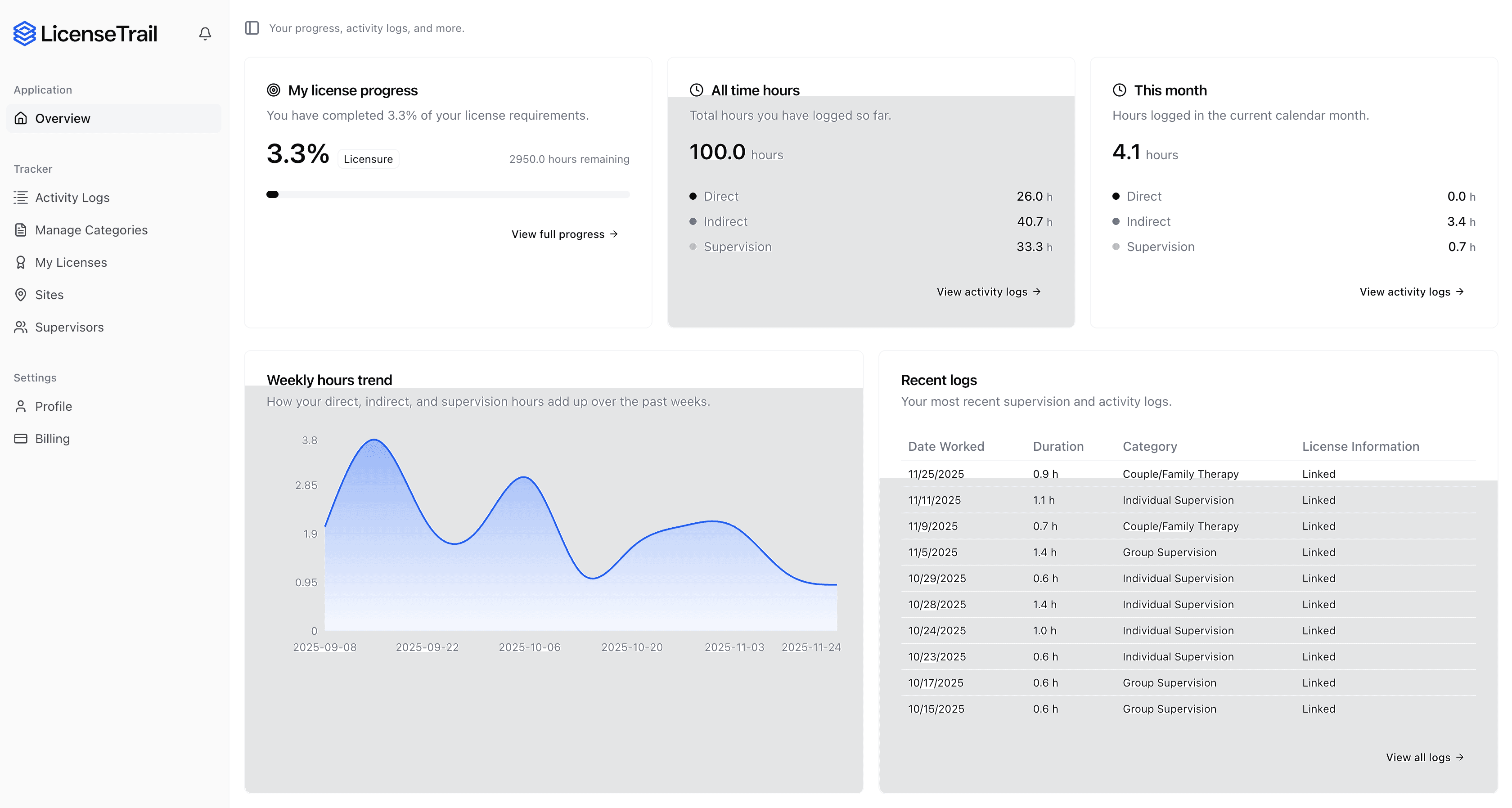
License Trail checks your direct, indirect, and supervision hours against Massachusetts LABA requirements continuously and flags mismatches before you submit.
 Start Tracking for Free
No credit card required · Free plan available
Is your spreadsheet hiding Massachusetts LABA risks?
Stop guessing if your categories match Massachusetts Board of Registration of Allied Mental Health and Human Services Professions requirements. License Trail checks your direct, indirect, and supervision hours continuously and flags mismatches before you submit.
Import or log
Bring your spreadsheet or start fresh
Upload your existing tracking spreadsheet and we'll map every hour into the right Massachusetts Board of Registration of Allied Mental Health and Human Services Professions categories automatically.
Verify against Massachusetts
Catch mismatches before the board does
License Trail checks your direct, indirect, and supervision hours against Massachusetts LABA requirements continuously.
Export board-ready
One-click clean reports
Generate professional, board-ready reports for supervision meetings and Massachusetts Board of Registration of Allied Mental Health and Human Services Professions submissions in seconds.
No credit card required · Free plan available