
Massachusetts LEP Requirements: Hours, Exams & Step-by-Step Guide
Stop guessing if your categories match Massachusetts requirements. License Trail checks your direct, indirect, and supervision hours against LEP requirements continuously and flags mismatches before you submit.
No credit card required · Free plan available
Quick Requirements Overview
- Degree: Master’s/CAGS/Doctorate in School Psychology (state licensed/accredited institution) + 60 approved graduate credits (shortfalls may be made up with additional grad coursework, Board-approved).
- Graduate field placement: 1,200 clock hours supervised practicum/internship (additional supervised hours allowed if program hours are short, with Board approval).
- School psychologist certification: Current MA DESE school psychologist certification (or comparable out-of-state).
- Post-master’s experience: 2 full-time academic years (min 360 days) of employment providing school psychological services; private practice/self-employment does not count.
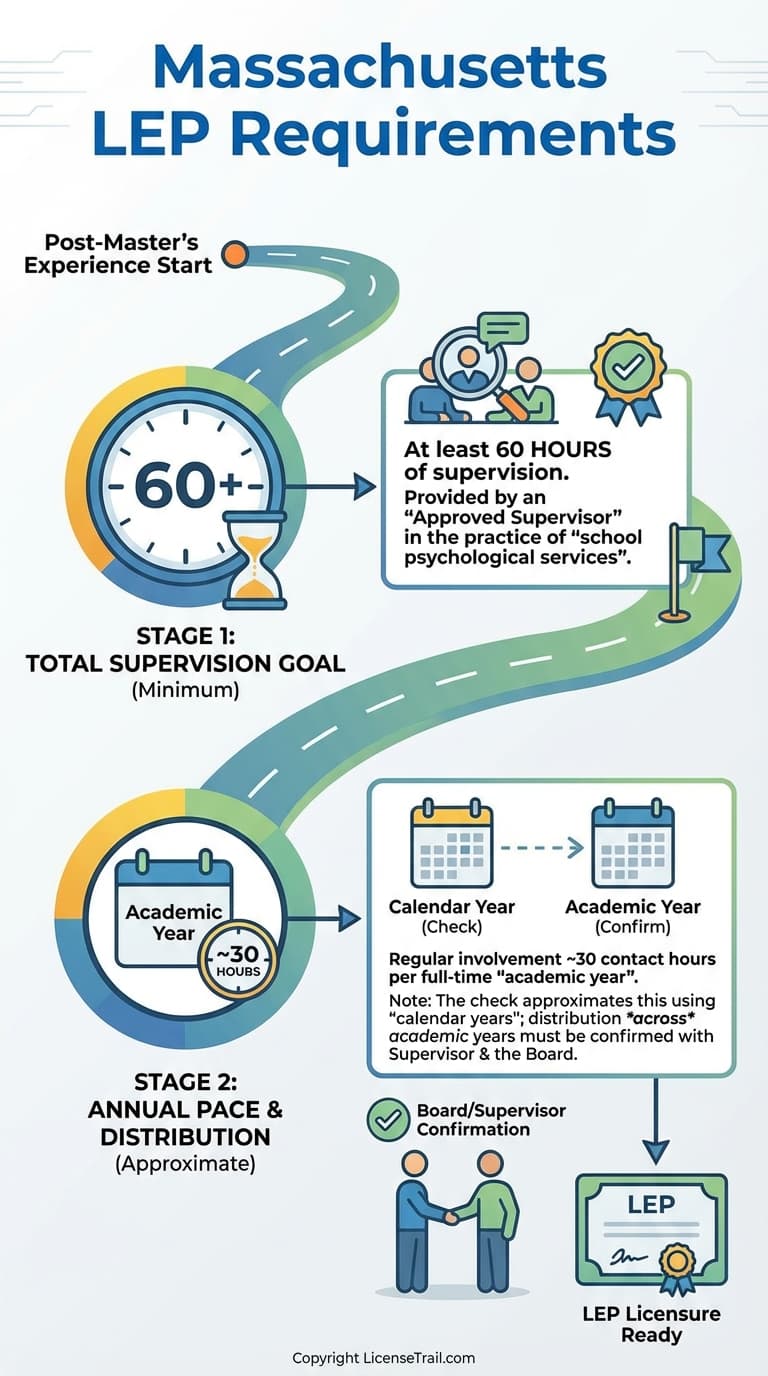
- Supervision (post-master’s): 60 hours supervised clinical experience via scheduled supervision meetings (peer supervision doesn’t count).
- Supervisor qualifications/contact: Must be an Approved Supervisor (LEP or LEP-eligible + 5 academic years experience) with ≥30 contact hours/year during the 2 academic years.
- Exam: Pass the National School Psychology Examination (ETS/NTE #40) (NASP/NCSP not required).
- General eligibility: Good moral character; no disqualifying conduct per §169.
License Details
Procedures
In Massachusetts, “Licensed Educational Psychologist” (LEP) is a protected allied mental health license governed by statute (Mass. Gen. Laws c.112) and by the Board of Registration of Allied Mental Health and Human Services Professions through 262 CMR 5.00.(mass.gov)
Unlike some states that specify a single number of “direct” and “supervised” hours, Massachusetts combines:
- A fixed-hour graduate practicum/internship (1,200 clock hours), plus
- Experience measured in full-time academic years (not total hours), and
- A defined minimum of supervised clinical hours (60 hours) with specific supervisor qualifications and contact-time requirements.(regulations.justia.com)
Below is a step‑by‑step guide with the Board’s own terminology highlighted.
1. Legal framework and role definition
Statutory basis
LEPs are one of four “allied mental health and human services professionals” licensed under Mass. Gen. Laws c.112, §§163–172 and implemented by 262 CMR.(mass.gov)
For LEPs specifically, the controlling provisions are:
- Mass. Gen. Laws c.112, §163 – Definitions (including “licensed educational psychologist” and “practice of educational psychology”).(mass.gov)
- Mass. Gen. Laws c.112, §165 – License qualifications for LEPs.(law.justia.com)
- 262 CMR 5.00 / 262 CMR 5.01 – “Requirements for licensure as an educational psychologist” adopted by the Board.(mass.gov)
Who is a “licensed educational psychologist”?
Section 163 defines a “licensed educational psychologist” as someone who:
- Is licensed or eligible for licensure under §165, and
- “Has been certified as a school psychologist by the Massachusetts department of education” (now DESE).(mass.gov)
The statute also bars an LEP in private practice from providing any of their licensed services to students in the same school system that employs them; violation carries mandatory license suspension under §169.(mass.gov)
2. Baseline conditions every LEP applicant must meet
Under the first paragraph of §165, all allied mental health licensees (including LEPs, via cross‑reference) must show:(law.justia.com)
- Good moral character.
- No disqualifying conduct – you “have not engaged or are not engaging in any practice or conduct which would be grounds for refusing to issue a license under section 169.”
- Compliance with the rule that if you also hold another specified license (e.g., LCSW), you must designate which license governs each practice and use the corresponding title in that practice. This is incorporated for LEPs as clause (5) of the first paragraph.(law.justia.com)
These character/conduct requirements apply in addition to the LEP‑specific education and experience elements described below.
3. Graduate degree requirements
Degree level and field
Under §165 and 262 CMR 5.01, you must have a graduate degree that satisfies both the statute and the Board’s more specific rule:
- Statute: a “relevant master’s degree in psychology” from an institution licensed by the state in which it is located.(law.justia.com)
- Regulation: a Master’s, CAGS, or Doctoral degree in school psychology from an educational institution “licensed or accredited by the state in which it is located.”(regulations.justia.com)
The Board further specifies that the graduate program must include:
“a minimum of 60 credits of approved graduate course work”
and allows you to make up any shortfall with additional graduate coursework, subject to Board approval.(regulations.justia.com)
In practice: expect to need at least 60 graduate credits in a school‑psychology program from an appropriately recognized institution.
4. Required graduate practicum / internship hours
The one place the Board gives a clear numeric hour requirement is for the graduate practicum/internship:
“a Practicum/Internship experience consisting of a minimum of 1200 clock hours of supervised field placement.”(regulations.justia.com)
Key points about this 1,200‑hour requirement:
- It is part of your graduate degree program in school psychology.
- If your program did not include at least 1,200 clock hours of supervised field placement, you must document “additional hours of supervised field placement outside of the graduate degree program sufficient to meet the 1200 clock hour requirement,” for Board review and approval.(regulations.justia.com)
- The regulation speaks in terms of “clock hours of supervised field placement” rather than differentiating “direct” vs. “indirect” hours.
So, Massachusetts does not use a 1,500‑direct / 1,500‑supervised model; it uses a 1,200‑hour supervised practicum/internship standard plus separate post‑master’s experience defined in school‑year units.
5. School psychologist certification requirement
Both statute and regulation require current school psychologist certification:
- 262 CMR 5.01(3)(b) requires “current certification as a school psychologist by the Department of Education of the Commonwealth of Massachusetts or comparable certification from another state.”(regulations.justia.com)
- Section 165 similarly requires that you “have been certified as a school psychologist by the department of education or hold a comparable certification from another state.”(law.justia.com)
You must therefore meet both:
- DESE’s requirements for school psychologist certification (a separate process), and
- The Allied Mental Health Board’s LEP requirements.
6. Post‑master’s “school psychological services” experience
Two full‑time academic years (not a fixed number of hours)
The LEP‑specific paragraph of §165 requires:(law.justia.com)
- “The equivalent of two full time academic years of post masters degree experience in school psychological services supervised by a licensed educational psychologist or a person eligible for licensing…,” and
- The supervisor must have been “regularly involved for at least thirty contact hours per year.”
262 CMR then defines how to interpret these phrases:
- “Full‑Time Academic Year” – “A full‑time academic year consists of a minimum of 180 days. Two full‑time academic years consist of a minimum of 360 days.”(regulations.justia.com)
- “School Psychological Services” – “Consists of employment by a public school system or private school or agency as a Department of Education certified school psychologist engaged in the role and performing the duties of a school psychologist. Private practice/self‑employment as a school psychologist is not acceptable in fulfillment of the post‑master’s degree work experience in school psychological services requirement.”(regulations.justia.com)
Put plainly:
- You need two full school years (or part‑time equivalent) after the master’s degree, totaling at least 360 days of paid school‑psychologist employment while holding school psychologist certification.
- That employment must be in school‑based roles (public school, private school, or agency in a school psychologist role); private practice does not count toward this requirement.(regulations.justia.com)
- Your supervisor (a licensed / board‑eligible LEP) must be “regularly involved” with you for at least 30 contact hours per year across those years. (law.justia.com)
The law does not translate those two years into a fixed total of “X clinical hours;” instead, it anchors the requirement to school‑year days plus a minimum pattern of supervisory contact.
7. Supervision and supervised clinical hours
There are two related but distinct supervision requirements:
a. Definition of the supervisor (“Approved Supervisor”)
262 CMR 5.01 defines an “Approved Supervisor” for LEP purposes as a school psychologist who:(regulations.justia.com)
- Is licensed as an educational psychologist, or meets the Board’s qualifications for LEP licensure; and
- Has a minimum of five full‑time academic years (or equivalent part‑time) of experience as a certified school psychologist.
b. Minimum “Supervised Clinical Experience” hours
The Board also defines “Supervised Clinical Experience” as:
“A minimum of **60 hours of post‑master’s degree supervision in the practice of school psychological services by an approved supervisor.”(regulations.justia.com)
And it defines “Supervision” as:
A “regularly scheduled meeting” of no more than six supervisees with an approved supervisor, for at least one hour; “peer supervision” does not count.(regulations.justia.com)
So, for post‑master’s supervision, you must demonstrate:
- At least 60 hours of formal supervision (in scheduled supervisory meetings) provided by an approved supervisor; and
- Per §165, the supervisor’s involvement must amount to at least 30 contact hours per year over the two full‑time academic years of experience.(law.justia.com)
Again, the Board does not break this down into “direct client contact vs. supervision hours” totals beyond those specific figures; the structure is:
- 1,200 practicum/internship hours (pre‑degree), plus
- Two full academic years / 360 days of post‑master’s employment, with
- At least 60 hours of supervision and ≥30 hours/year supervisor contact during those years.
8. Licensure examination requirement
Both 262 CMR 5.01 and §165 require an examination specific to educational psychology.
The examination itself
262 CMR 5.01(2) specifies that the licensure examination for LEPs is:(regulations.justia.com)
- The National School Psychology Examination (ETS/NTE #40) of the National Association of School Psychologists (NASP),
- Administered by Educational Testing Service (ETS).
- NASP’s NCSP credential is explicitly not required for licensure.
The regulation also notes that the exam is administered three times per year by ETS and directs applicants to ETS for locations, dates, and fees.(regulations.justia.com)
Section 165 restates the requirement that the applicant must “successfully pass an oral or written examination administered by the board to determine the applicant’s qualifications as an educational psychologist.”(law.justia.com)
Recent Board agendas indicate they have discussed whether holding NASP’s NCSP credential can be used as proof of having passed the Praxis/ETS exam for LEP licensing, so it is prudent to confirm current policy directly with the Board or via the LEP application checklist.(mass.gov)
9. Putting the requirements together, step by step
From the Board’s statutes and regulations, an applicant for the Massachusetts LEP license must typically be able to show:
-
Legal and ethical fitness
- Good moral character and no disqualifying conduct under §169.(law.justia.com)
-
Graduate degree
- A Master’s, CAGS, or Doctorate in School Psychology from a state‑licensed or accredited institution, with at least 60 graduate credits of approved coursework (or mix of degree and supplemental coursework totaling 60 credits).(regulations.justia.com)
-
Graduate practicum/internship
- At least 1,200 clock hours of supervised field placement as a practicum/internship in school psychology, with additional supervised hours documented if the degree program alone did not reach 1,200 hours.(regulations.justia.com)
-
School psychologist certification
- Current school psychologist certification from the Massachusetts Department of Elementary and Secondary Education (or comparable certification from another state).(law.justia.com)
-
Post‑master’s school psychological services
- Two full‑time academic years (or equivalent part‑time) of post‑master’s experience in school psychological services, defined as employment as a certified school psychologist in a public school, private school, or similar setting.
- This must total at least 360 days (two full academic years at 180 days each), and private practice/self‑employment does not count toward this requirement.(regulations.justia.com)
-
Supervision during that experience
- An Approved Supervisor (LEP or LEP‑qualified school psychologist with at least five full‑time academic years of experience) who:(regulations.justia.com)
- Is regularly involved with you for at least 30 contact hours per year, and
- Provides at least 60 hours of post‑master’s supervision that meets the Board’s definition of “Supervised Clinical Experience.”(regulations.justia.com)
- An Approved Supervisor (LEP or LEP‑qualified school psychologist with at least five full‑time academic years of experience) who:(regulations.justia.com)
-
Licensure exam
- A passing score on the National School Psychology Examination (ETS/NTE #40) used by the Board as its LEP licensure examination.(regulations.justia.com)
-
Application and Board approval
- Submission of an LEP application through the Health Professions Licensing Portal, including the Licensed Educational Psychologist Application Checklist documents (transcripts, verification of practicum hours, verification of school‑psychologist certification, verification of post‑master’s experience and supervision, exam score, and character questions).(mass.gov)
10. After you are licensed: continuing education (for completeness)
To maintain an LEP license, the Board’s continuing education policy requires:(mass.gov)
- 30 Continuing Education credits (CEUs) every renewal cycle (a two‑year cycle running from January 1 of an even‑numbered year through December 31 of the following odd‑numbered year).
- CE must be from entities the Board recognizes as approved providers and may be audited at any time.
Summary of “types and amounts” of experience the Board requires for a Massachusetts LEP
In Board language, the core experiential and supervision requirements are:
-
Graduate‑level supervised field experience
- “A Practicum/Internship… minimum of 1200 clock hours of supervised field placement” in school psychology.(regulations.justia.com)
-
Post‑master’s school‑based practice
- “The equivalent of two full time academic years of post masters degree experience in school psychological services” supervised by an LEP or LEP‑eligible person, where:
- A “full‑time academic year” = at least 180 days; two years = at least 360 days.(regulations.justia.com)
- “School psychological services” = employment as a certified school psychologist; private practice/self‑employment is not acceptable toward this requirement.(regulations.justia.com)
- “The equivalent of two full time academic years of post masters degree experience in school psychological services” supervised by an LEP or LEP‑eligible person, where:
-
Supervision of that post‑master’s experience
- Supervisor “regularly involved for at least thirty contact hours per year,” and
- A “Supervised Clinical Experience” of at least 60 hours of post‑master’s degree supervision in the practice of school psychological services by an approved supervisor, in formal supervisory meetings (not peer supervision).(regulations.justia.com)
These are the controlling, Board‑defined requirements for becoming a Licensed Educational Psychologist in Massachusetts; everything else in the process (forms, fees, portal steps) is built on demonstrating you meet these statutory and regulatory standards.
Track your LEP hours with confidence
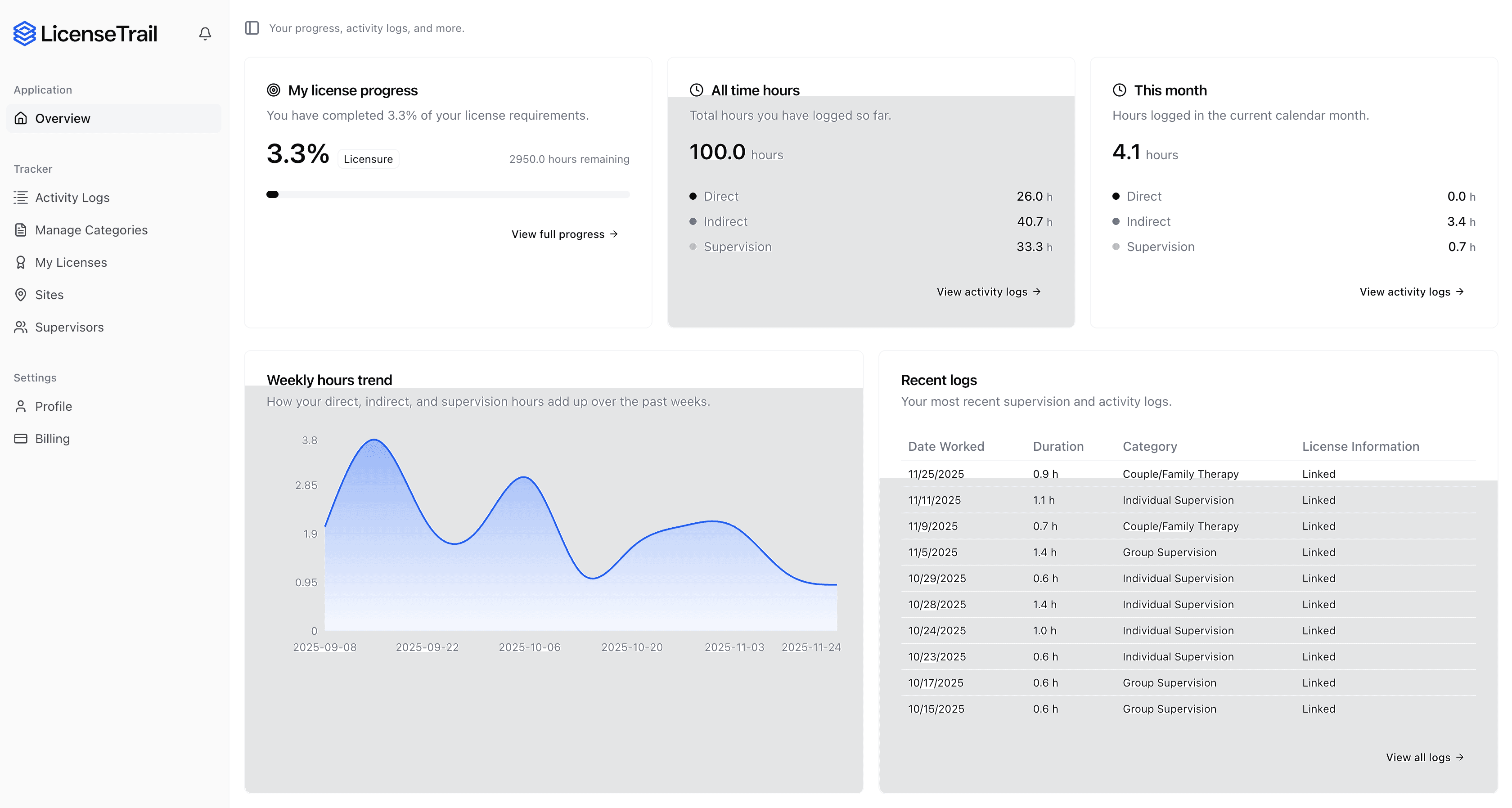
License Trail checks your direct, indirect, and supervision hours against Massachusetts LEP requirements continuously and flags mismatches before you submit.
 Start Tracking for Free
No credit card required · Free plan available
Is your spreadsheet hiding Massachusetts LEP risks?
Stop guessing if your categories match Massachusetts Board of Registration of Allied Mental Health and Human Services Professions requirements. License Trail checks your direct, indirect, and supervision hours continuously and flags mismatches before you submit.
Import or log
Bring your spreadsheet or start fresh
Upload your existing tracking spreadsheet and we'll map every hour into the right Massachusetts Board of Registration of Allied Mental Health and Human Services Professions categories automatically.
Verify against Massachusetts
Catch mismatches before the board does
License Trail checks your direct, indirect, and supervision hours against Massachusetts LEP requirements continuously.
Export board-ready
One-click clean reports
Generate professional, board-ready reports for supervision meetings and Massachusetts Board of Registration of Allied Mental Health and Human Services Professions submissions in seconds.
No credit card required · Free plan available