
Massachusetts LMHC Requirements: Hours, Exams & Step-by-Step Guide
Stop guessing if your categories match Massachusetts requirements. License Trail checks your direct, indirect, and supervision hours against LMHC requirements continuously and flags mismatches before you submit.
No credit card required · Free plan available
Quick Requirements Overview
- Education: Graduate program in Mental Health Counseling/Related Field totaling 60 semester credits (80 quarter) (rules differ by matriculation pre/post 7/1/2017).
- Pre‑master’s practicum: 40 direct client contact hours + 25 supervision hours (≥10 individual; ≥5 group); ≥7 weeks.
- Pre‑master’s internship: ≥600 clock hours including 240 direct client contact hours + 45 supervision hours (≥15 individual; ≥15 group).
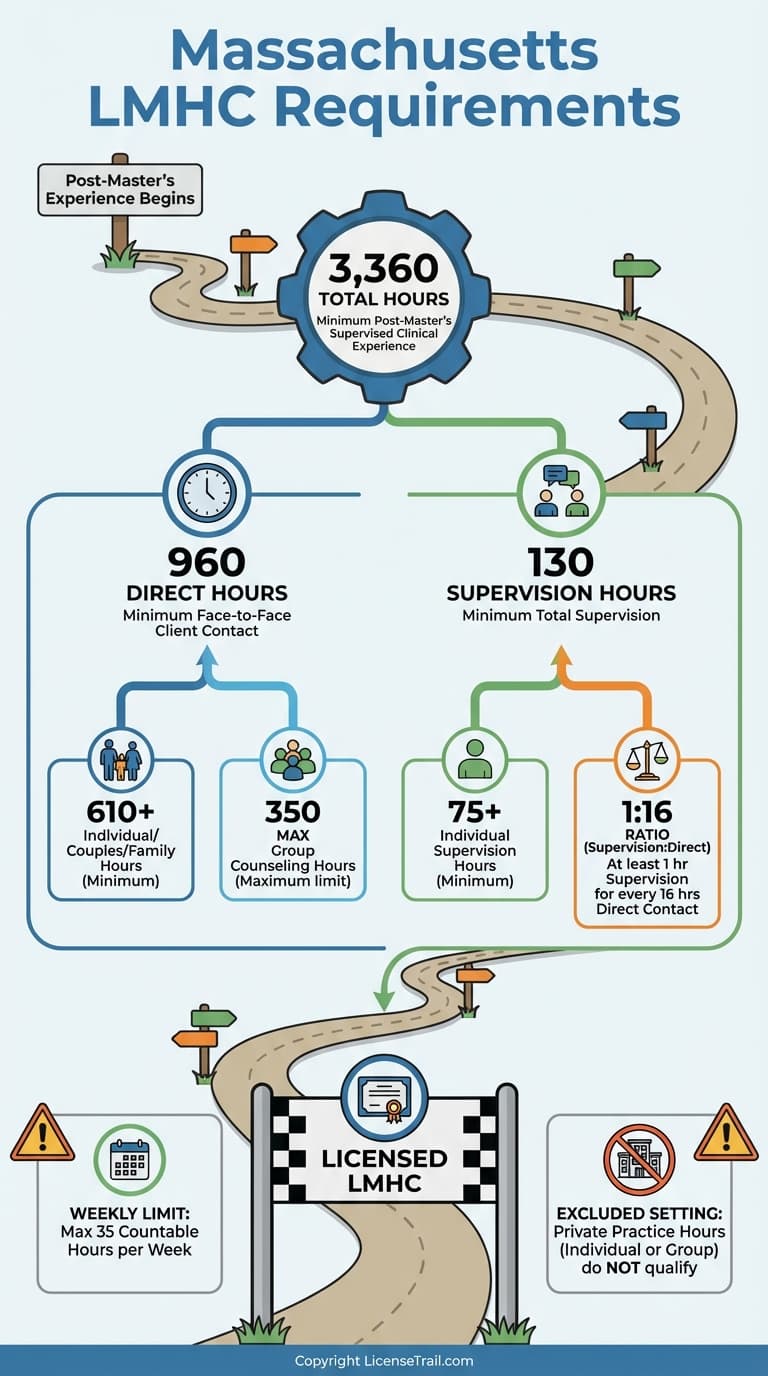
- Post‑master’s timeframe: Complete supervised experience in 2–8 years (full‑time defined as 35 hrs/wk for 48 wks/yr with ≥10 direct contact hrs/wk).
- Post‑master’s hours: 3,360 total hours including 960 direct client contact hours (≥610 individual/couple/family; ≤350 group).
- Supervision: ≥130 post‑master’s supervision hours (≥75 individual) and 1 supervision hour per 16 direct contact hours (part‑time: at least 1 supervision hour every 2 weeks).
- Total supervision (pre + post): 200 supervisory contact hours total; ≥50 (pre‑7/1/2017) or ≥75 (on/after 7/1/2017) must be provided by an LMHC (or equivalent).
- Exam/Application: Pass NCMHCE (score valid 5 years) and apply via MA Health Professions Licensing Portal with transcripts + verified field experience/supervision documentation.
License Details
Procedures
Licensure as a Licensed Mental Health Counselor (LMHC) in Massachusetts is governed primarily by 262 CMR 2.00, issued by the Board of Registration of Allied Mental Health and Human Services Professions. The Board looks at four main areas:
- Degree and coursework
- Pre‑master’s clinical field experience (practicum and internship)
- Post‑master’s supervised clinical field experience (the big block of hours)
- Examination and formal application to the Board
The sections below walk through each piece, with the Board’s own terminology and hour requirements highlighted.
1. Educational degree requirements
The Board distinguishes between applicants based on when they first matriculated into their degree program.
If you matriculated before July 1, 2017
Under 262 CMR 2.04, pre‑July 1, 2017 applicants must show:
- At least 60 semester credits of graduate‑level coursework in Mental Health Counseling or a Related Field,
- Including a minimum 48‑credit master’s degree.
If the master’s itself is under 48 credits, the applicant must also hold one of the following from a recognized institution: an advanced certificate, a second master’s, or a doctoral degree, on top of the original master’s. (regulations.justia.com)
If you matriculated on or after July 1, 2017
Under 262 CMR 2.05, post‑July 1, 2017 applicants must have either:
- A master’s degree in Mental Health Counseling or a Related Field with at least 60 semester credits (or 80 quarter credits) from an integrated, planned, comprehensive program, or (regulations.justia.com)
- A doctoral degree in Mental Health Counseling or a Related Field from such a program. (regulations.justia.com)
In both eras, the regulations go on to require specific “required course areas,” but the key point is that you must meet the appropriate 60‑credit (or equivalent) graduate degree standard with the required counseling‑specific content.
2. Key Board definitions that affect your hours
A few regulatory definitions shape exactly what “counts” toward your hours:
-
Direct Client Contact Experience is face‑to‑face clinical mental health counseling with individuals, couples, families, or groups at approved clinical field experience sites and must fall within the Board’s stated scope of mental health counseling. Activities like vocational guidance, academic school guidance counseling, industrial/organizational consulting, teaching, or research do not count as Direct Client Contact Experience. (regulations.justia.com)
-
A Contact Hour is a unit of Direct Client Contact Experience of at least 45 minutes, which can be made up of 15‑minute segments. (regulations.justia.com)
-
Supervised Clinical Field Experience means supervision by an approved supervisor while the supervisee is actually practicing clinical mental health counseling. (regulations.justia.com)
-
A Supervisory Contact Hour is at least 45 consecutive minutes of individual supervision, group supervision, or supervised clinical field experience. (regulations.justia.com)
-
Full Time clinical mental health counseling is defined as 35 hours per week for 48 weeks per year, and must include at least 10 Contact Hours per week of Direct Client Contact Experience. (regulations.justia.com)
These definitions are what your program directors and supervisors must use in certifying hours on your application.
3. Pre‑master’s clinical field experience (practicum + internship)
Under 262 CMR 2.06, all eligible applicants must complete both a practicum and an internship that together make up the pre‑master’s supervised clinical field experience. (regulations.justia.com)
3.1 Practicum requirements
The practicum must:
- Occur over at least seven weeks,
- Take place on campus or at a Clinical Field Experience Site, and
- Include both supervised clinical field experience and direct client contact.
Hour requirements for the practicum: (regulations.justia.com)
-
40 Contact Hours of Direct Client Contact Experience, which may be:
- At clinical field experience sites that fit the mental health counseling scope of practice, or
- Structured peer role‑plays and lab experiences in individual, group, couple, and family interactions.
-
25 Supervisory Contact Hours of supervision, broken down as:
- At least 10 hours of Individual Supervision
- At least 5 hours of Group Supervision (maximum 10 supervisees per group)
- The remaining 10 hours may be either individual or group supervision
3.2 Internship requirements
After the practicum, you must complete an internship (a “distinctly defined, post‑practicum, supervised curricular experience” totaling at least 600 clock hours). (regulations.justia.com)
Within that internship, the clinical and supervisory requirements are: (regulations.justia.com)
- 240 Contact Hours of Direct Client Contact Experience at Clinical Field Experience Sites within the mental health counseling scope of practice.
- 45 Supervisory Contact Hours of supervision, with:
- At least 15 hours of Individual Supervision
- At least 15 hours of Group Supervision (no more than 10 supervisees per group)
- The remaining 15 hours may be individual or group supervision
Together, the practicum and internship account for:
- 280 Contact Hours of Direct Client Contact Experience (40 + 240)
- 70 Supervisory Contact Hours (25 + 45)
The Board also requires that practicum/internship supervisees only see clients when an approved or contract supervisor is on site, or at minimum an emergency contact is present in the approved situations described in the regulation. (regulations.justia.com)
4. Post‑master’s supervised clinical field experience
This is the major block of hours many people think of as “post‑grad supervision” or “residency.” The Board uses precise terms and numbers in 262 CMR 2.07.
4.1 Overall time frame
You must complete your post‑master’s experience:
- In no less than two years, and
- In no more than eight years,
as full‑time or equivalent part‑time supervised clinical field experience with direct client contact. (regulations.justia.com)
4.2 Total post‑master’s hours and direct client contact hours
262 CMR 2.07(2) sets the minimum post‑master’s requirements as follows: (regulations.justia.com)
- 3,360 total hours of post‑master’s clinical field experience, which must include:
- 960 Contact Hours of Direct Client Contact Experience, of which:
- At least 610 Contact Hours must be in individual, couples, or family counseling, and
- No more than 350 Contact Hours may be in group counseling.
- 960 Contact Hours of Direct Client Contact Experience, of which:
In other words, the Board does not use a “1,500 direct / 1,500 supervised” formulation. Instead, for the post‑master’s period it uses:
- 3,360 total hours,
- With 960 of those hours being Direct Client Contact,
- And within those 960 direct hours, the mix must be heavily weighted toward individual/couple/family work (610 minimum) with a capped amount of group counseling (350 maximum).
4.3 Required supervision during post‑master’s hours
On top of the raw hour totals, you must meet explicit supervision requirements during the post‑master’s period. 262 CMR 2.07(3) requires: (regulations.justia.com)
- At least 130 total hours of supervision post‑master’s,
- Of which at least 75 hours must be Individual Supervision.
- A minimum ratio of 1 Supervisory Contact Hour for every 16 Contact Hours of Direct Client Contact Experience.
- For part‑time work, supervision must be pro‑rated but still at least one Supervisory Contact Hour every two weeks.
4.4 On‑site supervision and relationship to the site
The Board further requires that: (regulations.justia.com)
- You have a formal relationship with each Clinical Field Experience Site.
- Your supervisor be:
- A staff member of the site who is an Approved Supervisor, or
- A Contract Supervisor (an LMHC with at least three years of full‑time post‑licensure experience and a written supervision agreement) whose agreement is on file at the site. (regulations.justia.com)
- The site maintain annual evaluations of your performance completed by the approved or contract supervisor.
- An Emergency Contact be available at all sites; this does not replace the need for an Approved or Contract Supervisor. (regulations.justia.com)
5. Total supervision across pre‑ and post‑master’s training
Although the earlier sections spell out pre‑ and post‑master’s supervision separately, 262 CMR 2.08 explicitly references the “200 total Supervisory Contact Hours of supervision required (pre‑ or post‑Master’s degree)” and then sets a minimum share of those hours that must be provided by a Licensed Mental Health Counselor. (regulations.justia.com)
From the regulations:
- Practicum + internship supervision (pre‑master’s): 70 hours
- Post‑master’s supervision: at least 130 hours
- Total required supervision: 200 Supervisory Contact Hours, pre‑ and post‑master’s combined (this total is explicitly referenced in 262 CMR 2.08). (regulations.justia.com)
5.1 Minimum supervision specifically by an LMHC
Under 262 CMR 2.08: (regulations.justia.com)
-
For supervision received before July 1, 2017:
- At least 50 of the 200 total Supervisory Contact Hours must be provided by a Licensed Mental Health Counselor (LMHC) (or equivalent LMHC in another jurisdiction).
-
For supervision received on or after July 1, 2017:
- At least 75 of the 200 total Supervisory Contact Hours must be provided by an LMHC (or equivalent).
The rest of the 200 supervisory hours may be provided by other “Approved Supervisors” as defined in 262 CMR 2.02 (e.g., LICSW, LMFT, licensed psychologist with health service provider certification, psychiatrist, psychiatric NP, or equivalent out‑of‑state independently licensed mental health professional). (regulations.justia.com)
6. Examination requirement
All LMHC applicants must pass the Board’s designated examination:
- The National Clinical Mental Health Counseling Examination (NCMHCE), administered by the National Board for Certified Counselors (NBCC), is the required exam for LMHC licensure. (mass.gov)
According to the regulations, a passing exam score remains valid for five years from the date the exam was taken. (regulations.justia.com)
7. Formal application to the Massachusetts Board
Under 262 CMR 2.03, to apply for LMHC licensure you must submit to the Board: (regulations.justia.com)
- Completed LMHC application through the Health Professions Licensing Portal, using the Board’s own application form.
- Final official transcript(s) showing you have met the applicable degree and education requirements under 262 CMR 2.04 or 2.05.
- Evidence of completed clinical field experience, documenting that you met:
- Pre‑master’s practicum and internship requirements (262 CMR 2.06), and
- Post‑master’s clinical field experience and supervision requirements (262 CMR 2.07 and 2.08).
- Evidence of a passing score on the NCMHCE, within five years of the date of exam.
- If applying by reciprocal recognition (already licensed as LMHC or equivalent in another state), additional materials specified in 262 CMR 2.03(2) and the Board’s reciprocity policy (e.g., verification of license in good standing, proof of years of practice). (regulations.justia.com)
The Board’s Mass.gov “Apply for a license (Allied Mental Health and Human Services Professions)” page routes you to the online licensing portal and points to the LMHC‑specific application guides and forms. (mass.gov)
8. Putting the hour requirements into a single snapshot
Using the Board’s own categorizations and terms:
-
Pre‑master’s (Practicum + Internship) (regulations.justia.com)
- 40 Contact Hours of Direct Client Contact (practicum)
- 240 Contact Hours of Direct Client Contact (internship)
- 25 + 45 = 70 Supervisory Contact Hours total
-
Post‑master’s (Supervised Clinical Field Experience) (regulations.justia.com)
- 3,360 total hours
- Including 960 Contact Hours of Direct Client Contact, broken down as:
- ≥ 610 contact hours in individual, couples, or family counseling
- ≤ 350 contact hours in group counseling
- At least 130 Supervisory Contact Hours, including:
- ≥ 75 hours of Individual Supervision
- A supervision ratio of 1 hour of supervision per 16 Contact Hours of direct client work
-
Across pre‑ and post‑master’s combined (regulations.justia.com)
- 200 total Supervisory Contact Hours required
- Of those 200 total hours:
- At least 50 hours by an LMHC (or equivalent) if the supervision was before July 1, 2017, or
- At least 75 hours by an LMHC (or equivalent) if the supervision was on or after July 1, 2017.
In short, Massachusetts does not use a simple split like “1,500 hours of direct experience and 1,500 hours of supervised experience.” Instead, it specifies:
- A 3,360‑hour post‑master’s supervised clinical field experience, with
- 960 Contact Hours of strictly defined Direct Client Contact Experience and
- 200 Supervisory Contact Hours total across your graduate and post‑graduate training, with a significant portion of those supervision hours provided specifically by LMHCs.
Track your LMHC hours with confidence
License Trail checks your direct, indirect, and supervision hours against Massachusetts LMHC requirements continuously and flags mismatches before you submit.
 Start Tracking for Free
No credit card required · Free plan available
Is your spreadsheet hiding Massachusetts LMHC risks?
Stop guessing if your categories match Massachusetts Board of Registration of Allied Mental Health and Human Services Professions requirements. License Trail checks your direct, indirect, and supervision hours continuously and flags mismatches before you submit.
Import or log
Bring your spreadsheet or start fresh
Upload your existing tracking spreadsheet and we'll map every hour into the right Massachusetts Board of Registration of Allied Mental Health and Human Services Professions categories automatically.
Verify against Massachusetts
Catch mismatches before the board does
License Trail checks your direct, indirect, and supervision hours against Massachusetts LMHC requirements continuously.
Export board-ready
One-click clean reports
Generate professional, board-ready reports for supervision meetings and Massachusetts Board of Registration of Allied Mental Health and Human Services Professions submissions in seconds.
No credit card required · Free plan available