
Massachusetts LRC Requirements: Hours, Exams & Step-by-Step Guide
Stop guessing if your categories match Massachusetts requirements. License Trail checks your direct, indirect, and supervision hours against LRC requirements continuously and flags mismatches before you submit.
No credit card required · Free plan available
Quick Requirements Overview
- Protected title (MA): “Licensed Rehabilitation Counselor (LRC)” (and similar titles) may not be used/advertised without MA licensure.
- Degree: Master’s or doctorate in rehabilitation counseling or a Board‑approved related field from a recognized institution.
- Minimum education: 48 semester hours (or equivalent) total graduate study.
- Required coursework: One graduate course in each: job placement/development/vocational analysis; vocational assessment; vocational & affective counseling; rehab plan development; medical aspects of disabilities.
- Internship: Must be included in the graduate program (structured, supervised, with evaluations); no fixed hour minimum stated; up to ½ internship hours may credit toward post‑master’s experience (Board review).
- Post‑master’s experience: 2 years full‑time supervised clinical experience in rehabilitation counseling (or equivalent part‑time); full‑time defined as 35 hrs/wk, 48 wks/yr (~3,360 hrs over 2 years).
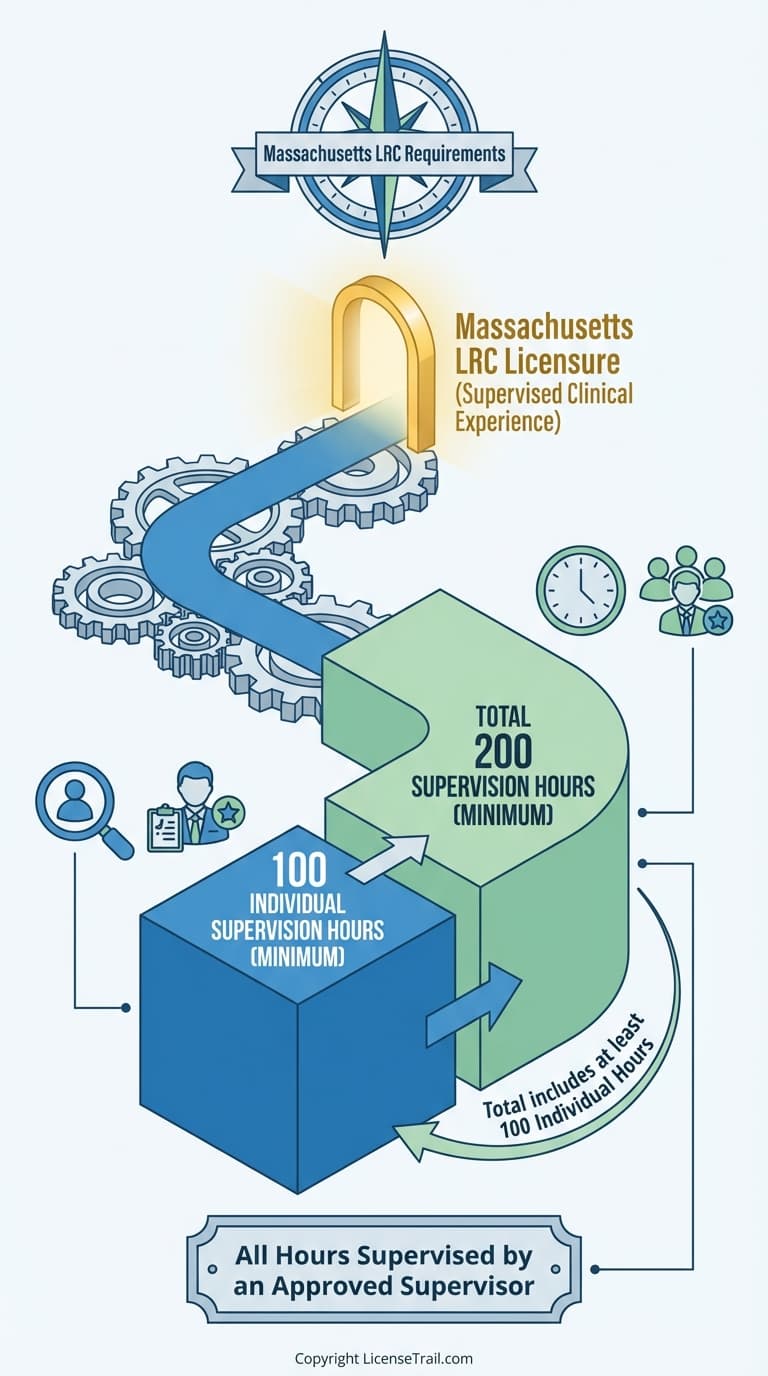
- Supervision requirement: 200 hours total supervision during clinical practice; ≥100 hours individual (remainder may be group; max 6 in group; no peer supervision).
- Exam: Pass the CRCC Certification Examination (CRC credential not required; current CRC in good standing may submit proof in lieu of score report).
License Details
Procedures
Licensure Requirements for Licensed Rehabilitation Counselors (LRC) in Massachusetts
Massachusetts regulates Licensed Rehabilitation Counselors (LRCs) through the Board of Registration of Allied Mental Health and Human Services Professions under Mass. Gen. Laws c. 112, §§163–172 and its regulations at 262 CMR 4.00. (mass.gov)
The title “licensed rehabilitation counselor” (often abbreviated LRC) is legally protected. No one may use that title (or similar titles like “licensed rehabilitation specialist” or “licensed rehabilitation advisor”) or represent themselves as a licensed allied mental health professional without a license under these sections. (mass.gov)
The Board does not divide requirements into something like “1,500 hours direct experience and 1,500 hours supervised experience.” Instead, the governing regulation 262 CMR 4.01 requires: (law.cornell.edu)
- A qualifying graduate degree and specific coursework
- An internship as part of the graduate program
- A minimum of two years full‑time post‑master’s supervised clinical experience in rehabilitation counseling (or equivalent part‑time)
- A supervised clinical experience consisting of at least 200 hours of supervision, with at least 100 hours of individual supervision
- Passing the licensure examination (the CRCC Certification Examination)
Below is a step‑by‑step guide, with the Board’s own terminology and how the “hours” actually work.
1. Understand what counts as “rehabilitation counseling”
State law defines both the role and the protected title: (malegislature.gov)
- “Licensed rehabilitation counselor” – “a person licensed or eligible for licensure under section one hundred and sixty‑five.”
- “Practice of rehabilitation counseling” – the rendering of professional services for compensation that apply “principles, methods and techniques of the rehabilitation counseling profession such as client assessment, job analysis, vocational assessment, counseling and job development” to maximize or restore the capacities of individuals with physical or mental disabilities for self‑sufficiency and independent living (including vocational and social functioning), and to create conditions favorable to that goal.
This definition is important because your clinical hours must be in rehabilitation counseling, not just any counseling.
2. Meet the graduate degree requirement
Degree type and institution
262 CMR 4.01(3)(a) requires: (law.cornell.edu)
- A Master’s or Doctoral Degree in Rehabilitation Counseling or a Related Field from a Recognized Educational Institution.
The regulation defines: (law.cornell.edu)
- Recognized Educational Institution – an institution licensed in its state that meets national standards for granting a master’s or doctoral degree (including approval by the U.S. Department of Education).
- Related Field – “counselor education, psychology, counseling psychology, education with a concentration in counseling or psychology, or other field determined by the Board to be a related field.”
Minimum credit hours and internship
The graduate program must: (law.cornell.edu)
- Include at least 48 semester hours of graduate study (or the equivalent) in total; and
- Include an internship as part of the program.
If your degree is under 48 semester hours, or it did not include required courses or an internship, the Board allows you to make up missing coursework or internship outside the degree and submit evidence so the Board can determine if overall requirements are met. (law.cornell.edu)
Required graduate-level courses
You must complete one graduate-level course in each of five specific content areas (each course must be a standard 3‑credit semester or 4‑credit quarter graduate course). (law.cornell.edu)
The regulation lists these areas as:
- Job Placement / Development / Vocational Analysis / Transferable Skill Development
- Vocational Assessment and Evaluation
- Vocational and Affective Counseling
- Rehabilitation Plan Development
- Medical Aspects of Disabilities
3. Complete an internship (as defined by the Board)
The Board defines Internship in 262 CMR 4.01(2): (law.cornell.edu)
- A post‑practicum, supervised curricular experience designed to refine basic rehabilitation counseling skills and develop more advanced skills;
- It must have a clearly defined program and schedule of services and duties, with written evaluations of the intern and an evaluation of the internship by the intern.
The regulation does not assign a specific numeric hour requirement to the internship itself; instead, it requires that an internship be included in the graduate program and be a structured, supervised clinical experience in rehabilitation counseling. (law.cornell.edu)
However, internship hours can later be partially credited toward the post‑master’s clinical experience requirement (see section 4).
4. Post‑master’s supervised clinical experience (your main “hours” requirement)
How many hours of clinical work?
262 CMR 4.01(3)(c) states that an applicant must complete: (law.cornell.edu)
“A minimum of two years full‑time, post‑master’s degree supervised clinical experience or equivalent part‑time, work experience in rehabilitation counseling in a clinic or hospital licensed by the Department of Mental Health or accredited by the Joint Commission on Accreditation of Hospitals or in an equivalent center or institute, or under the direction of an approved supervisor.”
The regulation defines Full Time as: (law.cornell.edu)
“35 hours per week / 48 weeks per year.”
Using the Board’s own definition, two years full‑time equals approximately:
- 35 hours/week × 48 weeks/year × 2 years
- = 3,360 hours of post‑master’s supervised clinical work in rehabilitation counseling.
This 3,360‑hour figure is not written as a number in the regulation itself; it is derived directly from the Board’s definition of “Full Time” and “two years full‑time.” (law.cornell.edu)
Type of experience and setting
The Board requires that this clinical experience: (law.cornell.edu)
- Be in rehabilitation counseling (as defined in statute – assessment, job analysis, vocational assessment, counseling, job development, etc., aimed at maximizing or restoring functioning of individuals with disabilities); (malegislature.gov)
- Occur in one of the following types of settings:
- A clinic or hospital licensed by the Massachusetts Department of Mental Health;
- A clinic or hospital accredited by the Joint Commission on Accreditation of Hospitals;
- An equivalent center or institute; or
- Under the direction of an approved supervisor in an appropriate rehabilitation counseling setting. (law.cornell.edu)
The regulation does not break these 3,360 hours into “direct client contact hours” versus “indirect hours” (such as paperwork or meetings). It simply requires supervised clinical experience in rehabilitation counseling for that full‑time equivalent period.
How much of your internship can count toward these hours?
The same subsection provides that: (law.cornell.edu)
Applicants who completed a qualifying 48‑semester‑hour master’s that included an internship “may be credited a maximum of ½ of the total number of hours of the internship experience toward the clinical experience requirement.”
So if your internship was, for example, 600 hours, up to 300 hours could be counted toward the 3,360 or equivalent. The Board has discretion to determine the exact credit based on documentation.
5. Supervised Clinical Experience – the required supervision hours
Separate from the overall clinical work hours, the Board defines a Supervised Clinical Experience as a specific block of supervision hours: (law.cornell.edu)
“A minimum total of 200 hours of group and individual supervision in the clinical practice of rehabilitation counseling by an approved supervisor. A minimum of 100 hours of the required minimum 200 hours of supervision must be individual supervision.”
Key points:
- These 200 hours are supervision hours, not additional clinical work hours.
- They must occur while you are actually engaged in the clinical practice of rehabilitation counseling.
- At least 100 of the 200 hours must be one‑to‑one (or one‑to‑two) individual supervision; the remainder can be group supervision. (law.cornell.edu)
The regulation further defines:
- Individual Supervision – a meeting of not more than one or two rehabilitation professionals with an approved supervisor for at least one hour.
- Group Supervision – a regularly scheduled meeting of no more than six rehabilitation professionals with an approved supervisor for at least one hour; “peer” supervision is explicitly not qualifying. (law.cornell.edu)
In everyday terms, the Board’s structure is:
- About 3,360 hours of supervised clinical rehabilitation counseling work (over at least two years full‑time or equivalent part‑time),
- Within which you must log at least 200 hours of formal supervision, including 100 hours or more of individual supervision.
Again, the Board does not label these as “1,500 direct” + “1,500 supervised” or similar; the controlling language is “two years full‑time … supervised clinical experience” and “a minimum total of 200 hours of group and individual supervision.”
6. Who qualifies as an “approved supervisor”?
Because all of your qualifying supervision and much of your clinical work must be under an approved supervisor, the definition in 262 CMR 4.01(2) is critical. An Approved Supervisor is: (law.cornell.edu)
- (a) A rehabilitation counselor currently certified as a CRC by the Commission on Rehabilitation Counselor Certification (CRCC); or
- (b) A currently licensed rehabilitation counselor (LRC), or an individual who meets the Board’s qualifications for licensure as a rehabilitation counselor; or
- (c) A person with at least five years of clinical experience in rehabilitation counseling and either:
- a master’s degree in rehabilitation counseling or a related field,
- a doctorate in psychology, or
- a medical degree with a subspecialization in psychiatry.
You must ensure that all supervision hours you count toward the 200‑hour Supervised Clinical Experience and toward your clinical experience requirement were provided by such an approved supervisor.
7. Licensure examination requirement
The Board’s regulation specifies the examination directly: (law.cornell.edu)
- The licensure examination for rehabilitation counselors is the CRCC Certification Examination (the same exam used for the Certified Rehabilitation Counselor credential).
- The regulation states that the CRC credential itself is not required for licensure; the exam is used as the licensing exam.
- If the applicant is currently a CRC in good standing, a copy of the CRCC membership certificate may be submitted in lieu of an examination score report.
The exam is administered twice per year by CRCC; the Board directs applicants to CRCC for details about sites, dates, and fees.
8. Ethics and ongoing professional standards
Once licensed, LRCs must comply with both state regulations and designated professional ethics codes. 262 CMR 8.01 adopts as official guides, for Licensed Rehabilitation Counselors: (law.cornell.edu)
- The Code of Professional Ethics for Rehabilitation Counselors of the CRCC; and
- The Certification of Disability Management Specialists Commission Code of Professional Conduct.
These apply “except as such codes deviate in any way” from Massachusetts regulations or statutes—in which case state law controls.
9. Protected title and scope of practice
Finally, note that: (mass.gov)
- No one may advertise, use the title, or hold themselves out as a “licensed rehabilitation counselor” (or similar) without being licensed or exempt under the statute.
- Individuals who are not licensed may still practice as counselors or therapists generally, but may not represent themselves as licensed allied mental health professionals (including LRCs).
10. Practical summary of the hour‑based requirements
Putting the Board’s language into an hour‑based snapshot:
-
Graduate internship
- Must be included in your degree program and meet the Board’s definition of internship.
- No fixed hour number in the regulation, but up to one‑half of your internship hours may count toward the post‑master’s clinical experience if your master’s was at least 48 credits and included the internship. (law.cornell.edu)
-
Post‑master’s clinical experience
- “A minimum of two years full‑time … supervised clinical experience” in rehabilitation counseling (or equivalent part‑time).
- Full‑time is defined as 35 hours/week × 48 weeks/year.
- This works out to approximately 3,360 hours of supervised clinical rehabilitation counseling work. (law.cornell.edu)
-
Supervision hours (“Supervised Clinical Experience”)
- At least 200 hours of group and individual supervision in the clinical practice of rehabilitation counseling by an approved supervisor.
- Of these, at least 100 hours must be individual supervision (1–2 supervisees per supervisor, at least 1 hour per session). (law.cornell.edu)
Massachusetts’ Board therefore structures LRC licensure around time‑in‑practice (two years full‑time / ~3,360 hours) plus intensive supervision (200 hours, half of which must be individual), rather than splitting requirements into separate direct vs supervised hour buckets.
Track your LRC hours with confidence
License Trail checks your direct, indirect, and supervision hours against Massachusetts LRC requirements continuously and flags mismatches before you submit.
 Start Tracking for Free
No credit card required · Free plan available
Is your spreadsheet hiding Massachusetts LRC risks?
Stop guessing if your categories match Massachusetts Board of Registration of Allied Mental Health and Human Services Professions requirements. License Trail checks your direct, indirect, and supervision hours continuously and flags mismatches before you submit.
Import or log
Bring your spreadsheet or start fresh
Upload your existing tracking spreadsheet and we'll map every hour into the right Massachusetts Board of Registration of Allied Mental Health and Human Services Professions categories automatically.
Verify against Massachusetts
Catch mismatches before the board does
License Trail checks your direct, indirect, and supervision hours against Massachusetts LRC requirements continuously.
Export board-ready
One-click clean reports
Generate professional, board-ready reports for supervision meetings and Massachusetts Board of Registration of Allied Mental Health and Human Services Professions submissions in seconds.
No credit card required · Free plan available