
Massachusetts LMFT Requirements: Hours, Exams & Step-by-Step Guide
Stop guessing if your categories match Massachusetts requirements. License Trail checks your direct, indirect, and supervision hours against LMFT requirements continuously and flags mismatches before you submit.
No credit card required · Free plan available
Quick Requirements Overview
- Eligibility routes: AAMFT Clinical Member route or standard route (degree + practicum + post‑master’s experience)
- Degree: Master’s/doctoral in MFT or related field; 60 semester credits total (or add grad coursework to reach 60)
- Coursework (within 60 credits): 3 courses each in Marital & Family Studies, MFT, Human Development (incl. psychopathology); 1 course Professional Studies; 1 course Research; plus clinical practicum/internship
- Pre‑degree practicum/internship: 300 direct client hours + 100 supervision hours (≥50 individual; ≥25 direct observation/recording review)
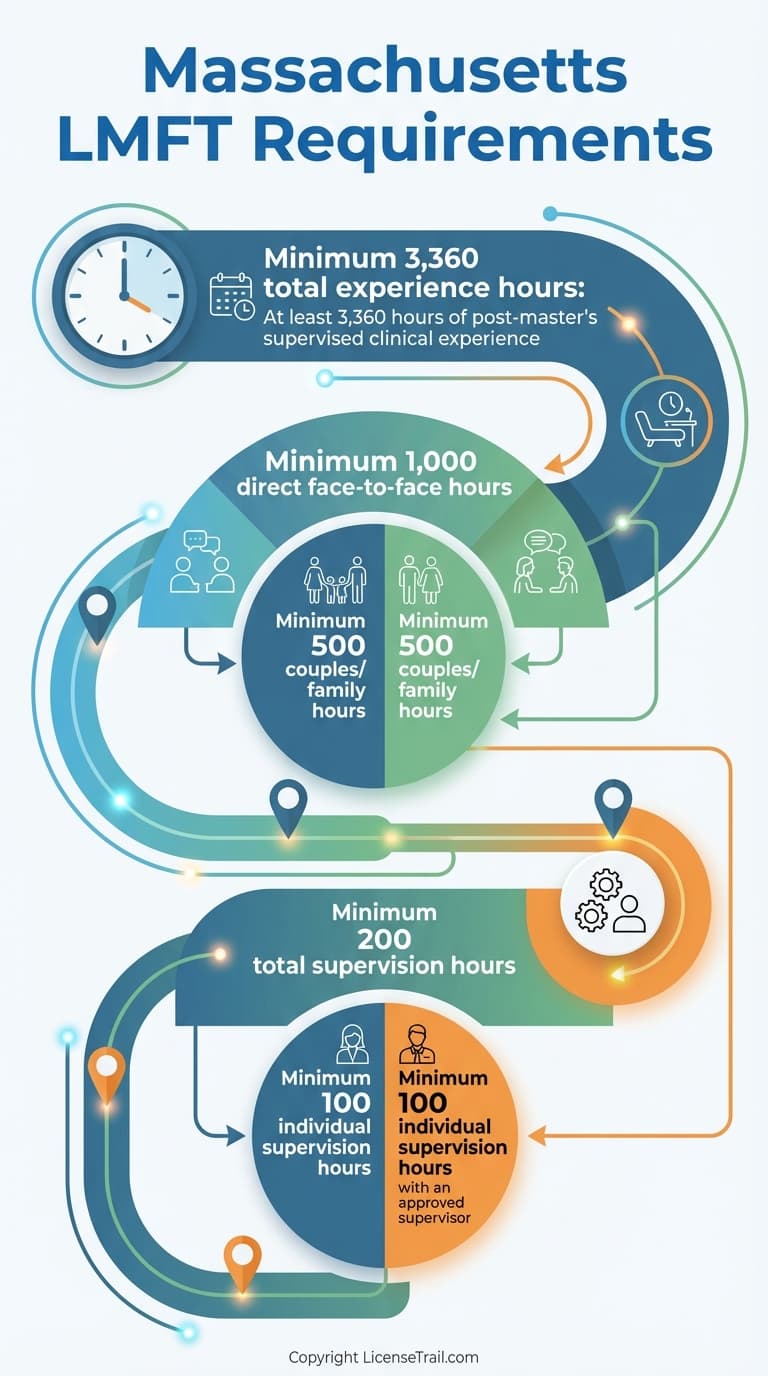
- Post‑master’s experience: 3,360 hours (2 years FTE equivalent) in approved settings/under Approved Supervisor; private practice alone not acceptable
- Post‑master’s client contact: 1,000 face‑to‑face hours, including ≥500 with couples/families
- Post‑master’s supervision: 200 hours supervision by Approved Supervisor (≥100 individual)
- Exam: Pass the AMFTRB national MFT licensure exam
License Details
Procedures
In Massachusetts, licensure as a Licensed Marriage and Family Therapist (LMFT) is governed by 262 CMR 3.00, issued by the Board of Registration of Allied Mental Health and Human Services Professions under M.G.L. c. 112, §§163–172. (mass.gov)
The Board recognizes two main eligibility routes under 262 CMR 3.03:
- Clinical Member of the American Association for Marriage and Family Therapy (AAMFT), or
- Standard path based on a qualifying degree plus specific practicum and post‑master’s supervised clinical experience. (law.cornell.edu)
The details below focus on the standard path, since this is where the specific hour requirements are defined.
1. Educational Foundation
1.1 Degree level and total credit hours
Under 262 CMR 3.03(2), an LMFT applicant must hold a master’s or doctoral degree in marriage and family therapy or a related field from a “recognized educational institution.” (law.cornell.edu)
- If the qualifying degree was completed after July 1, 1999, the graduate program must be at least 60 semester hours.
- If the degree program itself was under 60 credits, the applicant must document additional graduate coursework that brings the total to a minimum of 60 semester hours, including required content areas and practicum/internship. (law.cornell.edu)
“Recognized educational institution” and “related field” are defined in 262 CMR 3.02; related fields include disciplines such as psychology, social work, counselor education, theology, law, medicine, and others the Board deems related. (law.cornell.edu)
1.2 Required content areas (coursework)
262 CMR 3.03(2)(b) specifies that the 60-credit program must include the following graduate‑level coursework: (law.cornell.edu)
-
Three graduate courses in each of these three areas (9 courses total):
- Marital and Family Studies (e.g., family life cycle, families under stress, family in social and cross‑cultural context).
- Marital and Family Therapy (e.g., family therapy methods, family assessment, major clinical theories of marital and family therapy).
- Human Development (e.g., human development, personality theory, human sexuality, psychopathology). At least one course must specifically be psychopathology or its equivalent.
-
One graduate course in each of these two areas (2 courses total):
4. Professional Studies (e.g., professional roles, legal responsibilities and liabilities, ethics, family law).
5. Research (e.g., research design, methods, statistics, research related to marital and family studies/therapy). -
A “clinical internship or practicum” in marriage and family therapy, as further defined in 262 CMR 3.02.
2. Required Clinical Internship or Practicum (Pre‑degree)
The Board uses the specific term “Clinical Internship or Practicum” and defines it in 262 CMR 3.02. (law.cornell.edu)
For the internship/practicum to count toward LMFT licensure, it must include at least:
- 300 hours of direct / face‑to‑face client contact
- Clients may be individuals, family groups, couples, groups, or organizations (public or private).
- 100 face‑to‑face hours of supervision with an approved supervisor, of which:
- At least 50 hours must be individual supervision, and
- At least 25 hours must consist of supervision based on direct observation or review of audio/video recordings of the applicant’s clinical work.
Key Board terms:
- “Clinical Internship or Practicum” – the pre‑degree supervised MFT internship that is part of the master’s or doctoral program.
- “Direct/face‑to‑face client contact” – the client hours required for this internship/practicum.
- “Approved Supervisor” – defined in detail in 262 CMR 3.02 and includes either:
- A marriage and family therapist formally designated as an Approved Supervisor by AAMFT; or
- Certain licensed mental health professionals (e.g., LMFT, LMHC, psychologist, psychiatrist) with specified supervisory experience or roles, and appropriate graduate degrees. (law.cornell.edu)
COVID‑era flexibility (time‑limited)
For LMFT applicants who graduated between March 10, 2020 and September 30, 2022, the Board adopted a policy allowing incomplete pre‑master’s “clinical internship or practicum” hours to be finished using additional hours from acceptable post‑graduate work experience, without changing the total required amounts or hour types. (mass.gov)
3. Post‑Master’s Supervised Clinical Experience
After the degree and clinical internship/practicum are completed, 262 CMR 3.03(3) imposes a “Two Year Experience Requirement.” This is where Massachusetts specifies the major hour counts.
3.1 Total post‑master’s experience hours
The regulation requires: (law.cornell.edu)
- “A minimum of two years full‑time, or equivalent part‑time (3360 hours), post‑masters supervised clinical experience” in marriage and family therapy.
Definitions and structure:
- Full‑time is defined as 35 hours per week for 48 weeks per year, and must include at least 10 hours per week of clinical work with individuals, couples, families, groups, or organizations. (law.cornell.edu)
- The 3,360 hours can be accrued part‑time as long as the total hours and content requirements are met.
These hours must be completed:
- In a clinic or hospital licensed by the Massachusetts Department of Mental Health,
- Or in a facility accredited by the Joint Commission on Accreditation of Health Care Organizations (JCAHO) or an equivalent center/institute,
- Or under the direction of an Approved Supervisor as defined in 262 CMR 3.02.
- Private practice settings, standing alone, are explicitly not acceptable as the setting for this required post‑master’s supervised clinical experience. (law.cornell.edu)
3.2 Required client contact within those 3,360 hours
Within the 3,360 total hours, the Board further requires:
- At least 1,000 hours of post‑master’s face‑to‑face clinical contact with individuals, family groups, couples, groups, or organizations (public or private),
- At least 500 of those 1,000 hours must be face‑to‑face clinical contact with couples and families, all under the direction of an Approved Supervisor. (law.cornell.edu)
So in Board language, Massachusetts does not divide the requirement into “1,500 hours of direct experience and 1,500 hours of supervised experience.” Instead, it requires:
- 3,360 total hours of post‑master’s supervised clinical experience, which must include
- 1,000 face‑to‑face client hours, of which
- 500 face‑to‑face hours are specifically with couples and families.
All of this experience must be supervised in the manner described below.
3.3 Required supervision within those 3,360 hours
The Board uses the defined term “Supervised Clinical Experience (Post‑degree)” and specifies that the post‑master’s work must include: (law.cornell.edu)
- At least 200 hours of supervision in the clinical practice of marriage and family therapy with an Approved Supervisor.
- At least 100 of those 200 hours must be individual supervision.
Supervision terms in 262 CMR 3.02: (law.cornell.edu)
- “Individual Supervision” – a regularly scheduled MFT supervision meeting of no more than two practitioners with an Approved Supervisor, lasting at least one hour.
- “Group Supervision” – a regularly scheduled MFT supervision meeting of no more than six practitioners plus an Approved Supervisor, lasting at least 1.5 hours. Peer supervision alone does not count toward required supervision.
4. Examination Requirement
Both the AAMFT‑membership route and the standard route require a passing score on the national MFT licensing exam.
262 CMR 3.02 defines the “Licensure Examination” as the “Examination in Marital and Family Therapy” developed by the Association of Marital and Family Therapy Regulatory Boards (AMFTRB). The Board or its agent administers this exam, and applicants must achieve a passing score under 262 CMR 3.03(1)(b) or 3.03(4). (law.cornell.edu)
5. AAMFT Clinical Member Route
262 CMR 3.03(1) provides an alternative eligibility category: “Clinical Member of the AAMFT.” (law.cornell.edu)
Under this option, an applicant may be eligible for licensure by:
- Demonstrating that they are currently a clinical member in good standing with the American Association for Marriage and Family Therapy (AAMFT), and
- Showing that they have achieved a passing score on the national licensing examination (or its equivalent).
Because AAMFT clinical membership itself requires substantial supervised MFT experience under qualified supervision, the Board accepts this as satisfying its specific supervised‑experience structure, but still evaluates each application for compliance.
6. Reciprocity for LMFTs Licensed in Other Jurisdictions
The Board has a Reciprocity Standards policy for LMFTs (and LMHCs) licensed elsewhere. To obtain a Massachusetts LMFT license through reciprocity, an applicant generally must provide: (mass.gov)
- A complete Board application for licensure;
- A final transcript showing that their degree and education meet Massachusetts requirements;
- Evidence of a passing score on the relevant national exam; and
- License verification from another jurisdiction showing at least three years of licensure in good standing before applying.
This policy is in addition to, and interpreted consistent with, 262 CMR 3.03 and 3.04 (Reciprocity).
7. Teletherapy and Remote Supervision Policy (Time‑Limited)
In response to changes in practice modalities, the Board adopted a policy accepting certain teletherapy and remote supervision hours toward experience requirements.
- For applicants across all license types, teletherapy client sessions and supervision conducted by video or telephone between September 1, 2021 and September 30, 2023 can count toward required experience hours and Direct Client Contact Experience or supervision requirements. (mass.gov)
This policy does not change the total numbers or categories of hours required by 262 CMR 3.02 and 3.03; it only clarifies that qualifying telehealth hours can be used during the listed dates.
8. Snapshot: Core Hour Requirements for LMFT in Massachusetts
Putting the Board’s terminology and numbers together, the core experiential requirements are:
Pre‑degree (as part of the MFT program): (law.cornell.edu)
- Clinical Internship or Practicum
- 300 hours minimum of direct/face‑to‑face client contact.
- 100 hours of face‑to‑face supervision, including:
- 50 hours minimum of individual supervision; and
- 25 hours minimum of supervision based on direct observation or recorded sessions.
Post‑master’s (after the degree): (law.cornell.edu)
- Two Year Experience Requirement
- 3,360 hours total of post‑master’s supervised clinical experience in approved settings.
- Within those 3,360 hours:
- 1,000 hours minimum of post‑master’s face‑to‑face client contact, and
- 500 hours minimum of those 1,000 hours must be face‑to‑face with couples and families.
- 200 hours total of supervision in MFT practice by an Approved Supervisor, including:
- 100 hours minimum of individual supervision.
Plus:
- Completion of a qualifying degree program (60 semester hours with specified coursework and practicum), and
- A passing score on the AMFTRB national MFT licensure examination. (law.cornell.edu)
9. Note on Possible Future Amendments
As of the latest published versions (current through Register 1550, June 20, 2025), the requirements summarized above are in effect. (regulations.justia.com)
The Board has noticed a public hearing on amendments to 262 CMR 3.00 that could further clarify LMFT eligibility criteria, so anyone currently planning licensure should confirm whether any amendments have taken effect after that date by checking the official 262 CMR 3.00 text on Mass.gov or the current Massachusetts Register. (sec.state.ma.us)
Track your LMFT hours with confidence
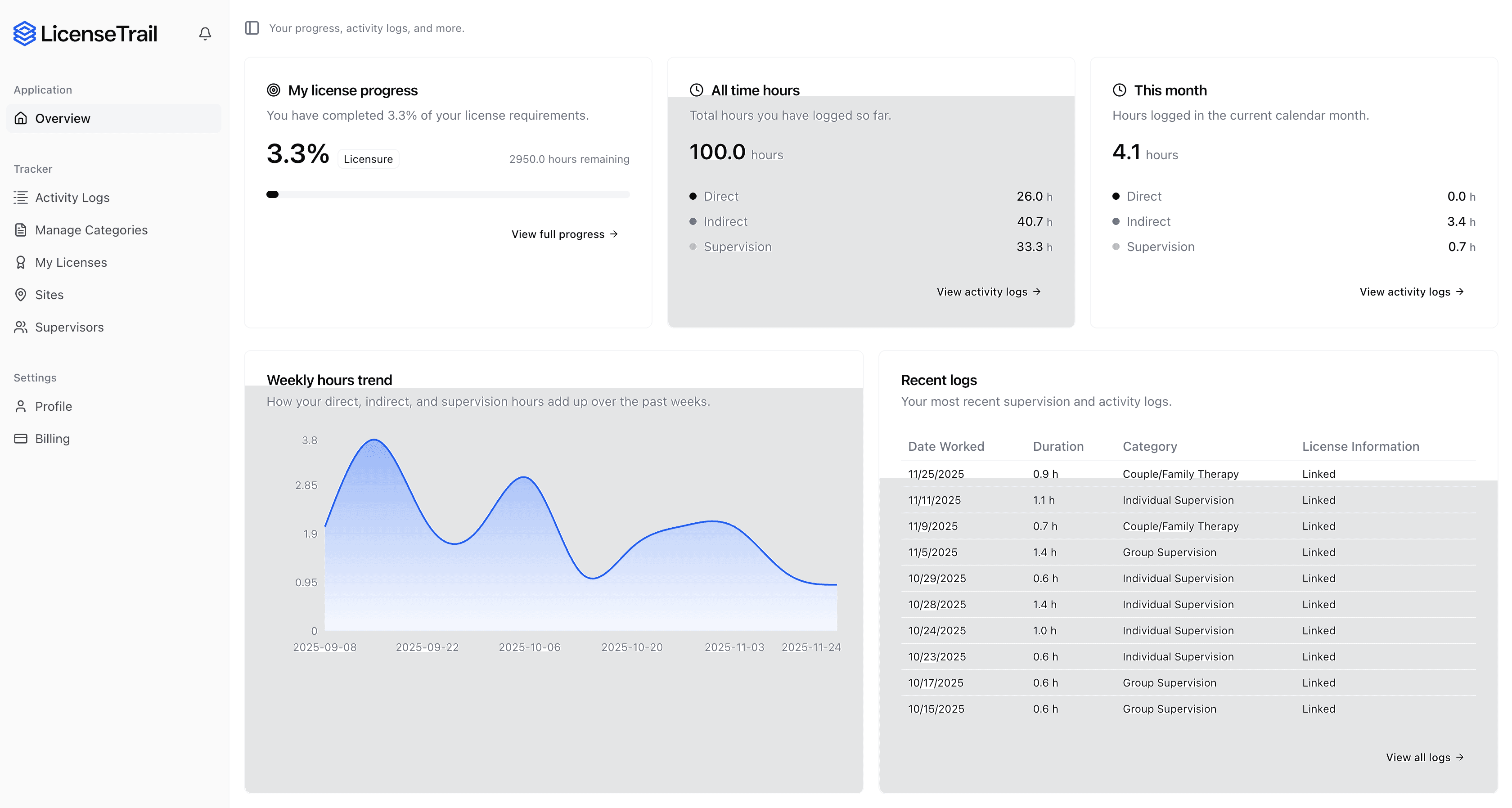
License Trail checks your direct, indirect, and supervision hours against Massachusetts LMFT requirements continuously and flags mismatches before you submit.
 Start Tracking for Free
No credit card required · Free plan available
Is your spreadsheet hiding Massachusetts LMFT risks?
Stop guessing if your categories match Massachusetts Board of Registration of Allied Mental Health and Human Services Professions requirements. License Trail checks your direct, indirect, and supervision hours continuously and flags mismatches before you submit.
Import or log
Bring your spreadsheet or start fresh
Upload your existing tracking spreadsheet and we'll map every hour into the right Massachusetts Board of Registration of Allied Mental Health and Human Services Professions categories automatically.
Verify against Massachusetts
Catch mismatches before the board does
License Trail checks your direct, indirect, and supervision hours against Massachusetts LMFT requirements continuously.
Export board-ready
One-click clean reports
Generate professional, board-ready reports for supervision meetings and Massachusetts Board of Registration of Allied Mental Health and Human Services Professions submissions in seconds.
No credit card required · Free plan available