
Montana CBHPSS Requirements: Hours, Exams & Step-by-Step Guide
Stop guessing if your categories match Montana requirements. License Trail checks your direct, indirect, and supervision hours against CBHPSS requirements continuously and flags mismatches before you submit.
No credit card required · Free plan available
Quick Requirements Overview
- License required to practice peer support in MT (CBHPSS regulated by MT Board of Behavioral Health; MCA 37-39 / ARM 24.219).
- Eligibility: behavioral health disorder diagnosis by a mental health professional + received treatment + “in recovery” per board rule.
- Recovery screen: must meet 2-year criteria before applying (no incarceration; no BH hospitalization/inpatient stay >72 hours; if chemical dependency, 2 years sustained remission).
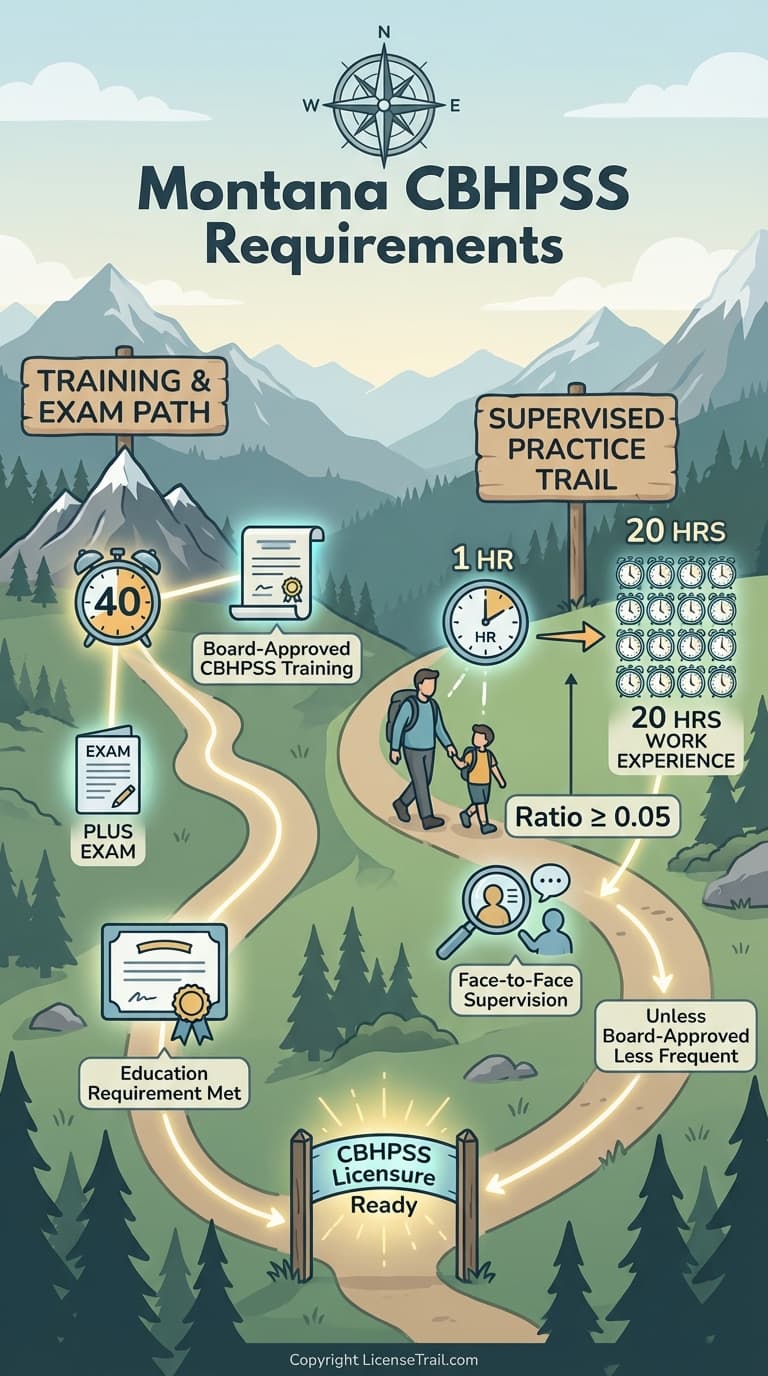
- Training: complete 40 hours of board-approved peer support training + pass the associated exam.
- Supervision: must have a qualified supervisor; minimum 1 hour face-to-face supervision/consultation per 20 hours worked (no more than 40 work hours without required supervision unless Board approves).
- Supervisor qualifications: licensed mental health professional in good standing; typically licensed ≥3 years or supervision coursework/20 hours supervision training.
- Recordkeeping: maintain supervision records; retain for 7 years after a supervisor stops supervising.
- No fixed pre-licensure “1,000 hours” (or other total) supervised work-experience requirement currently in MCA/ARM/checklist.
License Details
Procedures
Licensure requirements for a Certified Behavioral Health Peer Support Specialist (CBHPSS) in Montana are set primarily by:
- Montana Code Annotated (MCA), Title 37, Chapter 39 (Behavioral Health)
- Administrative Rules of Montana (ARM), Title 24, Chapter 219 (Board of Behavioral Health)
- The Board of Behavioral Health’s licensure checklist and CBHPSS information page (boards.bsd.dli.mt.gov)
Below is a structured guide that tracks those sources closely and highlights every place where specific hours are required.
1. What the license is and who regulates it
Montana treats behavioral health peer support as a regulated behavioral health profession, alongside social work, counseling, marriage and family therapy, and addiction counseling. (law.justia.com)
For peer support:
- You may not practice peer support in Montana unless you are licensed under Title 37, chapter 1 and chapter 39. (law.justia.com)
- The specific peer support license is the Certified Behavioral Health Peer Support Specialist (CBHPSS). (boards.bsd.dli.mt.gov)
2. Core eligibility: lived experience and recovery
2.1 Statutory behavioral‑health criteria
To qualify for a peer support specialist license under MCA 37‑39‑312, an applicant must: (law.justia.com)
-
Have a diagnosis from a mental health professional of a behavioral health disorder.
- “Behavioral health disorder” is defined in rule as either a mental disorder (under Montana’s mental health statute) or chemical dependency (under the chemical dependency statute). (law.justia.com)
-
Have received treatment for that diagnosed behavioral health disorder.
-
Be “in recovery” as defined by board rule from that behavioral health disorder.
-
Have successfully completed an approved program in behavioral peer support, including an ethics component, as defined by board rule. (law.justia.com)
2.2 Board rule definition of “in recovery”
The Board defines “recovery” for CBHPSS in ARM 24.219.301(22). In compressed form, recovery means: (regulations.justia.com)
- A process of change in which individuals improve health and wellness, live a self‑directed life, and strive to reach their potential; and
- For two years immediately before application:
- No incarceration at all;
- No hospitalization or inpatient admission related to a behavioral health disorder lasting more than 72 hours; and
- If there is a diagnosed chemical dependency, at least two years of “sustained remission” (as defined in the DSM), meaning no symptoms other than a strong desire or urge to drink.
The Board’s licensure checklist restates this practically as a requirement that, over the last two years, you have had no incarceration, no hospitalization longer than 72 hours for the disorder, and **no chemical‑dependency symptoms except craving for alcohol. (boards.bsd.dli.mt.gov)
This recovery definition functions as an eligibility screen; if you do not meet it, you cannot be licensed as a CBHPSS.
3. Required training hours and curriculum
3.1 Minimum training hours
The Board of Behavioral Health’s CBHPSS page states that all CBHPSS must complete 40 hours of board‑approved training to meet the minimum education requirement. (boards.bsd.dli.mt.gov)
The CBHPSS checklist further specifies:
- “Peer support training: 40 hours plus an exam.” (boards.bsd.dli.mt.gov)
In other words:
Training hours requirement for initial licensure:
40 hours of board‑approved behavioral health peer support training, plus passing the associated exam.
There is no additional state‑mandated “direct-service hours” requirement for initial licensure beyond these 40 training hours (see section 6 below on the often‑cited “1,000 hours”).
3.2 Content of the training (verbiage from ARM)
ARM 24.219.912 requires that a board‑approved CBHPSS training course: (regulations.justia.com)
- Must include an examination that must be passed; and
- Must cover content including SAMHSA core peer competencies, boundaries and ethics, confidentiality, scope of practice, communication skills, self‑care, suicide awareness, stages of change, trauma‑informed care, cultural awareness, pathways of recovery, recovery story, clinical supervision, community resources, emotional intelligence, supporting others in recovery, one‑on‑one session skills, support group facilitation, and recovery planning.
Training programs accepted by the Board must reflect this rule.
4. Supervision requirements and hours of supervision
This is where most of the hour‑based requirements for CBHPSS appear. There are two layers to understand: who may supervise you, and how much supervision you must receive as you work.
4.1 Who can supervise a CBHPSS
Supervisor requirements for CBHPSS are set in ARM 24.219.421 (Supervisor Qualifications) and mirrored in the licensure checklist. In summary: (regulations.justia.com)
-
All supervisors must:
- Hold an active license in good standing in the jurisdiction where supervision occurs; and
- Either:
- Have been licensed at least three years (excluding time as a candidate), or
- Have completed at least one semester‑credit of graduate education in supervision or 20 hours of board‑approved training in supervision.
-
CBHPSS supervisors specifically must be licensed mental health professionals as defined in statute and rule. The checklist translates this into the following license types:
- Physician
- Psychologist
- Social worker (LBSW/LMSW/LCSW)
- Professional counselor (LCPC)
- Addiction counselor (LAC)
- Marriage and family therapist (LMFT)
- Advanced practice registered nurse with a psychiatric‑mental health specialty
All must be “active in good standing” and meet the 3‑year or supervision‑training threshold above. (regulations.justia.com)
4.2 Required supervision hours per work hours
The key numerical supervision requirement appears in ARM 24.219.907 (CBHPSS Requirements). That rule provides that a CBHPSS: (law.cornell.edu)
- Must receive at least 1 hour of face‑to‑face supervision and consultation for every 20 hours of work experience, and
- No more than 40 hours of work may occur without having received the required supervision/consultation.
- Less frequent supervision is allowed only with prior Board approval.
Practically, this means:
Supervision ratio requirement:
For each 20 hours you work as a CBHPSS, you must log at least 1 hour of face‑to‑face supervision/consultation with a qualified supervisor. You cannot simply accrue large blocks of work hours without supervision; once you reach 40 hours of work, supervision must have occurred to remain compliant.
There is no upper limit in the rule on total hours you may work; the requirement is about proportional supervision, not overall work‑experience accumulation.
4.3 You cannot practice without ongoing supervision
ARM 24.219.422 (General Supervision and Recordkeeping Requirements) further clarifies: (law.cornell.edu)
- A CBHPSS may not practice without a supervisor who meets the chapter’s requirements.
- Supervision arrangements and changes of supervisor must be reported to the Board within 20 business days.
- Both the CBHPSS and the supervisor share responsibility for compliance with statutes and rules.
5. Recordkeeping requirements for supervision
CBHPSS are required to keep fairly detailed supervision records for a long time. Under ARM 24.219.422(3), a CBHPSS must keep, for seven years from the date a supervisor stops supervising them: (law.cornell.edu)
- Names and license numbers of the CBHPSS and supervisor;
- Dates and lengths of each supervision session (in blocks of at least 15 minutes) with a brief description;
- A summary of session content (excluding confidential client information); and
- The supervisor’s attestation that the records are accurate.
These records may be requested by the Department and can be subject to audit.
6. Do you need a fixed number of “experience hours” (e.g., 1,000 or 3,000) to be licensed?
6.1 What the current law and rules do say
As of November 23, 2025, neither:
- MCA 37‑39‑312 (peer support specialist qualifications), nor
- ARM 24.219.9 subchapter (CBHPSS rules), nor
- The Board’s July 17, 2025 CBHPSS licensure checklist
require a CBHPSS applicant to log a fixed total number of supervised work‑experience hours (such as “1,500 direct hours” or “1,500 supervised hours”) before initial licensure. (boards.bsd.dli.mt.gov)
The mandatory, number‑based requirements that are in force are:
- 40 hours of board‑approved peer support training plus passing the training exam; (boards.bsd.dli.mt.gov)
- 1 supervision hour per 20 work hours, with no more than 40 hours of work between supervision sessions, unless the Board specifically approves less frequent supervision. (law.cornell.edu)
6.2 Where the “1,000 hours” language comes from
You will see references online to a “1,000 hours of supervised training and work experience” requirement for Montana peer specialists. That language appears in House Bill 137 (2023) and related bill drafts, which at one stage envisioned: (archive.legmt.gov)
- A licensure candidate status for behavioral health peer support; and
- A requirement that a candidate complete 1,000 hours of supervised training and work, including:
- 200 hours of one‑on‑one peer support;
- 10 hours facilitating or co‑facilitating groups;
- A specified package of training hours in suicide prevention, professional boundaries, self‑care, professional development, de‑escalation, and opiate overdose response.
However:
- The enacted provisions now codified as MCA 37‑39‑307 (candidates generally) and 37‑39‑312 (peer support qualifications) do not contain the 1,000‑hour requirement. (law.justia.com)
- The current CBHPSS‑specific rules in ARM 24.219.9 also do not impose a 1,000‑hour experience requirement; they regulate supervision ratios and training content instead. (law.cornell.edu)
In other words:
As of late 2025, Montana does not require a CBHPSS applicant to complete 1,000 hours (or any other fixed total) of supervised work experience to obtain the CBHPSS license.
The only mandatory hours are the 40 training hours and the ongoing supervision ratio (1:20).
If the Legislature or Board later implements the 1,000‑hour concept by rule, that would appear in updated versions of MCA Title 37, Chapter 39, or ARM Title 24, Chapter 219, not in older bill drafts.
7. Application components and process
7.1 General application requirements (all Board of Behavioral Health licenses)
The Board’s 2025 “Licensure Checklist” lists items required of all applicants (including CBHPSS): (boards.bsd.dli.mt.gov)
- Online application and fee (submitted via the state eBiz portal).
- Applicant Rights & Consent to Fingerprint form and completion of a fingerprint‑based background check (instructions are provided after application).
- Verification of any other licenses held in any profession and any jurisdiction (current, previous, or expired).
- Any additional forms as needed (e.g., Supervision Attestation, Work History Evaluation for certain pathways).
7.2 CBHPSS‑specific checklist items
On the CBHPSS page (page 14 of 14 of the July 17, 2025 checklist), the Board identifies three main eligibility items plus supervisor confirmation: (boards.bsd.dli.mt.gov)
Option 1: Standard in‑state applicant
- Diagnosis of a behavioral health disorder by a mental health professional, for which you have received treatment.
- In recovery under the Board’s two‑year, no‑incarceration/no‑hospitalization‑over‑72‑hours / sustained‑remission standard.
- Peer support training: 40 hours of board‑approved training plus exam.
- Supervisor: A qualified Montana‑licensed mental health professional (as described in section 4.1).
Option 2: Equivalent out‑of‑state license
- Hold a current, active, substantially equivalent peer support license in another state; and
- Have a Montana‑qualified supervisor (as above).
Option 3: Non‑equivalent out‑of‑state license
- Applicants with non‑equivalent out‑of‑state licenses may be licensed subject to Board review, and must still designate a qualified supervisor.
The checklist does not add any total work‑hour requirement beyond the 40‑hour training course plus supervision requirements.
8. After licensure: supervision, audits, and renewal
8.1 Ongoing supervision and audits
Once licensed, the supervision rules described earlier continue to apply:
- You must maintain the 1:20 supervision ratio and keep detailed records for seven years after a supervisor stops supervising you.
- The Department may request your supervision records at any time and may conduct random audits of CBHPSS licensees each year to check recordkeeping and supervision compliance. (law.cornell.edu)
8.2 Renewal timing
The Board’s general license‑information page explains that, for all license types other than addiction counseling, the renewal window is: (boards.bsd.dli.mt.gov)
- November 1 – December 31 each year.
- Licenses expire at the end of that period, with a 45‑day late‑renewal grace period (with late fee).
CBHPSS licenses fall into that November–December renewal cycle.
8.3 Continuing education / post‑certification learning
Historically, CBHPSS‑specific rules required 20 hours of continuing education per year, and numerous Montana‑specific resources still describe “20 CE hours per year” for peer support workers. (copelandcenter.com)
However:
- The CBHPSS‑only continuing education rules in ARM 24.219.927‑.933 were formally repealed in 2024. (law.cornell.edu)
- As a result, the exact formal CE requirement for CBHPSS is in flux and may now be governed by more general continuing‑education rules for behavioral‑health licensees or by updated Board policy.
Practically, employers and training organizations in Montana still expect peer specialists to complete around 20 hours of CE annually, particularly in suicide intervention, ethics/boundaries, self‑care, and trauma‑informed practice. (peersupportworks.org)
Anyone planning to practice should confirm current CE expectations directly with the Board at the time of renewal, because this area has been restructured recently.
9. Summary of actual hour‑based requirements for CBHPSS (as of late 2025)
Putting it together, the current Montana Board of Behavioral Health requirements for CBHPSS that explicitly involve hours are:
-
Training hours (initial licensure)
- 40 hours of board‑approved CBHPSS training, including an exam you must pass. (boards.bsd.dli.mt.gov)
-
Supervision ratio while practicing
- At least 1 hour of face‑to‑face supervision/consultation for every 20 hours of work as a CBHPSS.
- No more than 40 work hours may elapse without having received supervision that satisfies this ratio, unless the Board has granted prior approval for less frequent supervision. (law.cornell.edu)
-
Supervision‑record retention
- Maintain supervision records for 7 years after each supervisor ceases supervising you. (law.cornell.edu)
-
Recovery timeframe
- Must demonstrate 2 years of qualifying recovery immediately before application, with no incarceration and no qualifying hospitalization over 72 hours during that period, and (for chemical dependency) two years of sustained remission. (regulations.justia.com)
-
Continuing education / post‑certification learning
- Historically 20 CE hours per year, but CBHPSS‑specific CE rules have been repealed; employers and training organizations still generally expect ongoing CE at about this level. Board guidance should be checked at each renewal. (law.cornell.edu)
There is no current statutory or rule‑based requirement that CBHPSS applicants complete 1,000 hours or any other fixed total of supervised work experience prior to initial licensure. Instead, Montana’s system focuses on:
- Verified lived experience and recovery;
- A 40‑hour structured training + exam;
- Ongoing supervision proportional to hours worked; and
- Continuing learning, as defined by evolving Board policy and employer expectations.
Track your CBHPSS hours with confidence
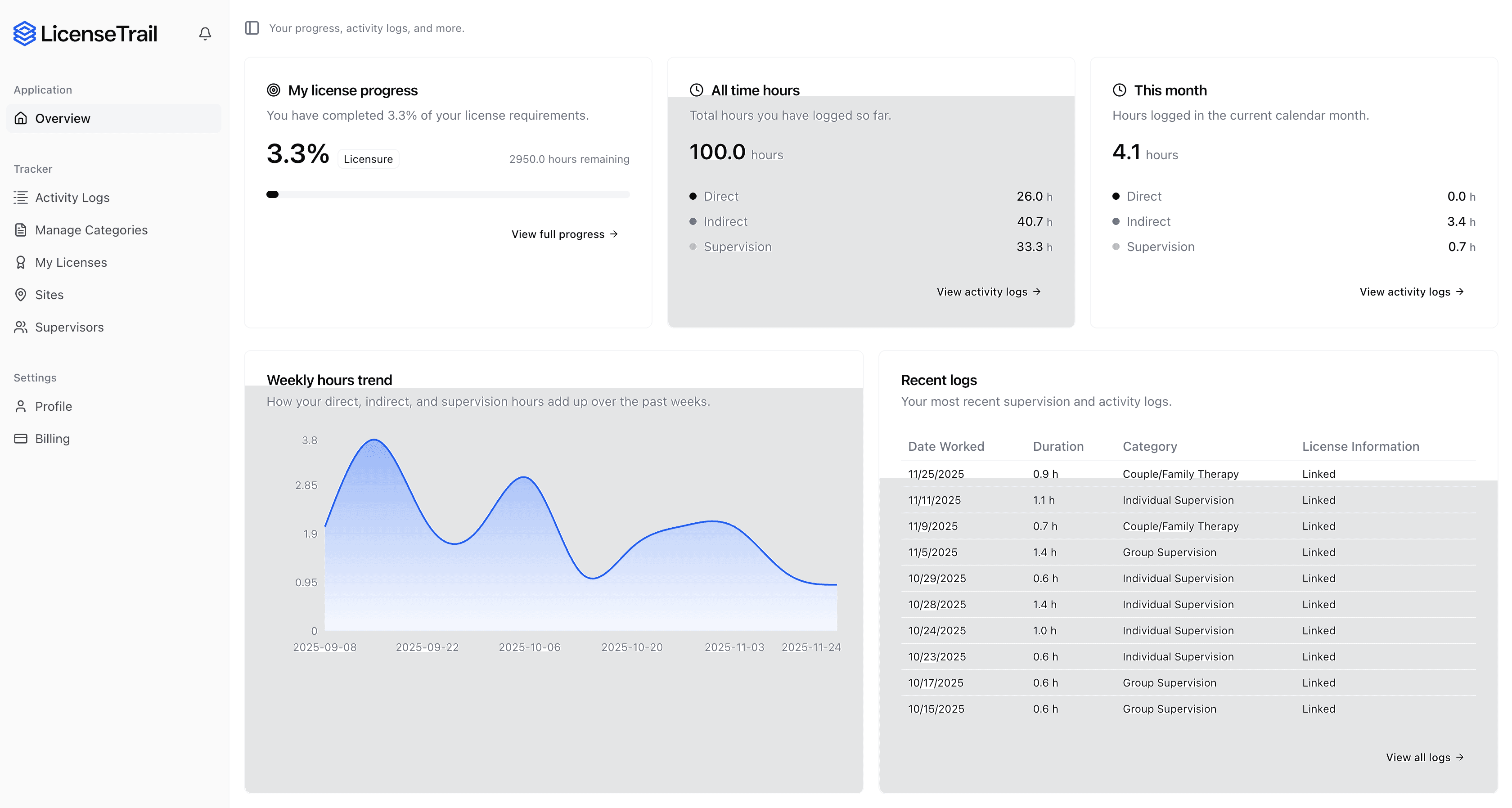
License Trail checks your direct, indirect, and supervision hours against Montana CBHPSS requirements continuously and flags mismatches before you submit.
 Start Tracking for Free
No credit card required · Free plan available
Is your spreadsheet hiding Montana CBHPSS risks?
Stop guessing if your categories match Montana Board of Behavioral Health requirements. License Trail checks your direct, indirect, and supervision hours continuously and flags mismatches before you submit.
Import or log
Bring your spreadsheet or start fresh
Upload your existing tracking spreadsheet and we'll map every hour into the right Montana Board of Behavioral Health categories automatically.
Verify against Montana
Catch mismatches before the board does
License Trail checks your direct, indirect, and supervision hours against Montana CBHPSS requirements continuously.
Export board-ready
One-click clean reports
Generate professional, board-ready reports for supervision meetings and Montana Board of Behavioral Health submissions in seconds.
No credit card required · Free plan available