
Montana LCSW Requirements: Hours, Exams & Step-by-Step Guide
Stop guessing if your categories match Montana requirements. License Trail checks your direct, indirect, and supervision hours against LCSW requirements continuously and flags mismatches before you submit.
No credit card required · Free plan available
Quick Requirements Overview
- Degree: MSW/DSW from CSWE-accredited (or Board-approved/equivalent) program required before candidacy
- Pre-licensure status: Register as Social Worker Licensure Candidate (SWLC/LCSW candidate) to practice and accrue hours; submit application/fee, education proof, supervision plan, good moral character, fingerprints
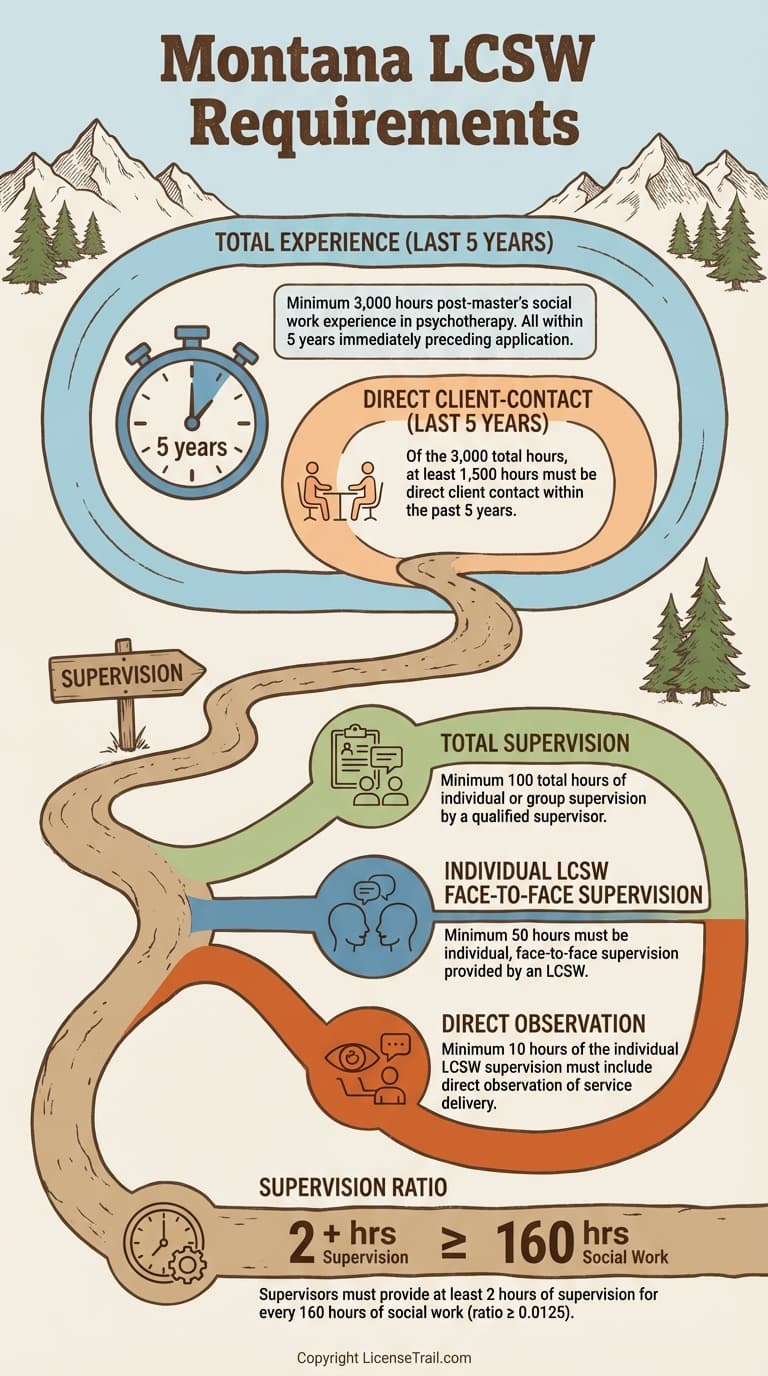
- Experience: 3,000 hrs supervised post-master’s psychotherapy social work over ≥24 months, completed within past 5 years
- Direct client contact: ≥1,500 hrs (in-person, phone, or interactive video; includes family/representative sessions)
- Supervision (within 3,000 hrs): ≥100 hrs total supervision; ≥50 hrs individual face-to-face by an LCSW; ≥10 hrs include direct observation of service delivery
- Supervision ratio: ≥2 hrs supervision per 160 hrs worked
- Supervisor must be qualified: Active, in-good-standing; typically ≥3 years licensed or supervision training; acceptable supervisors include LCSW, LCPC, LMFT, psychologist, board-certified psychiatrist
- Exam & background check: Pass ASWB Clinical exam; complete state & FBI fingerprint-based criminal background check before license issuance
License Details
Procedures
In Montana, the Licensed Clinical Social Worker (LCSW) credential is issued by the Board of Behavioral Health under Title 37, chapter 22 of the Montana Code Annotated and the Administrative Rules of Montana (ARM) 24.219. The path is structured around five pieces: education, registration as a social worker licensure candidate, supervised post‑master’s practice, examination, and a background check.
Below is a step‑by‑step guide, with the Board’s own terminology and hour types highlighted.
1. Educational requirement
Montana statute requires that an LCSW applicant:
- Hold a master’s or doctorate in social work from a CSWE‑accredited program or one approved by the Board; or
- If the degree is not one of those, meet additional post‑degree social work experience requirements the Board sets “equivalent” to the standard education and experience provisions. (law.justia.com)
This education must be completed before you can register as a social worker licensure candidate.
2. Register as a “social worker licensure candidate” (SWLC)
Anyone who has finished the required education for clinical, master’s, or baccalaureate social work licensure but has not yet completed the supervised work experience must register as a social worker licensure candidate to perform social work in Montana and accrue hours. (law.justia.com)
To register, the statute requires that you submit: (law.justia.com)
- The Board’s candidate application and fee
- Proof of completion of the education requirement
- Fingerprints for state and FBI criminal background checks
- Proof of good moral character
- A training and supervision plan that meets Board standards
Once approved, you may work using the title “social worker licensure candidate” at the appropriate level (clinical, master’s, or baccalaureate) while accruing supervised hours. (law.justia.com)
For LCSW, this candidate status is often referred to on Board materials as an LCSW candidate (sometimes abbreviated SWLC). (boards.bsd.dli.mt.gov)
3. Supervised post‑master’s experience: exact hour requirements
3.1 Total hours and time frame
Statute 37‑22‑301 sets the core supervised‑experience requirement for an LCSW applicant. You must have: (law.justia.com)
- At least 24 months of supervised post‑master’s work experience in psychotherapy; and
- Within that period, 3,000 hours of social work experience, of which at least 1,500 hours are in “direct client contact”, all completed within the past 5 years.
In other words, the Board’s structure is:
- 3,000 total supervised post‑degree hours
- ≥ 1,500 hours must be direct client contact (see definition below)
- The remaining ≤ 1,500 hours may be other qualifying social work tasks (documentation, case consultation, collateral contacts, coordination, etc.), but they are still part of supervised clinical social work.
All 3,000 hours are supervised; Montana does not treat 1,500 as “unsupervised” in any way. The law groups everything under “supervised post‑master’s degree work experience in psychotherapy” and then carves out the 1,500‑hour minimum for direct client contact. (law.justia.com)
3.2 Supervision hours inside the 3,000 hours
ARM 24.219.504 adds a second layer: of those 3,000 total hours, a certain number must be formal supervision hours with a qualified supervisor. For LCSW applicants, the rule states that supervised work experience obtained post‑degree must: (law.cornell.edu)
- Include 3,000 total hours of supervised work (matching the statute); and
- At least 100 hours must be individual or group supervision with a qualified supervisor (defined in ARM 24.219.421).
Within those 100 supervision hours: (law.cornell.edu)
- At least 50 hours must be individual, face‑to‑face supervision by an LCSW.
- Of those 50 hours, at least 10 hours must include “direct observation of service delivery” (definition below).
The rule also sets an ongoing supervision ratio:
- Supervisors must provide at least 2 hours of supervision for every 160 hours of social work performed by the candidate. (law.cornell.edu)
So, in summary of the types of hours required:
- 3,000 total supervised post‑degree social work hours, over ≥ 24 months and within 5 years
- At least 1,500 hours = direct client contact
- At least 100 hours = formal supervision (a subset of the 3,000)
- ≥ 50 of those 100 = individual, face‑to‑face supervision by an LCSW
- ≥ 10 of those 50 = direct observation of service delivery
3.3 Board definitions of key hour types
The Board defines these terms in ARM 24.219.301, and that language controls how you count your hours.
Direct client contact
The rule defines “direct client contact” as physical presence, telephonic presence, or interactive video link presence of the client, client family member, or client representative. (law.cornell.edu)
This means client sessions by phone or secure video count as direct contact, as do sessions with a client’s family or designated representative.
Direct observation of service delivery
“Direct observation of service delivery” is defined as the supervisor:
- Participating in the service delivery, or
- Observing it in real time (e.g., through a two‑way mirror or interactive video), or
- Reviewing recorded video or audio of the service delivery. (law.cornell.edu)
The key point is that in those 10 minimum observation hours, the supervisor is directly watching you provide services, either live or via recording, in a way that allows meaningful feedback.
4. Supervisor qualifications and supervision structure
Your hours must be supervised by someone who meets the “supervisor qualifications” rule, ARM 24.219.421. That rule requires, in general, that supervisors: (regulations.justia.com)
- Hold an active license in good standing in the jurisdiction where supervision occurs; and
- Either
- Have been licensed in their discipline for at least three years (excluding time as a candidate), or
- Have completed board‑approved supervision training (at least one semester‑credit of graduate‑level supervision coursework or 20 hours of board‑approved supervision training).
For LCSW candidates specifically, the rule states that they must be supervised by one of the following license types: (regulations.justia.com)
- Licensed Clinical Social Worker (LCSW)
- Licensed Clinical Professional Counselor (LCPC)
- Licensed Marriage and Family Therapist (LMFT)
- Licensed psychologist
- Licensed and board‑certified psychiatrist
Additionally, the Board requires that supervisors have experience and expertise with the candidate’s client population and methods of practice (e.g., child vs. adult, individual vs. family therapy). (law.cornell.edu)
Candidates must also maintain detailed supervision and experience records (session dates, durations, content summaries, evidence of growing competence, and supervisor attestations) for at least seven years after licensure or the end of candidate status. (law.cornell.edu)
5. Examination requirement
Once you have completed the supervised experience as a social worker licensure candidate, statute 37‑22‑301 requires that you: (law.justia.com)
- Satisfactorily complete an examination prescribed by the Board, and
- Submit a completed application and the required fee.
The Board’s LCSW license information page specifies that Montana “accepts test scores from the Association of Social Work Boards (ASWB) clinical examination” for LCSW licensure. (boards.bsd.dli.mt.gov)
If you fail the exam, you may re‑apply to take it and may continue as a social worker licensure candidate, subject to terms the Board sets. (law.justia.com)
6. Fingerprint‑based background check and ethics
Statute 37‑22‑301 further requires that, before a license is issued, the Board must obtain your fingerprints for state and FBI criminal background checks, under 37‑1‑307. (law.justia.com) The LCSW license page on the Board site repeats that LCSW applicants must complete a fingerprint‑based background check through the Montana Department of Justice. (boards.bsd.dli.mt.gov)
An LCSW, once licensed, is:
- Subject to the social work ethical standards adopted under 37‑22‑201
- Authorized to engage in “independent practice” (as defined by the Board)
- Allowed to use the initials “LCSW” for “licensed clinical social worker” (law.justia.com)
7. Practical summary of hour requirements (LCSW only)
Putting the Board’s language and numbers together, the supervised‑experience component for Montana LCSW licensure is:
- 3,000 hours total of supervised post‑master’s social work experience in psychotherapy,
- Completed over at least 24 months,
- Finished within the 5 years before application. (law.justia.com)
Within that 3,000 hours:
- At least 1,500 hours must be direct client contact, defined as in‑person, telephone, or interactive video sessions with the client, a client family member, or client representative. (law.justia.com)
- At least 100 hours must be formal supervision with a qualified supervisor,
- ≥ 50 hours of that must be individual, face‑to‑face supervision by an LCSW,
- ≥ 10 of those 50 hours must involve direct observation of service delivery. (law.cornell.edu)
- Supervision must also satisfy the minimum ratio of 2 hours of supervision for every 160 hours of social work performed. (law.cornell.edu)
On top of these experience requirements, you must:
- Hold the required MSW/DSW degree
- Be properly registered and in good standing as a social worker licensure candidate while accumulating hours (law.justia.com)
- Pass the ASWB Clinical exam, as accepted by the Montana Board of Behavioral Health (boards.bsd.dli.mt.gov)
- Complete a fingerprint‑based background check and meet ethical and character standards (law.justia.com)
Because statutes and rules can change, it is wise to verify details against the current text of MCA 37‑22‑301, 37‑22‑313 and ARM 24.219.301, 24.219.421, 24.219.504, as well as the LCSW section of the Board of Behavioral Health website, shortly before you apply.
Track your LCSW hours with confidence
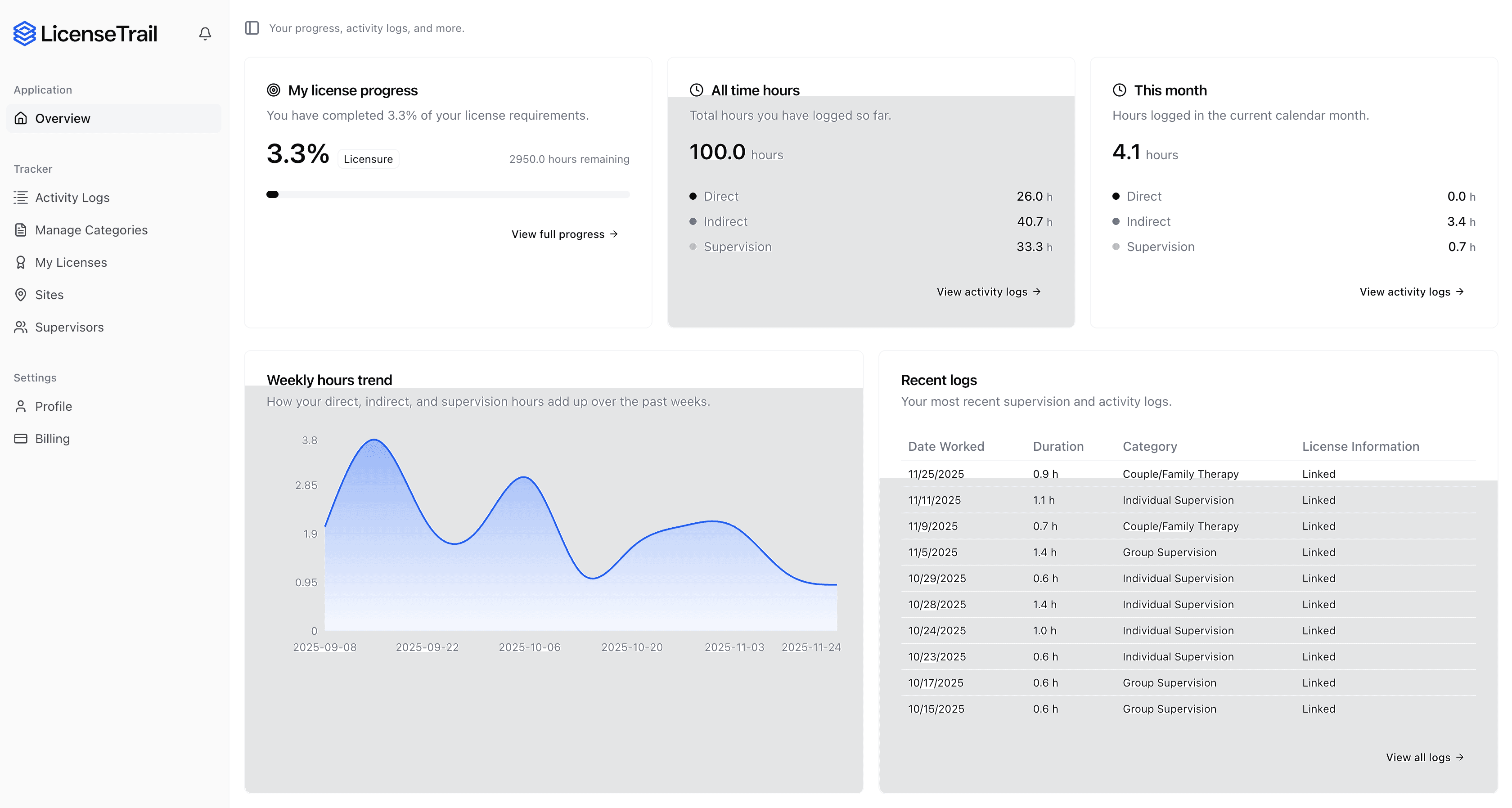
License Trail checks your direct, indirect, and supervision hours against Montana LCSW requirements continuously and flags mismatches before you submit.
 Start Tracking for Free
No credit card required · Free plan available
Is your spreadsheet hiding Montana LCSW risks?
Stop guessing if your categories match Montana Board of Behavioral Health requirements. License Trail checks your direct, indirect, and supervision hours continuously and flags mismatches before you submit.
Import or log
Bring your spreadsheet or start fresh
Upload your existing tracking spreadsheet and we'll map every hour into the right Montana Board of Behavioral Health categories automatically.
Verify against Montana
Catch mismatches before the board does
License Trail checks your direct, indirect, and supervision hours against Montana LCSW requirements continuously.
Export board-ready
One-click clean reports
Generate professional, board-ready reports for supervision meetings and Montana Board of Behavioral Health submissions in seconds.
No credit card required · Free plan available