
Montana LAC Requirements: Hours, Exams & Step-by-Step Guide
Stop guessing if your categories match Montana requirements. License Trail checks your direct, indirect, and supervision hours against LAC requirements continuously and flags mismatches before you submit.
No credit card required · Free plan available
Quick Requirements Overview
- Regulator: Montana Board of Behavioral Health (Title 37, ch. 35, MCA; ARM 24.219.50)
- Credential: Licensed Addiction Counselor (LAC) (single independent level)
- Education: Qualifying degree pathway (behavioral-health BA+; addictions AA/certificate; or any BA+ with specified counseling coursework; possible “exceptional experience” substitution)
- Addiction studies training: 285 contact hours in 9 required content areas (assessment 60; counseling 90; pharmacology 15; ethics 15; A&D studies 30; tx planning/docs 30; multicultural 15; co-occurring 15; gambling/gaming 15)
- Candidate status required: Register as LAC Licensure Candidate before earning supervised hours; annual renewal; submit supervision plan + transcripts + hours + fingerprints/fee
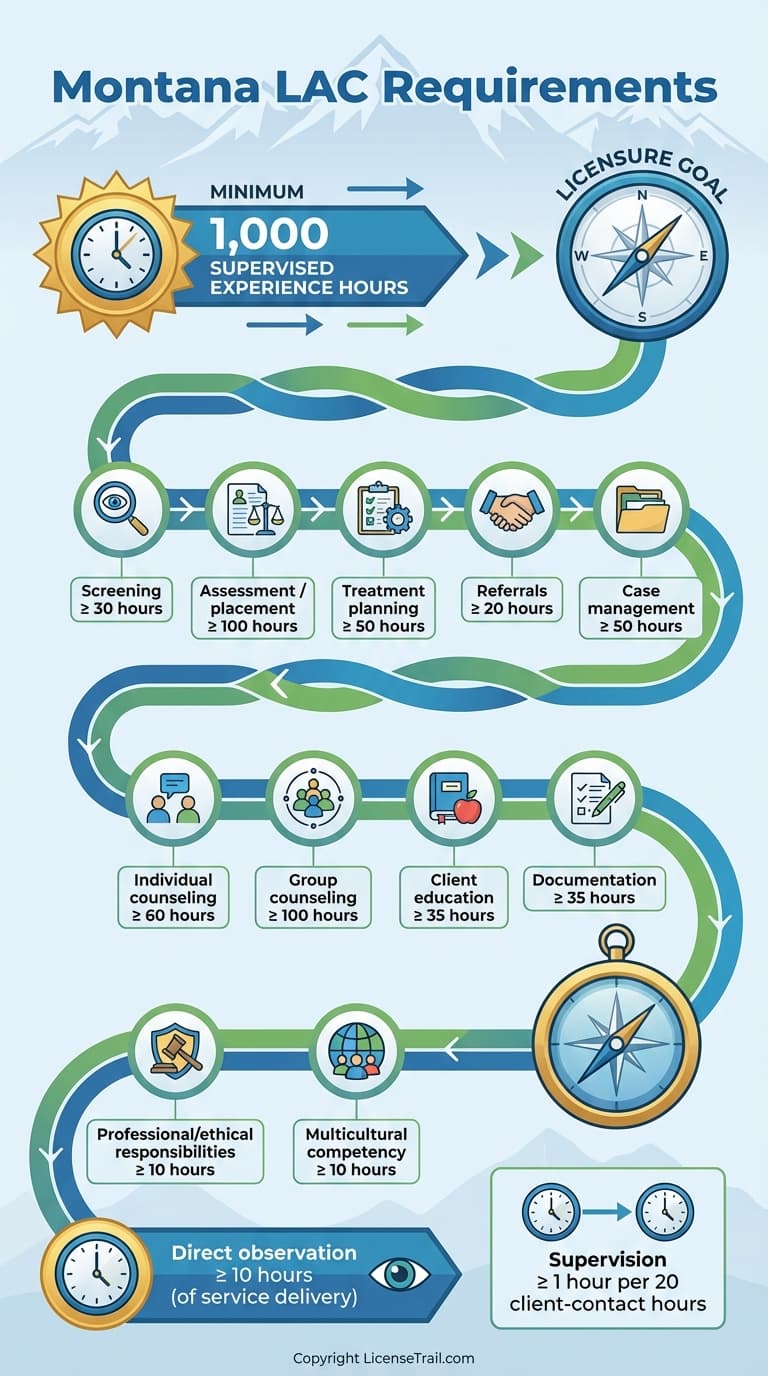
- Supervised work experience: 1,000 hours over ≥7 months in a qualified treatment program; completed in ≤2 programs; ≥500 hours across specified skill areas (e.g., assessment 100, group 100, individual 60, etc.)
- Supervision structure: 20:1 client-contact to supervision ratio; includes individual + group supervision and 10 hours direct observation
- Exam + background check: Pass a Board-approved written exam (NAADAC/IC&RC/regional options) and complete fingerprint-based criminal background check for candidate + licensure
License Details
Procedures
Montana licenses addiction professionals at a single independent level: the Licensed Addiction Counselor (LAC), regulated by the Montana Board of Behavioral Health under Title 37, chapter 35, MCA and the Board’s administrative rules in ARM 24.219.50.(law.justia.com)
What follows is a structured summary of what the Board itself requires, with emphasis on the exact types and amounts of hours.
Quick snapshot of the hour requirements
To become a Montana LAC you must meet three separate “hour” requirements:
-
Addiction‑specific education hours (classroom/CE contact hours)
- 285 contact hours of training in addiction studies, allocated as:(regulations.justia.com)
- 60 hours – addiction assessment
- 90 hours – addiction counseling
- 15 hours – pharmacology
- 15 hours – ethics for counselors
- 30 hours – alcohol and drug studies
- 30 hours – addiction treatment planning and documentation
- 15 hours – multicultural competency
- 15 hours – co‑occurring disorders
- 15 hours – gambling/gaming disorder assessment and counseling
- 285 contact hours of training in addiction studies, allocated as:(regulations.justia.com)
-
Post‑degree supervised work experience hours (clinical practice)
Board rule states supervised work experience hours obtained post‑degree or post‑certificate must include:(law.cornell.edu)- At least seven months and 1,000 hours of supervised work experience
in an addiction‑counseling qualified treatment program. - Of those 1,000 hours, at least 500 hours must be in specified direct‑service skill areas (screening, assessment, counseling, etc.; detailed below).
- All 1,000 hours must be completed in no more than two qualified treatment programs.
- Supervision must follow a 20:1 ratio of client‑contact hours to supervision and include both group and individual supervision plus 10 hours of direct observation.
- At least seven months and 1,000 hours of supervised work experience
-
Supervision hours (embedded in the 1,000 hours)
The Board does not set a second, stand‑alone “block” of supervision hours (such as 1,500 direct + 1,500 supervised). Instead, supervision is built into the same 1,000 supervised work experience hours through that 20:1 client‑contact‑to‑supervision requirement and the direct‑observation minimum.(law.cornell.edu)
Step 1 – Meet the degree requirement
Montana statute sets multiple degree pathways. You must meet one of these:(law.justia.com)
-
Behavioral‑health bachelor’s or higher
A baccalaureate or advanced degree from an accredited college or university in:- Alcohol and drug studies
- Psychology
- Sociology
- Social work
- Counseling
- Human services
- Psychiatric rehabilitation
- Community health
-
Associate degree or certificate in addictions
An associate of arts degree or a certificate from an accredited institution in:- Alcohol and drug studies
- Addiction
- Substance abuse
-
Any bachelor’s/graduate degree plus specified counseling‑related coursework
A baccalaureate or advanced degree in any area, plus all of the following college credits:- 6 semester credits in human behavior, sociology, psychology, or a similar emphasis
- 3 semester credits in psychopathology/abnormal or deviant behavior
- 6 semester credits in counseling, including 3 in group counseling and 3 in counseling theory
-
Exceptional experience pathway
If you do not hold a qualifying degree as above, the Board may allow additional work‑experience in an addiction treatment program to substitute, “as equivalent and necessary” to meet the degree requirements.(law.justia.com)
These degree requirements are separate from, and in addition to, the 285 contact hours of addiction‑specific training discussed next.
Step 2 – Complete Board‑specified addiction studies training (285 contact hours)
Board rule 24.219.5006 – LAC Education Requirements states:
“Applicants must have completed a minimum of 285 contact hours of training in addiction studies…”(regulations.justia.com)
Those 285 hours must be spread across nine content areas, in the exact amounts below:(regulations.justia.com)
-
Addiction assessment – 60 hours
Must include chemical dependency assessment, biopsychosocial testing, diagnosis, referrals, and patient placement. -
Addiction counseling – 90 hours
-
Pharmacology – 15 hours
Must include drug classification, effects, detoxification, and withdrawal. -
Ethics for counselors – 15 hours
-
Alcohol and drug studies – 30 hours
-
Addiction treatment planning and documentation – 30 hours
-
Multicultural competency – 15 hours
Knowledge of and sensitivity to the cultural factors and needs of diverse populations, and demonstrated competency applying culturally relevant skills. -
Co‑occurring disorders – 15 hours
-
Gambling/gaming disorder assessment and counseling – 15 hours
Key points about these hours:
- They may be completed as part of your qualifying degree or certificate or outside the degree program, as long as they are from acceptable providers.(regulations.justia.com)
- Schools like the University of Montana convert academic credits to contact hours (e.g., 1 credit ≈ 15 contact hours) when helping students document these requirements, but the Board’s standard is the contact‑hour totals above.(umt.edu)
Step 3 – Apply as an Addiction Counselor Licensure Candidate (LAC Candidate)
Under the statute, once you have completed the education required for licensure but before finishing the supervised work experience, you must register as an “addiction counselor licensure candidate” in order to provide addiction counseling and earn supervised hours in Montana.(law.justia.com)
The Board’s LAC Candidate information page describes this registration:(boards.bsd.dli.mt.gov)
- You apply online as a Licensed Addiction Counselor Candidate (LAC Candidate).
- You must submit:
- Official transcripts showing you meet the degree requirement
- Documentation of the required addiction‑studies contact hours
- A training and supervision plan signed by a qualified supervisor
- Fingerprints and background‑check materials
- The application fee
A person registered as an addiction‑counselor licensure candidate must renew annually until they become a fully licensed LAC. The Board may limit how many years you can remain in candidate status.(law.justia.com)
Step 4 – Complete post‑degree supervised work experience (the 1,000 hours)
4.1 Overall requirement and timing
The supervised work requirement is set in Mont. Admin. R. 24.219.5008 – LAC Supervised Work Experience Requirements. It provides that supervised work experience hours obtained post‑degree or post‑certificate must include:(law.cornell.edu)
- At least seven months and 1,000 hours of supervised work experience
- All hours must be in an addiction‑counseling qualified treatment program as defined by ARM 24.219.5010.
- The 1,000 hours must be completed in no more than two different qualified treatment programs.
University of Montana’s advising materials (developed in consultation with the Board) explicitly note that these 1,000 hours are post‑degree only, so social‑work or other academic practicums generally do not count toward the 1,000 required hours.(umt.edu)
4.2 Required direct‑service skill areas (at least 500 of the 1,000 hours)
Within those 1,000 supervised hours, rule 24.219.5008 requires that at least 500 hours be distributed across specific counseling skill areas as follows:(law.cornell.edu)
- Screening – minimum 30 hours
- Assessment / patient placement – minimum 100 hours
- Treatment planning – minimum 50 hours
- Referrals – minimum 20 hours
- Case management – minimum 50 hours
- Individual counseling – minimum 60 hours
- Group counseling – minimum 100 hours
- Client education – minimum 35 hours
- Documentation – minimum 35 hours
- Professional and ethical responsibilities – minimum 10 hours
- Multicultural competency – minimum 10 hours
The rule does not add a second, separate block of “indirect” hours. Instead:
- You must accrue 1,000 total supervised work experience hours.
- Of those, at least 500 must be documented in the skill areas above; the remaining hours can be in other appropriate clinical and program activities, subject to Board definitions of supervised work experience.(law.cornell.edu)
4.3 Supervision structure and hours
Supervision of these 1,000 hours is governed by the same rule:(law.cornell.edu)
- Supervision must occur at a 20:1 ratio of client‑contact hours to supervision.
- Practically, for every 20 hours of client contact, you need at least 1 hour of documented supervision.
- Supervision must include:
- Group supervision, and
- Individual supervision, and
- 10 hours of direct observation (e.g., live observation of your counseling, consistent with the Board’s general definition of direct observation in ARM 24.219.301).
Supervisor qualifications (who can supervise you) are set in separate Board rules and generally require a current, active license in good standing and specific addiction‑counseling training; the Board and your candidate checklist will direct you to those rules when you complete your supervision plan.(regulations.justia.com)
Step 5 – Pass a Board‑approved addiction‑counseling exam
By statute, every applicant for licensure must “successfully pass a written examination prescribed by the board.”(law.justia.com)
The Board’s LAC Candidate materials specify that it currently accepts any one of the following examinations:(boards.bsd.dli.mt.gov)
- NCC/NAADAC exams:
- National Certified Addiction Counselor (NCAC) Level I
- NCAC Level II
- Master Addiction Counselor (MAC)
- IC&RC exams:
- Alcohol and Drug Counselor (ADC)
- Advanced Alcohol and Drug Counselor (AADC)
- Regional exams:
- Northwest Certification II
- Southwest Certification II
You must have completed the required education and supervised work experience before the Board will fully license you, but the exact timing of when you sit for the exam can vary depending on Board policy and the specific exam’s eligibility rules.
Step 6 – Criminal‑background check and final LAC application
Montana statute requires a fingerprint‑based criminal background check for both LAC licensure and licensure‑candidate registration. The Board must submit your fingerprints to the Montana Department of Justice and the FBI as part of processing your application.(law.justia.com)
Once you have:
- Met the degree requirement,
- Documented the 285 contact hours in addiction studies,
- Held registration as an addiction counselor licensure candidate,
- Completed at least seven months and 1,000 supervised hours (with the 500‑hour skill‑area breakdown and required supervision), and
- Passed an approved written examination,
you submit a complete LAC application to the Board. The application includes:
- Application form and fee
- Official transcripts and education documentation
- Detailed verification of supervised work experience and supervision
- Proof of passing the required exam
- Background‑check clearance
If the Board determines you meet the statutory “eligibility requirements and competency standards” and there are no disqualifying criminal or disciplinary issues, it issues the Licensed Addiction Counselor license. At that point you may use the title “licensed addiction counselor” in Montana.(law.justia.com)
How Montana’s LAC hours compare to your example
Your example asked about a model with 1,500 hours of direct experience and 1,500 hours of supervised experience. In Montana’s current LAC rules:
- There is one unified requirement of 1,000 supervised work experience hours, not a 1,500 + 1,500 split.(law.cornell.edu)
- Those 1,000 hours are themselves supervised clinical hours, with:
- At least 500 hours in specific direct‑service skill areas, and
- Required supervision at a 20:1 client‑contact/supervision ratio, plus 10 hours of direct observation.(law.cornell.edu)
The other major “hours” you must track are not clinical hours but educational contact hours—the 285 hours of addiction‑studies coursework laid out in ARM 24.219.5006.(regulations.justia.com)
Taken together, those statutory and rule‑based requirements constitute the current, Board‑defined pathway to becoming a Licensed Addiction Counselor in Montana.
Track your LAC hours with confidence
License Trail checks your direct, indirect, and supervision hours against Montana LAC requirements continuously and flags mismatches before you submit.
 Start Tracking for Free
No credit card required · Free plan available
Is your spreadsheet hiding Montana LAC risks?
Stop guessing if your categories match Montana Board of Behavioral Health requirements. License Trail checks your direct, indirect, and supervision hours continuously and flags mismatches before you submit.
Import or log
Bring your spreadsheet or start fresh
Upload your existing tracking spreadsheet and we'll map every hour into the right Montana Board of Behavioral Health categories automatically.
Verify against Montana
Catch mismatches before the board does
License Trail checks your direct, indirect, and supervision hours against Montana LAC requirements continuously.
Export board-ready
One-click clean reports
Generate professional, board-ready reports for supervision meetings and Montana Board of Behavioral Health submissions in seconds.
No credit card required · Free plan available