
Montana LMFT Requirements: Hours, Exams & Step-by-Step Guide
Stop guessing if your categories match Montana requirements. License Trail checks your direct, indirect, and supervision hours against LMFT requirements continuously and flags mismatches before you submit.
No credit card required · Free plan available
Quick Requirements Overview
- Governing body/rules: MT Board of Behavioral Health; ARM 24.219 & Title 37, Ch. 39, MCA
- Education: Master’s in MFT from COAMFTE/CACREP or “equivalent” master’s with 60 semester (90 quarter) hours, incl. 48 semester (72 quarter) hours across 6 required content areas (systems, lifespan dev, treatment, ethics, multicultural, assessment/diagnosis)
- LMFT Candidate step: Apply as LMFT Candidate, submit transcripts, complete fingerprint-based DOJ background check; annual registration (generally up to 5 renewals unless board-approved extension)
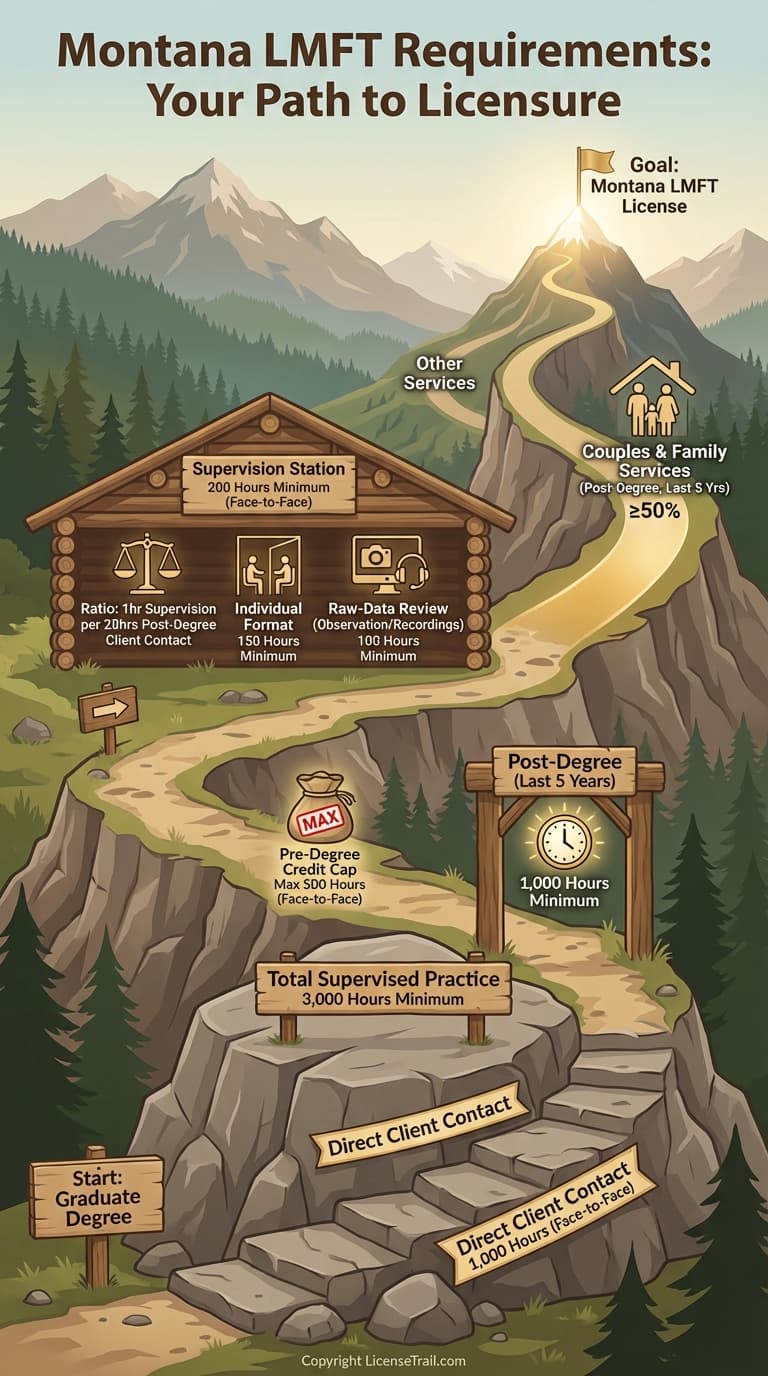
- Client contact: 1,000 post-degree direct client-contact hours within 5 years; ≥50% must be with couples/families (direct contact includes in-person/phone/interactive video)
- Supervision: Maintain 20:1 client-contact:supervision; ≥200 face-to-face supervision hours incl. ≥150 individual; ≥80 hours with each supervisor; group supervision max 6 candidates
- Raw data: ≥100 supervision hours using raw clinical data (live/one-way mirror/live-feed or audio/video review)
- Supervisor qualifications: Active, in-good-standing license; ≥3 years licensed (not as candidate) or 1 semester credit in supervision or 20 hours board-approved supervision training; acceptable supervisors: LMFT, LCPC, LCSW, psychologist, board-certified psychiatrist
- Exam/licensure: Pass AMFTRB National MFT Exam, then apply for full LMFT; post-licensure renewal is annual with 20 CE hours/year
License Details
Procedures
Montana regulates Licensed Marriage and Family Therapists (LMFTs) through the Board of Behavioral Health under the Administrative Rules of Montana (ARM) chapter 24.219 and Title 37, chapter 39, MCA. The path to licensure is essentially:
- Complete a qualifying graduate degree.
- Obtain an LMFT candidate status and accrue board‑defined supervised work experience.
- Pass the national AMFTRB MFT exam.
- Apply for full LMFT licensure and maintain it through renewal and continuing education.
Below is a step‑by‑step outline with the specific hours and terminology the board uses.
1. Educational foundation
Degree level and accreditation
Under ARM 24.219.701, LMFT applicants must hold at least a master’s degree that meets one of two options:(regulations.justia.com)
-
Accredited MFT degree route
- A minimum of a master’s degree in marriage and family counseling/therapy from a program accredited by:
- COAMFTE (Commission on Accreditation for Marriage and Family Therapy Education), or
- CACREP (Council for Accreditation of Counseling and Related Educational Programs).
- A minimum of a master’s degree in marriage and family counseling/therapy from a program accredited by:
-
“Equivalent” degree route
- A minimum of a master’s degree from an accredited institution totaling:
- At least 60 semester hours or 90 quarter hours, and
- Within that, at least 48 semester hours (or 72 quarter hours) of coursework in these required content areas (verbatim categories from the rule):
- Foundations of relational/systemic practice, theories, and models
- Biopsychosocial health and development across the life span
- Clinical treatment with individuals, couples, and families
- Ethics in marriage and family therapy
- Diverse, multicultural, and/or underserved communities
- Systemic/relational assessment and mental health diagnosis and treatment (regulations.justia.com)
- A minimum of a master’s degree from an accredited institution totaling:
What “direct client contact” and “supervised work experience” mean in Montana
The Board defines key terms in ARM 24.219.301:
- “Direct client contact” means the physical presence, telephonic presence, or interactive video link presence of the client, client family member, or client representative.(law.cornell.edu)
- “Supervised work experience” is defined as the period in which a candidate gains minimal competencies in areas such as having an identified theory base, applying differential diagnosis, establishing and monitoring treatment plans, using the professional relationship appropriately, assessing for imminent danger, and implementing an ethical professional relationship with clients and colleagues.(regulations.justia.com)
These definitions apply across the supervised experience requirements described below.
2. Become an LMFT candidate
After completing academic requirements, you function as an LMFT candidate while you accrue supervised hours.
- The Board’s LMFT Candidate page directs applicants to:
- Submit an online application as an LMFT candidate.
- Provide official transcripts.
- Undergo a fingerprint‑based criminal background check through the Montana Department of Justice; results go directly to the Board.(boards.bsd.dli.mt.gov)
Ongoing candidate registration
Montana treats candidates as a license category that must be renewed annually:
- LMFT candidates must:
- Register annually, and
- Are generally limited to five annual registrations, unless the Board approves additional registrations upon a written request explaining why more time is needed to complete the required supervised work experience.(law.cornell.edu)
This effectively gives you a finite window (normally five years) to complete your supervised experience unless an extension is granted.
3. Post‑degree supervised work experience: the hour breakdown
Montana’s LMFT supervised experience requirements are contained in ARM 24.219.704 – LMFT SUPERVISED WORK EXPERIENCE REQUIREMENTS.(law.cornell.edu)
The rule is framed around “supervised work experience hours obtained post‑degree” and it specifies both:
- The type of hours (client‑contact vs. supervision), and
- The minimum quantities, including how they must be distributed.
3.1 Minimum post‑degree direct client‑contact hours
ARM 24.219.704(1)(c) requires:
- At least 1,000 post‑degree hours of client contact,
- Accumulated within the last five years, and
- At least 50% of those hours must be providing services to couples and families.(law.cornell.edu)
Because “direct client contact” includes in‑person, telephonic, and interactive video sessions with clients, family members, or client representatives, telehealth and phone sessions can count toward these hours if they otherwise meet Board standards.(law.cornell.edu)
3.2 Required supervision ratio and total supervision hours
The same subsection requires that, for those 1,000 post‑degree client‑contact hours:
- There must be a 20:1 ratio of client contact hours to supervision hours.(law.cornell.edu)
In addition, Montana sets absolute minimum supervision‑hour thresholds:
-
Face‑to‑face supervision requirement
- You must receive at least 200 hours of face‑to‑face supervision, of which:
- At least 150 hours must be in individual supervision, and
- A minimum of 80 supervision hours must be earned with each supervisor you use (so you cannot spread a tiny number of hours across many supervisors).(law.cornell.edu)
- You must receive at least 200 hours of face‑to‑face supervision, of which:
-
Raw‑data supervision requirement
- At least 100 hours of your supervision must involve “raw clinical data”—defined in the rule as live observation in the therapy room or through a one‑way mirror or live‑feed camera, or review of videotapes or audiotapes of sessions.(law.cornell.edu)
-
“100 individual hours” clause
- ARM 24.219.704(1)(a) also states that supervised post‑degree experience must include “100 individual hours, using a 20:1 ratio of client contact hours to supervision hours of which at least 75 percent are in individual supervision.”(law.cornell.edu)
- The Board has not published a separate total‑hours figure in this rule; instead, these 100 hours function as a further specification within your required supervised experience, emphasizing that most supervision must be delivered in an individual format.
3.3 Group supervision limits
- Group supervision is allowed but groups may consist of no more than six candidates.(law.cornell.edu)
3.4 Putting the supervised‑experience hours together
Using only what the ARM currently specifies, your minimum post‑degree supervised experience for LMFT licensure in Montana must include:
- 1,000+ hours of post‑degree direct client contact, accumulated within five years, with:
- ≥ 500 hours (50%) spent providing services to couples and families.
- At least 200 hours of face‑to‑face supervision, of which:
- ≥ 150 hours are individual supervision, and
- ≥ 80 hours are obtained with each supervisor you use.
- At least 100 of your supervision hours must involve raw clinical data (live observation or recorded sessions).
- Supervision overall must maintain a 20:1 client‑contact to supervision ratio, and while group supervision is permitted, each group may include no more than six candidates.
- Within that structure, the rule also requires 100 hours where at least 75% of the supervision is delivered individually, reinforcing that supervision cannot be predominantly group‑based.
Note that some secondary sources and older checklists still refer to a total of 3,000 supervised hours for Montana LMFTs. Those numbers are rooted in earlier regulatory frameworks and in House Bill 137’s general language for behavioral‑health disciplines. The current LMFT‑specific rule (ARM 24.219.704, updated through June 6, 2025) only codifies the specific minimums above; it does not explicitly restate a 3,000‑hour total for LMFTs the way the LCPC rule does for counselors.(law.cornell.edu)
For precise planning—particularly if you intend to transfer hours from another jurisdiction—it’s prudent to confirm with the Board whether they are administratively applying a higher overall total (e.g., 3,000 supervised hours) in addition to the codified LMFT minimums.
4. Supervisor qualifications and supervision structure
Supervisor requirements for LMFT candidates are set out in ARM 24.219.421 – Supervisor Qualifications:(regulations.justia.com)
- License status: All supervisors must:
- Hold an active license in good standing in the jurisdiction where supervision occurs.
- Experience or training in supervision: Supervisors must either:
- Have been licensed in their discipline for at least three years (not counting any time licensed as a “candidate”), or
- Have completed board‑approved supervision training, defined as at least one semester credit of graduate education focused on supervision or 20 hours of board‑approved training in supervision.
- Permitted supervisor license types for LMFT candidates:
- LCSW (Licensed Clinical Social Worker)
- LCPC (Licensed Clinical Professional Counselor)
- LMFT (Licensed Marriage and Family Therapist)
- Licensed psychologist
- Licensed and board‑certified psychiatrist.(regulations.justia.com)
These supervisor‑type requirements apply while you accrue the LMFT supervised work experience described above.
5. Examination requirement
Montana uses the national AMFTRB Examination in Marital and Family Therapy:
- The Board’s LMFT and LMFT Candidate pages both state that Montana accepts exam scores from the Association of Marital and Family Therapy Regulatory Boards (AMFTRB) and that a passing score on that national exam is required.(boards.bsd.dli.mt.gov)
- Various state and program disclosures similarly identify the National Examination in Marital and Family Therapy as the licensing exam for Montana LMFTs.(onlinegrad.pepperdine.edu)
Once you have:
- Completed the required education,
- Accrued the supervised experience hours specified in ARM 24.219.704, and
- Passed the national AMFTRB exam,
you may apply to convert from LMFT candidate status to full Licensed Marriage and Family Therapist status through the Board’s online portal.(boards.bsd.dli.mt.gov)
6. Background check and character requirements
In addition to the education, supervised experience, and exam:
- Fingerprint‑based criminal background check: LMFT and LMFT candidate applicants must submit fingerprints to the Montana Department of Justice. The criminal record check results are sent directly to the Board prior to licensure.(boards.bsd.dli.mt.gov)
- Professional conduct: As with all behavioral‑health licenses in Montana, LMFTs and LMFT candidates are subject to the Board’s unprofessional‑conduct rules and code of ethics in ARM 24.219.2301.(regulations.justia.com)
7. After licensure: renewal and continuing education (briefly)
While not part of the initial licensure process, it is useful to note:
- The LMFT license renews annually (Board site lists renewal period November 1–December 31, with a short late‑renewal window).(boards.bsd.dli.mt.gov)
- Continuing education requirements for LMFTs are cross‑referenced at ARM 24.219.435 and related CE subchapters; these rules currently require 20 clock hours of approved continuing education per year for marriage and family therapists, with definitions of what counts as “clock hours” and which providers are acceptable.(studocu.com)
Summary of key hour requirements for Montana LMFT licensure
Using the Board’s current rules (as of June 6, 2025), the key hour‑based requirements for LMFT licensure in Montana are:
-
Graduate education
- 60 total semester hours (or 90 quarter hours) at minimum, including 48 graduate semester hours (72 quarter hours) in the six specified MFT content areas.(regulations.justia.com)
-
Post‑degree supervised work experience (LMFT‑specific)
- ≥ 1,000 post‑degree direct client‑contact hours, within 5 years, with ≥ 50% of hours serving couples and families.
- Supervision ratio 20:1 (client contact : supervision).
- ≥ 200 hours of face‑to‑face supervision, including:
- ≥ 150 hours of individual supervision; and
- ≥ 80 supervision hours with each supervisor utilized.
- ≥ 100 hours of supervision using raw clinical data (live or recorded observation).
- Supervised experience must include a specified 100 hours in which at least 75% of supervision is individual, and group supervision groups may have no more than six candidates.(law.cornell.edu)
-
Supervisors
- Must hold an active, unencumbered license and meet both experience or training criteria for supervision.
- Accepted supervisor licenses for LMFT candidates: LCSW, LCPC, LMFT, licensed psychologist, or licensed and board‑certified psychiatrist.(regulations.justia.com)
-
Exam
- Passing score on the National Examination in Marital and Family Therapy administered by AMFTRB.(boards.bsd.dli.mt.gov)
These are the Board‑defined components you must satisfy to progress from LMFT candidate to fully licensed LMFT in Montana.
Track your LMFT hours with confidence
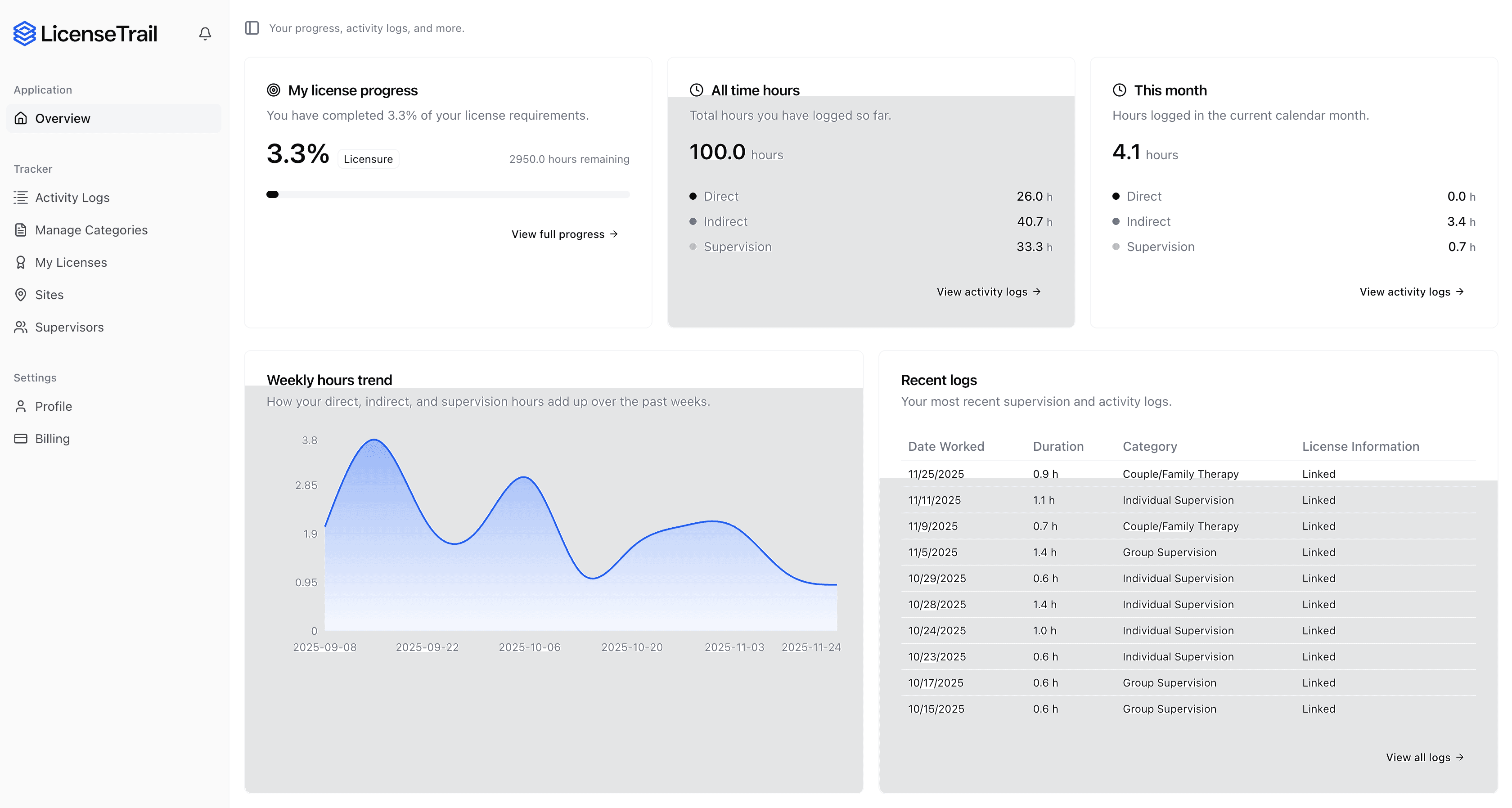
License Trail checks your direct, indirect, and supervision hours against Montana LMFT requirements continuously and flags mismatches before you submit.
 Start Tracking for Free
No credit card required · Free plan available
Is your spreadsheet hiding Montana LMFT risks?
Stop guessing if your categories match Montana Board of Behavioral Health requirements. License Trail checks your direct, indirect, and supervision hours continuously and flags mismatches before you submit.
Import or log
Bring your spreadsheet or start fresh
Upload your existing tracking spreadsheet and we'll map every hour into the right Montana Board of Behavioral Health categories automatically.
Verify against Montana
Catch mismatches before the board does
License Trail checks your direct, indirect, and supervision hours against Montana LMFT requirements continuously.
Export board-ready
One-click clean reports
Generate professional, board-ready reports for supervision meetings and Montana Board of Behavioral Health submissions in seconds.
No credit card required · Free plan available