
Montana LCPC Requirements: Hours, Exams & Step-by-Step Guide
Stop guessing if your categories match Montana requirements. License Trail checks your direct, indirect, and supervision hours against LCPC requirements continuously and flags mismatches before you submit.
No credit card required · Free plan available
Quick Requirements Overview
- Education: Qualifying graduate counseling degree; min 60 semester credits (CACREP-type core areas per Board rule).
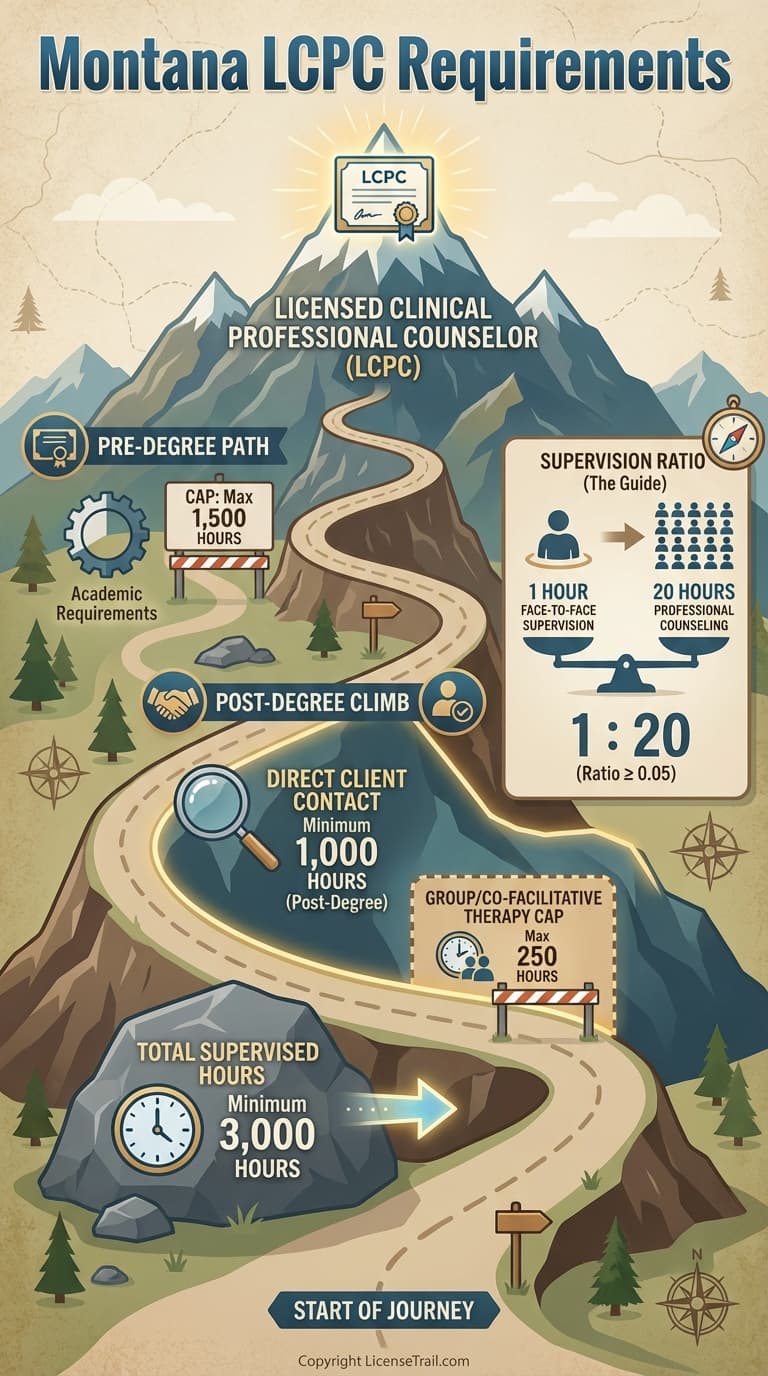
- Supervised work experience: 3,000 hours total.
- Post-degree requirement: ≥1,500 hours must be post-degree.
- Pre-degree allowance: Up to 1,500 hours may count pre-degree if program-approved.
- Direct client contact (post-degree): ≥1,000 hours direct client contact in a clinical setting; ≤250 hours may be group/co-facilitative.
- Supervision rate: ≥1 hour face-to-face supervision per 20 hours of professional counseling (applies across all 3,000 hours).
- Supervisor qualifications: Supervisor must be properly licensed (e.g., LCPC/LCSW/LMFT/psychologist/board-certified psychiatrist) and meet Board experience/training requirements.
- Other requirements: Pass NCE or NCMHCE; complete fingerprint-based background check and submit application/fees.
License Details
Procedures
Montana’s Licensed Clinical Professional Counselor (LCPC) license is governed by the Montana Board of Behavioral Health, with requirements laid out in statute and in the Administrative Rules of Montana (ARM). Taken together, they spell out very specific expectations for education, supervised work experience, and supervision structure.
Below is a structured guide focused on the supervised hours and how the Board itself defines them.
1. Big-picture overview of LCPC requirements
To qualify for full LCPC licensure in Montana, a typical applicant must:
- Hold a qualifying graduate counseling degree (minimum 60 semester hours in counseling-related coursework, meeting CACREP‑type core areas, per Board rule). (law.justia.com)
- Complete 3,000 hours of supervised counseling practice (“supervised work experience”) under a qualified supervisor. (law.justia.com)
- Ensure that:
- At least 1,500 of the 3,000 hours are post‑degree; and (law.justia.com)
- Within those post‑degree hours, at least 1,000 hours are direct client contact in a clinical setting, with detailed limits on group work (see Section 3). (regulations.justia.com)
- Receive supervision at a minimum rate of one hour of face‑to‑face supervision for every 20 hours of professional counseling. (regulations.justia.com)
- Pass an approved national counseling exam (NCE or NCMHCE). (boards.bsd.dli.mt.gov)
- Complete fingerprint‑based background checks and submit the Board’s application and fees. (boards.bsd.dli.mt.gov)
The Board refers to these 3,000 hours as “supervised work experience” and defines both the hours and the supervision in detail.
2. Total supervised hours and how they are split
2.1 Statutory requirement: 3,000 supervised hours
Montana law requires an LCPC applicant to have:
completed 3,000 hours of counseling practice supervised by a licensed professional counselor or licensed member of an allied mental health profession, at least half of which was postdegree. (law.justia.com)
This is the primary statutory language that drives all of the Board’s more detailed rules.
Interpretation in practice:
- Total supervised hours required: 3,000
- Minimum post‑degree hours: 1,500 of the 3,000 must be accrued after the qualifying graduate degree is awarded. (law.justia.com)
The Board’s rules then specify how many of these hours may be pre‑degree and what has to be direct client contact.
2.2 How many hours can be pre‑degree?
ARM 24.219.604(1), “LCPC Supervised Work Experience Requirements,” states that:
- Up to 1,500 of the required 3,000 hours may be obtained pre‑degree under the academic requirements of the degree program, and
- Those hours must be approved by the graduate program to count. (regulations.justia.com)
In other words:
- You can count up to 1,500 hours from practicum/internship or other program‑approved clinical experiences during your graduate program.
- The remaining hours (at least 1,500) must be accumulated after the degree (post‑degree).
Programs like the University of Montana note that hundreds of their supervised clinical hours (often up to ~700) can apply toward this 3,000‑hour requirement, but the cap and approval condition come from the Board’s rule. (umt.edu)
3. Required types of hours: direct client contact vs. other counseling work
The Board distinguishes post‑degree direct client contact from other supervised counseling activities, but it does not split the 3,000 hours into two large buckets (e.g., “1,500 direct / 1,500 supervised”). Instead, it lays out minimum direct‑service requirements within the 3,000‑hour total.
3.1 Post‑degree direct client contact requirement
ARM 24.219.604(2) provides the core breakdown for the post‑degree portion:
- Post‑degree hours must include at least 1,000 hours of direct client contact
- These must occur “under face‑to‑face supervision in a clinical setting” (using the clinical setting definition in ARM 24.219.301). (regulations.justia.com)
- No more than 250 of those 1,000 direct hours may be in group or co‑facilitative therapy. (regulations.justia.com)
Putting this in more practical language:
- Total supervised work experience: 3,000 hours
- Post‑degree hours: at least 1,500
- Within the post‑degree hours:
- At least 1,000 hours must be direct, face‑to‑face client counseling in a Board‑recognized clinical setting.
- Within those 1,000 direct hours, no more than 250 hours can be done in group or co‑facilitated therapy sessions.
The remaining post‑degree hours (up to 500 of the 1,500) and any pre‑degree hours can be a mix of other “professional counseling” activities—such as documentation, case consultation, coordination, or other counseling duties—as long as they meet the Board’s definition and are supervised correctly. (regulations.justia.com)
3.2 What the Board means by “supervised work experience” and “professional counseling”
The Board defines “supervised work experience” in ARM 24.219.301(26) as the period in which a candidate gains minimal competencies in:
- having an identified theory base,
- applying differential diagnosis,
- establishing and monitoring treatment plans,
- developing and using the professional relationship appropriately,
- assessing risk of imminent danger, and
- implementing a professional and ethical relationship with clients and colleagues. (regulations.justia.com)
The same rule defines “psychotherapy and counseling” as the therapeutic process of conducting assessments and diagnoses to set treatment goals and planning, implementing, and evaluating treatment that addresses mental, emotional, or behavioral disorders. (regulations.justia.com)
These definitions make clear that the 3,000 hours are not just time “on site”; they must involve activities that build core clinical competencies, under formal supervision.
4. Supervision structure and supervisor qualifications
4.1 Supervision ratio for all 3,000 hours
ARM 24.219.604(3) requires that, for all of the 3,000 supervised work experience hours:
- The supervisor must provide at least one hour of face‑to‑face supervision and consultation for every 20 hours of professional counseling. (regulations.justia.com)
This supervision ratio applies across the board:
- It counts for both pre‑degree and post‑degree hours; and
- It covers all types of professional counseling activities included toward the 3,000‑hour total.
4.2 Who can supervise?
Supervisor qualifications are set out in ARM 24.219.421:
-
General supervisor requirements (for all supervisees governed by the Board): (regulations.justia.com)
- Must hold an active license in good standing in the jurisdiction where supervision occurs; and
- Must either:
- Have been licensed in their discipline for at least three years (excluding candidate time); or
- Have completed board‑approved supervision training (at least one semester‑credit of graduate supervision coursework or 20 hours of board‑approved supervision training).
-
For LCPC candidates specifically, the rule states that LCSW, LCPC, and LMFT candidates must be supervised by one of the following:
- an LCSW (Licensed Clinical Social Worker),
- an LCPC (Licensed Clinical Professional Counselor),
- an LMFT (Licensed Marriage and Family Therapist),
- a licensed psychologist, or
- a licensed and board‑certified psychiatrist. (regulations.justia.com)
This aligns with the statutory language that supervision must be by “a licensed professional counselor or licensed member of an allied mental health profession” and gives concrete, Board‑recognized categories. (law.justia.com)
4.3 Documentation of supervision
ARM 24.219.422 requires candidates to maintain supervision records for at least seven years from licensure (or from expiration of a candidate license if they never obtain Montana licensure). These records must include: (law.cornell.edu)
- Names and license numbers of candidate and supervisor;
- Dates and length of supervision sessions in 15‑minute increments, with a description of the supervised work experience;
- A content summary for each supervision session;
- Documentation showing the candidate’s developing competence under the applicable supervised‑experience rule (for LCPCs, ARM 24.219.604); and
- Supervisor attestation that the records are accurate.
These documentation requirements are essential if the Board later audits or questions your supervised experience.
5. Educational requirements in Board language
Although your question focuses on hours, the education piece is tightly interwoven, especially given how many hours can be pre‑degree.
5.1 Degree and coursework
Current Montana law (as updated) requires completion of a graduate counseling program that is “primarily counseling in nature” and meets minimum content areas and hour requirements as established by the Board in rule. (law.justia.com)
In practice, ARM 24.219.601 (LCPC Education Requirements) and related guidance specify that:
- You must have a graduate degree with at least 60 semester hours meeting CACREP‑style core counseling competencies (or an equivalent program approved by the Board). (tinyeye.com)
Older versions of the statute explicitly required “60 semester hours” and “6 semester hours … in an advanced counseling practicum,” language you still see echoed in many summaries and school disclosures. (archive.legmt.gov)
5.2 45‑credit pathway and provisional/candidate stage
Historically, Montana allowed applicants with at least 45 semester hours to obtain a provisional or candidate license and finish the remaining credits within five years. That model is still reflected in many Board‑oriented summaries: (counselingdegreeguide.org)
- 45+ credit master’s: may be sufficient to begin as a Licensed Clinical Professional Counselor Candidate (often abbreviated PCLC or LCPC Candidate).
- Full LCPC licensure still requires 60 credits that meet the Board’s counseling coursework requirements.
Because the education rules have been updated via rulemaking under ARM 24.219.601, it is wise to cross‑check the current LCPC “Education Requirements” rule and the Board’s LCPC application checklist before relying on the 45‑credit pathway. (boards.bsd.dli.mt.gov)
6. Examination, background check, and application steps
6.1 Examination
Montana contracts with the National Board of Certified Counselors (NBCC) to use:
- The National Counselor Examination (NCE), or
- The National Clinical Mental Health Counselor Examination (NCMHCE)
as the qualifying exam for LCPC licensure. (boards.bsd.dli.mt.gov)
The statute itself refers to passing an exam prepared and administered by the National Board of Certified Counselors or an equivalent national clinical mental health counselor body. (archive.legmt.gov)
6.2 Background check
Before a license is issued, the Board requires:
- Submission of fingerprints for checks by the Montana Department of Justice and the FBI, under 37‑1‑307 MCA. (law.justia.com)
The LCPC and LCPC Candidate pages for the Board explicitly state that applicants must complete a fingerprint‑based background check, with results sent directly from the Montana DOJ. (boards.bsd.dli.mt.gov)
6.3 Candidate stage and accrual of hours
Although some earlier LCPC candidate rules in ARM 24.219.6 have been repealed and replaced, the Board continues to use a candidate license category (LCPC Candidate / PCLC) to allow people to accrue post‑degree supervised hours and sit for the exam. (boards.bsd.dli.mt.gov)
The typical sequence is:
- Complete your qualifying graduate degree (or at least reach the credit threshold the Board allows for candidate status).
- Apply for LCPC Candidate status with the Board of Behavioral Health (online application, fee, fingerprints, transcripts, etc.). (boards.bsd.dli.mt.gov)
- Accrue your supervised work experience:
- Make sure your supervisor meets ARM 24.219.421,
- Track your hours and supervision to meet ARM 24.219.604 and 24.219.422, and
- Aim for the required 3,000 total hours, including at least 1,500 post‑degree, with 1,000 post‑degree direct client contact hours (max 250 in group/co‑facilitative therapy), under the 1:20 supervision ratio. (regulations.justia.com)
- Pass the NCE or NCMHCE. (boards.bsd.dli.mt.gov)
- Apply for full LCPC licensure, submitting proof of all supervised work experience that meets ARM 24.219.604 and supervision requirements. (tinyeye.com)
7. How the hours break down in numerical terms
Putting the Board’s requirements into the kind of breakdown you asked for (using the exact structure of Montana’s rules rather than a generic template):
- 3,000 hours total of “supervised work experience” in professional counseling. (law.justia.com)
- Of those:
- Up to 1,500 hours may be pre‑degree, if:
- They are under the academic requirements of your degree program, and
- They are formally approved by the graduate program. (regulations.justia.com)
- At least 1,500 hours must be post‑degree. (law.justia.com)
- Up to 1,500 hours may be pre‑degree, if:
- Within the post‑degree portion:
- At least 1,000 hours must be direct client contact in a clinical setting under face‑to‑face supervision,
- No more than 250 of those 1,000 direct hours may be in group or co‑facilitative therapy. (regulations.justia.com)
- Across all 3,000 hours, supervision must occur at least at a 1 hour of face‑to‑face supervision for every 20 hours of professional counseling. (regulations.justia.com)
Viewed this way, Montana’s LCPC requirement is effectively:
- 3,000 hours of supervised counseling practice total
- Minimum 1,500 post‑degree hours
- At least 1,000 of those post‑degree hours = direct, face‑to‑face clinical client contact
- Up to 250 of the 1,000 direct hours allowed in group/co‑facilitative therapy
- Up to 1,500 pre‑degree hours from approved graduate program experience
- Minimum 1,500 post‑degree hours
- Supervision: ≥ 1 hour face‑to‑face for every 20 hours of counseling, by a Board‑qualified supervisor.
Because Montana has updated its counseling laws and rules as recently as 2023–2025 (including through House Bill 137 and corresponding ARM changes), it is wise to verify details on the Montana Board of Behavioral Health’s LCPC and LCPC Candidate pages and the current text of ARM 24.219.601, 24.219.604, 24.219.301, and 24.219.421 when you are ready to apply. (boards.bsd.dli.mt.gov)
Track your LCPC hours with confidence
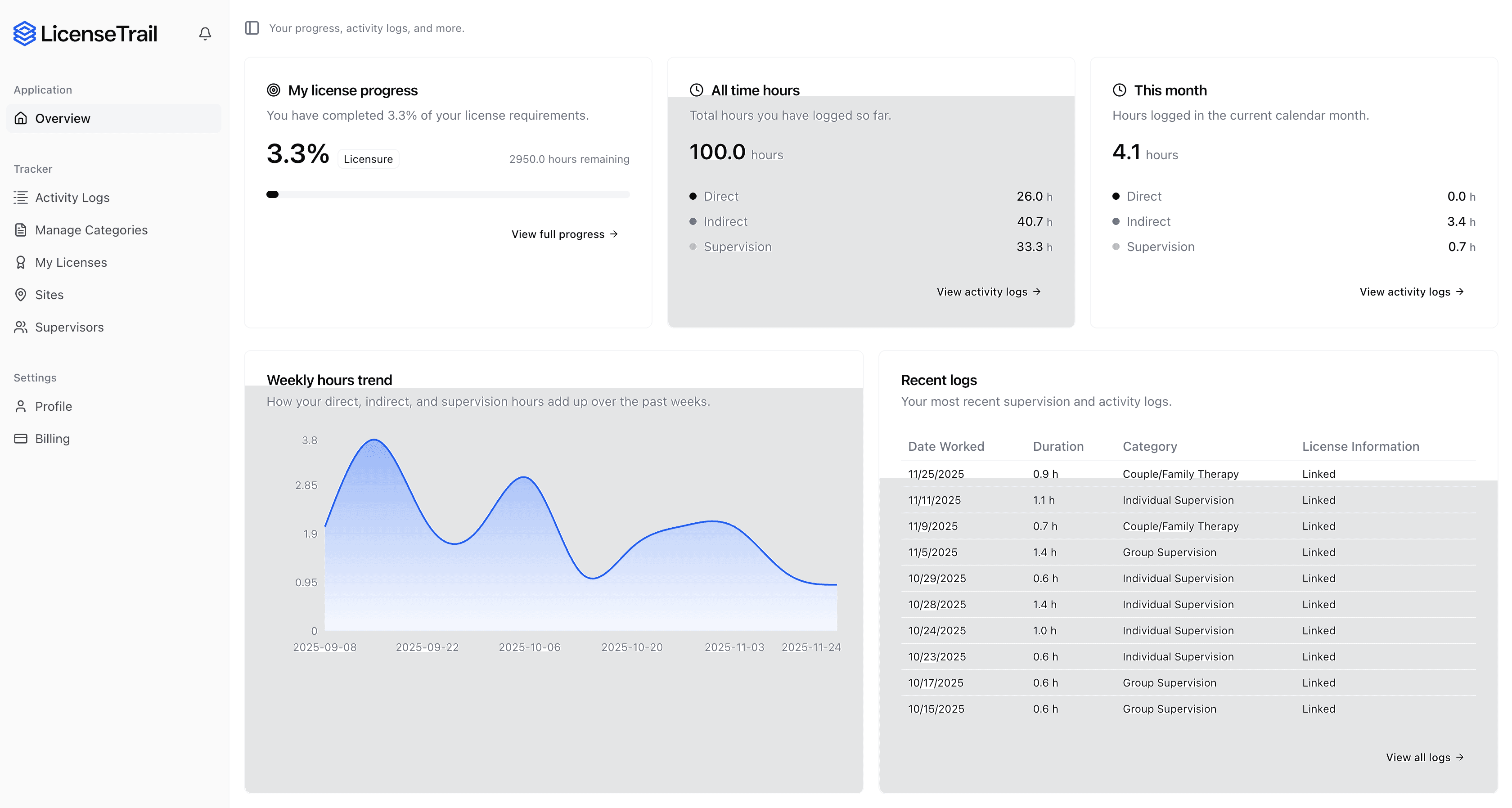
License Trail checks your direct, indirect, and supervision hours against Montana LCPC requirements continuously and flags mismatches before you submit.
 Start Tracking for Free
No credit card required · Free plan available
Is your spreadsheet hiding Montana LCPC risks?
Stop guessing if your categories match Montana Board of Behavioral Health requirements. License Trail checks your direct, indirect, and supervision hours continuously and flags mismatches before you submit.
Import or log
Bring your spreadsheet or start fresh
Upload your existing tracking spreadsheet and we'll map every hour into the right Montana Board of Behavioral Health categories automatically.
Verify against Montana
Catch mismatches before the board does
License Trail checks your direct, indirect, and supervision hours against Montana LCPC requirements continuously.
Export board-ready
One-click clean reports
Generate professional, board-ready reports for supervision meetings and Montana Board of Behavioral Health submissions in seconds.
No credit card required · Free plan available