
New-hampshire LCMHC Requirements: Hours, Exams & Step-by-Step Guide
Stop guessing if your categories match New-hampshire requirements. License Trail checks your direct, indirect, and supervision hours against LCMHC requirements continuously and flags mismatches before you submit.
No credit card required · Free plan available
Quick Requirements Overview
- Education: 60‑semester‑credit master’s/doctoral in Clinical Mental Health Counseling (CACREP or equivalent; ≥2 academic years)
- If non‑CACREP: document equivalent program incl. ≥700‑hour practicum/internship (counts toward degree only, not post‑master’s hours)
- Pre-approval required: Board-approved Candidate for Licensure: Supervision Agreement before any post‑master’s hours will count
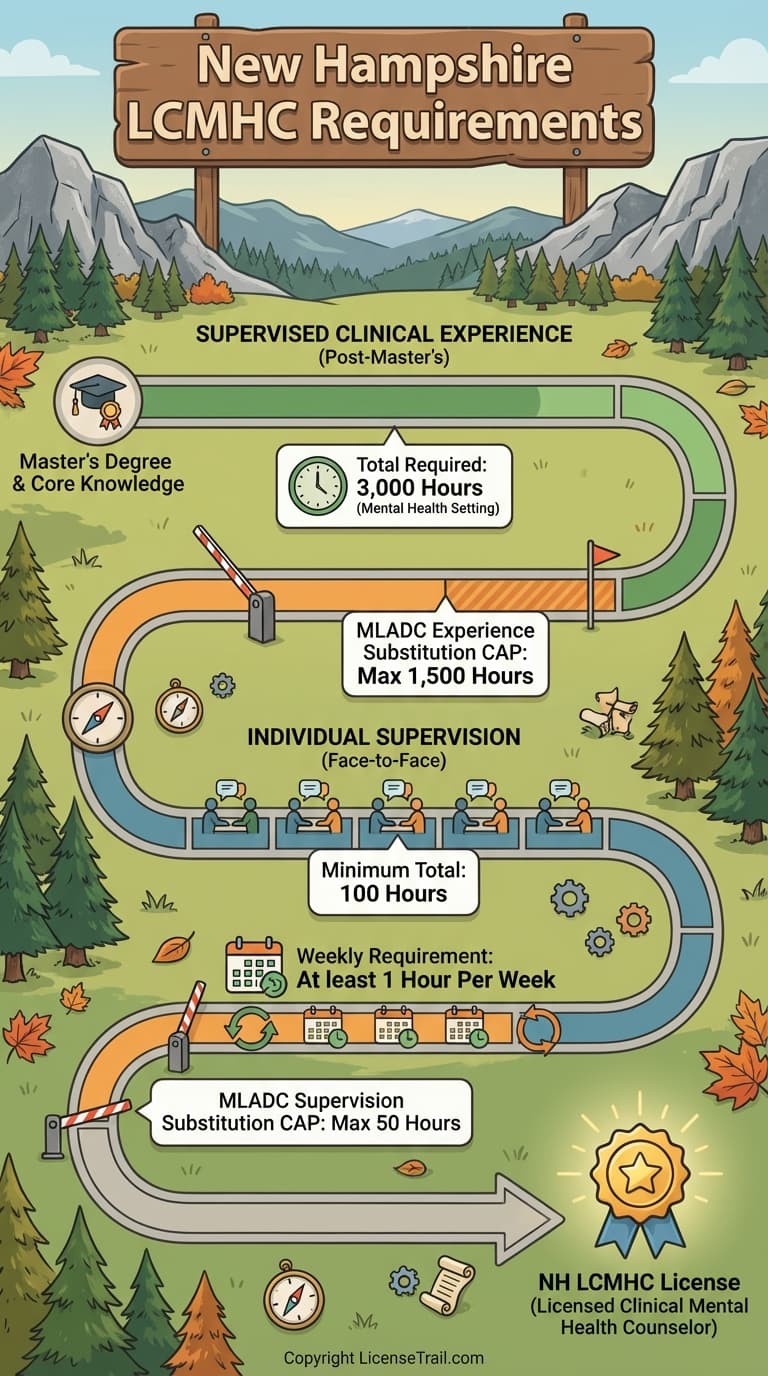
- Post‑master’s experience: 3,000 hours paid, supervised clinical work in a mental health setting over ≥2 years
- Year definition: each “year” = ≥1,500 hours completed in 12–24 consecutive months
- Supervision: ≥100 hours individual, face‑to‑face supervision (≈1 hr/week); HIPAA‑compliant synchronous virtual allowed
- Exclusions/limits: no class/practicum/internship or pre‑degree hours; no supervisee‑owned independent practice; private practice must be W‑2 (not 1099)
- Exam: pass NCMHCE (NBCC) and send scores to the Board
License Details
Procedures
New Hampshire regulates Licensed Clinical Mental Health Counselors (LCMHCs) through the Board of Mental Health Practice, housed in the Office of Professional Licensure and Certification (OPLC). To obtain this license, you must meet specific education, supervised experience, examination, and application requirements laid out in statute (RSA 330‑A) and in the administrative rules (Mhp 300‑series).
Below is a step‑by‑step breakdown, with an emphasis on how the state defines and counts your hours.
1. Degree and program requirements
New Hampshire statute requires that an LCMHC applicant:
- Hold a 60‑credit master’s or doctoral degree in clinical mental health counseling from a CACREP‑accredited institution, or an equivalent 60‑credit program from a regionally accredited institution. (gc.nh.gov)
Key points from the rules and state‑summaries:
- The program must be at least 60 semester credits and at least two academic years (or four semesters) in length. (counselingschools.com)
- If it is not CACREP‑accredited, you must demonstrate that it is equivalent, including a minimum 700‑hour practicum/internship in mental health counseling as part of the graduate program. (counselingschools.com)
These practicum/internship hours are part of the education requirement; they do not count toward your post‑master’s supervised clinical experience for licensure (see Section 3). (gc.nh.gov)
2. Becoming a “candidate for licensure” and supervision agreement
Before New Hampshire will credit any supervised post‑degree hours toward LCMHC licensure, you must have an approved “Candidate for Licensure: Supervision Agreement” on file with the Board.
The Mhp 300 rules specify that:
- No hours of supervised practice are credited until the “Candidate for Licensure: Supervision Agreement” has been approved by the Board. (gc.nh.gov)
In practice:
- You complete your qualifying 60‑credit CMHC degree.
- You and your proposed supervisor submit a Candidate for Licensure: Supervision Agreement to the Board.
- Once the Board approves it, you hold a supervised status (often described informally as a “candidate” or post‑graduate supervisee), and only then do your supervised clinical hours begin to count toward the LCMHC requirement.
3. Post‑master’s supervised clinical experience: hours and structure
3.1 Statutory requirement (RSA 330‑A:19)
The governing statute for LCMHCs (RSA 330‑A:19) states that the Board will issue a clinical mental health counselor license to a person who, among other things:
- Has completed “a minimum of 2 years of post‑masters experience including completion of a minimum of 3,000 hours of post‑masters, supervised clinical experience” under a Board‑approved supervisor. (gc.nh.gov)
So the statutory core requirement is:
- 2 years minimum post‑master’s experience
- 3,000 hours of post‑master’s, supervised clinical experience
3.2 How the rules define a “year” and the 3,000 hours
The administrative rules under Mhp 300 build out what that means in practice for clinical mental health counselors. In summary they require that: (gc.nh.gov)
- Applicants must complete at least 2 years of post‑master’s or doctoral supervised clinical work experience in a mental health setting.
- A year of supervised clinical work experience is defined as not less than 1,500 hours, completed within not less than 12 months and not more than 24 consecutive months.
- The post‑graduate supervised clinical experience must total 3,000 hours.
Taken together:
For LCMHC in New Hampshire, you must complete 3,000 hours of post‑master’s supervised clinical work experience, accumulated over at least 2 years, with each year consisting of at least 1,500 hours within a 12–24 month window.
These hours must be paid clinical work in a mental health setting, not volunteer hours. (mentalhealthcounselorlicense.com)
3.3 Direct client hours vs. “other” hours
Unlike some states, New Hampshire does not divide the 3,000 hours into a fixed ratio of “direct client contact” vs. “indirect” hours for LCMHCs in statute or rule.
Instead, the language used is “post-masters, supervised clinical experience” and “post-master’s or doctoral supervised clinical work experience in a mental health setting.” (gc.nh.gov)
In practice:
- Most of your 3,000 hours are expected to be direct clinical work with clients (assessment, treatment planning, individual, group, and family counseling).
- The Board does not specify something like “1,500 hours must be direct client contact and 1,500 hours may be indirect activities.”
- However, your confirmation forms require reporting the “total hours of paid supervised clinical work experience” and the hours of individual face‑to‑face supervision, which keeps the focus on true clinical work. (gc.nh.gov)
So the requirement is best expressed as:
3,000 hours of paid, post‑master’s supervised clinical work experience, rather than a split between “direct” and “supervised” hours.
3.4 Required supervision within those 3,000 hours
Within the 3,000 hours, the rules require a specified level of individual, face‑to‑face supervision:
- Supervision must provide at least one hour per week of individual face‑to‑face supervision between supervisor and applicant, for a total of at least 100 hours of such supervision over the supervised period. (gc.nh.gov)
Board language emphasizes that acceptable supervised experience:
- Requires face‑to‑face contact with a supervisor who is responsible for the clinical development and guidance of the supervisee and is familiar with the supervisee’s work and setting. (gc.nh.gov)
3.5 What does not count toward the 3,000 hours
The rules are explicit about exclusions:
- Class work, practicum, internship, or other course‑related experiences do not count toward the required post‑master’s supervised experience. (gc.nh.gov)
- Hours accrued before your qualifying clinical graduate degree is conferred do not count.
- Independent private practice run by the supervisee is not acceptable as supervised professional experience.
- If supervised experience occurs in private practice, the supervisee must have a W‑2 employment relationship; a 1099 independent‑contractor relationship does not qualify. (gc.nh.gov)
3.6 Supervisor qualifications and setting
Your post‑master’s supervision must be provided by someone who:
- Is licensed in the state where the supervision occurs.
- Meets the Board’s criteria for supervision (for LCMHCs, typically a licensed clinical mental health counselor or licensed independent clinical social worker approved by the Board, in line with RSA 330‑A:19). (gc.nh.gov)
- Has at least 2 years of clinical practice and no recent disciplinary sanctions, and is not a relative or in a dual relationship that would impair objectivity. (gc.nh.gov)
Supervision may occur:
- On site where you deliver services,
- At another mutually agreeable, ethically appropriate location, or
- Through a HIPAA‑compliant synchronous virtual platform. (gc.nh.gov)
3.7 Special rule for MLADC license holders
If you hold a current Master Licensed Alcohol and Drug Counselor (MLADC) license, both statute and rules allow substitution of some of those hours:
- You may substitute up to 1,500 hours of your MLADC supervised clinical experience for 1,500 of the 3,000 required LCMHC hours.
- You may also substitute up to 50 hours of face‑to‑face supervision toward the 100‑hour supervision requirement. (gc.nh.gov)
The Board must provide a rationale if it does not allow the full 1,500‑hour substitution, and cannot deny the substitution solely because your MLADC supervisor held a different license. (gc.nh.gov)
4. Examination requirement
New Hampshire requires passage of the National Clinical Mental Health Counseling Examination (NCMHCE):
- RSA 330‑A:19 specifies that you must pass “the clinical mental health counselor's proctored examination of the National Board for Certified Counselors, Inc.” (gc.nh.gov)
- The NCMHCE is administered by NBCC; New Hampshire does not require state pre‑authorization to sit for it, but you must have your scores sent to the Board. (publichealthonline.org)
5. Application to the Board
Once education, supervised experience, and exam are complete, you apply to the New Hampshire Board of Mental Health Practice for your LCMHC license.
Typical application components include: (gc.nh.gov)
-
Completed LCMHC application form, including:
- Demographic information
- Education history
- Disclosure questions (discipline, criminal history, etc.)
-
Summary of supervised clinical experience form (for you):
- Start/end dates of each supervised position
- Facility and supervisor names
- Total hours of paid supervised clinical work experience at each setting
- Total individual face‑to‑face supervision hours at each setting
- Total supervised clinical hours across all settings
-
Supervisor’s Confirmation of Clinical Experience:
- Supervisor verifies your total paid supervised clinical work hours and face‑to‑face supervision hours
- Description of the supervision methods, issues covered, and the nature and quality of your clinical work.
-
Three professional references, at least one from a supervisor, on Board‑supplied forms, returned to you in sealed, signed envelopes.
-
Official transcripts documenting your qualifying 60‑credit CMHC degree.
-
NCMHCE exam scores sent directly to the Board.
-
Criminal background information, such as a Criminal Offender Record Report for each state where you have lived in the previous 5 years (as currently described in licensure summaries). (counselingschools.com)
-
Fees:
- Application and initial licensure fees as set by rule (amounts may change, so they must be checked on current Board forms). (gc.nh.gov)
6. After licensure: renewal and continuing education (briefly)
While not part of initial licensing, it is useful to note that LCMHC licenses in New Hampshire:
- Are generally renewed every 2 years.
- Require 40 continuing education units (CEUs) per renewal period, including at least 6 hours in ethics. (counselingschools.com)
7. Quick numerical summary of the New Hampshire LCMHC requirements
Education
- 60‑credit master’s or doctoral degree in Clinical Mental Health Counseling.
- CACREP‑accredited or equivalent regionally accredited program.
- Embedded supervised practicum/internship of at least 700 hours (for non‑CACREP programs, must be documented explicitly). (counselingschools.com)
Supervised post‑master’s experience
- Total hours:
- 3,000 hours of post‑master’s supervised clinical work experience in a mental health setting. (gc.nh.gov)
- Time frame:
- At least 2 years post‑master’s.
- Each “year” = at least 1,500 hours completed within 12–24 consecutive months. (gc.nh.gov)
- Supervision within those hours:
- At least 100 hours of individual, face‑to‑face supervision, typically one hour per week. (gc.nh.gov)
- Nature of hours:
- Paid, supervised clinical work in a mental health setting.
- Not classwork, practicum, or internship; not pre‑degree hours; not independent practice owned by the supervisee; and not 1099 contractor work in private practice. (gc.nh.gov)
- Substitution for MLADC licensees (if applicable):
- Up to 1,500 hours of the 3,000 and up to 50 supervision hours may be substituted with qualifying MLADC experience, at the Board’s discretion. (gc.nh.gov)
Exam
- Pass the NCMHCE (NBCC). (gc.nh.gov)
Board process
- Have an approved Candidate for Licensure: Supervision Agreement on file before supervised hours begin to count.
- Submit application, supervisor verification forms, references, transcripts, exam scores, background checks, and required fees.
This is the framework—statutory and regulatory—that the New Hampshire Board of Mental Health Practice currently uses to license LCMHCs.
Track your LCMHC hours with confidence
License Trail checks your direct, indirect, and supervision hours against New-hampshire LCMHC requirements continuously and flags mismatches before you submit.
 Start Tracking for Free
No credit card required · Free plan available
Is your spreadsheet hiding New-hampshire LCMHC risks?
Stop guessing if your categories match New Hampshire Board of Mental Health Practice requirements. License Trail checks your direct, indirect, and supervision hours continuously and flags mismatches before you submit.
Import or log
Bring your spreadsheet or start fresh
Upload your existing tracking spreadsheet and we'll map every hour into the right New Hampshire Board of Mental Health Practice categories automatically.
Verify against New-hampshire
Catch mismatches before the board does
License Trail checks your direct, indirect, and supervision hours against New-hampshire LCMHC requirements continuously.
Export board-ready
One-click clean reports
Generate professional, board-ready reports for supervision meetings and New Hampshire Board of Mental Health Practice submissions in seconds.
No credit card required · Free plan available