
New-hampshire LPP Requirements: Hours, Exams & Step-by-Step Guide
Stop guessing if your categories match New-hampshire requirements. License Trail checks your direct, indirect, and supervision hours against LPP requirements continuously and flags mismatches before you submit.
No credit card required · Free plan available
Quick Requirements Overview
- Governing law/rules: RSA 330‑A; Board of Mental Health Practice rules Mhp 300 series (title “pastoral psychotherapist/psychotherapist” is protected)
- Baseline eligibility: BA + M.Div. (or equivalent); faith-group authorization (ordination/consecration/equivalent)
- Education pathway: Qualify via Theological Studies (includes required doctoral-level pastoral psychotherapy/psychology & clinical studies content) or Multidisciplinary (requires an active qualifying MH/psychology license + required core body of knowledge)
- Supervised experience (Doctoral/Theological route): 3,000 hours over 2 years (≥1,500 hrs/year), incl. ≥1,375 clinical counseling hrs and ≥250 hrs individual face-to-face supervision
- Supervised experience (Multidisciplinary/already-licensed route): 750 supervised clinical hours (all clinical), incl. ≥50 hrs face-to-face supervision with a board-approved licensed pastoral psychotherapist supervisor
- Supervision rules: Typically ≥2 NH-approved supervisors (≥1 must be an LPP); no relatives/impermissible dual relationships; supervised experience starts after required coursework (and after qualifying license for multidisciplinary route)
- CPE: 1 unit of CPE (ACPE-accredited or NH Pastoral Psychotherapist Association–approved)
- Exam & membership: Pass the NHPPA Pastoral Psychotherapist Licensure Examination (Clinical Theory & Practice) and maintain active NHPPA membership
License Details

Procedures
Licensure as a pastoral psychotherapist in New Hampshire is governed by RSA 330‑A and the Board of Mental Health Practice’s administrative rules (Mhp 300 series). This credential is commonly referred to as “LPP – Licensed Pastoral Psychotherapist,” but in the law and rules it is simply the pastoral psychotherapist license. (gc.nh.gov)
Below is a structured summary of what the Board actually requires, with an emphasis on the precise hour requirements and how they are described in the rules.
1. Who Regulates Licensed Pastoral Psychotherapists in NH?
- Statute: RSA 330‑A (Mental Health Practice)
- Rules: Mhp 300–309 (Board of Mental Health Practice rules)
- Title protection: It is unlawful to call yourself a “pastoral psychotherapist” or use the word “psychotherapist” unless you are licensed by the Board or working as a candidate under supervision. (law.justia.com)
2. Basic Statutory Requirements (Apply to All LPP Applicants)
RSA 330‑A:17 requires the Board to license as a pastoral psychotherapist any person who meets all of the following (or their equivalent): (gc.nh.gov)
-
Examination
- Must pass a proctored examination in pastoral counseling, “set and defined by the board.”
-
Academic Degrees
- A baccalaureate degree from an accredited college.
- A Master of Divinity (M.Div.) degree (or equivalent) from a school of theology accredited by the Association of Theological Schools.
-
Religious Authorization
- Must have been authorized by a denomination or faith group (ordination, consecration, or equivalent) to exercise specific religious leadership and service on behalf of that group.
The detailed implementation of those statutory requirements is in the Board’s rules at Mhp 303.01–303.04. (law.cornell.edu)
3. Educational Pathways: Two Main Concentrations
Under Mhp 303.01, all applicants must qualify under one of two educational “concentrations”: (law.cornell.edu)
3.1. Concentration in Theological Studies
Key points:
- Must meet all standards of RSA 330‑A:17, I–X (degrees, ordination, etc.).
- Degrees must include:
- Baccalaureate degree from a regionally accredited college/university.
- Master of Divinity (M.Div.) from a school of theology accredited by the Association of Theological Schools (or an equivalent theological body of knowledge approved by ACPE and the NH Pastoral Psychotherapist Association).
- A doctoral degree in pastoral psychotherapy or psychology and clinical studies whose content is primarily psychology, pastoral counseling/psychotherapy, and clinical studies, or an equivalent program in subject matter and extent of training. (law.cornell.edu)
- The academic work must cover a detailed set of areas (theories of personality, group dynamics, psychopathology, psychology of religious experience, integration of psychology and spirituality, etc.).
3.2. Concentration in Multidisciplinary Studies
Key points:
- Must already hold a current active license recognized by the NH Board of Mental Health Practice or the NH Board of Psychologists (e.g., clinical mental health counselor, clinical social worker, marriage and family therapist, psychologist). (law.cornell.edu)
- Must complete a defined multidisciplinary core body of knowledge, including:
- “Area I: Core Clinical Theory” (minimum graduate semester hours in counseling theory, group dynamics, couples/family systems, diversity, and advanced clinical topics).
- “Area II: Pastoral Counseling Foundations” (graduate work in sacred texts, theology/ethics, history of pastoral care and counseling, pastoral diagnosis, basic pastoral care, spirituality, pastoral theology, faith development, etc.). (law.cornell.edu)
The clinical hour requirements differ between these two concentrations, which is where Mhp 303.02 and 303.03 come in.
4. Supervised Experience and Hour Requirements
There are two main supervised‑experience patterns relevant to pastoral psychotherapist applicants:
- 3000‑hour model – for applicants using a doctoral degree in clinical psychology/pastoral psychotherapy (theological studies concentration).
- 750‑hour model – for applicants using a multidisciplinary concentration and an existing mental health license.
4.1. 3000‑Hour Path: Doctoral/Clinical Psychology Route (Mhp 303.02)
Rule: “Practical Experience for Pastoral Psychotherapists Who Graduated With a Doctoral Degree in Clinical Psychology,” Mhp 303.02. (regulations.justia.com)
This is the core experiential requirement for applicants whose advanced degree is a doctoral program in psychology/clinical studies related to pastoral psychotherapy. The rule states:
-
Total duration and hours
- Applicants must complete 2 years of supervised experience in pastoral psychotherapy.
- “A year of experience shall be not less than 1500 hours.”
- In practice: 3000 total supervised hours over at least 24 months.
-
Breakdown of those 3000 hours
- At least 1,375 hours must be clinical counseling hours (direct clinical work with clients in a pastoral psychotherapy context).
- Must include at least 250 hours of individual face‑to‑face supervision.
- The supervision requirement (250 hours) is part of the supervised experience total, not a separate 250 outside the 3000.
-
Supervision structure
- Supervision must be provided by at least two different New Hampshire state‑approved supervisors, and at least one must be a licensed pastoral psychotherapist, per Mhp 302.01(c). (regulations.justia.com)
- Supervisors cannot be relatives (spouse, parent, step‑parent, in‑laws, child, sibling, etc.) and may not have a “dual relationship” that could impair objectivity, as referenced in Mhp 501.02(c). (regulations.justia.com)
-
Timing relative to education
- Supervised experience must begin after completion of the academic/coursework portion of the postgraduate pastoral counseling studies.
-
Content of experience
- The hours must be “adequately divided” so the applicant gains competence in:
- intake and referral consultation;
- individual therapy;
- group therapy;
- marriage and divorce counseling;
- family therapy. (regulations.justia.com)
- The hours must be “adequately divided” so the applicant gains competence in:
-
What does not count
- Supervised experience does not include class work, practicum, or other course‑related experiences.
- “Independent private mental health practice shall not be considered supervised professional experience.”
- If experience is accrued in a private practice, the supervisee must have a W‑2 employment relationship with the site (not a 1099 independent contractor). (regulations.justia.com)
-
Clinical Pastoral Education (CPE) requirement
- Applicants must show satisfactory completion of one unit of Clinical Pastoral Education (CPE) accredited by the Association for Clinical Pastoral Education or training approved by the New Hampshire Pastoral Psychotherapist Association. (regulations.justia.com)
In other words (hours in plain numbers):
- Total supervised pastoral psychotherapy: 3,000 hours minimum
- Of which must be direct clinical counseling: at least 1,375 hours
- And must be 1:1 individual supervision: at least 250 hours
- Minimum yearly total: 1,500 supervised hours each year, over 2 years
This is more specific than “1,500 hours of direct experience and 1,500 of supervised experience.” The New Hampshire rule explicitly sets a 3,000‑hour supervised total, with minimums for direct clinical work and for face‑to‑face supervision embedded within that total.
4.2. 750‑Hour Path: Multidisciplinary / Already‑Licensed Route (Mhp 303.03)
The Board also provides a substantially smaller supervised‑experience requirement for applicants who already hold a mental health license and complete a multidisciplinary concentration in pastoral psychotherapy.
In Mhp 303.03 (“Practical Experience for Pastoral Psychotherapists Who Have a Mental Health License in Another State”) and the related text incorporated at Mhp 303.03 for “applicants applying with multidisciplinary concentration,” the Board sets out the following: (law.cornell.edu)
For applicants with a mental health license and multidisciplinary concentration:
-
Total supervised pastoral psychotherapy
- Must complete 750 hours of supervised experience in pastoral psychotherapy.
-
All hours are clinical
- The rule requires that all 750 hours be clinical counseling hours (that is, the whole block is direct clinical pastoral psychotherapy, not administrative or non‑clinical time).
-
Supervision requirements
- All 750 hours must be under supervision by a board‑approved, licensed pastoral psychotherapist supervisor.
- Must complete 50 hours of face‑to‑face supervision with a board‑approved licensed pastoral psychotherapist supervisor.
- Supervision must begin after:
- obtaining a license from the NH Board of Mental Health Practice or the NH Board of Psychologists; and
- completing the defined core body of knowledge coursework.
- The applicant may not have a personal relationship with the supervisor (as described in Mhp 302.03(b)(3)).
Additional pastoral requirements for this group:
- Must provide evidence of satisfactory completion of one unit of CPE approved by the NH Pastoral Psychotherapist Association.
- Supervision must involve at least two different New Hampshire state‑approved supervisors, at least one of whom is a licensed pastoral psychotherapist. (law.cornell.edu)
In plain numbers for the multidisciplinary route:
- Total supervised pastoral psychotherapy: 750 hours
- All 750 hours must be direct clinical counseling under supervision
- Individual face‑to‑face supervision: at least 50 hours
- CPE: 1 unit of CPE required
5. Other Board‑Specific Requirements for All LPP Applicants
Under Mhp 303.04 – Other Requirements for Pastoral Psychotherapists, every applicant (regardless of pathway) must: (gc.nh.gov)
-
Pass the state‑specific pastoral psychotherapy exam
- Take and pass the New Hampshire Pastoral Psychotherapist Association (NHPPA) Pastoral Psychotherapist Licensure Examination: Clinical Theory and Practice.
-
Maintain professional membership
- Hold active membership in the New Hampshire Pastoral Psychotherapist Association (NHPPA).
Combined with RSA 330‑A:17, this means that in addition to the supervised hours, applicants must show:
- Required degrees (BA, M.Div., doctoral or qualifying degree depending on the track),
- Ordination/authorization by a faith group,
- Passing score on the board‑recognized exam,
- Active NHPPA membership. (gc.nh.gov)
6. Application Processes for In‑State and Out‑of‑State Professionals
The same hour and coursework rules (Mhp 303.01–303.03) are referenced in the application procedures for those already licensed in another state.
6.1. If You Are Licensed in Another State for 5 Years or Less
Under Mhp 302.06, applicants who wish to be licensed as pastoral psychotherapists in NH and who are already licensed elsewhere for 5 years or less must: (regulations.justia.com)
- Submit the standard application form (as specified in Mhp 302.05).
- Pass the pastoral psychotherapist examination (Mhp 303.05 / NHPPA exam).
- Meet the educational requirements in Mhp 303.01 (theological or multidisciplinary).
- Meet the coursework specifics in Mhp 303.01.
- Meet the supervision requirements in:
- Mhp 303.02 if applying with a doctoral degree in clinical psychology (the 3000‑hour path).
- Mhp 303.03 if applying with a mental health license (the 750‑hour path).
- Submit documents for a criminal history records check.
6.2. If You Are Licensed in Another State for 5 Years or More (Fast Track)
Under Mhp 302.07, those actively licensed as a mental health professional in another state for 5 or more years in good standing may use a “fast track” application. They still submit the universal application and criminal record check, and must show that their prior exam and credentials are compatible with NH requirements, but the Board can accept equivalency more flexibly. (law.cornell.edu)
Even on the fast track, the underlying expectation is that your education and supervised experience are equivalent to what Mhp 303.01–303.03 require for pastoral psychotherapists.
7. Practical Summary of Hour Requirements by Path
To make the core numerical requirements clear, here is a side‑by‑side summary:
Path A – Theological/Doctoral Route (Mhp 303.02)
For applicants using a doctoral degree in clinical psychology/pastoral psychotherapy:
-
Total supervised pastoral psychotherapy:
- 3,000 hours (over at least 2 years)
- The Board’s rule states that “a year of experience shall be not less than 1500 hours”, and requires 2 years. (regulations.justia.com)
-
Within those 3,000 hours:
- Clinical counseling (direct client care): at least 1,375 hours.
- Individual, face‑to‑face supervision: at least 250 hours.
- Must include competence across intake/referral, individual, group, couple/marriage/divorce, and family therapy.
-
Plus:
- 1 unit of CPE (ACPE‑accredited or approved by NH Pastoral Psychotherapist Association).
- Supervision must involve at least 2 state‑approved supervisors, one of whom is a licensed pastoral psychotherapist.
Path B – Multidisciplinary / Already‑Licensed Route (Mhp 303.03)
For applicants who already hold a mental health license and meet the multidisciplinary coursework:
-
Total supervised pastoral psychotherapy:
- 750 hours.
-
Within those 750 hours:
- All 750 hours must be clinical counseling hours in pastoral psychotherapy.
- Face‑to‑face supervision: at least 50 hours with a board‑approved licensed pastoral psychotherapist supervisor.
-
Plus:
- 1 unit of CPE approved by the NH Pastoral Psychotherapist Association.
- Supervision by at least 2 NH‑approved supervisors, at least one a licensed pastoral psychotherapist.
- Supervision must begin after obtaining the qualifying mental health license and completing the core body of knowledge.
8. Key Takeaways
- New Hampshire does not simply require “1,500 hours of direct experience and 1,500 hours of supervised experience” for pastoral psychotherapist licensure.
- Instead, for the doctoral/theological route, the Board specifies:
- 3,000 supervised hours of pastoral psychotherapy over at least two years,
- 1,375 clinical counseling hours, and
- 250 hours of individual face‑to‑face supervision, plus 1 CPE unit and specific supervision conditions. (regulations.justia.com)
- For the multidisciplinary/already‑licensed route, the Board requires:
- 750 supervised hours of pastoral psychotherapy, all clinical counseling,
- 50 hours of face‑to‑face supervision, plus 1 CPE unit and similar supervision safeguards. (law.cornell.edu)
- All applicants must also:
- Meet the educational and ordination/authorization standards in RSA 330‑A:17 and Mhp 303.01,
- Pass the NHPPA Pastoral Psychotherapist Licensure Examination: Clinical Theory and Practice, and
- Maintain active membership in the New Hampshire Pastoral Psychotherapist Association. (gc.nh.gov)
This is the current Board‑defined framework for becoming licensed as a pastoral psychotherapist (LPP) in New Hampshire as of late 2025.
Track your LPP hours with confidence
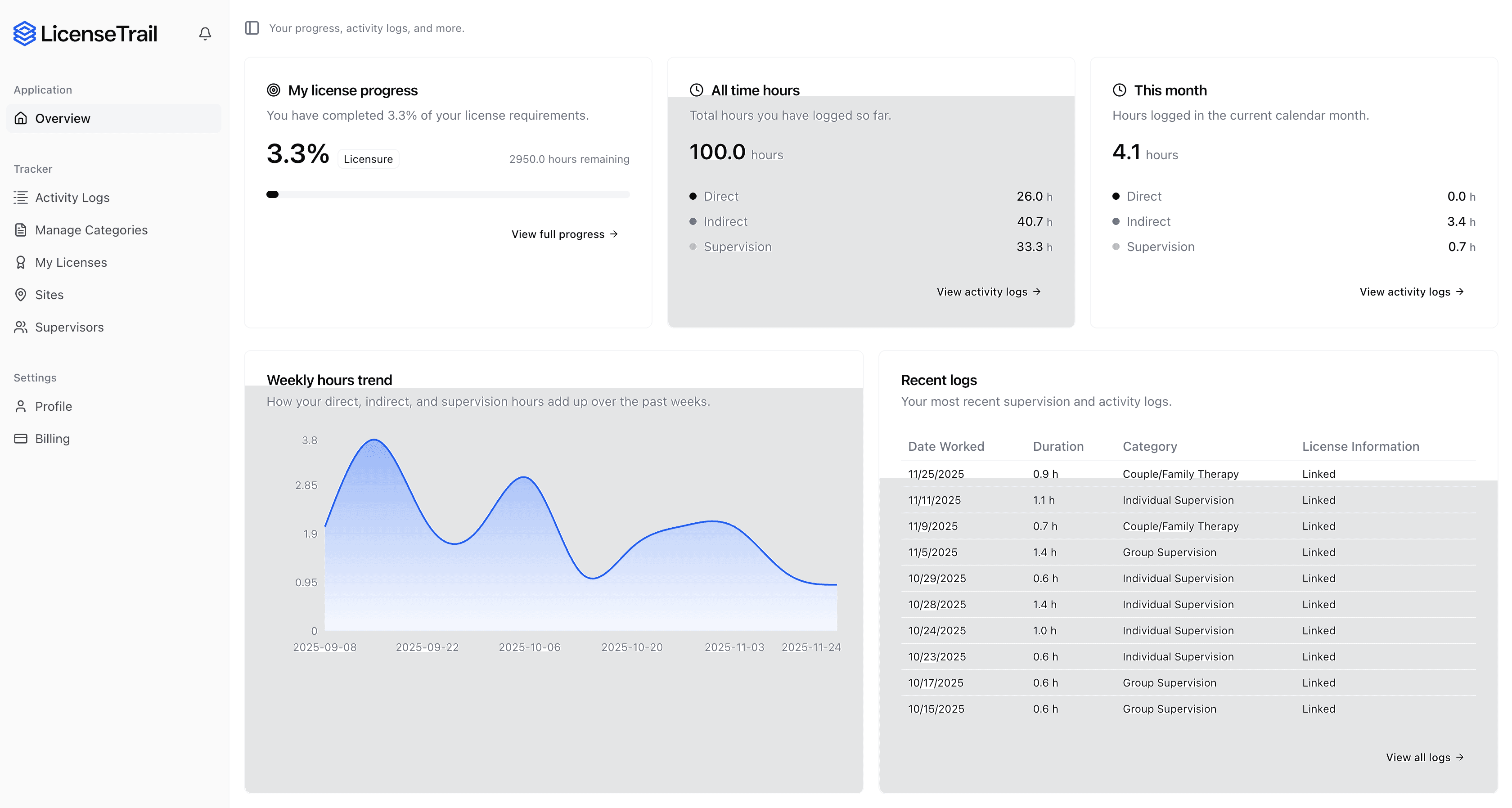
License Trail checks your direct, indirect, and supervision hours against New-hampshire LPP requirements continuously and flags mismatches before you submit.
 Start Tracking for Free
No credit card required · Free plan available
Is your spreadsheet hiding New-hampshire LPP risks?
Stop guessing if your categories match New Hampshire Board of Mental Health Practice requirements. License Trail checks your direct, indirect, and supervision hours continuously and flags mismatches before you submit.
Import or log
Bring your spreadsheet or start fresh
Upload your existing tracking spreadsheet and we'll map every hour into the right New Hampshire Board of Mental Health Practice categories automatically.
Verify against New-hampshire
Catch mismatches before the board does
License Trail checks your direct, indirect, and supervision hours against New-hampshire LPP requirements continuously.
Export board-ready
One-click clean reports
Generate professional, board-ready reports for supervision meetings and New Hampshire Board of Mental Health Practice submissions in seconds.
No credit card required · Free plan available