
New-hampshire LMFT Requirements: Hours, Exams & Step-by-Step Guide
Stop guessing if your categories match New-hampshire requirements. License Trail checks your direct, indirect, and supervision hours against LMFT requirements continuously and flags mismatches before you submit.
No credit card required · Free plan available
Quick Requirements Overview
- Education: Master’s/doctorate in MFT (COAMFTE) or related mental health degree + COAMFTE post‑grad training or regionally accredited degree w/ MFT concentration; AAMFT clinical membership may qualify as equivalent
- Graduate practicum/internship (pre‑degree): ≥1 year supervised by AAMFT‑approved supervisor; ≥300 face‑to‑face client hours (individuals/couples/families), ≥150 with couples/families
- Before post‑grad hours count: Board‑approved “Candidate for Licensure: Supervision Agreement” + conditional license (typically up to 2 years, one renewal possible)
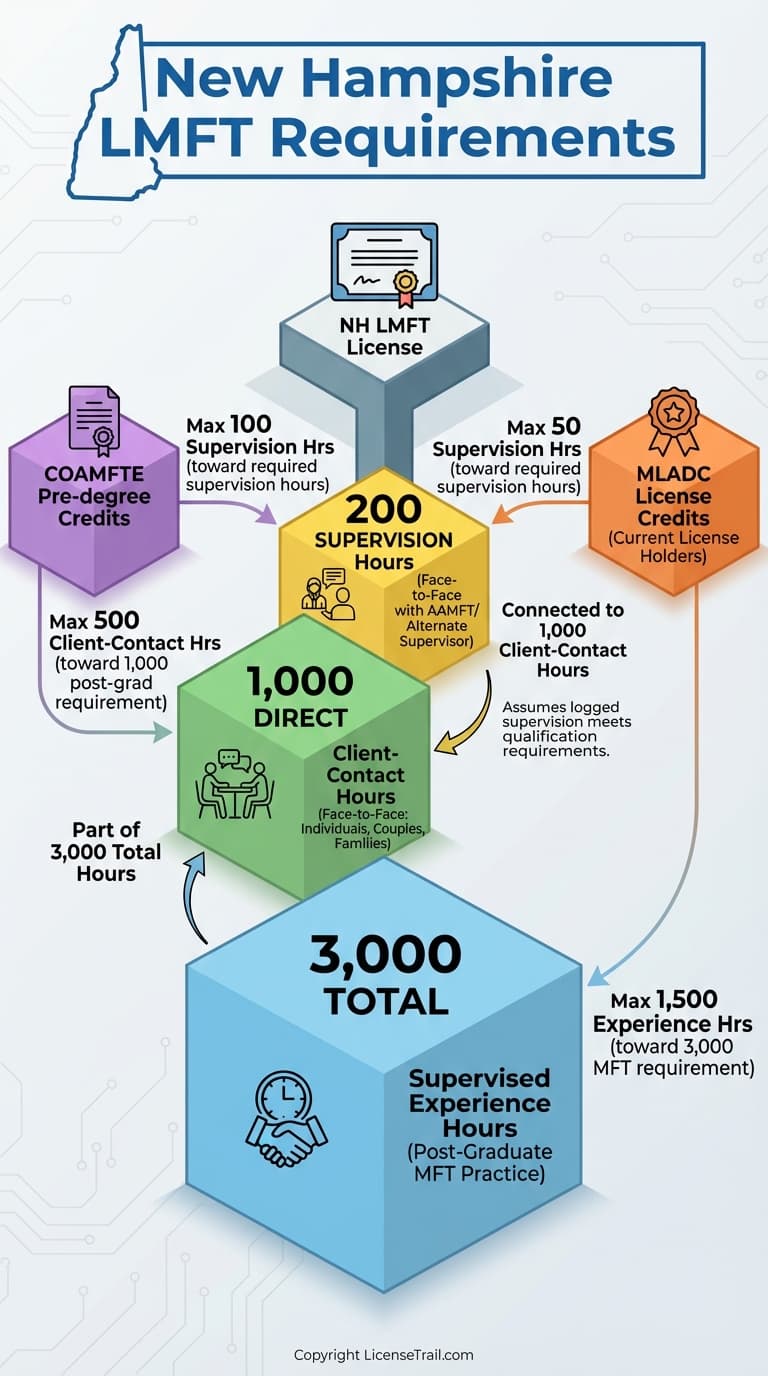
- Post‑graduate practical experience: 3,000 hours total over ≥2 years; each “year” ≥1,500 hours completed in 12–24 consecutive months
- Within 3,000 hours: ≥1,000 supervised face‑to‑face clinical client contact hours with individuals/couples/families
- Supervision: 200 hours face‑to‑face supervision for those client‑contact hours by AAMFT‑approved (or alternate) supervisor; plus ≥1 hour/week individual face‑to‑face supervision during experience
- Exam & background check: Pass AMFTRB national LMFT exam; complete NH criminal history check (fingerprints/release)
- Key counting rules/options: No independent private practice; private‑practice setting must be W‑2 (not 1099); COAMFTE grads may credit up to 500 client hours + 100 supervision hours; MLADC may substitute up to 1,500 hours + 50 supervision hours (Board approval)
License Details
Procedures
Licensure as a Licensed Marriage and Family Therapist (LMFT) in New Hampshire is governed by RSA 330‑A and the Board of Mental Health Practice’s administrative rules in Chapter Mhp 300 and Part Mhp 306. What follows focuses on the exact categories of hours New Hampshire requires and the Board’s own terminology, especially “post‑graduate practical experience,” “supervised face‑to‑face clinical client contact hours,” and “face‑to‑face supervision.” (gc.nh.gov)
1. Education and pre‑degree practicum requirements
Degree requirement
To qualify for LMFT licensure, you must meet one of the following educational pathways: (gc.nh.gov)
- Hold a master’s or doctoral degree in marriage and family therapy from a program accredited by the Commission on Accreditation for Marriage and Family Therapy Education (COAMFTE); or
- Hold a master’s or doctoral degree in a mental health field and complete a post‑graduate training program accredited by COAMFTE; or
- Hold a master’s or doctoral degree with a concentration in marriage and family therapy from a regionally accredited institution.
Statute also recognizes clinical membership in the American Association for Marriage and Family Therapy (AAMFT) as an equivalent educational route. (gc.nh.gov)
Required graduate practicum / internship
Before the degree is completed, New Hampshire requires a substantial supervised practicum or internship in marriage and family therapy: (gc.nh.gov)
- You must complete at least one year of practicum or internship supervised by an AAMFT‑approved supervisor.
- This pre‑degree experience must include a minimum of 300 hours of face‑to‑face client contact with individuals, couples, and families for assessment, diagnosis, and treatment.
- At least half of those 300 hours must be with couples and families.
These 300 hours are part of your educational requirement and are distinct from the post‑graduate practical experience required for full licensure (though some COAMFTE practicum hours and supervision may later be counted toward post‑graduate requirements, as explained below). (gc.nh.gov)
2. Conditional licensure and supervision agreement (before you count any hours)
New Hampshire treats post‑graduate LMFT experience as “candidate” or “conditional” practice that must be pre‑approved.
Conditional license eligibility
To obtain a conditional license as a marriage and family therapist, you must: (gc.nh.gov)
- Hold the qualifying master’s or doctoral degree in family/marriage and family therapy (or an equivalent degree/concentration or AAMFT clinical membership); and
- Obtain a board‑approved supervisory agreement with documented intent to pursue LMFT licensure;
- Meet any other criteria reasonably established by the Board.
Once the supervisory agreement is approved, the Board issues a conditional license, which is generally valid for up to 2 years, with a possible one‑time renewal if you remain in good standing. (gc.nh.gov)
“Candidate for Licensure: Supervision Agreement”
Under Mhp 300, no supervised practice hours count toward licensure until the Board has approved your supervision agreement. The rules state that, pursuant to RSA 330‑A:22, no hours of supervised practice are credited until a “Candidate for Licensure: Supervision Agreement” has been approved by the Board. (gc.nh.gov)
In practice, that means:
- You and your supervisor(s) must submit the Board’s Candidate for Licensure: Supervision Agreement form before you start counting post‑graduate hours.
- If your supervision arrangement changes or cannot meet the terms of the approved agreement, you and the supervisor must notify the Board in writing and may request a modification. (gc.nh.gov)
3. Post‑graduate practical experience: exact hours and categories
The core of LMFT licensure in New Hampshire is the post‑graduate practical experience defined in Mhp 306.02 and in RSA 330‑A:21, III. These two authorities line up and provide a precise breakdown of required hours. (law.cornell.edu)
Overall structure of the experience
The Board’s rules describe this as “post‑graduate practical experience for marriage and family therapists.” The requirements are: (law.cornell.edu)
-
Duration and total hours
- You must complete at least 2 years of supervised experience in the practice of marriage and family therapy.
- A “year of experience” is defined as not less than 1,500 hours, completed over not less than 12 and not more than 24 consecutive calendar months.
- The post‑graduate experience must total 3,000 hours of experience.
In other words, New Hampshire expects a minimum of 3,000 post‑master’s hours over at least 2 years, with each year containing at least 1,500 hours.
-
Ongoing supervision requirement (weekly)
- During these 2+ years, you must have a minimum of one hour per week of individual face‑to‑face supervision.
- This supervision must be provided by a psychologist, clinical mental health counselor, independent clinical social worker, pastoral psychotherapist, or marriage and family therapist licensed in the state where the supervision takes place. (law.cornell.edu)
Breakdown of the 3,000 post‑graduate hours
Within the 3,000 total hours of post‑graduate experience, the rules and statute carve out two key sub‑requirements: (law.cornell.edu)
-
Supervised face‑to‑face clinical client contact hours
- At least 1,000 hours must be “supervised face‑to‑face clinical client contact hours with individuals, couples, and families.”
- These are direct therapy hours (assessment, diagnosis, treatment) with clients in person or through a Board‑accepted “face‑to‑face” modality (which may include HIPAA‑compliant synchronous telehealth, under the telemedicine provision). (law.cornell.edu)
-
Face‑to‑face supervision by an AAMFT‑level supervisor
- For those 1,000 client‑contact hours, the rules require 200 hours of face‑to‑face supervision from an AAMFT‑approved supervisor or AAMFT‑approved alternate supervisor. (law.cornell.edu)
- “Individual supervision” is defined as face‑to‑face contact between one supervisor and up to two supervisees.
- “Group supervision” is face‑to‑face contact between one supervisor and up to six supervisees; both individual and group supervision can count toward the required supervision hours if arranged according to the rules. (law.cornell.edu)
Putting the Board’s categories into a simple summary:
-
Total post‑graduate experience:
- 3,000 hours of supervised post‑master’s practice in marriage and family therapy,
- Over at least 2 years, with no year fewer than 1,500 hours.
-
Within that 3,000 hours:
- 1,000 hours must be supervised face‑to‑face clinical client contact with individuals, couples, and families.
- Within those 1,000 client hours, 200 hours must be face‑to‑face supervision by an AAMFT‑approved supervisor or approved alternate (these are hours of supervision, not additional client hours). (law.cornell.edu)
This is the key hour breakdown the Board uses instead of something like “1,500 direct / 1,500 supervised.” New Hampshire explicitly distinguishes: total hours, client‑contact hours, and supervision hours.
Using COAMFTE graduate hours toward post‑graduate requirements
Graduates of COAMFTE‑accredited master’s and doctoral programs may apply limited pre‑degree experience toward the post‑graduate requirements: (law.cornell.edu)
- You may count up to 100 hours of pre‑degree supervision toward the 200 hours of required face‑to‑face supervision.
- You may count up to 500 face‑to‑face client contact hours earned during your graduate program toward the 1,000 required post‑graduate client‑contact hours.
AAMFT’s summary of New Hampshire also reflects that up to 500 supervised experience hours and 100 hours of direct supervision from COAMFTE graduate training may be counted toward the post‑degree requirement. (aamft.org)
Restrictions on what counts as supervised experience
The Board’s rules also define what does not count: (law.cornell.edu)
- Independent private mental health practice is not considered supervised professional experience.
- If the supervised experience occurs in a private practice, the supervisee must have a W‑2 employment relationship with the site; a 1099 independent contractor relationship does not meet the requirement.
- Supervisors cannot be related to the supervisee (spouse, parent, stepparent, parent‑in‑law, child, sibling, etc.), and must avoid dual relationships that impair objectivity.
If you do not have an AAMFT‑approved supervisor at your worksite, the rules allow outside supervision under a written contract that ensures access to case documentation, clear communication between supervisors, emergency procedures, and at least two worksite visits per year by the AAMFT‑approved supervisor or alternate. (law.cornell.edu)
MLADC substitution option
Both statute and rule recognize that a current Master Licensed Alcohol and Drug Counselor (MLADC) license can substitute for part of the LMFT experience: (law.cornell.edu)
- An applicant holding a current MLADC license issued under RSA 330‑C may substitute up to 1,500 hours of MLADC work experience for 1,500 of the required 3,000 hours of LMFT work experience.
- The applicant may also substitute up to 50 hours of face‑to‑face supervision from MLADC supervision toward the LMFT supervision requirement.
- If the Board denies the full 1,500‑hour substitution, it must provide a rationale and may not deny solely because the supervisor was “only” MLADC‑licensed.
4. National examination requirement
Licensure requires passing the national LMFT exam.
- RSA 330‑A:21 requires that applicants have “passed the national proctored examination of the Association of Marital and Family Therapy Regulatory Boards” (AMFTRB). (gc.nh.gov)
- The Board’s rule Mhp 306.03 provides that applicants must pass the national examination in marital and family therapy distributed by AMFTRB and describes the Board’s “Request to Sit for the Marriage and Family Therapy Exam” form. (gc.nh.gov)
In practice, you must:
- Obtain Board approval to sit for the AMFTRB exam (usually after your education and supervision agreement are in place), and
- Have official exam results sent directly to the Board.
5. Criminal history check and application for full LMFT licensure
Criminal history record check
New Hampshire law requires a criminal history record check for all new mental health licensees: (gc.nh.gov)
- You must submit the State Police’s criminal history record release form and a full set of fingerprints taken by a qualified agency or Department of Safety employee, as described in RSA 330‑A:15‑a and implemented in Mhp 302.05.
Application for full license after hours and exam
Once you have:
- Completed the required education and pre‑degree practicum,
- Held a conditional license with an approved Candidate for Licensure: Supervision Agreement,
- Completed the 3,000 hours of post‑graduate supervised experience, including:
- 1,000 supervised face‑to‑face clinical client contact hours with individuals, couples, and families; and
- 200 hours of face‑to‑face supervision by an AAMFT‑approved supervisor or approved alternate; and
- Passed the AMFTRB national LMFT exam,
you may submit the Board’s application for full LMFT licensure, including: (gc.nh.gov)
- A completed application form (currently the “Universal Application for Initial Licensure”),
- Summary of Supervised Clinical Experience – Marriage and Family Therapist form documenting:
- Dates of each supervised experience,
- Sites and supervisors,
- Total hours of individual supervision for each experience,
- Total clinical hours and total supervised clinical hours across all experiences,
- Official transcripts, exam verification, criminal history documentation, and the required fee.
The Board will then review the application under Mhp 302.03 and 302.07 and either approve or deny licensure, typically within set timelines after receiving a complete application. (gc.nh.gov)
6. Concise hour breakdown (New Hampshire LMFT)
Using the Board’s own categories and terminology, the New Hampshire LMFT requirements can be summarized as:
Pre‑degree (within your graduate program) (gc.nh.gov)
- 300 hours minimum of face‑to‑face client contact (individuals, couples, families) in a practicum or internship supervised by an AAMFT‑approved supervisor.
- At least half (150+) of these hours must be with couples and families.
Post‑degree (post‑graduate practical experience) (law.cornell.edu)
-
Total post‑graduate hours:
- 3,000 hours of post‑master’s, supervised practice of marriage and family therapy,
- Over at least 2 years, with no year fewer than 1,500 hours (each year 12–24 consecutive months).
-
Within those 3,000 hours:
- 1,000 hours must be supervised face‑to‑face clinical client contact with individuals, couples, and families.
- For those 1,000 client‑contact hours, 200 hours must be face‑to‑face supervision by an AAMFT‑approved supervisor or approved alternate.
-
Supervision structure:
- At least one hour per week of individual face‑to‑face supervision over the 2+ years of practice, with a qualified licensed mental health professional in the state of practice.
-
COAMFTE programs may apply:
- Up to 500 pre‑degree client‑contact hours and 100 pre‑degree supervision hours (from COAMFTE‑accredited graduate training) may be counted toward the 1,000 client hours and 200 supervision hours, respectively.
-
MLADC substitution option:
- If you hold a current MLADC license, you may substitute up to 1,500 of the 3,000 post‑graduate hours and up to 50 supervision hours, subject to Board approval.
Together with the required education, exam, conditional license, supervision agreement, and criminal history check, meeting these specific hour requirements is what the New Hampshire Board of Mental Health Practice recognizes as qualifying for licensure as a Licensed Marriage and Family Therapist (LMFT) under RSA 330‑A and the Mhp 306 rules.
Track your LMFT hours with confidence
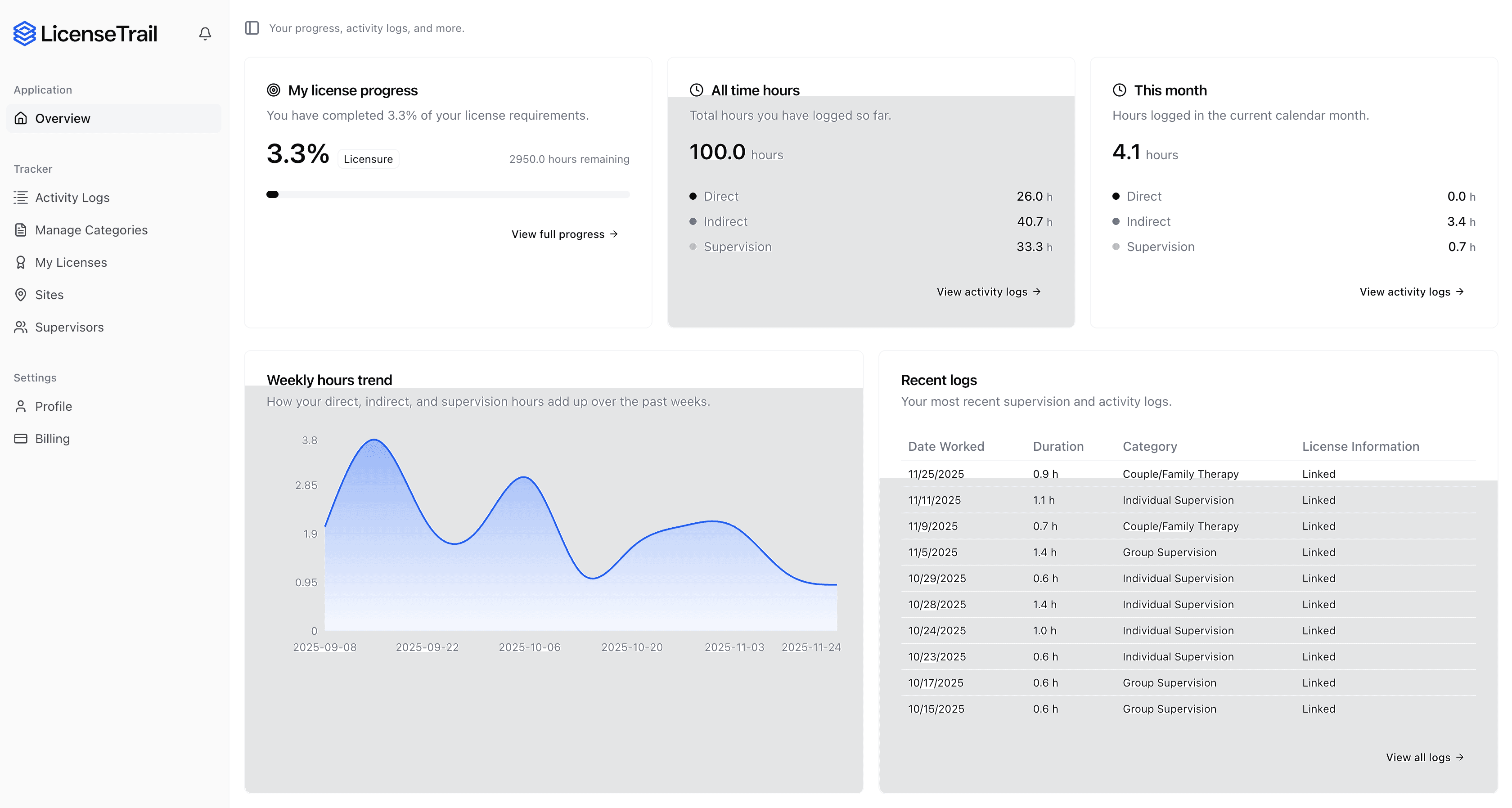
License Trail checks your direct, indirect, and supervision hours against New-hampshire LMFT requirements continuously and flags mismatches before you submit.
 Start Tracking for Free
No credit card required · Free plan available
Is your spreadsheet hiding New-hampshire LMFT risks?
Stop guessing if your categories match New Hampshire Board of Mental Health Practice requirements. License Trail checks your direct, indirect, and supervision hours continuously and flags mismatches before you submit.
Import or log
Bring your spreadsheet or start fresh
Upload your existing tracking spreadsheet and we'll map every hour into the right New Hampshire Board of Mental Health Practice categories automatically.
Verify against New-hampshire
Catch mismatches before the board does
License Trail checks your direct, indirect, and supervision hours against New-hampshire LMFT requirements continuously.
Export board-ready
One-click clean reports
Generate professional, board-ready reports for supervision meetings and New Hampshire Board of Mental Health Practice submissions in seconds.
No credit card required · Free plan available