
New-hampshire LSSW Requirements: Hours, Exams & Step-by-Step Guide
Stop guessing if your categories match New-hampshire requirements. License Trail checks your direct, indirect, and supervision hours against LSSW requirements continuously and flags mismatches before you submit.
No credit card required · Free plan available
Quick Requirements Overview
- Legal basis/board: “School Social Worker” license under RSA 330‑A:18‑a, issued by NH Board of Mental Health Practice (OPLC)
- Degree: MSW (2‑year) or doctorate in Social Work from a CSWE‑approved school (plus an undergraduate degree)
- Experience timeframe: Minimum 2 years post‑master’s experience required
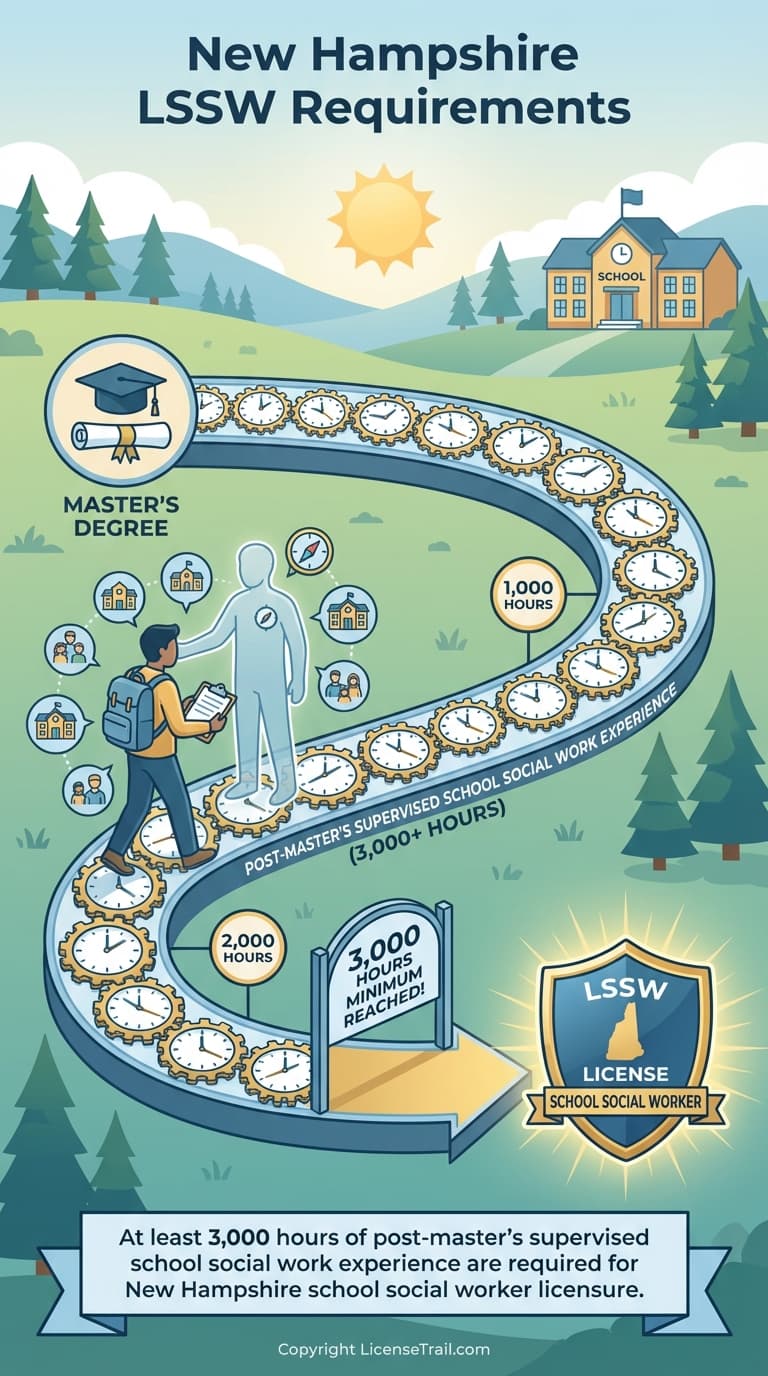
- Hours: 3,000 hours minimum of post‑master’s, supervised school social work experience (single total; no statutory sub‑split)
- Supervision: Must be supervised by a Board‑approved supervisor (e.g., licensed independent school social worker or LCMHC supervisor); supervision agreement approval is expected before accruing hours
- Exam: Pass a Board‑approved national proctored exam
- Documentation: Submit Board forms verifying paid post‑master’s supervised clinical work hours and face‑to‑face supervision hours
- Separate from DOE: NH DOE school social worker educator certification (Ed 508.03) is a separate requirement for working in schools and doesn’t replace the Board license requirements
License Details
Procedures
New Hampshire’s “school social worker” license is created in statute at RSA 330‑A:18‑a and implemented by the New Hampshire Board of Mental Health Practice. This license is what districts often mean when they advertise for a “licensed school social worker” (sometimes abbreviated informally as LSSW), even though the statute itself uses the title “school social worker.” (law.justia.com)
Below is a structured description of what the Board and state law actually require, with attention to the exact types and amounts of hours.
1. License type and agencies involved
Title used in law
- The license is legally called “school social worker” in RSA 330‑A:18‑a. (law.justia.com)
Two separate systems you should be aware of
- NH Department of Education (NH DOE) – issues educator certification as a school social worker under rule Ed 508.03. This is about being allowed to work in K‑12 schools as an educator. (gc.nh.gov)
- Board of Mental Health Practice / Office of Professional Licensure and Certification (OPLC) – issues the school social worker mental‑health license under RSA 330‑A:18‑a. This is the license referenced for mental‑health practice and for Medicaid billing of school‑based services. (law.justia.com)
The question you asked is specifically about the Board of Mental Health Practice license in RSA 330‑A:18‑a; that’s what the rest of this guide focuses on. I will note the DOE educator piece where it matters, but not treat it as the primary subject.
2. Basic statutory requirements for the school social worker license
Under RSA 330‑A:18‑a, the Board “shall issue a school social worker license” to a person who meets one of two pathways: (law.justia.com)
A. Grandfather / conversion pathway (now quite narrow)
You qualify if you:
- Were already certified as a school social worker by the NH Department of Education (bureau of credentialing) and
- Were certified as of the effective date of the statute (March 9, 2020). (gc.nh.gov)
Those individuals could notify OPLC of their intent to be licensed and receive a Board license without documenting the 3,000‑hour post‑master’s requirement, with their initial license fee waived for one period. (law.justia.com)
For anyone entering the field now, that window is effectively closed, so you should assume you must follow the standard (post‑master’s) pathway below.
B. Standard pathway (what new applicants follow)
You must satisfy all of the following: (law.justia.com)
-
Undergraduate degree
- “Has received a college undergraduate degree.” (Any major; the statute does not restrict the major at the undergraduate level.)
-
Graduate degree in social work (CSWE‑approved)
- “Has received a 2‑year master’s degree or doctorate degree in social work from a school approved by the Council on Social Work Education.”
In practice, this means a CSWE‑accredited MSW or DSW/PhD in social work.
-
Post‑master’s supervised school social work experience – this is where the hours come in
- You must have *“a minimum of 2 years of post‑masters experience including completion of a minimum of 3,000 hours of post‑masters, supervised school social work experience.”
- The experience must be supervised by:
“a board approved licensed independent school social worker or licensed clinical mental health counselor supervisor, or any other supervisor based on reasonable and specific criteria established in rules adopted under RSA 330‑A:10.” (law.justia.com)
So, the exact Board language about hours is:
- “minimum of 2 years of post‑masters experience”
- “minimum of 3,000 hours of post‑masters, supervised school social work experience”
There is no split in New Hampshire law for this license such as “1,500 hours direct client contact and 1,500 hours other experience.” It is a single figure: 3,000 total post‑master’s supervised hours over at least two years.
-
Licensing examination
- You must have “passed a national proctored examination approved by the board.” (law.justia.com)
- For clinical social workers, the Board’s rules specify the ASWB Clinical level exam. For school social workers, the statute does not name a specific test, but in practice the Board typically uses an ASWB exam appropriate to the level and scope and designates it as the approved “national proctored examination.”
3. What exactly counts as the 3,000 hours?
The statute and Board rules do not break the 3,000 hours into detailed sub‑categories (e.g., a minimum number of “direct client contact” hours) for school social workers. Instead, they use the broader concept of paid, post‑master’s supervised clinical work in school social work.
The key Board rule that clarifies how they look at hours is Mhp 302.05 (Licensure Application Process), which governs all Board‑licensed mental health professions, including school social workers. For supervised clinical experience, you must submit: (law.cornell.edu)
- A “Summary of Supervised Clinical Experience” form that asks for:
- Start and end dates of each supervised experience
- Hours of individual supervision for each experience
- “Total hours of clinical experiences for each supervised experience”
- “Total hours of supervised clinical experience for all experiences” (this is where the 3,000+ hours show up)
- A “Supervisor’s Confirmation of Clinical Experience” form (specific version for “Clinical Mental Health Counselors, Independent Clinical Social Workers, and … School Social Workers”), which requires your supervisor to verify:
- “Total hours of face‑to‑face supervision”
- “Total hours of paid post‑master’s supervised clinical work experience” (defined as hours per week × weeks worked)
From these Board forms and rules, two things are clear:
-
There are two different categories of hours the Board tracks:
- Total post‑master’s supervised clinical work hours (your 3,000+ hours of school social work practice, paid and supervised), and
- Total hours of face‑to‑face supervision with your supervisor.
-
New Hampshire does not currently specify, in law or rule, a fixed minimum number of supervision hours or of “direct client contact” hours for school social workers, unlike what it does for some other licenses (for example, clinical social workers have an explicit minimum of 100 face‑to‑face supervision hours written into Mhp 304.02). (regulations.justia.com)
Because the school social worker license statute only requires “3,000 hours of post‑masters, supervised school social work experience” and the rules for school social workers do not add a specified breakdown, you should understand the requirement this way:
- Minimum of 3,000 total hours of paid post‑master’s school social work practice,
- All of those hours must be supervised by an approved supervisor,
- You must be able to report and document how many hours you met with that supervisor face‑to‑face, but there is no published rule that says, for example, “100 hours of supervision are required” for this specific license.
Board documents and general supervision rules also make clear:
- Supervised experience is expected to be clinical in nature (screening, assessment, treatment planning, intervention, etc., appropriate to a school social worker’s scope of practice), rather than purely administrative. (gc.nh.gov)
- The “total hours of paid post‑master’s supervised clinical work experience” is the number of hours worked per week multiplied by weeks worked in qualified roles; unpaid internships and student practicum hours are not counted here. (law.cornell.edu)
Timeframe
The statute requires a “minimum of 2 years of post‑masters experience” in addition to the 3,000 hours. (law.justia.com)
Even if you were to reach 3,000 hours more quickly (for instance, working very long weeks), the Board will not issue the license until at least two years have elapsed after your MSW/DSW is awarded, because both the hour requirement and the time requirement must be met.
4. Supervisor requirements and what “supervised” means
Although RSA 330‑A:18‑a names the acceptable license types for supervisors, the specific requirements for supervisors are laid out in Mhp 302.03 (Supervisor Requirements) and in the application‑process rule. (regulations.justia.com)
For your supervised school social work experience to count toward the 3,000 hours:
-
Your primary supervisor must be:
- a licensed independent school social worker, or
- a licensed clinical mental health counselor, or
- another supervisor who meets “reasonable and specific criteria” in Board rules and is approved accordingly. (law.justia.com)
-
The supervisor must:
- Be currently licensed in the state where the supervision occurs,
- Meet Board training requirements in supervision (e.g., graduate‑level supervision coursework or a recognized supervision certificate, plus specified continuing education in supervision), and
- Take legal and ethical responsibility for the supervised activities, including being available for consultation and intervening if your practice exceeds your competence. (regulations.justia.com)
-
Before beginning supervised practice, you and your supervisor must submit a “Candidate for Licensure: Supervision Agreement” to the Board, indicating the school social worker license type as your target. (gc.nh.gov)
The Board’s rules make clear that supervision agreements must be approved before hours begin to accrue, so you should not assume that work you did before the agreement will count.
While the rules for school social workers do not set a numeric supervision minimum, the Board:
- Requires you to document hours per week of face‑to‑face individual supervision and total face‑to‑face supervision hours, and
- Uses similar structures in other licenses where a minimum (such as 100 hours for clinical social workers) is spelled out. (regulations.justia.com)
In practice, many supervision agreements for school social workers in New Hampshire mirror the clinical model (for example, at least one hour of supervision per week while accruing hours), but that level of detail is typically individualized in your supervision contract rather than mandated for this license category in rule text.
5. Relationship to Department of Education certification
To work in a school as a school social worker, you normally also need NH DOE educator certification as a school social worker, established by rule Ed 508.03. The DOE requirements are separate from the Board’s 3,000‑hour licensure requirement and focus on your preparation as a school‑based professional. (gc.nh.gov)
Ed 508.03 requires, in simplified form:
- A master’s‑level program in school social work, or
- An MSW plus either:
- an approved “conversion program” in school social work including a two‑year internship supervised by a licensed school social worker, or
- documented acquisition of school social work knowledge and skills under DOE’s alternative certification routes. (gc.nh.gov)
The DOE internship or conversion program hours are educational hours, not the post‑master’s professional hours the Board counts toward the 3,000‑hour requirement. The Board’s rules for supervised experience for other social work categories specifically say class work, practicum, and other course‑related experiences do not count toward supervised professional experience; the same principle is applied in practice when reviewing your 3,000 post‑master’s hours, even though it is not written in a separate school‑social‑worker‑only rule. (gc.nh.gov)
So, conceptually:
- DOE internship/practicum → part of your graduate education / DOE certification route.
- Board’s 3,000 post‑master’s hours → paid, post‑degree, supervised professional school social work experience.
6. Application package and fees
When you have:
- Completed your degree requirements,
- Accrued at least 2 years and 3,000 hours of qualifying supervised school social work experience under an approved supervision agreement, and
- Passed the Board‑approved national exam,
you submit an application to the Board/OPLC with the documentation required by Mhp 302.05 and the fee schedule in Plc 1002.29. (law.cornell.edu)
The application normally includes:
- Application form for the school social worker license.
- Summary of Supervised Clinical Experience form detailing:
- Each supervised employment setting,
- Dates,
- Total hours of clinical experience and supervised clinical experience. (law.cornell.edu)
- Supervisor’s Confirmation of Clinical Experience form(s), one per supervisor, each in sealed/signed format, verifying:
- Total hours of paid post‑master’s supervised clinical work experience,
- Total hours of face‑to‑face supervision,
- Supervisory methods and quality of your work. (law.cornell.edu)
- Professional references, including at least one from a supervisor. (gc.nh.gov)
- Verification of exam results from ASWB or whichever exam body the Board specifies for the school social worker license. (regulations.justia.com)
- Applicable application and licensing fee as listed for “school social worker” under Plc 1002.29 (the exact dollar amounts change periodically, so the Board directs applicants to the current table). (regulations.justia.com)
7. How the hours question you raised fits New Hampshire’s actual rules
You asked whether the Board divides hours into, for example, “1,500 hours of direct experience and 1,500 hours of supervised experience.” In some states and for some licenses, that type of breakdown is written explicitly into regulation; New Hampshire does this for clinical social workers (3,000 total clinical hours with a required minimum number of face‑to‑face supervision hours), but it does not do so for the school social worker license. (regulations.justia.com)
For school social workers in New Hampshire, the governing texts say:
-
Amount and type of experience:
- “a minimum of 2 years of post‑masters experience”
- “including completion of a minimum of 3,000 hours of post‑masters, supervised school social work experience” under an approved supervisor. (law.justia.com)
-
How it is documented:
- Total hours of paid post‑master’s supervised clinical work experience, and
- Total hours of face‑to‑face supervision, verified on specific Board forms. (law.cornell.edu)
There is no additional, published Board rule at this time that further subdivides those 3,000 hours into required blocks (e.g., “X hours direct client contact,” “Y hours assessment,” etc.) for the school social worker license.
So, in New Hampshire terms, the clean statement of the requirement is:
- 3,000 hours total post‑master’s supervised school social work experience over at least 2 years,
- All under supervision by a Board‑approved licensed independent school social worker, licensed clinical mental health counselor, or other Board‑approved supervisor,
- With documented face‑to‑face supervision hours, but no fixed statutory or regulatory minimum number of supervision hours unique to the school social worker license.
Track your LSSW hours with confidence
License Trail checks your direct, indirect, and supervision hours against New-hampshire LSSW requirements continuously and flags mismatches before you submit.
 Start Tracking for Free
No credit card required · Free plan available
Is your spreadsheet hiding New-hampshire LSSW risks?
Stop guessing if your categories match New Hampshire Board of Mental Health Practice requirements. License Trail checks your direct, indirect, and supervision hours continuously and flags mismatches before you submit.
Import or log
Bring your spreadsheet or start fresh
Upload your existing tracking spreadsheet and we'll map every hour into the right New Hampshire Board of Mental Health Practice categories automatically.
Verify against New-hampshire
Catch mismatches before the board does
License Trail checks your direct, indirect, and supervision hours against New-hampshire LSSW requirements continuously.
Export board-ready
One-click clean reports
Generate professional, board-ready reports for supervision meetings and New Hampshire Board of Mental Health Practice submissions in seconds.
No credit card required · Free plan available