
New-hampshire LICSW Requirements: Hours, Exams & Step-by-Step Guide
Stop guessing if your categories match New-hampshire requirements. License Trail checks your direct, indirect, and supervision hours against LICSW requirements continuously and flags mismatches before you submit.
No credit card required · Free plan available
Quick Requirements Overview
- Education: Bachelor’s degree + CSWE-accredited 2-year MSW (or social work doctorate); no hours count until degree is conferred
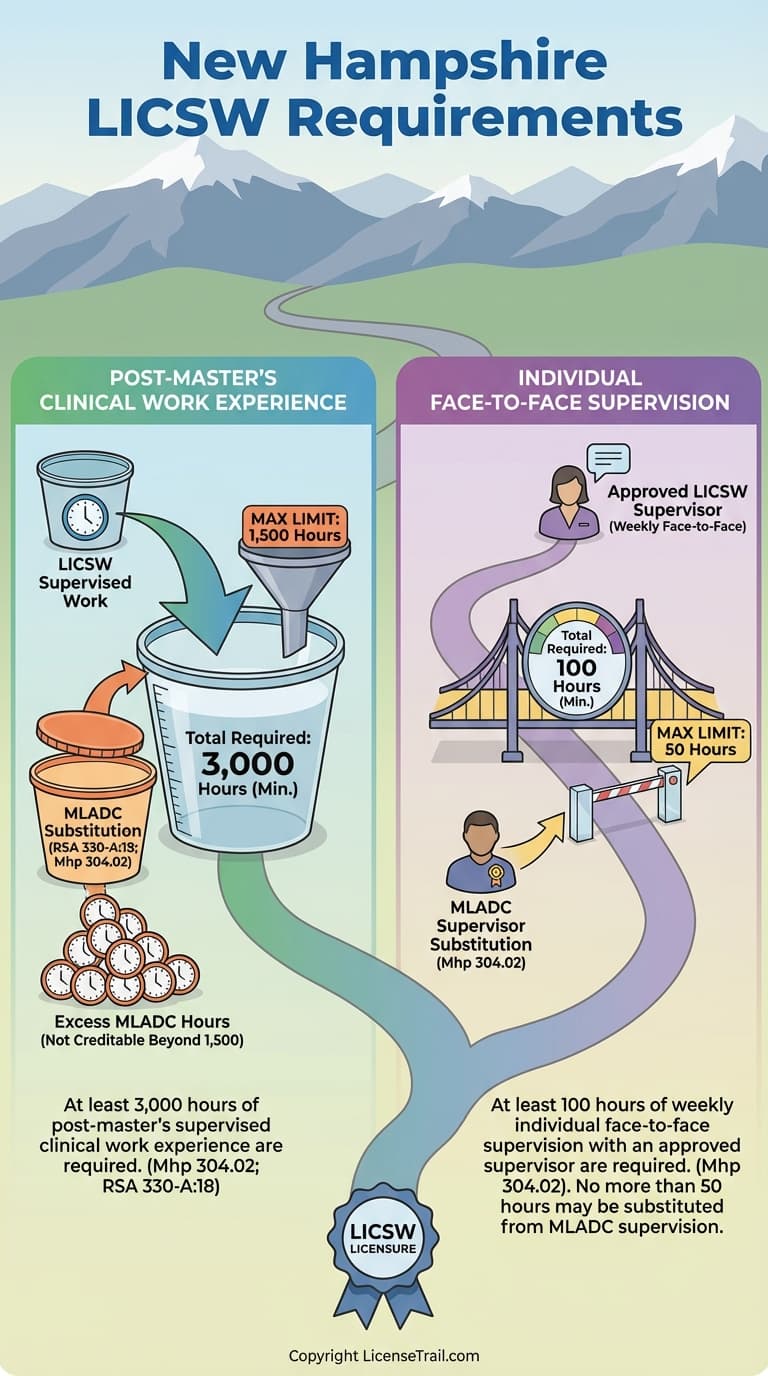
- Experience: 3,000 hours post-master’s supervised clinical work
- Duration: Completed in 2–4 years from start of approved supervision; ≥1,500 hours per year (2 “years”)
- Setting/Employment: Must be in an organized clinical/mental health setting; not independent private practice; private practice hours require W-2 (not 1099)
- Supervision: 100 hours minimum individual, face-to-face supervision, about 1 hour/week; HIPAA-compliant virtual allowed
- Supervisor: Board-approved LICSW or LCMHC (or other rule-qualified); must be NH-licensed, clinically practicing ≥2 years, no conflicts/discipline
- Exam: Pass a Board-approved national proctored exam (typically ASWB Clinical)
- MLADC substitution (optional): Up to 1,500 of the 3,000 hours and up to 50 of the 100 supervision hours may be substituted with current MLADC, subject to Board approval
License Details
Procedures
Licensure as a Licensed Independent Clinical Social Worker (LICSW) in New Hampshire is governed by RSA 330‑A:18 and the Board of Mental Health Practice’s administrative rules (especially Mhp 304.02). Together, they spell out clear education, experience, supervision, and examination requirements.
Below is a step‑by‑step outline, with the Board’s own key phrases highlighted and the numbers broken down as concretely as possible.
1. Educational prerequisites
New Hampshire statute requires both an undergraduate degree and a CSWE‑approved graduate degree in social work:
- You must have “a college undergraduate degree.” (law.justia.com)
- You must have “a 2‑year master’s degree or doctorate degree in social work from a school approved by the Council on Social Work Education.” (law.justia.com)
In practical terms, this means:
- A bachelor’s degree (field is not specified in statute), and
- An MSW or DSW/PhD in Social Work from a CSWE‑accredited program.
You cannot begin counting LICSW qualifying hours until after the clinical graduate degree is actually conferred. (gc.nh.gov)
2. Post‑master’s supervised clinical experience
2.1 Total hours and time frame
RSA 330‑A:18 requires:
- “a minimum of 2 years of post‑masters experience including completion of a minimum of 3,000 hours of post‑masters, supervised clinical experience” supervised by a board‑approved LICSW or LCMHC (or another supervisor meeting criteria in the rules). (law.justia.com)
The Board’s administrative rule Mhp 304.02 clarifies how this must be structured:
- You must complete “at a minimum, 2 years of post‑masters supervised clinical work experience.” (law.cornell.edu)
- “A year of supervised clinical work experience shall be at least 1500 hours… for a total of 3000 hours of work experience.” (law.cornell.edu)
- The supervised experience “shall be completed between 2 and 4 years from the date the approved supervision began.” (law.cornell.edu)
In plain language:
- Total clinical work hours required: 3,000
- Minimum pace: at least 1,500 hours in each “year” of supervised work
- Minimum duration: 2 years (even if you reach 3,000 hours sooner)
- Maximum duration: 4 years from when the Board‑approved supervision formally starts
- Hours must all be post‑MSW/doctoral social work degree (no pre‑degree hours count).
The rules do not break this into “1,500 direct client hours + 1,500 other hours” in the way some other states do. New Hampshire’s official language is the 3,000 total hours of “post‑masters supervised clinical work experience” structured as two 1,500‑hour years. (law.justia.com)
Several licensure guides (not the Board itself) state that the Board expects at least 1,500 of the 3,000 hours to be direct client contact, with the remainder consisting of related clinical tasks such as assessment, treatment planning, documentation, case consultation, and so on. (socialworkdegrees.org) That breakdown is helpful for planning, but it is an interpretation, not spelled out verbatim in statute or rule.
2.2 What counts as “clinical” supervised experience
Mhp 304.02 describes “acceptable clinical supervised experience” as requiring “face‑to‑face contact with a supervisor who is responsible for the clinical development and guidance of the supervisee and is familiar with the supervisee’s work and organized setting.” (law.cornell.edu)
Additional points from Mhp 300/304:
- The experience must occur in an organized clinical or mental health setting (agency, clinic, hospital, group practice, etc.), not in your own independent private practice. (gc.nh.gov)
- If the experience is in a private practice, you must have a W‑2 employment relationship with the site (not a 1099 contractor arrangement) for the hours to count. (law.cornell.edu)
- No hours accumulated prior to the conferral of the clinical graduate degree may count. (gc.nh.gov)
In practice, qualifying experience typically includes:
- Direct psychotherapy and clinical social work services
- Intake, assessment, diagnosis (within social work scope and under supervision)
- Treatment planning, crisis intervention, individual/group/family work
- Clinical documentation, case consultation, and treatment team work
3. Supervision requirements (within the 3,000 clinical hours)
3.1 Total supervision hours and structure
Mhp 304.02 is very explicit about supervision:
- “The supervision shall have included a minimum of one hour per week of individual face‑to‑face supervision between the supervisor and the applicant for a total of 100 hours.” (law.cornell.edu)
So within the 3,000 clinical hours:
- You must receive at least 100 hours of individual, face‑to‑face supervision
- You must meet with your supervisor at least one hour per week on average during the supervised period
“Face‑to‑face” supervision may be:
- In person at the workplace or other ethically appropriate location, or
- Via a HIPAA‑compliant virtual platform, as allowed by the rules. (law.cornell.edu)
3.2 Supervisor qualifications
By statute, the 3,000 hours must be “supervised clinical experience by a board approved licensed independent clinical social worker or licensed clinical mental health counselor supervisor, or any other supervisor based on reasonable and specific criteria established in rules.” (law.justia.com)
The Mhp 300 rules add more detail. In summary, at least one of your supervisors:
- Must be a currently licensed mental health practitioner in New Hampshire (LICSW, LCMHC, etc.)
- Must have been practicing clinically for at least 2 years
- Must not be under discipline, on probation, or closely related to you (spouse, parent, child, sibling, etc.) and must not have a dual relationship that could impair objectivity. (gc.nh.gov)
The Board also uses a standardized supervision verification process. Under Mhp 302.05, supervisors complete a “Supervisor’s Confirmation of Clinical Experience Form – Clinical Mental Health Counselors, Independent Clinical Social Workers, and Pastoral Psychotherapists, or School Social Workers” documenting:
- Total hours of face‑to‑face supervision
- Total hours of paid, post‑master’s supervised clinical work experience
- Dates of supervision and setting information, and
- Whether an approved “Candidate Licensure Supervisor Agreement” was on file before supervision started (for NH‑based supervision). (law.cornell.edu)
3.3 Supervision agreement (before hours start)
While the statute doesn’t use the term, the rules and Board forms functionally require a board‑approved supervisory or candidate licensure agreement before supervised hours in New Hampshire start accruing. This is reflected in:
- The yes/no question on the supervisor’s confirmation form: whether there was an approved “Candidate Licensure Supervisor Agreement” on file “prior to the commencement of supervision.” (law.cornell.edu)
Several practice guides emphasize that you should submit this agreement (with a modest filing fee) and wait for approval before counting any supervision hours. (careersinpsychology.org)
4. Substituting hours if you hold an MLADC license
New Hampshire allows partial substitution of substance‑use‑disorder experience for LICSW hours if you are already a Master Licensed Alcohol and Drug Counselor (MLADC):
- RSA 330‑A:18(III) and Mhp 304.02(b) permit a current MLADC license to be substituted for up to 1,500 of the required 3,000 hours of supervised clinical experience. (law.justia.com)
- Mhp 304.02(b) also allows substitution of up to 50 of the 100 required face‑to‑face supervision hours. (law.cornell.edu)
- If the Board denies substitution of the full 1,500 hours, it must provide its rationale, and it may not deny solely because the MLADC supervisor held an MLADC license. (law.justia.com)
5. Examination requirement
RSA 330‑A:18(IV) requires that an LICSW applicant:
- “Has passed a national proctored examination approved by the board.” (law.justia.com)
Current practice (as reported in multiple licensure resources and Board‑related guidance) is:
- The exam is the ASWB Clinical examination (Association of Social Work Boards, Clinical level). (careersinpsychology.org)
Typically, you:
- Complete or make substantial progress in your supervised hours
- Request Board approval to sit for the ASWB Clinical exam
- Take and pass the exam
- Then finalize your LICSW application with documentation of both hours and exam.
6. Application, documentation, and references
The Board’s application and rules (Mhp 302.05 and related) require you to document both your education and supervised experience in detail. In practice, a complete LICSW application package usually includes:
- Official transcripts showing conferral of the CSWE‑accredited MSW or doctoral social work degree
- The Supervisor’s Confirmation of Clinical Experience Form(s) documenting:
- 3,000 hours of post‑master’s supervised clinical work
- At least 100 hours of individual, face‑to‑face supervision
- Dates, settings, supervisor licenses, and confirmation that supervision met Board rules (law.cornell.edu)
- Evidence of an approved supervision/candidate agreement if supervision took place in New Hampshire (law.cornell.edu)
- ASWB Clinical exam passing score sent directly to the Board (careersinpsychology.org)
- Professional references, typically three, including one from your primary clinical supervisor, as summarized across several licensure guides. (careersinpsychology.org)
Fees and some procedural details (e.g., exact application fee, separate licensing fee) are set by rule and can change over time, so the Board’s forms and fee schedule should be checked directly at the time you apply. (agentsofchangeprep.com)
7. After licensure: renewal and continuing education (briefly)
Once licensed as an LICSW:
- Licenses are issued for two‑year terms. (mswguide.org)
- You must earn 40 hours of continuing education every two years, including at least 6 hours in ethics and 3 hours in suicide prevention, with specified portions from Category A providers. (naswnh.socialworkers.org)
Summary of the key “hour” requirements for NH LICSW
From the New Hampshire Board of Mental Health Practice’s statutes and rules:
-
Total clinical work hours:
- 3,000 hours of post‑master’s supervised clinical work experience in a qualifying mental health setting (law.justia.com)
-
Time frame:
- At least 2 years, but no more than 4 years, from the start of approved supervision (law.cornell.edu)
-
Yearly minimum:
- Each “year” must include at least 1,500 hours of supervised clinical work (law.cornell.edu)
-
Supervision within those hours:
- Minimum 100 hours of individual, face‑to‑face supervision, at about 1 hour per week (law.cornell.edu)
-
Optional MLADC substitution:
- Up to 1,500 hours of the 3,000 and up to 50 supervision hours may be substituted if you hold a current MLADC, subject to Board approval. (law.justia.com)
The law and rules do not use the exact formula “1,500 hours direct client + 1,500 hours supervised experience.” Instead, they require 3,000 hours of supervised clinical work plus 100 hours of individual supervision, structured over 2–4 years, with additional detail on settings and supervisor qualifications.
Track your LICSW hours with confidence
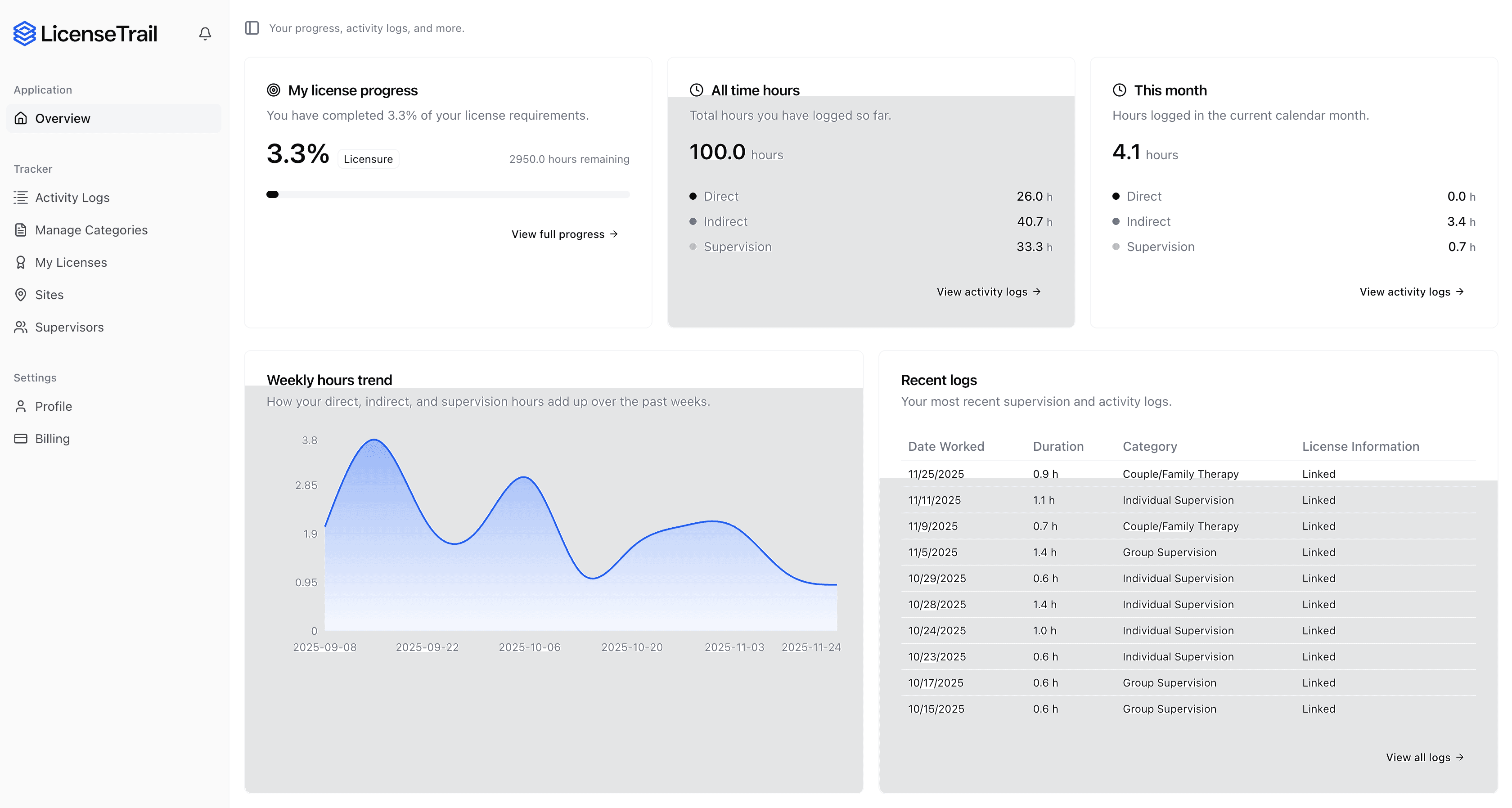
License Trail checks your direct, indirect, and supervision hours against New-hampshire LICSW requirements continuously and flags mismatches before you submit.
 Start Tracking for Free
No credit card required · Free plan available
Is your spreadsheet hiding New-hampshire LICSW risks?
Stop guessing if your categories match New Hampshire Board of Mental Health Practice requirements. License Trail checks your direct, indirect, and supervision hours continuously and flags mismatches before you submit.
Import or log
Bring your spreadsheet or start fresh
Upload your existing tracking spreadsheet and we'll map every hour into the right New Hampshire Board of Mental Health Practice categories automatically.
Verify against New-hampshire
Catch mismatches before the board does
License Trail checks your direct, indirect, and supervision hours against New-hampshire LICSW requirements continuously.
Export board-ready
One-click clean reports
Generate professional, board-ready reports for supervision meetings and New Hampshire Board of Mental Health Practice submissions in seconds.
No credit card required · Free plan available