
New-mexico CPP Requirements: Hours, Exams & Step-by-Step Guide
Stop guessing if your categories match New-mexico requirements. License Trail checks your direct, indirect, and supervision hours against CPP requirements continuously and flags mismatches before you submit.
No credit card required · Free plan available
Quick Requirements Overview
- Active, unrestricted NM psychologist license + doctoral degree in psychology
- Complete Board-qualifying postdoctoral psychopharmacology (RxP) program
- Didactic: ≥450 classroom hours (8 core areas) completed within 5 years; ≥75% from one program
- Practicum 1: 80 hours clinical assessment/pathophysiology in a medical setting under a physician/independently licensed prescriber (within 5 years)
- Practicum 2: 400 face-to-face hours treating ≥100 separate patients; supervision ≥1 hr per 8 patient hrs; completed 6–36 months and within 5 years
- Pass ASPPB PEP (Psychopharmacology Exam for Psychologists)
- Maintain malpractice insurance ≥$1M/$3M (per occurrence/aggregate) covering prescribing + complete 3-hour NM rules/laws training
- Conditional practice: 2 years under Board-approved supervisory plan with ≥4 hrs/month 1:1 supervision (~46 hrs/yr) and ≥50 unique patients treated with psychotropics during the 2 years
License Details
Procedures
New Mexico is one of the few states that authorizes specially trained psychologists to prescribe psychotropic medications. In New Mexico law and regulation, this role is created through a “conditional prescription certificate” (often informally called a CPP or conditional prescribing psychologist), followed by a full “prescription certificate” after additional supervised practice.
Below is a step‑by‑step description of what the New Mexico Board of Psychologist Examiners and state law require to obtain the conditional prescription certificate, with emphasis on hours, supervision, and key terminology.
1. Meet baseline psychology licensure requirements
Before you can even apply for a conditional prescription certificate, you must:
-
Hold a doctoral degree in psychology
The applicant must have “completed a doctoral program in psychology from an accredited institution of higher education or professional school,” or a program meeting standards acceptable to the Board if not accredited at the time of graduation. (law.cornell.edu) -
Hold an active, unrestricted New Mexico psychology license
You must “hold a current license to practice psychology in New Mexico.” (law.cornell.edu)
These requirements come from both § 61‑9‑17.1 NMSA 1978 and NMAC 16.22.23.8(A). (law.cornell.edu)
2. Complete a qualifying postdoctoral psychopharmacology program
New Mexico requires structured, Board‑approved psychopharmacology education (“RxP training program”).
2.1. Type of program
Your program must be one of the following, as specified in NMAC 16.22.23.8(A)(3): (law.cornell.edu)
- A postdoctoral psychopharmacology program from an institution of higher education accredited by a regional body recognized by the U.S. Department of Education or the Council for Higher Education Accreditation; or
- A continuing education provider approved by the American Psychological Association that offers a formal program of psychopharmacology education for psychologists; or
- A formal, organized CE program administered in collaboration with a school that leads to a credential in psychopharmacology from that school (with specific grandfathering provisions for pre‑2004 training).
The regulation also defines in some detail what an RxP training program must look like (integrated, organized program; designated training director who is a psychiatrist or doctoral psychologist trained in psychopharmacology; clearly identified as a psychopharmacology program intended to train psychologists to prescribe, etc.). (law.cornell.edu)
3. Complete required didactic coursework (classroom instruction)
Within the five years immediately preceding your application, you must complete no fewer than 450 classroom hours of didactic instruction in specified core areas.
-
NMAC 16.22.23.8(C)(1) states that the applicant must have “successfully completed didactic instruction of no fewer than 450 classroom hours” in at least the following areas:
- Neuroscience
- Pharmacology
- Psychopharmacology
- Physiology
- Pathophysiology
- Appropriate and relevant physical and laboratory assessment
- Clinical pharmaco‑therapeutics
- Cultural competence (law.cornell.edu)
-
At least three‑fourths of those 450 hours must come from a single certification/degree‑granting institution or continuing education program. (law.cornell.edu)
In statutory language, § 61‑9‑17.1(A)(5) describes this as “an organized program of education… consisting of didactic instruction of no less than four hundred fifty classroom hours” in nearly identical core areas. (law.justia.com)
4. Complete the required clinical practica before applying
New Mexico distinguishes two separate but related practica that must be completed within five years immediately preceding your application for the conditional prescription certificate:
- An 80‑hour practicum in clinical assessment and pathophysiology
- A 400‑hour practicum treating at least 100 patients with mental disorders
These are required by both statute (§ 61‑9‑17.1(A)(6)) and regulation (NMAC 16.22.23.8(D)–(E)). (law.cornell.edu)
4.1. “Eighty hour practicum in clinical assessment and pathophysiology”
NMAC 16.22.23.8(D) defines this practicum as: (law.cornell.edu)
- Part of the psychopharmacology training program from which you obtain the credential.
- Total hours: “The 80 hour practicum shall provide the opportunity for the applicant to observe and demonstrate competence in physical and health assessment techniques within a medical setting under the supervision of a physician.”
- Time frame: It must be completed “in a timeframe of full‑time over two weeks to 30 weeks,” with possible Board‑approved extension for illness or other extenuating circumstances.
- Supervising physician and training director must certify in writing that you:
- Assessed a “diverse and significantly medically ill patient population,”
- Observed progression of illness and continuity of care,
- Adequately assessed vital signs and demonstrated competent laboratory assessment, and
- Successfully completed the 80‑hour practicum.
Statute echoes this as “no less than an eighty‑hour practicum in clinical assessment and pathophysiology” under an independently licensed prescribing clinician. (law.justia.com)
4.2. “Four-hundred hour practicum… treating a minimum of 100 patients”
NMAC 16.22.23.8(E) sets out a separate “Four‑hundred hour practicum” with very specific hour and supervision language: (law.cornell.edu)
- Total time: “The four‑hundred hours shall refer to 400 face‑to‑face hours.”
- Those 400 hours:
- “shall include only time spent with patients to provide evaluation and treatment for medical psychopharmacotherapy” and
- time spent in collaboration with the patient’s treating health care practitioner(s).
- Patient requirement:
- “One‑hundred patients shall mean 100 separate patients.”
- You must have supervised experience evaluating and treating 100 patients with mental disorders, representing as diverse a population as possible across gender, age (including children/adolescents and geriatric when appropriate), range of DSM disorders (acute and chronic), ethnicity, socio‑cultural background, and economic background.
- Supervision ratio:
- “The applicant shall receive a minimum of one hour of supervision for every eight hours of patient time.”
- Supervisors:
- A psychiatrist or other appropriately trained physician (or, in the statute, “psychiatrist or other appropriately trained independently licensed prescribing clinician”) is the primary supervising practitioner and may assign training to secondary supervisors.
- Time frame for completion:
- The practicum must be completed “in a period of time of not less than six months and not more than three years” and within the five years immediately preceding the application date.
The statute summarizes this as an “additional supervised practicum of at least four hundred hours treating no fewer than one hundred patients with mental disorders,” supervised by “any one or a combination of a psychiatrist or other appropriately trained independently licensed prescribing clinician.” (law.justia.com)
5. Pass the national psychopharmacology examination
To demonstrate competency, you must pass a national exam:
-
NMAC 16.22.23.8(F) states that the applicant must pass the Psychopharmacology Examination for Psychologists (PEP), administered by the Association of State and Provincial Psychology Boards (ASPPB), and that the passing score is the one recommended by ASPPB. (law.cornell.edu)
-
The statute mirrors this by requiring that the applicant “has passed a national certification examination… that tests the applicant’s knowledge of pharmacology in the diagnosis, care and treatment of mental disorders.” (law.justia.com)
Regulation also specifies timelines and limits for retaking the exam if failed (90‑day wait after first failure, then a one‑year wait after the second attempt, and remedial training after the third failure). (law.cornell.edu)
6. Obtain and maintain malpractice insurance
Before and during the conditional prescribing period, you must maintain malpractice coverage:
-
Statute: § 61‑9‑17.1(A)(7) requires that you have “malpractice insurance in place, sufficient to satisfy the rules adopted by the board and the New Mexico medical board, that will cover the applicant during the period the conditional prescription certificate is in effect.” (law.justia.com)
-
Regulation: NMAC 16.22.24.9(A) further specifies that a conditional prescribing psychologist must maintain coverage of no less than $1,000,000 per occurrence with an aggregate limit of $3,000,000, explicitly covering prescribing of psychotropic medication. (srca.nm.gov)
You must submit the declaration page of your policy with your application and on renewal. (srca.nm.gov)
7. Complete New Mexico‑specific rules and laws training
Under the most recent version of NMAC 16.22.24.8(B), the application must include: (srca.nm.gov)
- “Evidence of completion of a three‑hour training in New Mexico rules and laws applicable to prescribing psychologists, as offered by the State Psychologist Association of New Mexico (SPA), or the New Mexico Psychological Association (NMPA).”
This 3‑hour law‑and‑rules course is a distinct requirement in addition to the 450 classroom hours and the two practica.
8. Submit a complete application for the conditional prescription certificate
Once the educational, practicum, exam, and insurance requirements are satisfied, you apply for the conditional prescription certificate (the CPP).
8.1. What must be in the application
NMAC 16.22.24.8(B) lists what you must submit to the Board: (srca.nm.gov)
-
Proof of psychopharmacology training
- “A copy of the degree, certificate or certification of completion of a post‑doctoral psychopharmacology training program.”
-
Certification of the 80‑hour practicum
- “Certification by the supervising clinician and program training director of successful completion of the 80 hour practicum in clinical assessment and pathophysiology.”
-
Certification of the 400‑hour/100‑patient practicum
- “Certification by the supervising clinician and the program‑training director of successful completion of the general 400 hour practicum treating a minimum of 100 patients with mental disorders.”
-
Evidence of passing the PEP (psychopharmacology examination for psychologists).
-
Proposed supervisory plan
- On a Board form, signed by you and your supervising clinician (who will oversee you during the two‑year conditional prescribing period).
-
Proof of malpractice insurance or binder, consistent with NMAC 16.22.24.9.
-
Non‑refundable application fee.
-
Evidence of the three‑hour New Mexico rules and laws training (SPA or NMPA).
Only complete applications are considered; the Board may request additional information and will notify you in writing within 60 days whether the application and supervisory plan are accepted or rejected. (srca.nm.gov)
9. Practice under the conditional prescription certificate (two‑year supervised practice)
Once approved, the Board issues the conditional prescription certificate, valid for two years (with limited options for extension). (srca.nm.gov)
During this period, you are a “conditional prescribing psychologist” and must prescribe only under supervision.
9.1. Supervising clinician and supervisory plan
- You must have a supervising clinician who is an independently licensed prescribing clinician (e.g., physician) with appropriate expertise and training in psychotropic medication and the population you treat. (srca.nm.gov)
- The Board must approve your supervisory plan before the conditional certificate is issued. The plan must specify:
- Beginning and ending dates of the two‑year supervised practice,
- Number of one‑on‑one supervisory hours per month and by whom,
- Setting(s) and location(s) where supervision will occur,
- Your duties and clinical responsibilities,
- How you will be represented to the public, and
- How supervision will be covered during supervisor absences. (srca.nm.gov)
9.2. Required supervision hours during the conditional period
NMAC 16.22.24.10(F) sets explicit minimum supervision: (srca.nm.gov)
- “Supervision by the primary supervising clinician shall be provided on a one‑to‑one basis for at least four hours a month and should total at least 46 hours of one‑to‑one supervision per year,” unless modified via a Board‑approved amendment.
- One‑to‑one supervision can be face‑to‑face, telephonic, or by live tele‑video. (srca.nm.gov)
A primary supervising clinician may not supervise more than three conditional prescribing psychologists at any one time. (srca.nm.gov)
9.3. Minimum patient experience during the conditional period
In addition to the 100‑patient practicum completed before application, the conditional period has its own minimum patient requirement:
- NMAC 16.22.24.10(S) requires that the conditional prescribing psychologist “shall see a minimum of 50 separate patients within the two‑year period who are seen for the purpose of evaluation and treatment with psychotropic medication.”
- “The duration of the two‑year supervisory period shall not be accelerated or reduced.” (srca.nm.gov)
So, in summary of patient‑care experience:
- Before application (training):
- 400 face‑to‑face hours treating at least 100 separate patients with mental disorders, with at least 1 hour of supervision per 8 patient hours.
- During conditional certificate (supervised practice):
- Two full years of practice, with at least four hours/month (about 46 hours/year) of one‑to‑one supervision by the primary supervising clinician, and at least 50 unique patients seen for psychotropic evaluation/treatment.
9.4. Logs, documentation, and end‑of‑period certification
- You must maintain a supervision log; each supervising clinician must attest to its contents.
- The supervisor must also keep a log of their contacts with any secondary supervisors. (srca.nm.gov)
- At the end of the two‑year period, the primary supervising clinician must provide an affidavit certifying, among other things, that:
- All charts and records for patients you treated under supervision were reviewed; and
- You have “successfully completed two years of evaluating for or prescribing psychotropic medication to at least 50 unique patients.” (srca.nm.gov)
If there are documented deficiencies, the supervisor must describe them and outline remediation; the Board may extend the conditional certificate and supervised period, with a new supervisory plan, until competence is demonstrated. (srca.nm.gov)
9.5. Expiration and interruption of practice
- The conditional prescribing certificate expires two years after issuance unless formally extended; you may not prescribe once it expires. (law.cornell.edu)
- You must notify the Board if supervision lapses, if you stop prescribing for more than 60 days, or if you decide not to apply for a full prescription certificate after completing the conditional period. (law.cornell.edu)
10. Transition from conditional prescription certificate to full prescription certificate
While your question focuses on becoming a CPP (conditional prescribing psychologist), it is worth noting the final step:
- To obtain a full prescription certificate, § 61‑9‑17.1(D) requires that you:
- Have been issued a conditional prescription certificate and have “successfully completed two years of prescribing psychotropic medication as certified by the supervising clinician”;
- Have “successfully undergone a process of independent peer review approved by the Board and the New Mexico Medical Board”;
- Hold a current New Mexico psychology license; and
- Maintain malpractice insurance and meet all other Board requirements. (law.justia.com)
Only after this stage are you a fully prescribing psychologist (no longer conditional).
Compact summary of the key hour‑ and experience‑based requirements
To become a conditional prescribing psychologist (CPP) in New Mexico, the core, quantifiable requirements are:
-
Didactic instruction:
- At least 450 classroom hours in 8 specified core areas, within 5 years before application.
-
Pre‑application clinical practica (as part of the RxP program):
- 80‑hour practicum in clinical assessment and pathophysiology in a medical setting under an independently licensed prescribing clinician.
- 400 face‑to‑face hours practicum evaluating and treating at least 100 separate patients with mental disorders, with a minimum of 1 hour of supervision for every 8 hours of patient time, completed over 6–36 months and within 5 years before application.
-
National examination:
- Passing the Psychopharmacology Examination for Psychologists (PEP).
-
Malpractice and law training:
- Malpractice coverage of at least $1,000,000 per occurrence / $3,000,000 aggregate and
- 3‑hour training in New Mexico rules and laws for prescribing psychologists.
-
Conditional prescribing period:
- Two years of supervised prescribing practice under a Board‑approved supervisory plan, with
- At least 4 hours/month (about 46 hours/year) of one‑to‑one supervision by the primary supervising clinician, and
- At least 50 unique patients seen for psychotropic evaluation/treatment during that two‑year period.
All of these elements, taken together, define how the New Mexico Board of Psychologist Examiners and state law conceptualize and regulate the pathway to becoming a conditional prescribing psychologist in the state.
Track your CPP hours with confidence
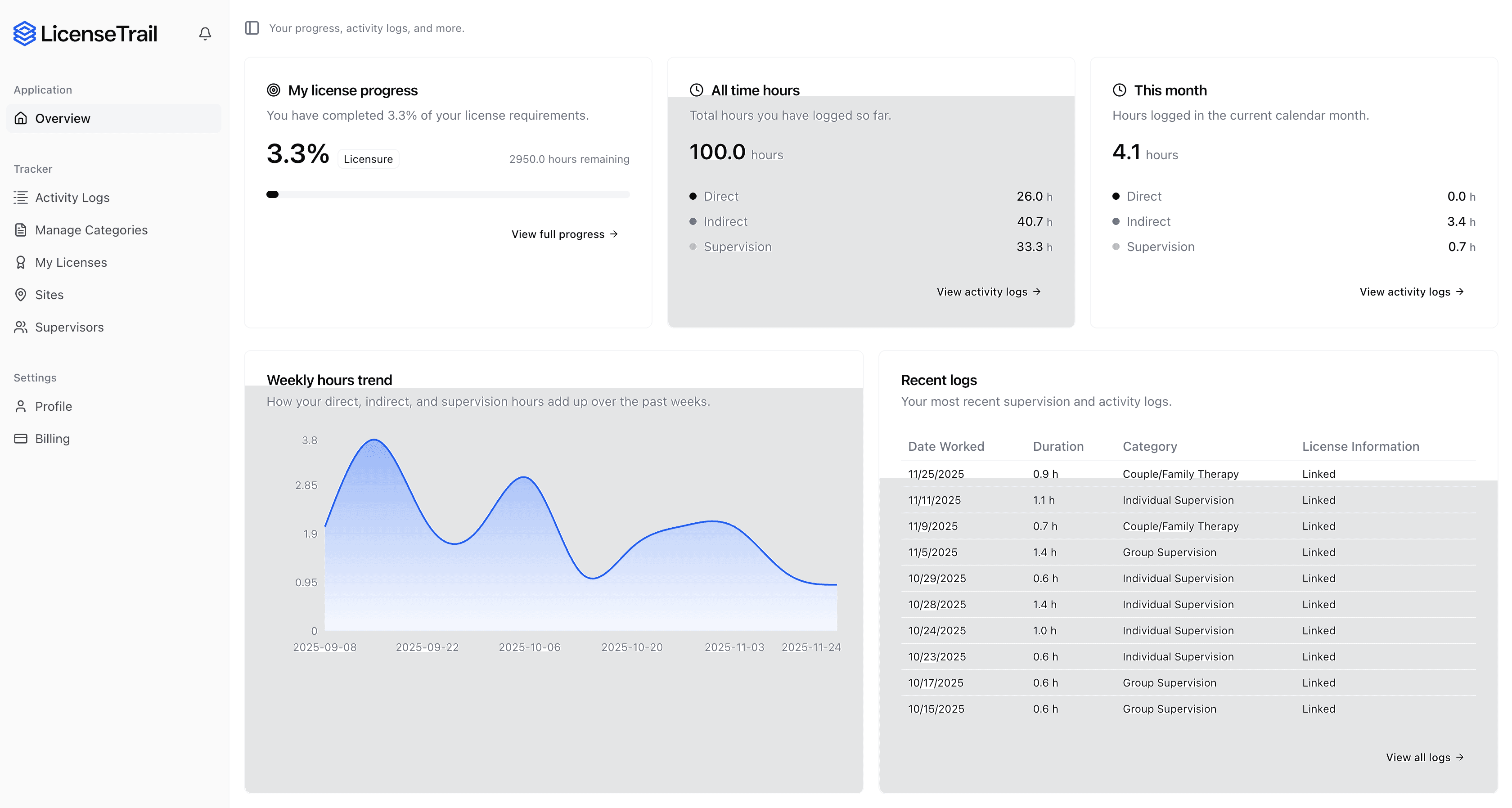
License Trail checks your direct, indirect, and supervision hours against New-mexico CPP requirements continuously and flags mismatches before you submit.
 Start Tracking for Free
No credit card required · Free plan available
Is your spreadsheet hiding New-mexico CPP risks?
Stop guessing if your categories match New Mexico Board of Psychologist Examiners requirements. License Trail checks your direct, indirect, and supervision hours continuously and flags mismatches before you submit.
Import or log
Bring your spreadsheet or start fresh
Upload your existing tracking spreadsheet and we'll map every hour into the right New Mexico Board of Psychologist Examiners categories automatically.
Verify against New-mexico
Catch mismatches before the board does
License Trail checks your direct, indirect, and supervision hours against New-mexico CPP requirements continuously.
Export board-ready
One-click clean reports
Generate professional, board-ready reports for supervision meetings and New Mexico Board of Psychologist Examiners submissions in seconds.
No credit card required · Free plan available