
Ohio IMFT Requirements: Hours, Exams & Step-by-Step Guide
Stop guessing if your categories match Ohio requirements. License Trail checks your direct, indirect, and supervision hours against IMFT requirements continuously and flags mismatches before you submit.
No credit card required · Free plan available
Quick Requirements Overview
- Education: Master’s/Doctorate in MFT (or related) with 60 semester / 90 quarter hours of Board-acceptable MFT coursework
- Graduate practicum (post‑2015 programs): 500 direct client-contact hours (250 with couples/families present) + 100 supervision hours (pre‑2015: 300/150 + 60)
- Prerequisite license: Must first qualify for and obtain Ohio MFT (includes passing the Board-accepted national MFT exam, typically within 7 years, plus background check/application)
- Post‑master IMFT supervised practice duration: Minimum 2 calendar years
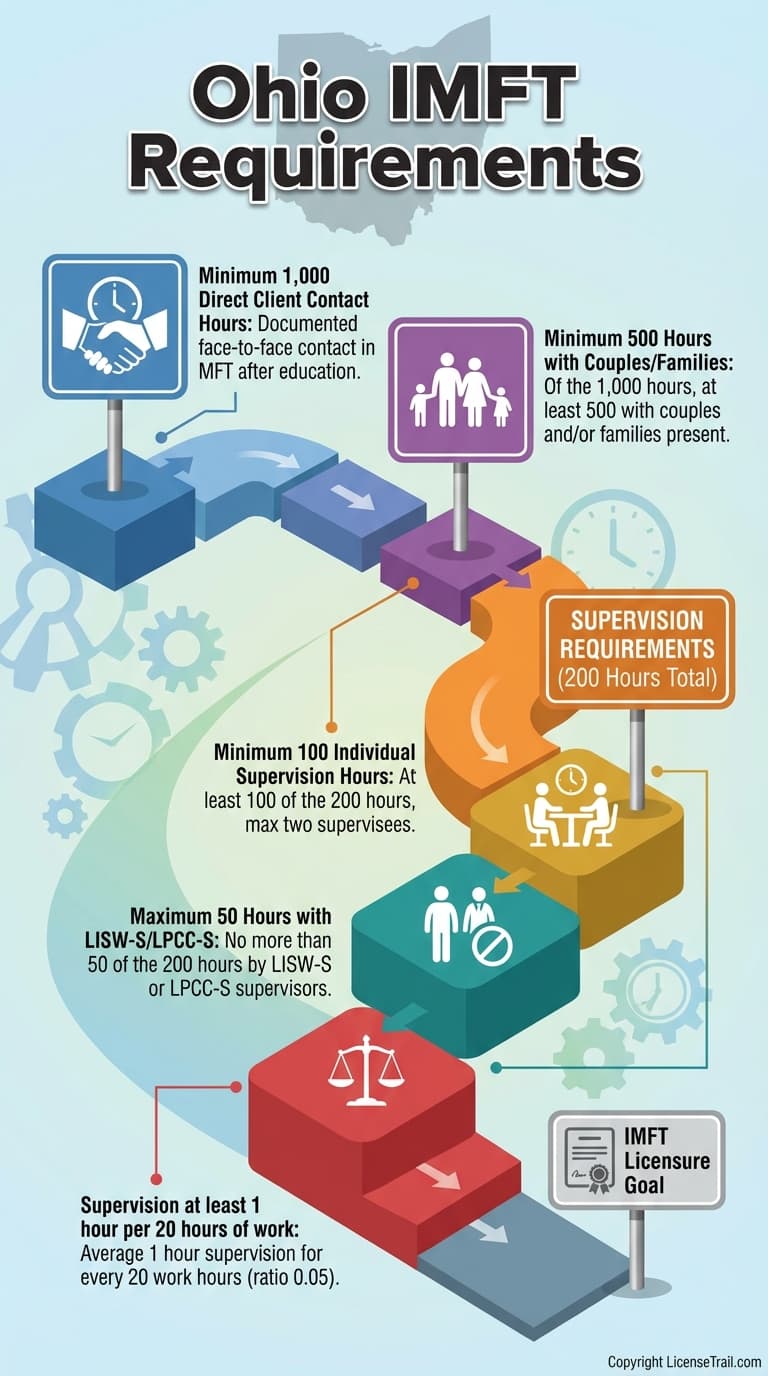
- Post‑master client-contact (IMFT): 1,000 face‑to‑face MFT hours, with 500 involving couples/families present
- Post‑master supervision (IMFT): 200 face‑to‑face supervision hours, including 100 individual; up to 50 hours may be from other approved independent clinicians
- Supervisor requirements & documentation: Supervision primarily by IMFT‑S (training supervision designation) or Board‑qualified equivalent; maintain signed logs (at least quarterly); final supervisor submits Board evaluation/verification within 30 days of request
License Details
Procedures
In Ohio, the Independent Marriage and Family Therapist (IMFT) license is the highest level of marriage and family therapy licensure issued by the Counselor, Social Worker, and Marriage and Family Therapist Board (CSWMFT Board). It allows you to diagnose and treat mental and emotional disorders independently, without clinical supervision, once licensed. (codes.ohio.gov)
Becoming an IMFT is a two‑stage process:
- Qualify for and obtain the basic Marriage and Family Therapist (MFT) license.
- Complete additional post‑master supervised clinical experience and supervision, then apply for IMFT.
Below is a structured, hour‑focused guide to what the Board and Ohio law require.
1. Educational foundation: graduate degree and practicum hours
1.1 Degree requirements
Ohio law requires a graduate degree in marriage and family therapy (master’s or doctorate) or a closely related graduate degree that includes a minimum of 90 quarter hours or 60 semester hours of graduate‑level MFT coursework acceptable to the Board. (codes.ohio.gov)
The program must be identifiable as an MFT program (e.g., clearly described as MFT, grounded in systemic theory, and preparing students for the national MFT exam or MFT licensure). (codes.ohio.gov)
1.2 Graduate practicum / internship hours (pre‑licensure)
Ohio’s MFT education rule spells out minimum clinical training hours during your graduate program: (codes.ohio.gov)
For students who began their program after January 2015:
-
Direct client contact (practicum/internship)
- At least 500 hours of direct face‑to‑face client contact with individuals, couples, and families.
- Of those 500 hours, at least 250 hours must be with couples and/or families present.
-
Supervision during practicum/internship
- At least 100 hours of supervision tied to those clinical hours.
For students who began their program before January 2015:
- At least 300 hours of direct face‑to‑face client contact, with at least 150 hours with couples and/or families present, and
- At least 60 hours of supervision.
These practicum/internship hours are educational requirements to qualify for the MFT license; they do not count toward the two‑year supervised practice required later for the IMFT. The rule explicitly states that post‑graduate supervised hours used to make up a practicum deficit “shall not be counted toward the two years of required supervised practice for IMFT licensure.” (codes.ohio.gov)
Your practicum or internship must be supervised by an appropriately qualified independent MFT with supervision designation, an AAMFT Approved Supervisor, an AAMFT supervisor candidate, or another independently licensed mental health practitioner with relevant competence and training in legal and ethical issues in MFT. (codes.ohio.gov)
2. First license: Marriage and Family Therapist (MFT)
Before you can become an IMFT, you must meet the requirements for the basic Marriage and Family Therapist license.
2.1 Statutory and rule‑based requirements
Ohio Revised Code section 4757.30(A) and Administrative Code rule 4757‑25‑03 require that an MFT applicant: (codes.ohio.gov)
- Completes the required graduate education in MFT (as described above).
- Passes a licensure examination prescribed by the MFT Professional Standards Committee (this is the national MFT exam). The exam must generally have been passed within 7 years of the application date, unless you’re already licensed in another state and passed it for that license.
- Completes a criminal records check and meets board standards concerning criminal convictions.
- Submits a complete application, pays the required fees, and provides official transcripts.
The statute also notes that to become an MFT (non‑independent), you must have completed a practicum with at least 300 hours of client contact, which is now operationalized in more detail by the 500‑hour practicum rule for more recent programs. (codes.ohio.gov)
Once you meet these requirements and are approved, the Board issues your MFT license. Only after you satisfy this stage (or at least the same educational and practicum requirements) can you work toward the IMFT.
3. Post‑master supervised experience for the IMFT license
The heart of IMFT licensure is the post‑degree, supervised clinical experience. This is where the specific hour and supervision requirements come in.
The controlling provisions are:
- Ohio Administrative Code rule 4757‑25‑04 (Requirements for licensure as an independent marriage and family therapist), and
- Ohio Revised Code section 4757.30(C) (IMFT licensing criteria). (codes.ohio.gov)
3.1 Timeframe requirement
After completing the required education (and meeting MFT requirements), you must complete at least two calendar years of supervised training while you are actively engaged in the practice of marriage and family therapy. (codes.ohio.gov)
That means:
- The supervised experience must span no less than two full calendar years.
- It must be post‑master’s (post‑degree) experience in MFT practice.
3.2 Minimum client contact hours (post‑master)
During those two years of supervised practice, you must document:
- 1,000 hours of face‑to‑face client contact in marriage and family therapy, and
- Of those 1,000 hours, at least 500 hours must involve couples and/or families present. (codes.ohio.gov)
Key points about how the Board uses this language:
- “Face‑to‑face client contact” refers to direct, live clinical contact with clients, traditionally in person. (The Board has allowed telehealth in various contexts, but you must follow the Board’s current teletherapy guidance and count hours according to their rules.)
- “Documented” means you must be able to show records (logs, agency reports, etc.) establishing your hours.
- The Board is specific that these hours must be in marriage and family therapy, not just generic counseling or social work.
3.3 Minimum supervision hours (post‑master)
While you are accumulating the 1,000 client hours, you must also receive:
- 200 hours of face‑to‑face supervision, which must occur while completing those 1,000 hours of client contact.
- Of those 200 supervision hours, at least 100 hours must be individual supervision (one‑on‑one with your supervisor). The remainder may be group supervision if allowed by the Board. (codes.ohio.gov)
Rule 4757‑29‑01 further specifies that up to 50 of the required 200 supervision hours may be under certain other qualified independent clinicians (e.g., an independent social worker with training supervision designation or a licensed professional clinical counselor with training supervision designation). The rest must be under a qualified IMFT supervisor as described below. (codes.ohio.gov)
4. Who can supervise your IMFT training hours?
Rule 4757‑25‑04 requires that your “training supervision” be provided by a supervisor whose training and experience meet the standards in rule 4757‑29‑01(C). (codes.ohio.gov)
In practice, this means:
- Your primary training supervisor must be an Ohio licensed Independent Marriage and Family Therapist with training supervision (“S”) designation, or
- A supervisor who otherwise qualifies under the Board’s supervision rule (e.g., certain AAMFT‑recognized supervisors), as cross‑referenced in the education and supervision rules. (codes.ohio.gov)
Key supervision structure requirements from rule 4757‑29‑01: (codes.ohio.gov)
- Records of training supervision must be maintained by you, the supervisee.
- Logs must include dates and times of supervision, content and goals, and must be signed or acknowledged by the supervisor at least quarterly.
- Upon completing the required supervision hours:
- The IMFT training supervisor who last supervised you must submit your accrued supervision hours to the Board using the Board’s online evaluation form.
- The supervisor reviews your log and any notes from prior supervisors before submitting.
- The evaluation must be submitted within 30 days of the supervisor receiving your request.
- The supervisor is not required to recommend you for independent licensure if, in their judgment, you are not yet ready for independent practice.
Failure by a supervisor to submit hours after a valid request can result in disciplinary action by the Board, according to the rule.
5. How the Board approves an IMFT application
Once you have:
- Completed the qualifying graduate degree (with required practicum/internship),
- Obtained or qualified for MFT licensure (education + exam + background check),
- Accrued the required post‑master supervised client and supervision hours over at least two calendar years,
you may apply for the IMFT license.
Rule 4757‑25‑07 outlines how the Board staff evaluates IMFT applications. An IMFT application will ordinarily be approved when the following are documented: (codes.ohio.gov)
-
Completed, clean application
- Application for IMFT with no flags requiring Board review (e.g., felony convictions, license loss in another state).
-
Degree documentation
- Official transcript from a regionally accredited institution showing a master’s or doctoral degree in marriage and family therapy or related degree that meets the Board’s definition and curriculum requirements.
-
Proof of supervised experience
- Evidence of at least two years of post‑master’s MFT experience that:
- Meets the hour requirements of rule 4757‑25‑04 (1,000 client hours with 500 couples/families, 200 supervision hours with 100 individual, over at least two calendar years), and
- Was supervised by an individual who meets the requirements of rule 4757‑29‑01(C) (an IMFT with training supervision designation or equivalent).
- Evidence of at least two years of post‑master’s MFT experience that:
-
Proof of examination
- Documentation of passing an examination acceptable to the Board “for the purpose of determining ability to practice as an independent marriage and family therapist.” In practice, this is the MFT exam recognized by the Board; if years have passed since you took it or you are coming from out of state, the Board’s current policies and timelines will govern whether a previous score is accepted. (codes.ohio.gov)
If there are any complicating factors (e.g., criminal history, disciplinary issues, non‑traditional degrees), the application may be held for review by the MFT Professional Standards Committee rather than being processed solely by staff. (codes.ohio.gov)
6. What changes once you are licensed as an IMFT?
Ohio law distinguishes clearly between the MFT and IMFT scopes of practice: (codes.ohio.gov)
-
A Marriage and Family Therapist (MFT):
- May diagnose and treat mental and emotional disorders only under supervision of:
- A psychologist,
- A psychiatrist,
- A licensed professional clinical counselor (LPCC),
- An independent social worker (LISW),
- Or an independent marriage and family therapist (IMFT).
- May diagnose and treat mental and emotional disorders only under supervision of:
-
An Independent Marriage and Family Therapist (IMFT):
- May diagnose and treat mental and emotional disorders without supervision.
- May engage in private practice of marriage and family therapy as an individual practitioner or as part of a group or partnership.
Once licensed as IMFT, you must meet the Board’s continuing education requirements to maintain your license. Currently, this includes 30 hours of approved continuing professional education per renewal cycle, with at least 3 hours in ethics; IMFTs with a supervision endorsement must complete 3 hours in supervision every two years. (codes.ohio.gov)
7. Hour requirements at a glance (IMFT track in Ohio)
Below is a concise summary of the key numeric hour requirements in Ohio’s IMFT pathway.
7.1 Graduate program (to qualify for MFT and IMFT track)
For students beginning MFT programs after January 2015: (codes.ohio.gov)
-
Program coursework:
- At least 60 semester hours (or 90 quarter hours) of graduate MFT coursework.
-
Practicum / internship (during the degree):
- 500 hours of direct face‑to‑face client contact with individuals, couples, and families.
- Of these, 250 hours with couples and/or families present.
- 100 hours of supervision associated with those client hours.
(Earlier cohorts have lower practicum hour minimums, but most current applicants will fall under the post‑2015 standards.)
7.2 Post‑master experience for IMFT (after obtaining or qualifying for MFT)
As specified in rule 4757‑25‑04 and section 4757.30(C): (codes.ohio.gov)
-
Timeframe
- At least two calendar years of supervised training while practicing marriage and family therapy.
-
Client contact hours
- 1,000 hours of documented face‑to‑face client contact in marriage and family therapy.
- At least 500 of those 1,000 hours must be with couples and/or families present.
-
Supervision hours
- 200 hours of face‑to‑face supervision obtained while completing the 1,000 client hours.
- At least 100 of the 200 hours must be individual supervision.
- Up to 50 of the 200 hours may be provided by other approved independent clinicians (e.g., LISW‑S, LPCC‑S) under rule 4757‑29‑01; the rest must be under a qualified IMFT supervisor. (codes.ohio.gov)
-
Supervisor qualifications
- Primarily an IMFT with training supervision (“S”) designation or another supervisor who meets standards in rule 4757‑29‑01(C), as cross‑referenced in 4757‑25‑04. (codes.ohio.gov)
-
Documentation
- You must maintain detailed supervision logs (dates, times, content, goals, supervisor signature/acknowledgment at least quarterly).
- Your final training supervisor must submit an online evaluation and hour verification directly to the Board within 30 days of your request. (codes.ohio.gov)
In summary, Ohio does not use a 1,500‑and‑1,500‑hour model for IMFT the way some states do. Instead, the Board’s regulations require:
-
During your graduate program:
- 500 direct client hours (250 with couples/families) + 100 supervision hours (for most current programs).
-
After your degree, on the path to IMFT:
- At least two calendar years of supervised practice,
- 1,000 hours of face‑to‑face MFT client contact (with 500 hours involving couples/families),
- 200 hours of face‑to‑face supervision (with 100 hours individual),
- All under qualifying supervision and documented in a way the CSWMFT Board accepts.
All of these requirements are grounded in Ohio Revised Code section 4757.30 and Ohio Administrative Code rules 4757‑25‑01, 4757‑25‑03, 4757‑25‑04, 4757‑25‑07, and 4757‑29‑01, as currently in effect. (codes.ohio.gov)
Track your IMFT hours with confidence
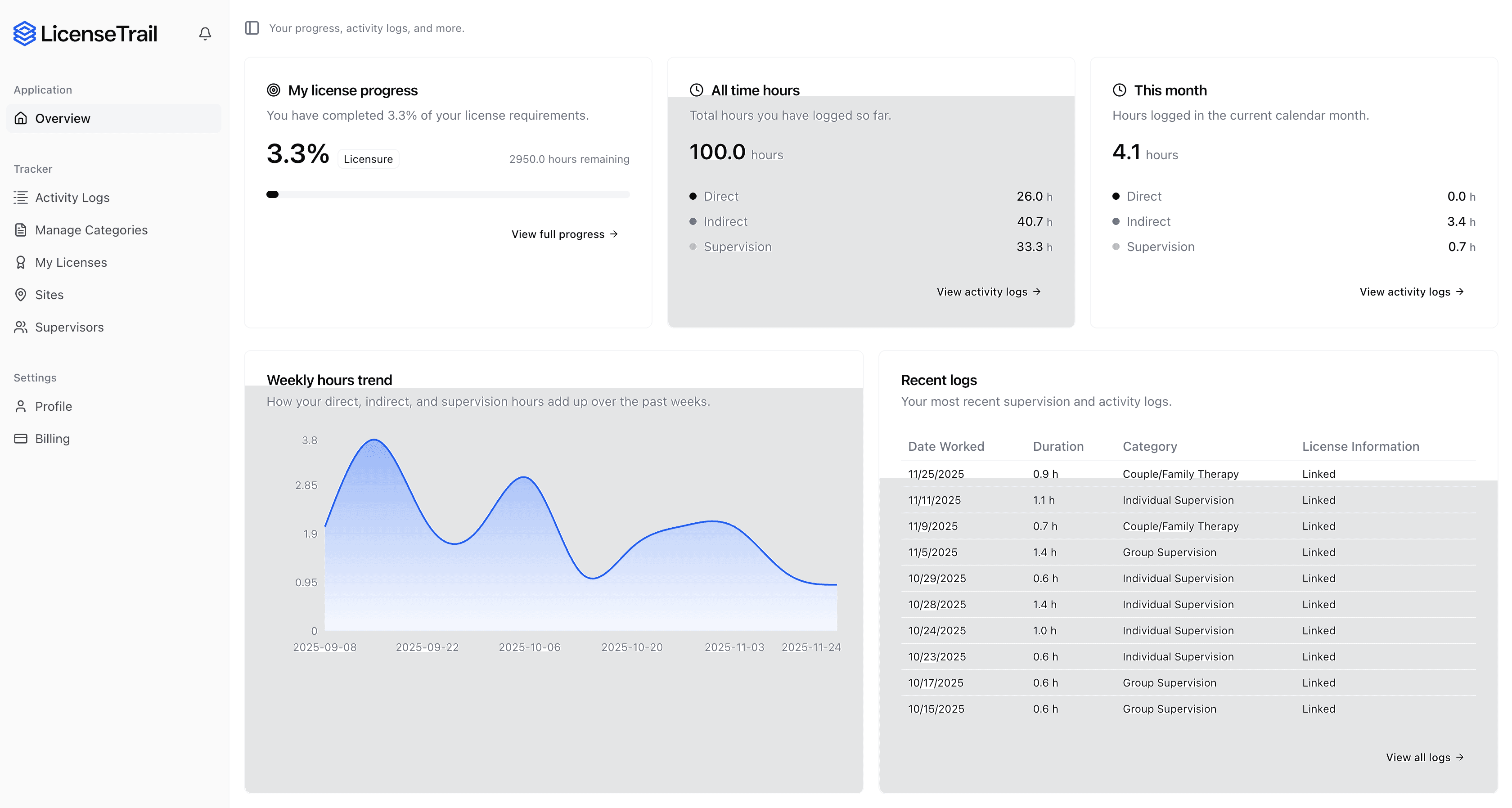
License Trail checks your direct, indirect, and supervision hours against Ohio IMFT requirements continuously and flags mismatches before you submit.
 Start Tracking for Free
No credit card required · Free plan available
Is your spreadsheet hiding Ohio IMFT risks?
Stop guessing if your categories match Ohio Counselor, Social Worker and Marriage and Family Therapist Board requirements. License Trail checks your direct, indirect, and supervision hours continuously and flags mismatches before you submit.
Import or log
Bring your spreadsheet or start fresh
Upload your existing tracking spreadsheet and we'll map every hour into the right Ohio Counselor, Social Worker and Marriage and Family Therapist Board categories automatically.
Verify against Ohio
Catch mismatches before the board does
License Trail checks your direct, indirect, and supervision hours against Ohio IMFT requirements continuously.
Export board-ready
One-click clean reports
Generate professional, board-ready reports for supervision meetings and Ohio Counselor, Social Worker and Marriage and Family Therapist Board submissions in seconds.
No credit card required · Free plan available