
Ohio LPAT Requirements: Hours, Exams & Step-by-Step Guide
Stop guessing if your categories match Ohio requirements. License Trail checks your direct, indirect, and supervision hours against LPAT requirements continuously and flags mismatches before you submit.
No credit card required · Free plan available
Quick Requirements Overview
- Regulator: Ohio CSWMFT Board (Art Therapy Professional Standards Committee); license title LPAT (Licensed Professional Art Therapist)
- Minimum age: 18+
- Education: Master’s (or higher) in art therapy from AATA‑approved, CAAHEP‑accredited, or CSWMFT‑accepted equivalent program
- Graduate practicum/internship (ATCB standard): 700 hrs total, incl. ≥350 direct client art therapy; supervision ratio 1 hr individual/10 hrs (or 1.5 hrs group/10 hrs)
- Post‑grad supervised clinical experience: ≥2 years and must meet ATCB ATR post‑education experience requirements
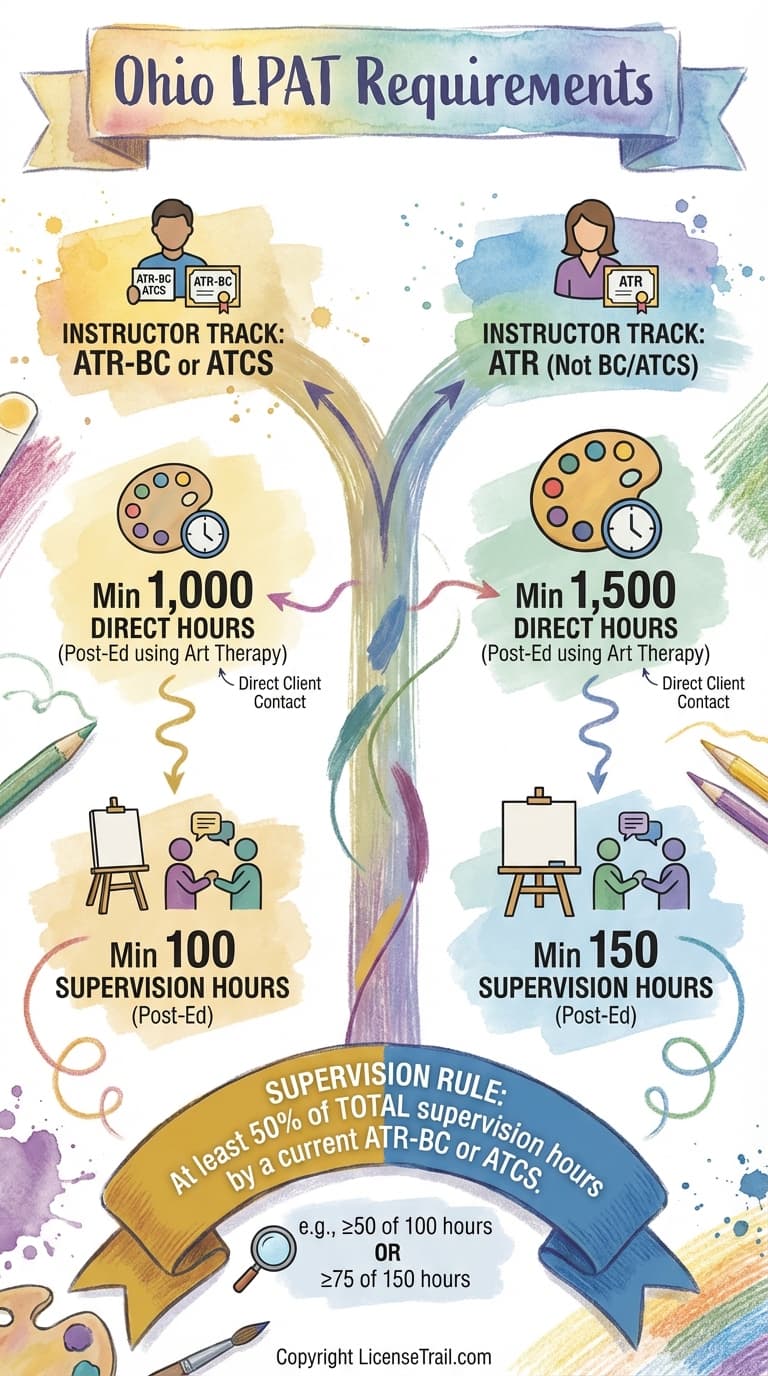
- ATCB post‑grad hours (path depends on practicum instructor): 1,000 direct + 100 supervision (≥50 by ATR‑BC/ATCS) or 1,500 direct + 150 supervision (≥75 by ATR‑BC/ATCS)
- Credential required: Must hold ATCB board certification (ATR‑BC) in good standing
- Application items: CSWMFT application/fees + BCI/FBI background checks + ATCB credential verification (and other board‑specified submissions)
License Details
Procedures
Ohio licenses art therapists under the Counselor, Social Worker, and Marriage and Family Therapist (CSWMFT) Board. The license is issued as an art therapist, with the official board abbreviation LPAT – Licensed Professional Art Therapist. (codes.ohio.gov)
What makes Ohio a little different is that the law does not spell out a fixed number of hours the way some counseling licenses do. Instead, it directly ties your required experience to the Art Therapy Credentials Board (ATCB) standards for becoming a Registered Art Therapist (ATR)—and then requires you to hold board certification (ATR‑BC).
Below is a step‑by‑step outline of what this means in practice, including the actual hour requirements that ATCB uses and which Ohio law incorporates.
1. Meet Ohio’s baseline legal requirements
Ohio Revised Code 4757.24(B) and Ohio Administrative Code 4757‑18‑01(A) set the core LPAT eligibility criteria: (law.justia.com)
To be eligible for a license to practice art therapy in Ohio, you must:
- Be at least 18 years old.
- Hold a master’s degree or higher in art therapy from a graduate program that, at the time your degree was conferred, meets one of these:
- Approved by the American Art Therapy Association (AATA), or
- Accredited by CAAHEP (Commission on Accreditation of Allied Health Education Programs), or
- Deemed “substantially equivalent” by the CSWMFT Board. (law.justia.com)
- Complete at least two years of post‑graduate supervised clinical experience that meets the ATCB’s experience requirements for becoming a Registered Art Therapist (ATR) at the time you completed it. (law.justia.com)
- Hold board certification in good standing with ATCB (i.e., be an ATR‑BC). (law.justia.com)
- Satisfy any additional requirements the Board sets (application, fees, criminal records check under ORC 4757.101, etc.). (law.justia.com)
In plain language: Ohio says “you must meet ATCB’s standards for ATR and hold ATR‑BC,” and then the state gives you the LPAT license.
2. Graduate‑level practicum & internship hours (during your degree)
To reach ATR/ATR‑BC, you first complete a qualifying master’s program in art therapy. ATCB’s Registration Standards (which Ohio relies on by requiring ATR) currently require a substantial practicum/internship. (atcb.org)
ATCB minimum practicum/internship requirements (during the degree):
- 700 total supervised practicum/internship hours, including:
- At least 350 hours of direct client provision of art therapy services (individuals, groups, or families, using art therapy).
- Up to 350 hours may be indirect activities such as supervision, case review, documentation, preparation, staff meetings, etc.
- Supervision during practicum/internship:
- Supervision must be part of a structured graduate practicum/internship course.
- The instructor of record for the course must be a current ATR‑BC or ATCS.
- On‑site supervision must be by someone with at least a master’s degree in a mental health field and a current master’s‑level license/credential.
- Supervision ratios:
- Individual (1:1) supervision: at least 1 hour for every 10 hours of practicum/internship.
- Group supervision: at least 1.5 hours for every 10 hours of practicum/internship.
- This translates to a minimum of 70 individual supervision hours or 105 group supervision hours (or a mix that meets the ratio). (atcb.org)
These graduate‑level hours are part of ATCB’s education standard; Ohio incorporates them indirectly by requiring that your degree come from an AATA/CAAHEP‑approved (or equivalent) program and that you qualify for ATR.
3. Post‑graduate supervised experience hours (after the degree)
Ohio law requires both:
- “At least two years of postgraduate supervised clinical experience”, and
- That this experience meets ATCB’s experience requirements for becoming an ATR. (law.justia.com)
ATCB’s 2025 Post‑Education Experience Requirements for ATR spell out the actual hour counts. (atcb.org)
3.1. Standard path (practicum/internship instructor was ATR‑BC or ATCS)
If the instructor of record for your graduate practicum/internship course was a current ATR‑BC or ATCS, ATCB requires:
- 1,000 hours of post‑education, direct client contact using art therapy.
- These must be after your master’s (or higher) degree is conferred.
- They must be direct client work using art therapy—administrative tasks do not count. (atcb.org)
- 100 hours of supervision over those 1,000 hours:
- At least 50 supervision hours must be provided by a current ATR‑BC or ATCS.
- The remaining supervision hours may be provided by:
- An ATR, or
- A fully licensed/credentialed independent practitioner in a related mental health field (counseling, marriage and family therapy, social work, psychology, addictions counseling, psychiatric nursing, psychiatry), provided their license requires at least a master’s degree. (atcb.org)
In practice for Ohio LPAT applicants, this path means:
Minimum post‑degree requirement:
1,000 hours of direct client art therapy + 100 hours of clinical supervision
completed over at least two years after graduation.
Ohio’s 2‑year requirement sets the timeframe, and ATCB’s ATR standard sets the hour counts and supervision structure.
3.2. Higher‑hour path (practicum/internship instructor was ATR, not ATR‑BC/ATCS)
If your graduate practicum/internship instructor of record was an ATR (but not currently ATR‑BC or ATCS), ATCB requires more hours:
- 1,500 hours of post‑education, direct client contact using art therapy.
- 150 hours of supervision, including:
- At least 75 supervision hours from a current ATR‑BC or ATCS.
- The remaining supervision hours may be from an ATR or a fully licensed master’s‑level mental health professional as above. (atcb.org)
In practice for Ohio LPAT applicants on this path:
Minimum post‑degree requirement:
1,500 hours of direct client art therapy + 150 hours of clinical supervision
completed over at least two years post‑graduation.
Ohio does not distinguish between these two paths in its own rules; it simply says you must meet “the experience requirements that the art therapy credentials board … required for an individual to become a registered art therapist.” The specific hour breakdown comes entirely from ATCB and depends on who taught/supervised your graduate internship. (law.justia.com)
4. Achieve ATCB credentials: ATR → ATR‑BC
Ohio law then requires board certification in good standing with the Art Therapy Credentials Board—i.e., you must be an ATR‑BC. (law.justia.com)
ATCB’s structure is:
- ATR‑P (Provisional Registered Art Therapist) – obtained after completing the degree and beginning supervised post‑graduate experience. Starting July 1, 2024, an ATR‑P is required before upgrading to ATR. (atcb.org)
- ATR (Registered Art Therapist) – earned once you’ve:
- Completed the qualifying master’s program (including practicum/internship hours), and
- Completed the required post‑education supervised art therapy experience (1,000/100 or 1,500/150, depending on your path), and
- Submitted references and documentation to ATCB. (atcb.org)
- ATR‑BC (Board Certified Registered Art Therapist) – obtained by:
- Holding an active ATR, and
- Passing ATCB’s national board certification exam. No additional coursework beyond the ATR is required. (atcb.org)
ATR‑BC must then be kept in good standing (annual ATR renewal plus 100 hours of continuing education every 5 years). (atcb.org)
Ohio’s LPAT license is built on top of this ATR/ATR‑BC credential stack.
5. Apply to the Ohio CSWMFT Board for LPAT
Once you meet the educational, experiential, and ATCB credentialing requirements, you apply to the CSWMFT Board’s Art Therapy Professional Standards Committee for your state license. Ohio law and board guidance indicate the following pieces: (law.justia.com)
- Submit a properly completed application for art therapist licensure and pay the fee (amount set by ORC 4757.31).
- Criminal records check:
- You must complete state (BCI) and federal (FBI) background checks consistent with ORC 4757.101.
- Board guidance for creative arts therapists directs applicants to complete BCI/FBI checks after submitting the application. (law.justia.com)
- Provide verification of your ATCB credentials:
- Proof of ATR‑BC in good standing (or, during the now‑expired grandparenting period, certain ATR holders with 5+ years’ practice). (addictioncounselorce.com)
- Any other Board‑specified items, such as:
- Electronic application via the Ohio eLicense portal,
- Proof of having reviewed the Board’s laws and rules (often via a required video),
- Any disclosures about discipline, criminal history, or licensure issues in other states. (codes.ohio.gov)
The Board is required to issue your license within 60 days of receiving proof you meet the statutory requirements and have completed the required criminal records check. (law.justia.com)
6. Practicing and using the LPAT title in Ohio
A few practice‑related points from Ohio law and rules:
- Protected title and practice: Beginning one year after October 3, 2023 (i.e., October 3–4, 2024), no one may “engage in the practice of art therapy” or use the title “art therapist” or similar title in Ohio without holding a valid license under Chapter 4757. (codes.ohio.gov)
- Working while accruing hours: Individuals completing supervised experience to qualify for licensure may work in the scope of art therapy under the supervision of a licensed art therapist, but they must not present themselves as licensed or registered under Chapter 4757. (codes.ohio.gov)
- Official title/initials: Once licensed, you may use the initials LPAT (Licensed Professional Art Therapist) as defined in Ohio Admin. Code 4757‑3‑02. (codes.ohio.gov)
7. Summary of the key hour requirements tied to an Ohio LPAT
Putting the pieces together:
During your master’s program (practicum/internship – ATCB standard): (atcb.org)
- 700 total supervised practicum/internship hours, including:
- ≥350 hours direct client art therapy services, and
- ≥70 individual or 105 group supervision hours (or a combination that meets the supervision ratio).
After your degree (post‑graduate supervised clinical experience – ATCB standard, which Ohio incorporates + a 2‑year minimum): (law.justia.com)
-
Path A (standard; practicum instructor ATR‑BC/ATCS):
- 1,000 hours of post‑education direct client contact using art therapy, plus
- 100 hours of supervision (≥50 hours by an ATR‑BC or ATCS).
-
Path B (higher‑hour; practicum instructor only ATR):
- 1,500 hours of post‑education direct client contact using art therapy, plus
- 150 hours of supervision (≥75 hours by an ATR‑BC or ATCS).
-
Timeframe imposed by Ohio:
- These post‑education supervised clinical hours must be spread over at least two years after graduation to satisfy ORC 4757.24 and OAC 4757‑18‑01. (law.justia.com)
After completing those educational and experiential requirements, you obtain ATR, then ATR‑BC, and then apply to the Ohio CSWMFT Board for licensure as an LPAT.
Track your LPAT hours with confidence
License Trail checks your direct, indirect, and supervision hours against Ohio LPAT requirements continuously and flags mismatches before you submit.
 Start Tracking for Free
No credit card required · Free plan available
Is your spreadsheet hiding Ohio LPAT risks?
Stop guessing if your categories match Ohio Counselor, Social Worker and Marriage and Family Therapist Board requirements. License Trail checks your direct, indirect, and supervision hours continuously and flags mismatches before you submit.
Import or log
Bring your spreadsheet or start fresh
Upload your existing tracking spreadsheet and we'll map every hour into the right Ohio Counselor, Social Worker and Marriage and Family Therapist Board categories automatically.
Verify against Ohio
Catch mismatches before the board does
License Trail checks your direct, indirect, and supervision hours against Ohio LPAT requirements continuously.
Export board-ready
One-click clean reports
Generate professional, board-ready reports for supervision meetings and Ohio Counselor, Social Worker and Marriage and Family Therapist Board submissions in seconds.
No credit card required · Free plan available