
Ohio LPCC Requirements: Hours, Exams & Step-by-Step Guide
Stop guessing if your categories match Ohio requirements. License Trail checks your direct, indirect, and supervision hours against LPCC requirements continuously and flags mismatches before you submit.
No credit card required · Free plan available
Quick Requirements Overview
- Graduate counseling degree (CACREP or Board‑approved) with ≥60 semester hours/90 quarter hours + required clinical diagnosis/treatment coursework + supervised practicum & internship
- Typically must hold Ohio LPC first; LPCC experience is completed as an LPC under Board‑compliant supervision
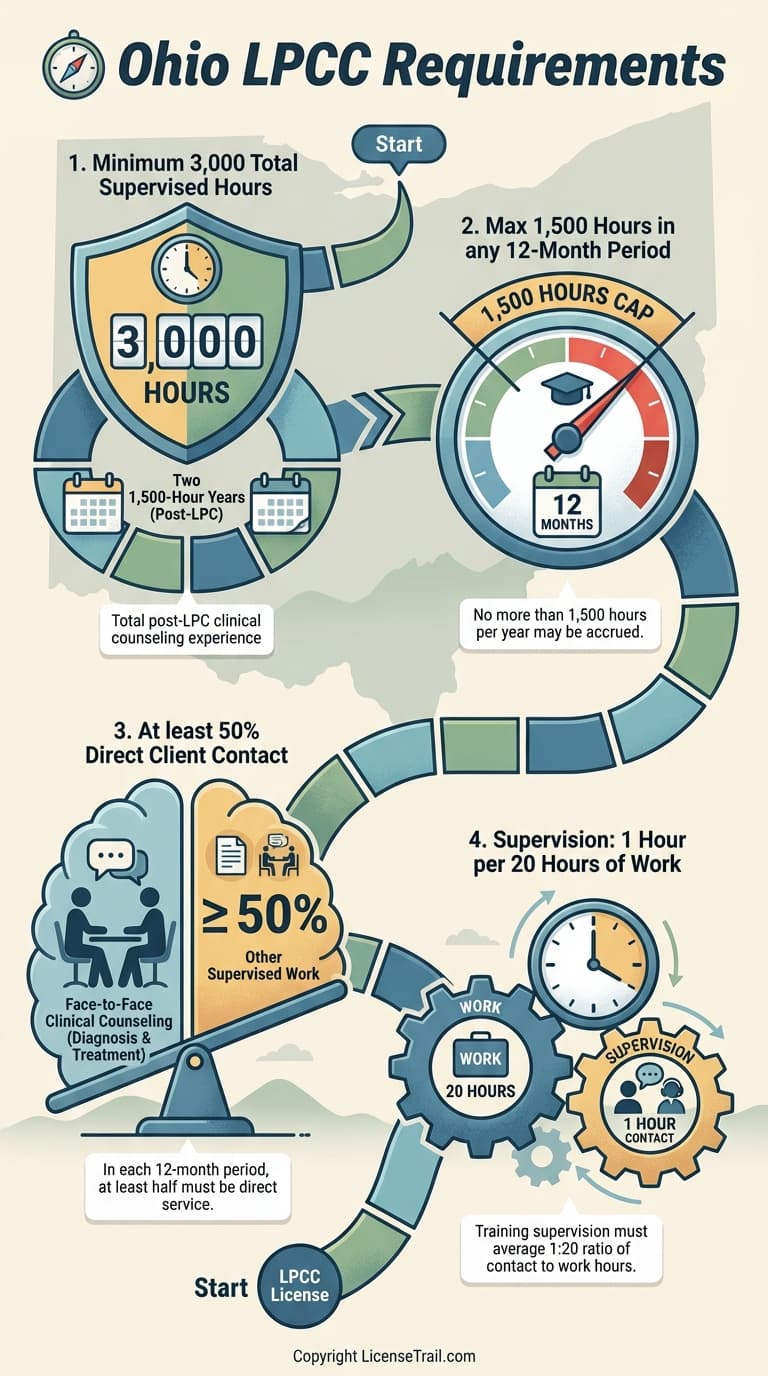
- Post‑LPC supervised clinical experience: 2 years / 3,000 hours total; max 1,500 hours per 12 months
- Direct client contact: ≥50% each year face‑to‑face; effectively ≥1,500 hours face‑to‑face including diagnosis & treatment
- Setting: qualifying hours must be in a clinical setting primarily focused on diagnosis & treatment (non‑clinical school/admissions roles don’t count)
- Supervision: Ohio hours must be supervised by an LPCC with Board supervision designation (rules also recognize certain other independent MH professionals)
- Supervision ratio: training supervision averages 1 hour per 20 hours worked (~150 hours across 3,000 hours) + maintain supervision logs
- Evaluations & exam: field evaluation + supervision evaluations at 1,500 and 3,000 hours; pass Board‑required LPCC exam within 2 years of application
License Details
Procedures
In Ohio, the Licensed Professional Clinical Counselor (LPCC) credential is the independent clinical counseling license issued by the Counselor, Social Worker and Marriage and Family Therapist (CSWMFT) Board. An LPCC is authorized to practice professional counseling and to perform the unsupervised diagnosis and treatment of mental and emotional disorders. (codes.ohio.gov)
Below is a step‑by‑step guide focused on the official statutory and rule language—especially the required hours, types of experience, and supervision.
1. Educational foundation
Ohio law requires a graduate counseling degree and specific coursework before you can be licensed as an LPCC. (codes.ohio.gov)
At the LPCC level, you must:
- Hold a graduate degree in counseling from:
- A CACREP‑accredited counseling program, or
- A counseling education program approved by the Board under its rules. (codes.ohio.gov)
- Complete at least 60 semester hours (or 90 quarter hours) of graduate counselor training acceptable to the Board.
- That training must include instruction in:
- Clinical psychopathology, personality, and abnormal behavior
- Evaluation of mental and emotional disorders
- Diagnosis of mental and emotional disorders
- Methods of prevention, intervention, and treatment of mental and emotional disorders (codes.ohio.gov)
- Participate in a supervised practicum and clinical internship in counseling as part of your graduate program. (codes.ohio.gov)
In practice, most applicants first qualify for and obtain Ohio’s Licensed Professional Counselor (LPC) credential under a closely related set of education requirements, then complete post‑LPC supervised experience to qualify for the LPCC.
2. Licensure path: LPC first, then LPCC
The LPCC is a higher, independent level of counselor licensure. Board rules on LPCC experience are written explicitly “as a licensed professional counselor.” (codes.ohio.gov)
So the typical sequence is:
- Meet education requirements and pass the counselor exam.
- Obtain the Licensed Professional Counselor (LPC) license.
- Work as an LPC in approved clinical settings under Board‑compliant supervision while you accumulate the experience required for LPCC.
- Then apply for the Licensed Professional Clinical Counselor (LPCC) license once all supervised hours, evaluations, and the LPCC exam are complete.
3. Total supervised experience required for LPCC
Ohio sets LPCC experience requirements in both statute (Ohio Revised Code 4757.22) and administrative rule (Ohio Admin. Code 4757‑13‑03). Read together, they create the following structure.
3.1 Length of supervised experience (time requirement)
Under the Revised Code, the supervised experience must be at least: (codes.ohio.gov)
-
Master’s (or other non‑doctoral) counseling degree:
- Not less than two years of supervised experience in counseling, completed after the master’s is awarded.
- Board rule further specifies this is two years of post‑LPC supervised experience in clinical counseling that includes diagnosis and treatment of mental and emotional disorders.
-
Doctorate in counseling:
- Not less than two years of supervised experience in clinical counseling including diagnosis and treatment.
- At least one year and a minimum of 1,500 hours of supervised experience must be:
- Completed after the doctoral degree is awarded, and
- Completed as a Licensed Professional Counselor.
- Up to one year and a maximum of 1,500 hours of supervised experience may be completed as part of a doctoral internship in a Board‑approved counselor education program. (codes.ohio.gov)
3.2 Amount and type of hours (the 3,000 hours)
The Board’s LPCC rule describes the experience in yearly blocks, but it effectively requires 3,000 total hours of supervised clinical counseling over at least two years:
- Each qualifying year must include “at least fifteen hundred hours of work” by the applicant.
- No more than 1,500 hours of experience may be counted in any 12‑month period.
- A minimum of fifty percent of this work each year must be face‑to‑face client contact providing clinical counseling services, including the diagnosis and treatment of mental and emotional disorders. (codes.ohio.gov)
Because two qualifying years are required, the rule results in:
- 3,000 total hours of supervised clinical counseling work (1,500 hours per year × 2 years).
- Of those 3,000 hours, at least 1,500 hours must be direct, face‑to‑face client contact delivering clinical counseling services that include diagnosis and treatment of mental and emotional disorders (since at least half of each year’s 1,500 hours must be face‑to‑face). (codes.ohio.gov)
The Board also specifies that this experience must take place in a “clinical setting which shall have a primary focus on the diagnosis and treatment of mental and emotional disorders.” School advising, academic admissions, and similar roles do not count as such clinical settings. (codes.ohio.gov)
4. Supervision: who can supervise and how it’s structured
4.1 Who may supervise
For LPCC qualifying experience, Board rule requires that each year of experience be under direct supervision of an independently‑licensed mental health professional, and in Ohio that supervision must come from a supervisor with a specific designation: (codes.ohio.gov)
-
Acceptable supervising license types:
- Licensed Professional Clinical Counselor (LPCC)
- Psychologist
- Psychiatrist
- Independent Social Worker with a clinical area of competence
- Other independently licensed mental health professionals acceptable to the Counselor Professional Standards Committee
-
All supervision obtained in Ohio for LPCC licensure must be provided by a Licensed Professional Clinical Counselor with a training supervision (supervision) designation issued by the Board.
Additionally, when an LPC’s practice includes diagnosis and treatment of mental and emotional disorders, the LPC must be under clinical/work supervision from an independently‑licensed mental health professional (e.g., LPCC, LISW, IMFT, psychologist, psychiatrist). (codes.ohio.gov)
4.2 Training supervision vs. work supervision
Board rules distinguish two key forms of oversight: (codes.ohio.gov)
-
Training supervision
- Applies to individuals gaining experience for LPC or LPCC licensure (including counselor trainees).
- Defined as supervision provided for the purposes of licensure and/or development of new proficiency areas while providing client services.
- It is an intentional, structured process aimed at professional growth, with both supervisor and supervisee sharing responsibility.
-
Clinical/work supervision
- Applies when an LPC is diagnosing and treating mental and emotional disorders.
- The supervisor evaluates performance, provides guidance, approves intervention and treatment plans, assumes responsibility for client welfare, and has access to (and reviews) client documentation.
4.3 Supervision hours: ratio and approximate total
For training supervision, the Board rule sets a required ratio:
Training supervision shall include an average of one hour of contact between the supervisor and supervisee for every twenty hours of work by the supervisee. (codes.ohio.gov)
Since LPCC applicants must complete 3,000 hours of supervised work, this ratio implies:
- Approximately 150 hours of documented supervision contact over the course of the 3,000 hours (3,000 ÷ 20 = 150).
This 150‑hour figure is not written as a flat number in the rule; it is an arithmetical result of the Board’s one‑hour‑per‑twenty‑hours requirement.
Supervision may be:
- Individual or triadic (one supervisor with one or two supervisees)
- Group (one supervisor with up to eight supervisees)
as long as the supervision meets the Board’s definitions and is properly documented. (codes.ohio.gov)
4.4 Documentation obligations
The Board places responsibility on the supervisee to keep detailed supervision records:
- Supervision logs must include dates/times, content, and goals of supervision and be signed or otherwise acknowledged by the supervisor at least quarterly.
- Logs may be kept in hard copy or electronic format and must be available to the Board upon request. (codes.ohio.gov)
When LPCC supervision requirements are completed:
- The LPCC supervisor with supervision designation who last provided training supervision must submit the accrued supervision hours to the Board via its online evaluation form, within 30 days of the supervisee’s request.
- The supervisor reviews the supervisee’s log and any prior supervisors’ notes when submitting.
- The supervisor is not required to recommend the supervisee for independent practice if they judge the supervisee not yet ready. (codes.ohio.gov)
5. Field evaluation and supervision evaluations
The LPCC applicant must pass a field evaluation prescribed by the Board, which is separate from the written licensing examination:
- The field evaluation must provide documented evidence of the quality, scope, and nature of the applicant’s experience and competence in diagnosing and treating mental and emotional disorders.
- It is completed by the applicant’s supervising counselors. (codes.ohio.gov)
Board rules also require:
- A supervision evaluation submitted to the Board:
- Once the applicant completes the first 1,500 hours of supervised experience, and
- Again at the completion of the full 3,000 hours.
- The supervising counselor must submit each evaluation within 30 days of the applicant reaching those hour milestones. (codes.ohio.gov)
6. LPCC licensing examination
In addition to the field evaluation, LPCC applicants must pass a licensure examination:
- The exam is prescribed and administered under the authority of the Counselor Professional Standards Committee.
- The applicant must successfully complete the exam within two years of application for LPCC.
- Certain counselors who took older Ohio/Texas single‑tier exams during specified periods are exempted by rule, but new applicants generally must sit for the current LPCC‑level exam. (codes.ohio.gov)
7. Application to the Board
To actually receive the LPCC license, an applicant must: (codes.ohio.gov)
- Submit a properly completed online application for LPCC licensure on Board‑prescribed forms.
- Pay the statutory licensing fee.
- Demonstrate that all educational requirements are satisfied (degree, coursework, practicum/internship).
- Provide documentation of:
- Required post‑LPC supervised experience in clinical settings (3,000 hours as described above).
- Supervision evaluations at 1,500 and 3,000 hours.
- A passing field evaluation.
- Show proof of passing the LPCC licensure examination within the required timeframe.
- Meet any additional Board requirements in effect at the time of application (e.g., background check, if required by current Board policy or statute).
8. Summary of key hour and supervision requirements (Ohio LPCC)
Drawing directly from the Ohio Revised Code and Administrative Code:
- Total supervised experience:
- 3,000 hours of supervised clinical counseling over at least two years after qualifying graduate education (and, in practice, after LPC licensure). (codes.ohio.gov)
- Direct client contact:
- At least 1,500 of those 3,000 hours must be face‑to‑face client contact providing clinical counseling services, including the diagnosis and treatment of mental and emotional disorders. (codes.ohio.gov)
- Clinical setting requirement:
- The experience must be in clinical settings whose primary focus is diagnosis and treatment of mental and emotional disorders; most school advising and academic administrative settings do not qualify. (codes.ohio.gov)
- Supervision ratio and total supervision hours:
- Training supervision must average 1 hour of supervisor contact per 20 hours of work, which for 3,000 hours equates to roughly 150 hours of documented supervision contact. (codes.ohio.gov)
- Who may supervise (in Ohio):
- Supervision for LPCC training must be provided by an LPCC with supervision designation, although the rules also recognize certain other independently‑licensed mental health professionals as potential supervisors. (codes.ohio.gov)
These are the core, Board‑defined hour and supervision requirements governing eligibility to become a Licensed Professional Clinical Counselor in Ohio as of the most recent rule updates.
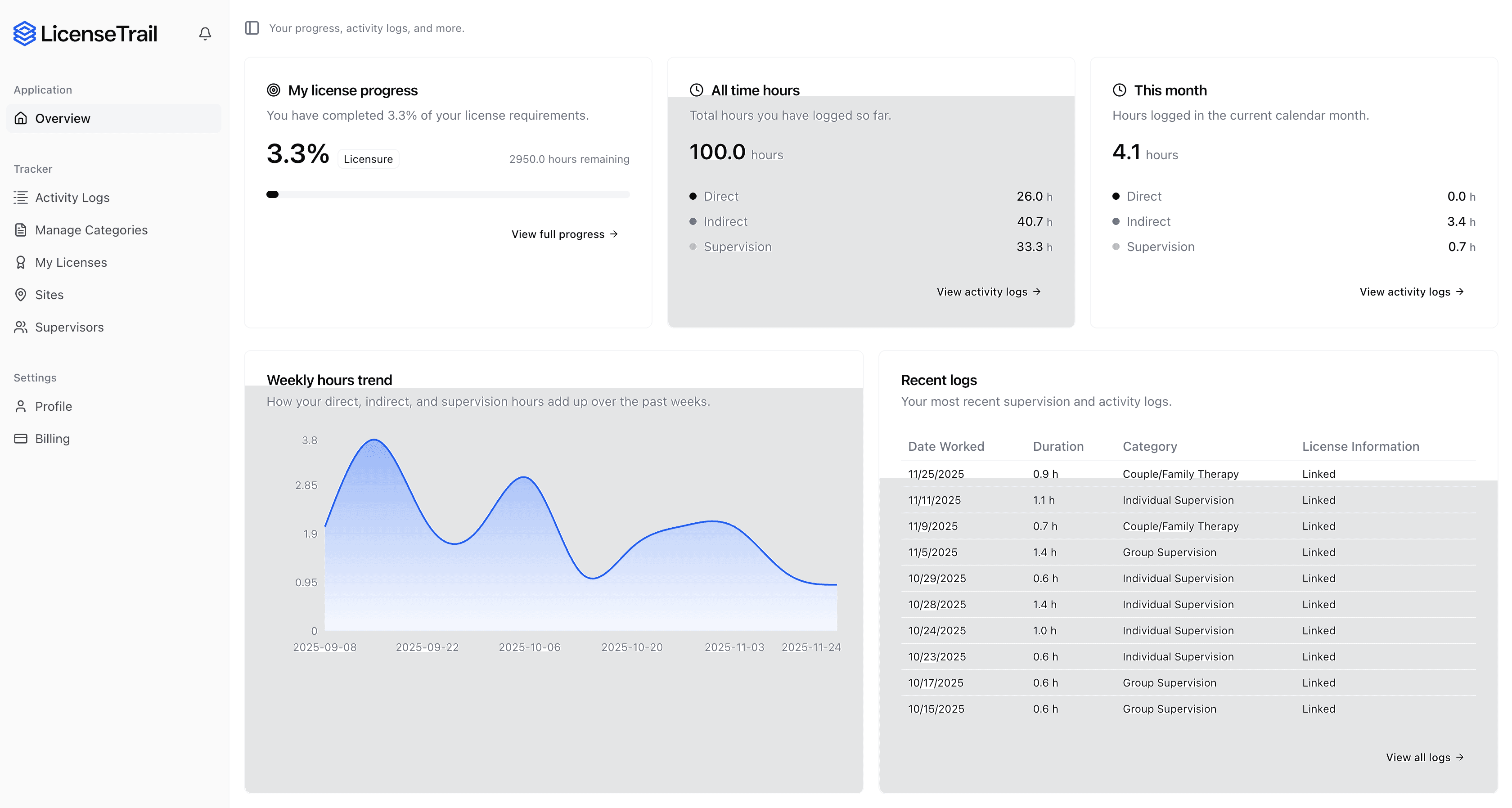
Track your LPCC hours with confidence
License Trail checks your direct, indirect, and supervision hours against Ohio LPCC requirements continuously and flags mismatches before you submit.
 Start Tracking for Free
No credit card required · Free plan available
Is your spreadsheet hiding Ohio LPCC risks?
Stop guessing if your categories match Ohio Counselor, Social Worker and Marriage and Family Therapist Board requirements. License Trail checks your direct, indirect, and supervision hours continuously and flags mismatches before you submit.
Import or log
Bring your spreadsheet or start fresh
Upload your existing tracking spreadsheet and we'll map every hour into the right Ohio Counselor, Social Worker and Marriage and Family Therapist Board categories automatically.
Verify against Ohio
Catch mismatches before the board does
License Trail checks your direct, indirect, and supervision hours against Ohio LPCC requirements continuously.
Export board-ready
One-click clean reports
Generate professional, board-ready reports for supervision meetings and Ohio Counselor, Social Worker and Marriage and Family Therapist Board submissions in seconds.
No credit card required · Free plan available