
Ohio LISW Requirements: Hours, Exams & Step-by-Step Guide
Stop guessing if your categories match Ohio requirements. License Trail checks your direct, indirect, and supervision hours against LISW requirements continuously and flags mismatches before you submit.
No credit card required · Free plan available
Quick Requirements Overview
- MSW required (master’s degree in social work).
- Hold Ohio LSW while accruing experience (unlicensed hours don’t count).
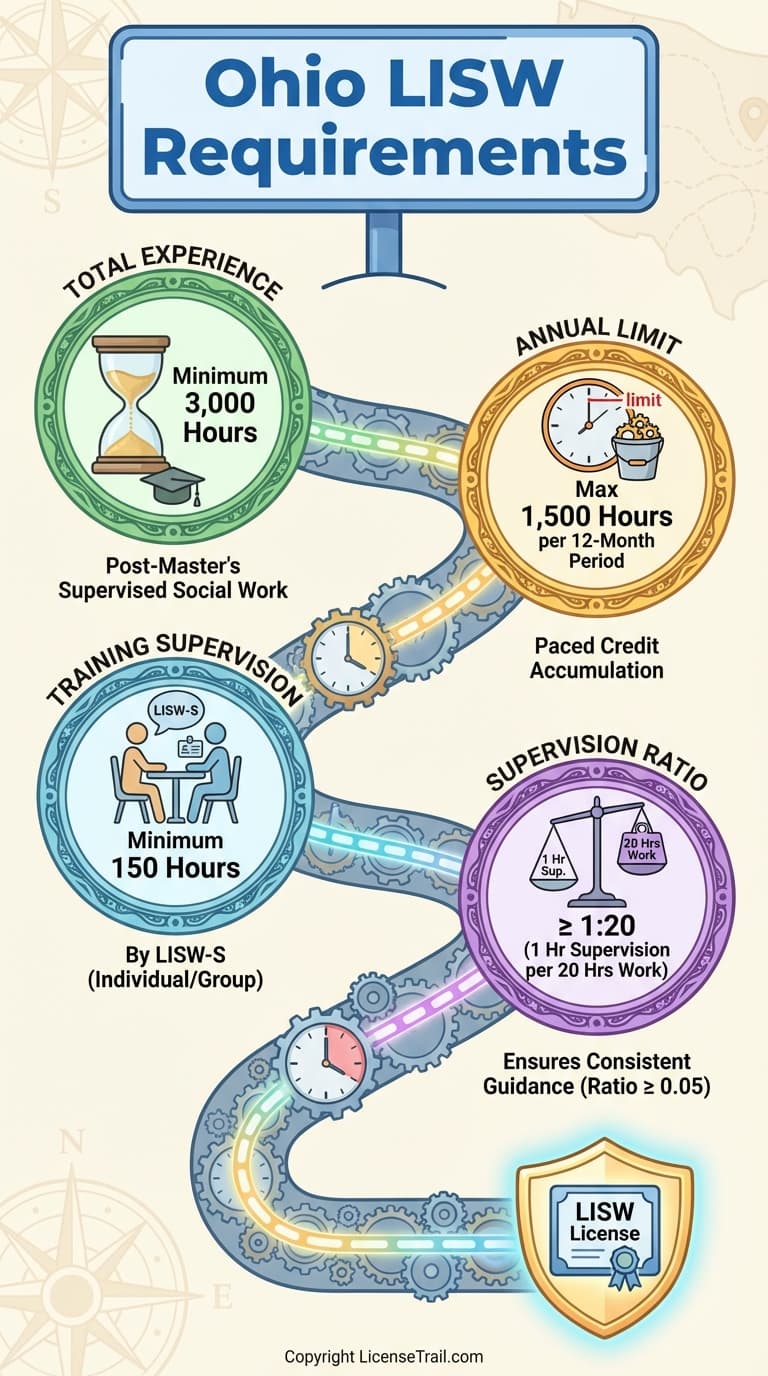
- Post‑master’s supervised experience: 3,000 hours over ≥2 complete years.
- Cap: max 1,500 hours credited per 12‑month period.
- Training supervision: 1 hour per 20 work hours, ≥150 total hours (individual and/or group).
- Supervisor: Ohio LISW‑S (training supervision designation); no direct family relationship; if in OH both must be OH‑licensed.
- Documentation: maintain supervision logs; supervisor acknowledges at least quarterly; available to Board; final hours submitted by supervisor.
- Exam/application: pass ASWB Clinical or Advanced Generalist (must be within 7 years of application unless exception); submit application/fee/background check.
License Details
Procedures
Licensure as a Licensed Independent Social Worker (LISW) in Ohio is governed by the Ohio Counselor, Social Worker and Marriage and Family Therapist (CSWMFT) Board and detailed in Chapter 4757 of the Ohio Administrative Code (OAC). The Board is very specific about the type and amount of experience and supervision required.
Below is a step‑by‑step description focused on those hour requirements and the Board’s own terminology.
1. Basic eligibility
To be considered for LISW in Ohio, you must:
-
Hold a master’s degree in social work
Rule 4757‑19‑02(D)(1) requires “a master’s degree in social work.” (codes.ohio.gov) -
Have two years of supervised social work experience while licensed as a social worker
This experience is further defined (see Section 2 below) and must be completed while “engaged in the practice of social work and [holding] licensure as a social worker.” (codes.ohio.gov) -
Complete post‑master’s supervised experience
For approval, Rule 4757‑19‑08 requires “at least two years of post‑master’s degree social work experience that prepares the applicant for independent practice supervised by an independent social worker with training supervision designation.” (codes.ohio.gov) -
Pass the LISW‑level exam
Rule 4757‑19‑02(D)(3) requires passing “the examination… to determine the applicant's ability to be an independent social worker.” (codes.ohio.gov)
In practice, this is the ASWB Clinical or Advanced Generalist exam. (mswguide.org) -
Submit an application, fee, and background check
Rules 4757‑19‑02 and 4757‑19‑08 require an application, fee, proof of degree, proof of supervised experience, and proof of passing the exam. (codes.ohio.gov)
2. Employment experience hours: 3,000 hours over at least 2 years
2.1 Board definition of “two years employment experience”
For LISW, the central experience requirement is found in Rule 4757‑19‑02(D)(2)(a). The Board defines:
“Two years employment experience” means at least two complete years supervised experience which includes three thousand hours of work for a fee, salary or other consideration, during which time the applicant was engaged in the practice of social work and held licensure as a social worker; except that no applicant may be credited with more than fifteen hundred hours of experience during any twelve‑month period. (codes.ohio.gov)
In practical terms, this means:
- Total employment hours:
- 3,000 hours of social work employment (paid or otherwise compensated).
- Timeframe:
- At least two complete years (24 months).
- You cannot count more than 1,500 hours in any 12‑month period toward the 3,000.
- Licensure status during hours:
- You must be licensed as a social worker (LSW) during these hours; unlicensed work does not count toward the LISW requirement. (codes.ohio.gov)
2.2 Type of work these 3,000 hours can include
The rule speaks in terms of being “engaged in the practice of social work,” not in a split between clinical vs. non‑clinical hours. (codes.ohio.gov)
Key points:
- The Board does not divide the 3,000 hours into categories like:
- “X hours of direct client contact” vs.
- “Y hours of supervision” vs.
- “Z hours of administration.”
- Instead, all 3,000 hours are supervised social work employment within your LSW scope of practice (e.g., assessment, counseling, case management, social psychotherapy under appropriate supervision). (codes.ohio.gov)
Your work must be substantial enough and of a type that, when combined with training supervision, “prepares the applicant for independent practice.” (codes.ohio.gov)
3. Training supervision hours: 150 hours minimum
Ohio makes a clear distinction between:
- Clinical/work supervision and
- Training supervision (the hours that count toward independent licensure).
These are defined in Rule 4757‑23‑01.
3.1 Board definition of “training supervision”
Rule 4757‑23‑01(A)(2) defines training supervision as supervision for the purposes of:
- Obtaining a license and/or
- Developing new areas of proficiency
while providing services to clients, with the training supervisor directing how you apply social work theory, knowledge, skills, and ethics in practice. (codes.ohio.gov)
This is distinct from clinical/work supervision, which is about oversight of ongoing practice and client welfare in settings where supervision is required for current work. (codes.ohio.gov)
3.2 Required quantity and ratio of training supervision
Rule 4757‑23‑01(F)(1) sets the quantitative requirement:
“One hour of individual and/or group supervision for each twenty hours of work by the supervisee with no less than one hundred fifty hours total.” (codes.ohio.gov)
Applied to the 3,000 employment hours:
- Minimum training supervision:
- 1 hour of training supervision per 20 work hours
- This yields a minimum of 150 hours of training supervision over the 3,000 employment hours.
- The 150 hours can be a mix of individual and group supervision, as defined in the same rule. (codes.ohio.gov)
3.3 Who can provide your training supervision?
The Board is explicit about the type of supervisor:
-
Supervisor type:
- Employment experience “required for licensure as an independent social worker” must be “supervised by an independent social worker.”
- For employment experience obtained after September 1, 2008, this must be an independent social worker with supervision designation (LISW‑S). (codes.ohio.gov)
-
Post‑master’s supervision requirement:
- For application approval, Rule 4757‑19‑08 requires your two years of post‑master’s experience to be “supervised by an independent social worker with training supervision designation.” (codes.ohio.gov)
-
Licensure and relationship constraints:
- If supervision occurs in Ohio, both supervisor and supervisee must be licensed in Ohio. (codes.ohio.gov)
- There can be no direct family relationship between supervisor and supervisee if the experience is to count toward licensure. (codes.ohio.gov)
3.4 Documentation of training supervision
The Board places the record‑keeping responsibility on you:
- You must maintain supervision logs that include:
- Dates/times of supervision
- Content and goals of supervision
- Your supervisor must sign or acknowledge the records at least quarterly. (codes.ohio.gov)
- Logs may be electronic or paper and must be available to the Board upon request. (codes.ohio.gov)
- When finished, you ask the LISW‑S who last provided training supervision to submit your accumulated training supervision hours to the Board using the online form. (codes.ohio.gov)
4. How the hours fit together (and what they are not)
4.1 The actual breakdown used by Ohio
Putting the rules together:
-
Employment experience:
- 3,000 hours of supervised social work employment
- Over at least 2 full years
- While licensed as a social worker (LSW)
- No more than 1,500 hours credit per 12‑month period (codes.ohio.gov)
-
Training supervision within that employment:
- At least 150 hours
- Provided by an LISW‑S
- At a 1:20 supervision‑to‑work ratio (1 hour supervision per 20 hours of work) (codes.ohio.gov)
Ohio’s rules do not say, for example, “1,500 hours of direct client contact and 1,500 hours of supervised experience.” Instead:
- All of the 3,000 hours must be supervised employment in the practice of social work.
- Within those 3,000 hours, you must accumulate 150 hours of formal training supervision that meet the Board’s definitions and documentation requirements.
Secondary summaries you’ll see (e.g., “3,000 hours supervised social work experience and 150 hours of supervision from an LISW‑S”) are exactly restating this structure. (mswguide.org)
5. Examination requirement
After completing the education and experience pieces, you must pass an examination “administered by the board for the purpose of determining ability to practice as an independent social worker.” (codes.ohio.gov)
The Board approves candidates for:
- ASWB Clinical exam
- or ASWB Advanced Generalist exam
Either satisfies the LISW requirement in Ohio. (mswguide.org)
There is a time limit: the required examination must have been passed within seven years of the application date, unless you fall within specified exceptions (e.g., currently licensed elsewhere at an equivalent level). (codes.ohio.gov)
6. Summary checklist of hour‑related requirements
To satisfy the Ohio CSWMFT Board for LISW licensure, your hours must meet all of the following:
-
3,000 hours of supervised social work employment
- At least two complete years (24 months) of supervised experience.
- No more than 1,500 hours counted in any 12‑month period.
- Hours are in the practice of social work, while you hold an LSW. (codes.ohio.gov)
-
150 hours of training supervision
- One hour of individual or group supervision for every 20 work hours.
- At least 150 total training supervision hours. (codes.ohio.gov)
-
Supervisor qualifications
- Supervisor is an independent social worker with training supervision designation (LISW‑S).
- No direct family relationship with you.
- If supervision is in Ohio, both parties must hold Ohio licenses. (codes.ohio.gov)
-
Documentation
- Maintain detailed supervision logs, signed/acknowledged quarterly, and available to the Board on request.
- Final hours are submitted electronically by your LISW‑S supervisor via the Board’s online system. (codes.ohio.gov)
These are the core, Board‑defined hour requirements that must be met to obtain LISW licensure through the Ohio Counselor, Social Worker and Marriage and Family Therapist Board as of the current Administrative Code revisions (effective late 2023–2024).
Track your LISW hours with confidence
License Trail checks your direct, indirect, and supervision hours against Ohio LISW requirements continuously and flags mismatches before you submit.
 Start Tracking for Free
No credit card required · Free plan available
Is your spreadsheet hiding Ohio LISW risks?
Stop guessing if your categories match Ohio Counselor, Social Worker and Marriage and Family Therapist Board requirements. License Trail checks your direct, indirect, and supervision hours continuously and flags mismatches before you submit.
Import or log
Bring your spreadsheet or start fresh
Upload your existing tracking spreadsheet and we'll map every hour into the right Ohio Counselor, Social Worker and Marriage and Family Therapist Board categories automatically.
Verify against Ohio
Catch mismatches before the board does
License Trail checks your direct, indirect, and supervision hours against Ohio LISW requirements continuously.
Export board-ready
One-click clean reports
Generate professional, board-ready reports for supervision meetings and Ohio Counselor, Social Worker and Marriage and Family Therapist Board submissions in seconds.
No credit card required · Free plan available