
Ohio LPMT Requirements: Hours, Exams & Step-by-Step Guide
Stop guessing if your categories match Ohio requirements. License Trail checks your direct, indirect, and supervision hours against LPMT requirements continuously and flags mismatches before you submit.
No credit card required · Free plan available
Quick Requirements Overview
- Regulator: Ohio CSWMFT Board (licenses music therapists as LPMT)
- Minimum age: 18+
- Education: Bachelor’s or higher in music therapy from an AMTA‑approved program (or successor)
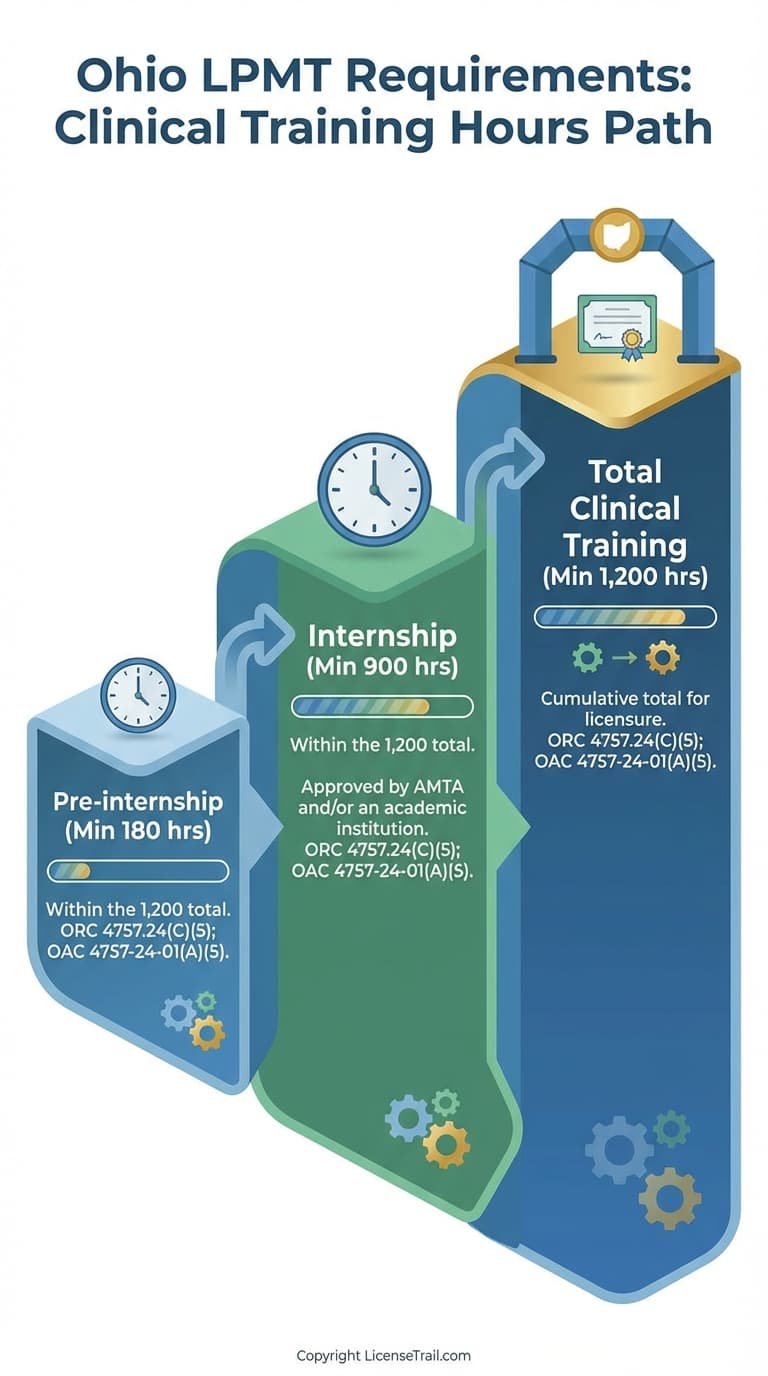
- Clinical training: 1,200 hours minimum, including ≥180 pre‑internship and ≥900 internship; internship approved by AMTA and/or academic institution
- Exam/certification: Pass CBMT exam and hold current MT‑BC in good standing (or successor)
- Background check: BCI/FBI criminal records check required under ORC 4757.101 / Ch. 4776
- Application: Apply via Ohio eLicense; submit application + transcripts + proof of exam/certification; certain “yes” answers/flags routed to committee review
- Renewal CE: 30 hours/2 years, including 3 ethics hours
License Details
Procedures
Ohio now licenses music therapists under the title “Licensed Professional Music Therapist” (LPMT) through the Counselor, Social Worker, and Marriage and Family Therapist (CSWMFT) Board. The LPMT credential is created in statute at Ohio Revised Code (ORC) 4757.24 and further defined in Ohio Administrative Code (OAC) Chapter 4757‑24. (codes.ohio.gov)
Below is a structured walkthrough of what the Board requires, with emphasis on hours, terminology, and where those requirements come from in law and rule.
1. Legal framework and title
- Statutory authority: ORC 4757.24 establishes the license “as a music therapist” and sets the core eligibility requirements. (codes.ohio.gov)
- Administrative rules: OAC 4757‑24‑01 (“Qualifications for a license as a licensed professional music therapist”) and 4757‑24‑02 (“Approval of applications for licensure as a music therapist”) implement those statutory requirements. (codes.ohio.gov)
- Official title/abbreviation: Under OAC 4757‑3‑02, “LPMT” is the Board‑recognized abbreviation for “Licensed Professional Music Therapist.” (codes.ohio.gov)
2. Baseline eligibility (non‑hour requirements)
Age
Both the statute and the rule require that an applicant:
- Be at least 18 years of age to be eligible for a music therapy license. (codes.ohio.gov)
Criminal records check
Under ORC 4757.101, every applicant for an initial license issued under Chapter 4757 must comply with Ohio’s criminal‑records‑check statutes in Chapter 4776. The Board may not grant a license unless that requirement is met. (codes.ohio.gov)
Practically, this means you must complete the required BCI/FBI background checks as part of your licensure application.
3. Education requirement
ORC 4757.24(C)(2) and OAC 4757‑24‑01(A)(2) require that an LPMT applicant must: (codes.ohio.gov)
- “Successfully completed an academic program with a bachelor’s or higher degree in music therapy”
- The program must be approved by the American Music Therapy Association (AMTA) or its successor organization.
Key points:
- The degree may be bachelor’s, master’s, or higher, but it must be a music therapy degree, not a generic music or counseling degree.
- “Approved” is defined via AMTA’s program approval standards; Ohio’s law simply incorporates that requirement rather than creating a separate state curriculum.
Because AMTA‑approved programs must themselves meet detailed clinical training standards (see Section 4), graduating from such a program is also how you meet the hour requirement written into Ohio law.
4. Clinical training hours: what Ohio law actually requires
Exact statutory language for hours
Both ORC 4757.24(C)(5) and OAC 4757‑24‑01(A)(5) require that an applicant: (codes.ohio.gov)
- Has completed “a minimum of one thousand two hundred hours of clinical training”
- With at least “one hundred eighty hours in preinternship experience”
- And at least “nine hundred hours in internship experience”
- The internship must be approved by AMTA (or its successor), an academic institution, or both.
In plain terms, for Ohio LPMT licensure you need:
- Total clinical training hours required:
- 1,200 hours minimum of clinical training.
- Breakdown by category:
- ≥ 180 hours of pre‑internship experience (also often called fieldwork or practicum in academic programs).
- ≥ 900 hours of internship experience.
- These hours are normally completed as part of your AMTA‑approved degree program, not as a separate, post‑degree supervised experience.
How “clinical training” and these hours are understood
Ohio’s law and rules do not separately define “clinical training”; they intentionally mirror AMTA’s education and training standards. AMTA defines clinical training as the continuum of supervised field experiences (observation, assisting, co‑leading, leading, and taking responsibility for program planning and treatment with clients). (musictherapy.org)
AMTA’s standard also states that students must complete at least 1,200 hours of clinical training, with a minimum of 180 hours in pre‑internship and 900 hours in internship, and notes that these hours should include both direct client contact and other activities directly related to clinical sessions (supervision, planning, documentation). (musictherapy.org)
Because Ohio law simply copies this structure and numbers, the “type” of hours the Board expects can be summarized as:
-
Pre‑internship hours (≥ 180):
- Usually multiple shorter placements during coursework.
- Supervised by credentialed music therapists.
- Combination of observing sessions, assisting, co‑leading, and some leading, plus related documentation and planning.
-
Internship hours (≥ 900):
- A full, extended internship at an AMTA‑approved (or institution‑approved) site.
- More advanced practice where you progressively assume responsibility for assessment, treatment planning, implementation, and evaluation under supervision.
Important clarification:
Ohio does not split these 1,200 hours into separate legal categories such as “X hours of direct client contact” vs. “Y hours of supervision,” nor does it require an additional post‑degree supervised practice period (like “1,500 supervised hours after graduation”). The only hour requirement written into the LPMT law and rule is the 1,200 clinical training hours with the 180/900 breakdown described above.
5. National certification requirement (MT‑BC)
Ohio ties licensure to the national music therapy credential.
Under ORC 4757.24(C)(3)–(4) and OAC 4757‑24‑01(A)(3)–(4), the applicant must: (codes.ohio.gov)
- Have passed the examination for board certification by the Certification Board for Music Therapists (CBMT) (or its successor), or have obtained CBMT certification as of January 1, 1985; and
- Be currently certified as a music therapist by that board (or its successor).
In practice, this means you must hold Music Therapy Board Certification (MT‑BC) in good standing. Continuing education sites summarizing the Board’s own instructions state that all LPMT applicants must hold MT‑BC in good standing, verified by CBMT. (impactce.com)
So the Board’s sequence is:
- Complete an AMTA‑approved music therapy degree (with 1,200 clinical hours).
- Sit for and pass the CBMT exam.
- Maintain current MT‑BC certification at the time you apply for the LPMT license.
6. The application and Board approval process
The detailed process is laid out in OAC 4757‑24‑02 (Approval of applications for licensure as a music therapist), along with the Board’s general application rule 4757‑1‑04. (codes.ohio.gov)
6.1. Create or use your Ohio eLicense account
The Board administers all licensure through the state’s eLicense system. Guidance disseminated via the Association of Ohio Music Therapists (quoting the Board) explains that you must: (aomt.org)
- Create an eLicense account (or use your existing one if you already hold any CSWMFT‑issued license).
- From your dashboard, select the option to apply for a new license and choose the LPMT license type.
6.2. Submit a complete LPMT application
Under OAC 4757‑24‑02(B), an application can be approved administratively (without committee review) if it meets all of the following: (codes.ohio.gov)
- A complete application for professional music therapist license is received under rule 4757‑1‑04, with no “yes” responses that trigger extra review (e.g., felony convictions, prior license discipline, etc.).
- Transcript(s) from an accredited institution showing a bachelor’s degree or higher in music therapy that meets OAC 4757‑24‑01(A) (i.e., AMTA‑approved degree).
- Proof of passing an examination acceptable to the Music Therapist Professional Standards Committee (MPSC) for determining ability to practice as a professional music therapist (i.e., proof you passed the CBMT exam).
You must also satisfy background‑check requirements pursuant to ORC 4757.101 and pay the licensure fee established under ORC 4757.31. (codes.ohio.gov)
6.3. When the Music Therapist Professional Standards Committee (MPSC) reviews your file
OAC 4757‑24‑02(C) requires staff to send certain applications to the MPSC for review at its next meeting (if materials are received at least 10 days before the meeting), including: (codes.ohio.gov)
- Applications with felony convictions, prior loss of license, or other issues requiring more detailed review.
- Applications with questionable or unclear qualifying degrees.
- Any application where staff believe more information is needed.
The MPSC then decides whether to approve, request more documentation, or deny licensure.
7. License issuance timeline
Both ORC 4757.24(D) and OAC 4757‑24‑01(B) state that, once the Board (through the appropriate professional standards committee) has received all information required by the section/rule and proof of compliance with ORC 4757.101, it must issue the license within 60 days. (codes.ohio.gov)
So, assuming your application is clean and complete:
- Staff may approve it administratively (per 4757‑24‑02(B)), and
- The formal outer limit for issuance is 60 days after all required information and background‑check compliance are received.
8. Post‑licensure obligations (brief overview)
Once licensed, LPMTs have to maintain the credential with continuing education and proper use of title.
Continuing education (CE)
OAC Chapter 4757‑9 sets CE rules for all Board licensees. For music therapists specifically, OAC 4757‑9‑01 (or related section) provides that: (codes.ohio.gov)
- Licensed professional music therapists must complete 30 clock hours of continuing education every two years as a condition of license renewal.
- Three of those hours must be in ethics.
- Acceptable CE content areas include (but are not limited to):
- Music theory
- Functional music skills
- Therapeutic applications
- Client assessment
- Treatment planning and assessment
- Any other program area relevant to a profession licensed by the Board.
Use of title
Under OAC 4757‑3‑02, once licensed you may use the title “Licensed Professional Music Therapist” and the abbreviation “LPMT.” (codes.ohio.gov)
You must not represent yourself as an LPMT or use that abbreviation until the Board has actually granted the license.
9. Summary of hour‑related requirements (and what Ohio does not require)
To directly address the type‑of‑hours issue:
-
Required by Ohio law/rule for LPMT:
- 1,200 total hours of clinical training, completed as part of an AMTA‑approved music therapy degree program, broken down as:
- ≥ 180 hours pre‑internship experience, and
- ≥ 900 hours internship experience. (codes.ohio.gov)
- These hours are supervised clinical training and typically include both direct client work and closely related clinical activities (planning, supervision, documentation) in line with AMTA standards. (musictherapy.org)
- 1,200 total hours of clinical training, completed as part of an AMTA‑approved music therapy degree program, broken down as:
-
Not required by Ohio for LPMT:
- No additional, separate “post‑degree supervised experience” in the style of:
- “1,500 hours of direct experience plus 1,500 hours of supervised experience,”
- Or any multi‑year, post‑graduate supervised clinical practice like that required for an LPCC.
- No state‑mandated division of the 1,200 hours into specific numbers of direct‑client vs. indirect hours, beyond the 180/900 pre‑internship/internship split.
- No additional, separate “post‑degree supervised experience” in the style of:
If you have completed an AMTA‑approved music therapy degree (bachelor’s or higher), including the required 1,200 clinical hours, and you currently hold MT‑BC certification and pass the Board’s background‑check and application requirements, you will have met Ohio’s hour‑related requirements to be licensed as an LPMT by the CSWMFT Board.
Track your LPMT hours with confidence
License Trail checks your direct, indirect, and supervision hours against Ohio LPMT requirements continuously and flags mismatches before you submit.
 Start Tracking for Free
No credit card required · Free plan available
Is your spreadsheet hiding Ohio LPMT risks?
Stop guessing if your categories match Ohio Counselor, Social Worker and Marriage and Family Therapist Board requirements. License Trail checks your direct, indirect, and supervision hours continuously and flags mismatches before you submit.
Import or log
Bring your spreadsheet or start fresh
Upload your existing tracking spreadsheet and we'll map every hour into the right Ohio Counselor, Social Worker and Marriage and Family Therapist Board categories automatically.
Verify against Ohio
Catch mismatches before the board does
License Trail checks your direct, indirect, and supervision hours against Ohio LPMT requirements continuously.
Export board-ready
One-click clean reports
Generate professional, board-ready reports for supervision meetings and Ohio Counselor, Social Worker and Marriage and Family Therapist Board submissions in seconds.
No credit card required · Free plan available