
Pennsylvania LAMFT Requirements: Hours, Exams & Step-by-Step Guide
Stop guessing if your categories match Pennsylvania requirements. License Trail checks your direct, indirect, and supervision hours against LAMFT requirements continuously and flags mismatches before you submit.
No credit card required · Free plan available
Quick Requirements Overview
- Purpose/Scope: Transitional license to practice only under Board-acceptable supervision while earning hours toward LMFT; no independent/private practice without supervisor direction; title “LAMFT/L.A.M.F.T.” protected.
- Eligibility: 21+, good moral character; meet LMFT education requirements (Master’s/Doctorate in MFT or closely related field from accredited school).
- Act 31: 3 hours Board-approved child abuse recognition/reporting training (provider reports to Board).
- Exam: No exam for LAMFT; National MFT Exam (AMFTRB) required later for LMFT.
- Application must include: Supervision plan (each employer/site, where client contact & supervision occur, detailed job description) + CV/resume for each supervisor; Board won’t review without these.
- Supervisor rules: Supervisors must be appropriately licensed and experienced; ≥50% of supervision hours must be with an LMFT who is AAMFT Approved Supervisor/Supervisor-in-Training; remainder may be qualified LMFT/related licensed professional (per Board).
- Fees/renewal: $75 application; $95 biennial renewal; max 3 renewals (≈ 8-year window total).
- Hours toward LMFT (earned while LAMFT): 3,000 hrs (Master’s) or 2,400 hrs (Doctorate; 1,200 post-degree) in 2–6 years; 500–1,800 hrs/year; ≥50% in direct service categories; supervision minimum 2 hrs per 40 hrs experience (≥1 hr individual in-person).
License Details
Procedures
Pennsylvania’s Licensed Associate Marriage and Family Therapist (LAMFT) credential is a new, transitional license that lets you begin practicing under supervision while you accumulate the hours needed for full LMFT licensure. It is governed by the Social Workers, Marriage and Family Therapists and Professional Counselors Act (63 P.S. § 1901 et seq.) and the Board’s regulations in 49 Pa. Code Chapter 48.
Below is a structured guide laying out the requirements, with emphasis on the hours and the exact categories the Board uses.
1. What the LAMFT License Is (and Is Not)
The Pennsylvania Department of State describes a LAMFT as:
“an individual who is gaining the supervised clinical experience required to become a licensed Marriage and Family Therapist (MFT).” (pa.gov)
By statute, a “licensed associate marriage and family therapist” is someone who is licensed under the Act and “is obtaining supervised clinical experience for the purpose of becoming a licensed marriage and family therapist.” (legis.state.pa.us)
Key implications:
- A LAMFT is not an independent practitioner.
- It is specifically for accumulating supervised clinical experience toward the LMFT.
- All clinical practice must be under the supervision of a Board‑acceptable supervisor.
The Act further provides that a LAMFT “shall work under the supervision of a licensed marriage and family therapist or a related licensed professional as approved by the board” and “shall not practice in a private setting without the direction of a supervisor.” (legis.state.pa.us)
2. Baseline Eligibility for LAMFT in Pennsylvania
2.1 Age and Character
Under section 7(e.1) of the Act, to qualify for an associate MFT license you must: (legis.state.pa.us)
- Be at least 21 years of age.
- Be of good moral character. (If you have a criminal conviction, the Board must conduct an individualized assessment under 63 Pa.C.S. § 3113.)
The Act also includes specific restrictions and waiting periods for certain felony drug convictions. (legis.state.pa.us)
2.2 Educational Requirement
You must already meet the educational requirements for a full LMFT, because the associate license is meant to cover only the supervised-experience phase.
The statute requires that a marriage and family therapist applicant meet one of three pathways (master’s or doctoral) in section 7(e)(2). (legis.state.pa.us)
The Department of State’s LAMFT Licensure Snapshot summarizes this as:
- Master’s or Doctoral degree in Marriage and Family Therapy or a “closely related” field from an accredited institution. (pa.gov)
The Board’s regulations list “fields closely related to the practice of marriage and family therapy” (49 Pa. Code § 48.1). The snapshot identifies them as including: counseling, education, medicine, ministry, nursing, pastoral counseling, psychology, social work, sociology, and theology. (pa.gov)
2.3 Child Abuse Continuing Education (for Initial LAMFT)
For initial licensure you must complete:
- 3 hours of Board‑approved continuing education in child abuse recognition and reporting (Act 31 training). (pa.gov)
The provider reports completion directly to the Board.
2.4 No Examination Required for the LAMFT Itself
- There is no exam requirement to obtain the LAMFT license. (pa.gov)
- Once your LAMFT application is complete, the Board will email instructions on how to register for the National MFT Exam (Association of Marital & Family Therapy Regulatory Boards), which you must pass later for LMFT licensure. (pa.gov)
3. Supervision Plan and Supervisor Requirements for LAMFT
A central requirement for LAMFT licensure is the supervision plan, since your associate license can only exist in the context of active, approved supervision.
3.1 Supervision Plan Content
Section 7(e.1) of the Act requires that the applicant has “submitted a supervision plan, including a detailed job description and each location where client contact and supervision will occur.” (legis.state.pa.us)
The Department’s LAMFT Snapshot clarifies that your supervision plan must include: (pa.gov)
- The name of each employer and
- The location where client contact and supervision will occur for each site, and
- A detailed job description of your duties at each location.
The Board will not review your application until this plan and all supervisor credentials are received. (pa.gov)
3.2 Supervisor Credentials and Distribution of Supervision Hours
The Act states that, to qualify for the associate license, you must submit the résumé or CV of “each licensee who provides supervision acceptable to the board.” Supervisors must: (legis.state.pa.us)
- Hold a current and active license to practice marriage and family therapy or a related licensed profession approved by the Board, and
- Have no less than five full‑time years of experience (or equivalent) in the prior 10 years (with more detail in Board regulations).
The LAMFT Snapshot adds a specific distribution requirement for supervision hours: (pa.gov)
- At least half of the required supervision hours must be overseen by a licensed MFT who is an AAMFT Approved Supervisor or Supervisor-in-Training.
- The remaining supervision hours may be provided by:
- Another LMFT who is also AAMFT‑approved, or
- A licensed professional in a closely related field with a master’s degree and at least 5 years of experience in the last 10 years.
These supervision hours are the hours of supervisory meetings, not client hours; they run concurrently with your accumulation of supervised clinical experience described in Section 5 below.
4. LAMFT License Mechanics: Fees, Renewal Limits, and Practice Restrictions
4.1 Fees
The Act specifies: (legis.state.pa.us)
- Initial LAMFT application fee: $75 (may be changed by regulation).
- Biennial renewal fee: $95.
4.2 Renewal Limits
Under section 7(e.1)(2), an associate marriage and family therapist license: (legis.state.pa.us)
- Is renewed on a biennial (every two years) basis, and
- Is eligible for no more than three renewals.
In practice, that caps the LAMFT period at approximately eight years (initial 2‑year term plus three renewals), giving a maximum window in which to complete your supervised experience and move to full LMFT licensure.
4.3 Practice Restrictions and Title Protection
- A LAMFT must work under supervision of a licensed MFT or other Board‑approved licensed professional, who “directs the activities of the licensed associate marriage and family therapist.” (legis.state.pa.us)
- A LAMFT may not practice in a private setting without a supervisor’s direction. (legis.state.pa.us)
- Only individuals licensed as LAMFTs may use the title “Licensed Associate Marriage and Family Therapist” or the designation “L.A.M.F.T.” (Section 16.5 of the Act). (legis.state.pa.us)
The statute also defines the “practice of associate marriage and family therapy” as applying psychotherapeutic and family systems theories to evaluate, assess, diagnose and treat mental and emotional disorders “while under the supervision of a licensed supervisor acceptable to the board.” (legis.state.pa.us)
5. The Hours You Must Accumulate as a LAMFT to Become an LMFT
Importantly, Pennsylvania does not set a separate minimum number of hours to qualify for the LAMFT license itself. Instead, the LAMFT is the status under which you accrue the “supervised clinical experience” required for full LMFT licensure.
The controlling provisions for those hours are in:
- Section 7(e)(3) of the Act, and
- 49 Pa. Code § 48.13 (“Licensed MFT”). (legis.state.pa.us)
5.1 Total Supervised Clinical Experience Required
The Board and statute use the term “supervised clinical experience” (not a split between “direct” and “indirect” hours).
Under the Act and § 48.13: (legis.state.pa.us)
- If you hold a qualifying master’s degree:
- You must complete at least 3,000 hours of supervised clinical experience,
- Obtained after completion of 48 semester hours / 72 quarter hours of graduate coursework.
- If you hold a qualifying doctoral degree:
- You must complete at least 2,400 hours of supervised clinical experience,
- Of which 1,200 hours must be obtained after the doctoral degree is granted.
The Department’s LMFT Snapshot restates this as:
- “Master’s Degree – 3,000 hours of Supervised Clinical Experience completed in no less than 2 years and no more than 6 years.”
- “Doctoral Degree – 2,400 hours of Supervised Clinical Experience completed, of which 1,200 hours was obtained after the granting of the doctoral degree.” (pa.gov)
5.2 Timeframe and Annual Limits
Section 48.13(b)(9) sets timing limits for when those hours can be accrued: (pacodeandbulletin.gov)
- The supervised clinical experience must be completed in no less than 2 years and no more than 6 years.
- In any 12‑month period, no fewer than 500 hours and no more than 1,800 hours may be credited.
These constraints apply regardless of whether the hours are obtained while you are a LAMFT (which will be the norm) or under some other qualifying supervised role that the Board accepts.
5.3 What Counts as Supervised Clinical Experience
Section 48.13(b) defines “supervised clinical experience” as experience “as a supervisee in a setting that is organized to prepare the applicant for the practice of marriage and family therapy consistent with the applicant’s education and training.” (pacodeandbulletin.gov)
At least one‑half of those hours must be in specific direct service roles:
- Assessment
- Couples therapy
- Family therapy
- Other systems interventions
- Consultation
- Individual therapy
- Group therapy (pacodeandbulletin.gov)
This means that:
- For a master’s‑level LMFT:
- Out of the 3,000 total supervised clinical hours, at least 1,500 hours must be in these direct service activities (calculated from the 50% requirement; the Board does not separately label them as “direct client hours,” but functionally they are).
- For a doctoral‑level LMFT:
- Out of 2,400 total hours, at least 1,200 hours must be in those direct service categories.
The remaining hours can be other clinically related activities carried out in a qualifying setting under supervision (for example, certain case conceptualization, documentation, treatment planning, and clinically focused consultation as permitted by the Board and your supervisor).
5.4 Required Supervision Ratio and Structure
Section 48.13(b)(5) sets the supervision ratio and method: (pacodeandbulletin.gov)
- The supervisor (or delegated supervisor) must meet with you for at least 2 hours of supervision for every 40 hours of supervised clinical experience.
- At least 1 of those 2 hours must be individual, in‑person supervision.
- The other hour may be group, in‑person supervision.
In practice, if you complete the full 3,000 hours:
- 3,000 hours ÷ 40 = 75 units of 40 hours.
- 75 units × 2 hours of supervision = 150 hours of supervision minimum.
For 2,400 hours:
- 2,400 ÷ 40 = 60 units; 60 × 2 = 120 hours of supervision minimum.
The Board also limits a supervisor to no more than six supervisees at the same time, unless a hardship exception is granted. (pacodeandbulletin.gov)
6. How the Hours, Supervision, and LAMFT License Work Together in Practice
Putting the statutory and regulatory pieces together, the Pennsylvania Board’s framework operates as follows:
- Graduate with the required MFT (or closely related) degree.
- Complete 3 hours of child abuse recognition and reporting education. (pa.gov)
- Secure a supervised position and supervisor(s) who meet:
- The Act’s experience and licensure standards; and
- The LAMFT Snapshot’s requirement that at least half of your supervision hours come from an AAMFT‑approved LMFT supervisor or supervisor‑in‑training. (pa.gov)
- Prepare and submit your LAMFT application:
- Completed application form and $75 fee. (pa.gov)
- Supervision plan listing each practice site, detailed job descriptions, and anticipated client contact and supervision locations. (pa.gov)
- CV or résumé for each proposed supervisor documenting licensure and the required experience. (legis.state.pa.us)
- Proof of education and child abuse CE.
- Obtain your LAMFT license, then begin practicing exclusively under supervision in approved settings. You cannot independently engage in the “independent practice” of marriage and family therapy or hold yourself out as an LMFT. (codes.findlaw.com)
- Accrue supervised clinical experience:
- Accumulate 3,000 (master’s) or 2,400 (doctoral) supervised clinical hours, within 2–6 years, with the half‑direct‑service requirement and the 2 hours per 40 hours supervision ratio. (pacodeandbulletin.gov)
- Ensure at least half of your supervision hours are provided by an AAMFT‑approved LMFT supervisor or supervisor‑in‑training, and that all supervisors otherwise meet the Board’s standards. (pa.gov)
- Pass the National MFT Exam (AMFTRB) if you have not already done so. (pa.gov)
- Apply for full LMFT licensure, documenting that you have:
- Met the degree requirements,
- Passed the national exam, and
- Completed the required supervised clinical experience in the exact form set out in the Act and 49 Pa. Code § 48.13. (pacodeandbulletin.gov)
7. How Pennsylvania’s Framework Relates to “Direct” vs. “Supervised” Hours
Your example mentioned a split like 1,500 hours of direct experience + 1,500 hours of supervised experience. Pennsylvania’s Board uses different terminology and structure:
- It requires 3,000 or 2,400 total hours of “supervised clinical experience.”
- Within that total, it requires that at least half of the hours be direct clinical services in specific roles (assessment, couples/family therapy, systems interventions, consultation, individual, and group therapy). (pacodeandbulletin.gov)
- Supervision is layered on top of those hours at a fixed 2:40 ratio, with additional rules about who may supervise and in what proportion. (pacodeandbulletin.gov)
So, while Pennsylvania does not state the requirements as “X hours direct + Y hours supervised,” the effect is functionally similar:
- A master’s‑level LAMFT working toward LMFT must complete:
- 3,000 total supervised clinical hours, of which at least 1,500 hours are in direct service roles; plus
- Approximately 150 hours of formal supervision meetings (minimum) spread across those 3,000 hours.
All of this is governed by the exact phrasing in the Act (“supervised clinical experience”) and the Board’s regulations in 49 Pa. Code § 48.13, rather than a “direct vs. supervised” hour split.
In summary, to become a LAMFT in Pennsylvania you must meet degree, age, character, supervision-plan, supervisor, and child-abuse‑training requirements, but you do not need a pre‑existing bank of clinical hours. Once licensed as a LAMFT, you then accumulate the Board‑defined supervised clinical experience—3,000 or 2,400 hours, with specified content and supervision ratios—required to convert your associate license into a full LMFT license.
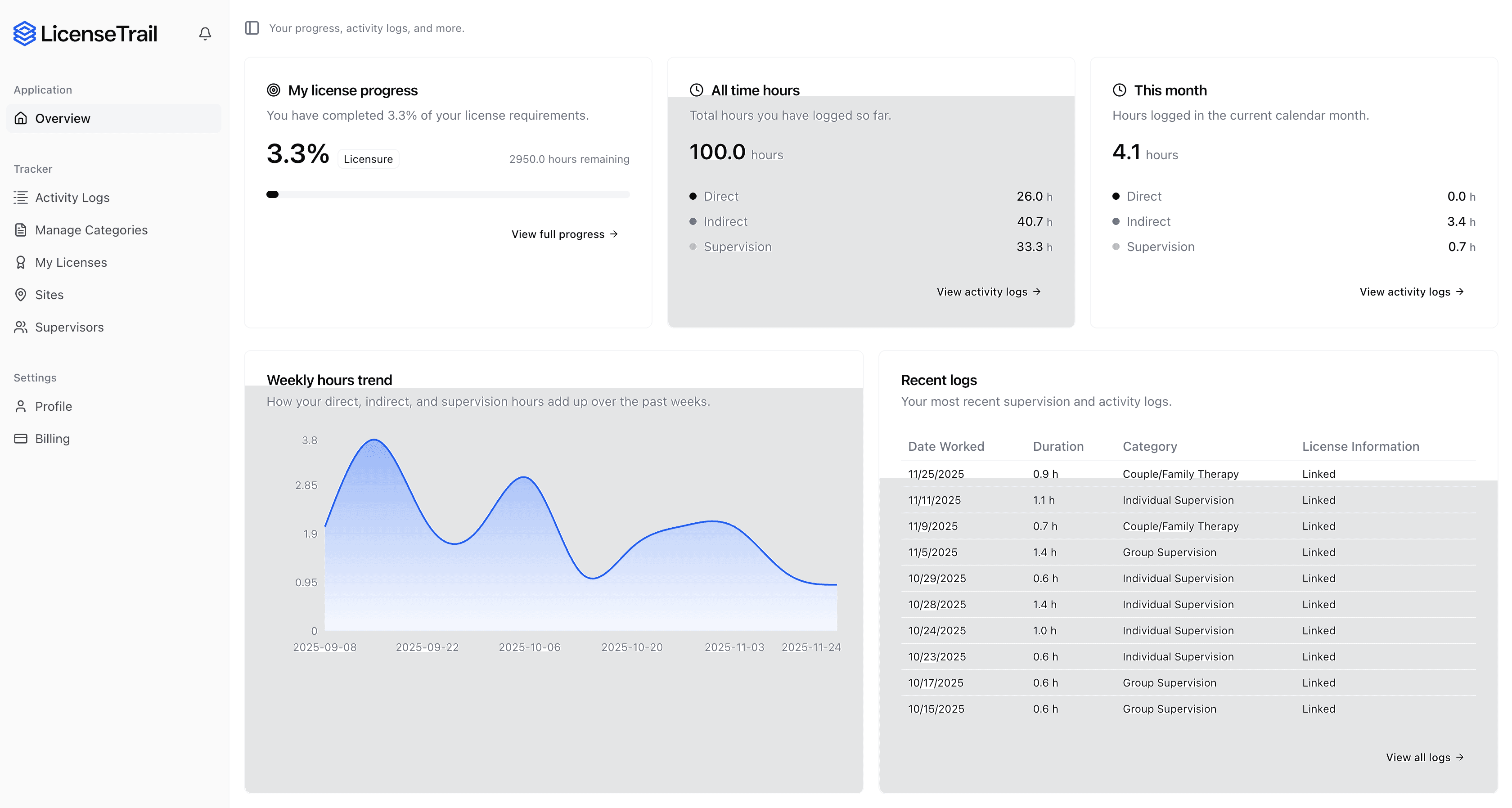
Track your LAMFT hours with confidence
License Trail checks your direct, indirect, and supervision hours against Pennsylvania LAMFT requirements continuously and flags mismatches before you submit.
 Start Tracking for Free
No credit card required · Free plan available
Is your spreadsheet hiding Pennsylvania LAMFT risks?
Stop guessing if your categories match Pennsylvania State Board of Social Workers, Marriage and Family Therapists and Professional Counselors requirements. License Trail checks your direct, indirect, and supervision hours continuously and flags mismatches before you submit.
Import or log
Bring your spreadsheet or start fresh
Upload your existing tracking spreadsheet and we'll map every hour into the right Pennsylvania State Board of Social Workers, Marriage and Family Therapists and Professional Counselors categories automatically.
Verify against Pennsylvania
Catch mismatches before the board does
License Trail checks your direct, indirect, and supervision hours against Pennsylvania LAMFT requirements continuously.
Export board-ready
One-click clean reports
Generate professional, board-ready reports for supervision meetings and Pennsylvania State Board of Social Workers, Marriage and Family Therapists and Professional Counselors submissions in seconds.
No credit card required · Free plan available