
Pennsylvania LAPC Requirements: Hours, Exams & Step-by-Step Guide
Stop guessing if your categories match Pennsylvania requirements. License Trail checks your direct, indirect, and supervision hours against LAPC requirements continuously and flags mismatches before you submit.
No credit card required · Free plan available
Quick Requirements Overview
- Purpose/role: Pre‑LPC associate license (Act 4 of 2024) to practice only under supervision while accruing LPC experience hours
- Eligibility: Age 21+; good moral character (criminal history reviewed); certain controlled‑substance felonies may disqualify
- Education: Master’s or doctoral in counseling or closely related field from an accredited institution (typically 60 semester / 90 quarter hours)
- Exam: No exam required for LAPC (exam required later for full LPC)
- Application must include: Supervision plan (employer(s)/location(s), duties) + CV/resume for each supervisor; application not reviewed until received
- Supervisor rules: Supervisors must be actively licensed and have 5 years experience in last 10; ≥50% of supervision hours must be by a qualified LPC
- Practice limits: Must be directed by supervisor; no private practice without supervisor direction
- Other admin: Act 31 child‑abuse training 3 hours; fees $75 application / $95 biennial renewal; LAPC can be renewed max 3 times
License Details
Procedures
Pennsylvania’s Licensed Associate Professional Counselor (LAPC) is a new, “pre‑LPC” license created by Act 4 of 2024 and administered by the State Board of Social Workers, Marriage and Family Therapists and Professional Counselors. It allows you to work as a counselor under supervision while you complete the supervised clinical experience required for full Licensed Professional Counselor (LPC) status. (pa.gov)
Below is a structured, step‑by‑step outline of what the Board requires, with a focus on hours and how the Board itself defines them.
1. How Pennsylvania Defines the LAPC Role
Act 4 adds the term “licensed associate professional counselor” and defines it as:
“An individual licensed as an associate professional counselor … who is obtaining supervised clinical experience for the purpose of becoming a licensed professional counselor.” (legis.state.pa.us)
The Department of State’s licensure snapshot further describes an LAPC as:
“An individual who is gaining supervised clinical experience to become a licensed professional counselor.” (pa.gov)
In other words, the LAPC license is the formal status you hold while you earn the supervised clinical hours that are later used to qualify for full LPC licensure.
2. Basic Eligibility Requirements for LAPC
2.1 Age and Character
The statute sets out baseline qualifications for an associate professional counselor license: (legis.state.pa.us)
- Minimum age: 21
- Good moral character: The Board must assess moral character; if you have a criminal conviction, the Board conducts an individualized assessment under 63 Pa.C.S. § 3113.
- Controlled substance felonies: Certain drug‑related felony convictions under Pennsylvania’s Controlled Substance, Drug, Device and Cosmetic Act (or equivalent out‑of‑state offenses) are disqualifying unless you meet specific statutory exceptions.
2.2 Educational Requirements
For LAPC, you must satisfy the same education standards that apply to full LPC applicants under § 1907(f)(2). In practice, this means: (pa.gov)
- Master’s or Doctoral degree in:
- Counseling, or
- A field “closely related to the practice of professional counseling” (examples in Board materials include social work, psychology, art therapy, dance/movement therapy, drama therapy, music therapy, human services, counselor education, or child development and family studies).
- Degree must be from an accredited educational institution.
- For most modern applicants, this is expected to be a 60‑semester‑hour (or 90‑quarter‑hour) graduate program in counseling or a Board‑approved related field.
The Associate Professional Counselor licensure snapshot explicitly notes that applicants must hold a qualifying master’s or doctoral degree in counseling or a closely related field that meets the Board’s educational requirements in 49 Pa. Code § 49.2. (pa.gov)
2.3 Examination Requirement (for LAPC)
- No licensing examination is required to obtain the LAPC. (pa.gov)
- The exam (e.g., NCE, CRC, etc.) is required later, when you apply for full LPC licensure. (pa.gov)
3. Supervision Plan and Supervisor Qualifications (Key for LAPC Approval)
To receive an LAPC license, you must submit a supervision plan and information about your supervisors. This is where the Board begins to tie your LAPC status to the supervised clinical experience you will use later for LPC licensure.
3.1 Required Supervision Plan Content
The Department of State’s LAPC snapshot states that LAPC applicants must submit: (pa.gov)
- A plan of supervision, including:
- The name of each employer and location where:
- Client contact will occur, and
- Supervision will occur.
- A detailed job description of your duties at each location.
- The name of each employer and location where:
- The curriculum vitae (CV) or résumé for each proposed supervisor, outlining:
- Employment/education history in chronological order,
- Employers (name, city, state), dates, and description of practice activity.
The Board will not review an LAPC application until the supervision plan and supervisor credentials are received. (pa.gov)
3.2 Supervisor Eligibility
The statute and Board materials together require that each supervisor: (legis.state.pa.us)
- Hold a current and active license:
- To practice professional counseling, or
- To practice in a related field approved by the Board.
- Have no fewer than five full‑time years (or the equivalent) of experience in the prior ten years in that field.
The LAPC snapshot specifies how supervision hours must be distributed among supervisors:
- At least one‑half of your supervision hours must be provided by a supervisor who:
- Is a licensed professional counselor, and
- Has 5 years of experience within the last 10 years as a professional counselor.
- The remaining supervision hours may be provided either by:
- Another professional counselor who meets the 5‑years‑in‑10 requirement, or
- A licensee with a master’s degree in a related field and 5 years of field experience in the last 10 years. (pa.gov)
The supervision must also comply with 49 Pa. Code §§ 49.1 (definitions), 49.3 (qualifications for supervisors), and 49.14 (standards for supervisors). (pa.gov)
4. Practice Restrictions While You Are an LAPC
Act 4 creates explicit limitations:
- You must work under the supervision of:
- A licensed professional counselor, or
- Another “related licensed professional” approved by the Board,
who directs your activities as an LAPC. (legis.state.pa.us)
- You may not practice in a private setting without the direction of a supervisor. (legis.state.pa.us)
The statute also clarifies that holding an LAPC license does not prevent you from taking the LPC exam while you are still completing your supervised hours for full LPC licensure. (legis.state.pa.us)
5. Hours: What You Need to Know as an LAPC Working Toward LPC
A key point:
- There is no specific pre‑licensure hour requirement just to obtain the LAPC license itself (beyond whatever practicum/internship was part of your graduate degree).
- The detailed hour requirements apply to the supervised clinical experience you must accumulate after your degree to qualify for the full LPC license. You will typically accrue these hours while holding the LAPC.
5.1 Total Supervised Clinical Hours Required for LPC
Under the Social Workers, Marriage and Family Therapists and Professional Counselors Act and its regulations:
- If you qualify via a master’s degree:
- You must complete at least 3,000 hours of supervised clinical experience acceptable to the Board and obtained after the qualifying graduate coursework. (codes.findlaw.com)
- If you qualify via a doctoral degree in counseling or an approved related field:
- You must complete at least 2,400 hours of supervised clinical experience,
- Of which 1,200 hours must be obtained after the doctoral degree is granted. (codes.findlaw.com)
These are the core “experience hours” you are working toward as an LAPC.
5.2 How the Board Defines “Supervised Clinical Experience”
49 Pa. Code § 49.13(b) defines acceptable supervised clinical experience as:
“Experience as a supervisee in a setting that is organized to prepare the applicant for the practice of counseling consistent with the applicant’s education and training.” (law.cornell.edu)
The regulation then breaks this down into:
5.2.1 Direct Service (Client‑Facing) Hours
The Board specifies that at least one‑half of the required experience must involve actual provision of counseling‑related services in one or more of the following areas: (law.cornell.edu)
- Assessment
- Counseling
- Therapy
- Psychotherapy
- Other therapeutic interventions
- Consultation
- Family therapy
- Group therapy
Translated into hours for a master’s‑level LPC applicant:
- Total required experience: 3,000 hours
- Minimum “direct service” requirement (½ of 3,000):
- At least 1,500 hours must be in the above service areas (assessment, counseling/therapy, etc.).
The remaining up to ~1,500 hours may involve other clinically relevant activities within your counseling role (e.g., record‑keeping, treatment planning, collateral contacts, case consultation, trainings in the agency), as long as they occur within an approved supervised clinical setting.
5.2.2 Supervision Hours and Structure
The Board’s supervision ratio is anchored in 49 Pa. Code § 49.13(b)(5): (law.cornell.edu)
- You must receive a minimum of 2 hours of supervision for every 40 hours of supervised clinical experience.
- At least 1 of these 2 hours must be individual, in‑person supervision.
- The other 1 hour may be group supervision, in person.
Applied to a 3,000‑hour master’s‑level experience:
- Total supervision hours (minimum):
- 3,000 hours ÷ 40 = 75 units of “40 clinical hours”
- 75 units × 2 hours of supervision = at least 150 hours of documented supervision.
- Of those 150 supervision hours:
- At least 75 hours must be one‑on‑one, in‑person supervision.
- Up to 75 hours can be group supervision, if your supervisor uses that format and it meets Board rules.
In addition, consistent with both the LAPC snapshot and general licensure rules:
- At least half of your total supervision hours must be provided by a supervisor who is a licensed professional counselor with at least 5 years of experience in the last 10 years. (pa.gov)
5.2.3 Pace and Timeframe Requirements
The Board limits how quickly or slowly you can accrue hours. Under § 49.13(b)(8)–(9): (law.cornell.edu)
- Your supervised work counts toward the requirement only if:
- It occurs in a single setting for:
- At least 30 hours per week (but no more than 40) over a minimum 3‑month period, or
- At least 15 hours per week over a minimum 6‑month period.
- It occurs in a single setting for:
- The 3,000 hours must be completed:
- In no less than 2 years and
- In no more than 6 years.
- Within any 12‑month period:
- You may credit no fewer than 500 hours and
- No more than 1,800 hours of supervised clinical experience.
These timing rules apply whether those hours are accrued while you hold an LAPC license or under another acceptable supervised role, as long as all Board criteria are met.
6. Continuing Education and Fees for LAPC
6.1 Initial Child Abuse Training
For initial LAPC licensure, the Board requires: (pa.gov)
- 3 hours of Board‑approved continuing education in child abuse recognition and reporting
(Act 31 training). - Course completion is reported directly to the Board by approved providers.
6.2 Fees and Renewals
According to both statute and the Department’s snapshot: (pa.gov)
- Initial LAPC application fee: $75
- Biennial renewal fee: $95
- Renewal limit: An associate professional counselor license may be renewed no more than three times (for a total of up to four 2‑year periods including the initial term).
This renewal cap underscores that the LAPC is intended as a time‑limited transitional license, not a permanent career endpoint.
7. Relationship Between LAPC and Full LPC Licensure
Putting it all together, the typical pathway in Pennsylvania is:
- Complete an approved master’s (or doctoral) degree satisfying the Board’s education criteria.
- Apply for LAPC:
- Verify age and character,
- Submit education documentation,
- Submit a supervision plan and supervisor credentials,
- Complete 3 hours of child abuse recognition and reporting training,
- Pay the $75 application fee.
- Work as an LAPC under supervision:
- Accrue 3,000 hours of supervised clinical experience (if master’s‑level) or 2,400 hours (if doctoral‑level), within the Board’s 2‑ to 6‑year window.
- Ensure at least half (~1,500 hours for master’s‑level) are in direct counseling‑related services (assessment, counseling, therapy, etc.).
- Obtain at least 150 hours of supervision (for 3,000 hours of experience), with:
- At least half your supervision provided by a qualified LPC supervisor.
- Take and pass a Board‑approved exam (e.g., NCE, CRC, ATCB, CBMT, etc.). (pa.gov)
- Apply for full LPC using your documented supervised clinical experience and exam results.
Throughout, you are bound by LAPC‑specific practice limitations (working under supervision, not practicing privately without supervisor direction, and using the LAPC title only if duly licensed). (legis.state.pa.us)
8. Key Hour Numbers at a Glance (Master’s‑Level Pathway)
While LAPC itself does not impose a separate, pre‑LAPC hour requirement, these are the Board‑defined experience and supervision standards you must ultimately meet for LPC, which you are expected to accrue while holding the LAPC:
- 3,000 total hours of supervised clinical experience (post‑degree, for master’s‑level applicants). (codes.findlaw.com)
- At least 1,500 hours (one‑half) must be in direct counseling‑related services such as assessment, counseling, therapy/psychotherapy, consultation, family therapy, group therapy, and other therapeutic interventions. (law.cornell.edu)
- At least 150 hours of supervision (for 3,000 hours), at a ratio of 2 supervision hours per 40 clinical hours, with at least half of those supervision hours as individual, in‑person supervision, and at least half of all supervision provided by a qualified LPC supervisor. (law.cornell.edu)
- Experience must be completed in no less than 2 years and no more than 6 years, with 500–1,800 hours per year creditable, and only in qualifying settings and weekly schedules defined by the Board. (law.cornell.edu)
For the most precise and current wording, always cross‑check with:
- The Pennsylvania State Board’s official LAPC and LPC “Licensure Snapshot” pages, and
- The governing statute (63 P.S. § 1907 and Act 4 of 2024) plus 49 Pa. Code §§ 49.1–49.14, especially § 49.13 on supervised clinical experience. (pa.gov)
Track your LAPC hours with confidence
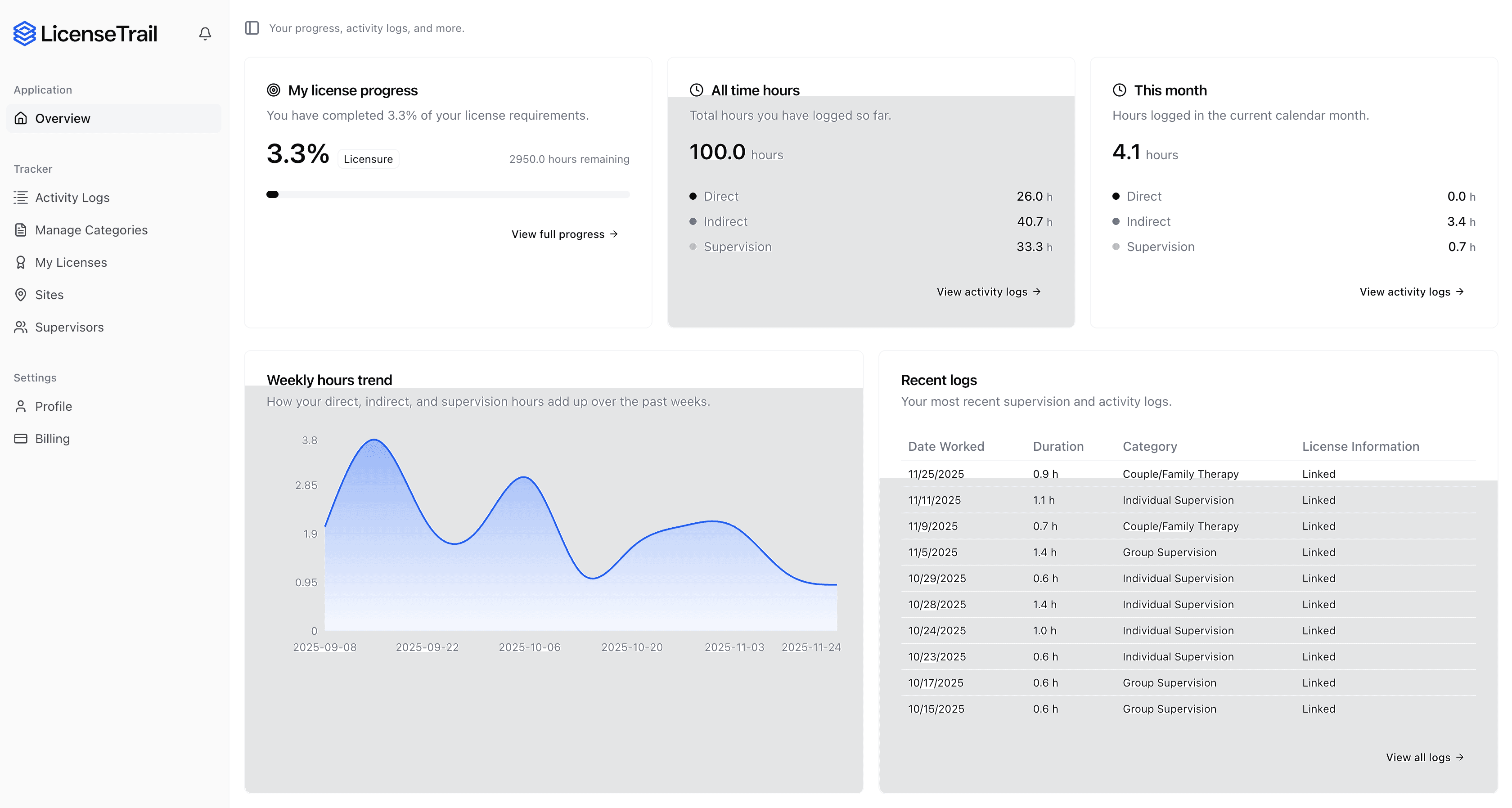
License Trail checks your direct, indirect, and supervision hours against Pennsylvania LAPC requirements continuously and flags mismatches before you submit.
 Start Tracking for Free
No credit card required · Free plan available
Is your spreadsheet hiding Pennsylvania LAPC risks?
Stop guessing if your categories match Pennsylvania State Board of Social Workers, Marriage and Family Therapists and Professional Counselors requirements. License Trail checks your direct, indirect, and supervision hours continuously and flags mismatches before you submit.
Import or log
Bring your spreadsheet or start fresh
Upload your existing tracking spreadsheet and we'll map every hour into the right Pennsylvania State Board of Social Workers, Marriage and Family Therapists and Professional Counselors categories automatically.
Verify against Pennsylvania
Catch mismatches before the board does
License Trail checks your direct, indirect, and supervision hours against Pennsylvania LAPC requirements continuously.
Export board-ready
One-click clean reports
Generate professional, board-ready reports for supervision meetings and Pennsylvania State Board of Social Workers, Marriage and Family Therapists and Professional Counselors submissions in seconds.
No credit card required · Free plan available