
Pennsylvania LBSW Requirements: Hours, Exams & Step-by-Step Guide
Stop guessing if your categories match Pennsylvania requirements. License Trail checks your direct, indirect, and supervision hours against LBSW requirements continuously and flags mismatches before you submit.
No credit card required · Free plan available
Quick Requirements Overview
- Must hold a CSWE-accredited bachelor’s degree in social work/social welfare (BSW or equivalent)
- Must pass the ASWB Bachelor’s exam (no separate PA jurisprudence exam)
- No post-degree supervised practice hours required for LBSW (no direct-client hour minimum)
- Complete 3 hours Act 31 approved child-abuse recognition/reporting training before initial licensure
- Meet general qualifications: good moral character; disclose history; felony drug conviction may be disqualifying unless 10+ years + rehabilitation/no risk
- Submit PALS online application + fee; 2 Certificates of Recommendation on Board forms
- Provide required background check/criminal history documentation as directed in PALS
- Unlawful to use the title/initials “LBSW” / “L.B.S.W.” without a PA license under the Act
License Details
Procedures
Licensing as a Licensed Bachelor Social Worker (LBSW) in Pennsylvania
Pennsylvania now operates a three‑tier social work licensing system: Licensed Bachelor Social Worker (LBSW), Licensed Social Worker (LSW), and Licensed Clinical Social Worker (LCSW). State law makes it unlawful to hold yourself out as a “licensed bachelor social worker” or to use the letters “L.B.S.W.” unless you hold a license under the Social Workers, Marriage and Family Therapists and Professional Counselors Act. (codes.findlaw.com)
The LBSW credential is entry‑level and, unlike the LCSW, does not require any post‑degree supervised practice hours. The only hour‑based requirement before licensure is a short mandatory training in child abuse recognition and reporting.
Below is a step‑by‑step guide, keyed directly to Pennsylvania regulations.
1. Understand what the LBSW requires (and what it does not require)
No supervised practice / clinical hours required
The LBSW regulation at 49 Pa. Code § 47.12e lists only three conditions:
- Meet the general qualifications for licensure in § 47.12.
- Have a bachelor’s degree in social work or social welfare from a program accredited by the Council on Social Work Education (CSWE).
- Pass the bachelor’s license examination described in § 47.11. (regulations.justia.com)
There is no requirement in § 47.12e for any specific number of supervised hours, direct client contact hours, or post‑degree work experience for the LBSW. Those kinds of hour requirements exist only for the clinical license (LCSW), which requires at least 3,000 hours of supervised clinical experience after the master’s degree. (regulations.justia.com)
So, for your example:
- 1,500 hours of direct experience – not required for LBSW in Pennsylvania.
- 1,500 hours of supervised experience – not required for LBSW in Pennsylvania.
The only explicit “hours” you must complete before licensure are training hours in child abuse recognition (Section 3 below).
2. Education requirement
The Board’s LBSW regulation states that an applicant must have:
“Received a bachelor’s degree from a program of social work or social welfare accredited by the Council on Social Work Education.” (regulations.justia.com)
In practice this means:
- You must complete a BSW (or equivalent bachelor’s in social work / social welfare) from a CSWE‑accredited program.
- Field education/practicum hours are built into CSWE‑accredited BSW programs (commonly 400+ hours), but the Pennsylvania Board itself does not set or count those practicum hours separately for LBSW licensure. Those are program‑accreditation standards, not state‑board hour requirements.
3. Examination requirement (ASWB Bachelor’s exam)
Pennsylvania’s licensure‑examination regulation for social workers specifies:
- “The examination required as a prerequisite to being granted a license to hold oneself out as a licensed bachelor social worker is the ASWB bachelor’s level examination.” (regulations.justia.com)
Key points:
- You must take the Association of Social Work Boards (ASWB) Bachelor’s exam.
- You apply to the testing organization and pay the exam fee “at the direction of the testing organization,” and you are responsible for having ASWB send your scores to the Board. (regulations.justia.com)
- The Board determines the passing score but does not publish a numeric cut‑score in the regulation. (regulations.justia.com)
There is no separate “jurisprudence” or state law exam for the LBSW.
4. General licensure qualifications that apply to LBSW
Section 47.12 of the Pennsylvania Code sets out general qualifications for licensure that every social work license type (including LBSW) must meet. (regulations.justia.com)
You must:
- Be of good moral character. (regulations.justia.com)
- Have no disqualifying felony drug conviction under Pennsylvania’s Controlled Substance, Drug, Device and Cosmetic Act, unless:
- at least 10 years have passed since the conviction, and
- you show significant rehabilitation and that licensure would not present a substantial risk of harm. (regulations.justia.com)
- Submit an application on Board forms (now via the PALS online system) and pay the required fee. (regulations.justia.com)
- Provide two Certificates of Recommendation on Board‑supplied forms. (regulations.justia.com)
- Complete mandatory child‑abuse training (see Section 5). (regulations.justia.com)
- Sign an affirmation attesting that the information in your application is true. (regulations.justia.com)
The Board also requires a criminal history check as part of the application process through the state’s PALS system; current guidance specifies an FBI background check within a defined window before or after application. (socialworkdegree.net)
5. Mandatory child‑abuse recognition and reporting training (hour requirement)
The one explicit hour‑based prerequisite for all applicants, including LBSWs, is child‑abuse recognition and reporting training under Act 31 of 2014 and the Board’s regulations.
For the social work board, the rule is:
- Individuals applying for an initial license must complete “at least 3 hours of training in child abuse recognition and reporting requirements” approved by the Department of Human Services and the Bureau. (pa.gov)
- Section 47.12 incorporates this by requiring that an applicant “has completed at least 3 hours of training in child abuse recognition and reporting in accordance with § 47.58.” (regulations.justia.com)
In other words:
- Training hours required before an LBSW license is issued:
- 3 hours of Board‑ and DHS‑approved child abuse recognition and reporting instruction.
- These are classroom/online training hours, not practice hours with clients.
For renewals, all health‑related licensees (including LBSWs) must complete 2 hours of approved child‑abuse training as part of their biennial continuing education, but that applies after you are licensed. (pa.gov)
6. Application and processing steps in practice
Putting the statutory and regulatory pieces together, the process to become an LBSW in Pennsylvania typically looks like this:
-
Earn a qualifying bachelor’s degree
- Complete a CSWE‑accredited BSW or social work/social welfare bachelor’s program. (regulations.justia.com)
-
Complete the 3‑hour Act 31 child‑abuse training
- Take a 3‑hour DHS‑approved course in child‑abuse recognition and reporting; approved providers are listed through the Department of State’s Act 31 resources. (pa.gov)
-
Create a PALS account and submit your online application
- In the PA Licensing System (PALS), choose the State Board of Social Workers, Marriage and Family Therapists and Professional Counselors and select the LBSW license.
- Upload/arrange for:
- Official transcripts (sent directly from your school).
- Verification of your 3‑hour child‑abuse course (sent electronically by the provider).
- Criminal history / FBI background check information, as directed. (socialworkdegree.net)
- Pay the current application fee (recent guidance indicates $75 for LBSW/LSW initial application; always verify in PALS for current figures). (socialworkdegree.net)
-
Meet character and background requirements
- Answer moral‑character and conviction‑history questions.
- If you have past criminal convictions, the Board will evaluate them under its “good moral character” and 10‑year felony‑drug‑conviction provisions. (regulations.justia.com)
-
Obtain Board eligibility and sit for the ASWB Bachelor’s exam
- Once your education and general qualifications are verified, you are approved to take the ASWB bachelor’s‑level exam. (regulations.justia.com)
- Register with ASWB, pay the exam fee, and take the exam.
- Have ASWB send your official exam results to the Board.
-
License issuance
- After the Board receives passing exam results and confirms that all other requirements (including the 3‑hour child‑abuse training) have been met, it issues your Licensed Bachelor Social Worker (LBSW) license. (regulations.justia.com)
7. Hours summary for the Pennsylvania LBSW
To directly address the “type of hours” question:
- Direct client‑contact hours required for LBSW licensure:
- None specified by the Pennsylvania State Board.
- Supervised practice/experience hours required for LBSW licensure:
- None specified by the Board.
- Training hours required before LBSW license issuance:
- 3 hours of Board‑approved child‑abuse recognition and reporting training. (regulations.justia.com)
By contrast, for the LCSW (not LBSW), the Board requires at least 3,000 hours of supervised clinical experience after the master’s degree, with detailed rules about how many hours must be direct client services and how supervision is provided. (regulations.justia.com)
For the LBSW in Pennsylvania, therefore, the pathway is education + exam + general/child‑abuse training requirements, without any separate, Board‑mandated practice‑hour totals.
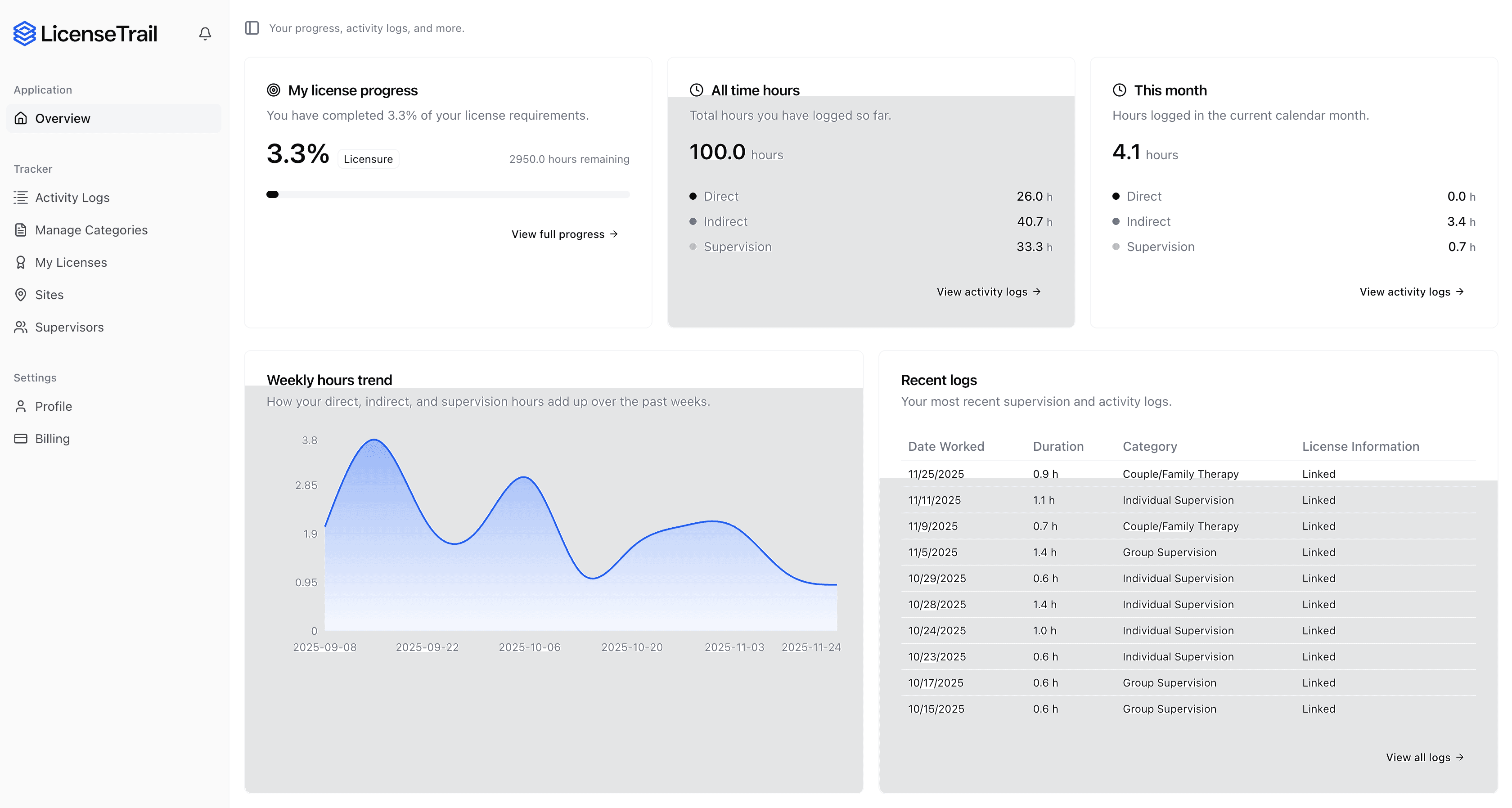
Track your LBSW hours with confidence
License Trail checks your direct, indirect, and supervision hours against Pennsylvania LBSW requirements continuously and flags mismatches before you submit.
 Start Tracking for Free
No credit card required · Free plan available
Is your spreadsheet hiding Pennsylvania LBSW risks?
Stop guessing if your categories match Pennsylvania State Board of Social Workers, Marriage and Family Therapists and Professional Counselors requirements. License Trail checks your direct, indirect, and supervision hours continuously and flags mismatches before you submit.
Import or log
Bring your spreadsheet or start fresh
Upload your existing tracking spreadsheet and we'll map every hour into the right Pennsylvania State Board of Social Workers, Marriage and Family Therapists and Professional Counselors categories automatically.
Verify against Pennsylvania
Catch mismatches before the board does
License Trail checks your direct, indirect, and supervision hours against Pennsylvania LBSW requirements continuously.
Export board-ready
One-click clean reports
Generate professional, board-ready reports for supervision meetings and Pennsylvania State Board of Social Workers, Marriage and Family Therapists and Professional Counselors submissions in seconds.
No credit card required · Free plan available