
Virginia CSOTP Requirements: Hours, Exams & Step-by-Step Guide
Stop guessing if your categories match Virginia requirements. License Trail checks your direct, indirect, and supervision hours against CSOTP requirements continuously and flags mismatches before you submit.
No credit card required · Free plan available
Quick Requirements Overview
- Issuer/Authority: VA Board of Psychology; governed by 18VAC125-30 (CSOTP is a certification treated as a license type in the system)
- Education: Master’s/Doctoral in social work/psychology/counseling/nursing (regionally accredited) or MD/DO (approved); non-accredited must show equivalency
- Required Training: 50 clock hours sex-offender–specific training (15 assessment; 15 interventions; 10 etiology/development; 5 legal/criminal justice; 5 effectiveness/relapse/recidivism)
- Experience (Standard Path): 2,000 hours postdegree clinical experience delivering assessment/treatment services (not pre-degree)
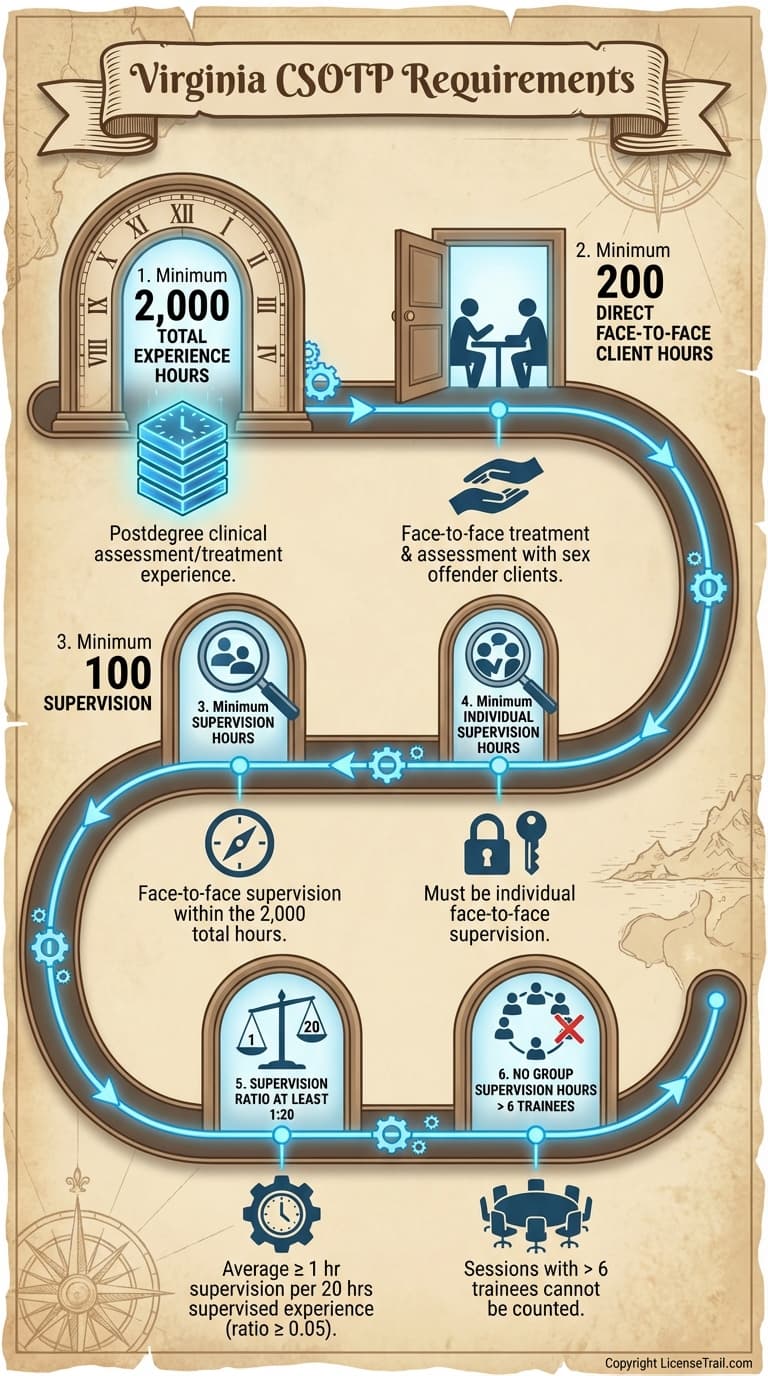
- Direct Client Contact: Within the 2,000 hours, ≥ 200 hours face-to-face assessment/treatment with sex offender clients
- Supervision: Within the 2,000 hours, ≥ 100 hours face-to-face supervision; ≥ 50 hours individual; 1 hour supervision per 20 hours experience; group supervision max 6 trainees
- Pre-Approval/Trainee Rule: VA hours don’t count without prior written Board approval (supervisory contract + registration/fee + official transcript); typically completed as a CSOTP Trainee
- Alternate Eligibility: 5 years documented out-of-state sex-offender treatment experience (or endorsement if substantially equivalent credential) may substitute for the 2,000-hour supervised path; annual renewal CE: 6 hours sex-offender-treatment related (first renewal CE attestation not required)
License Details
Procedures
In Virginia, the Certified Sex Offender Treatment Provider (CSOTP) credential is issued by the Board of Psychology under regulations in 18VAC125‑30 (Regulations Governing the Certification of Sex Offender Treatment Providers). It is technically a certification, but it is treated in the online system as a “license type.” (law.lis.virginia.gov)
The Board does not use a “1,500 direct + 1,500 supervised hours” model. Instead, the core requirement is 2,000 hours of postdegree clinical experience with specific sub‑requirements for sex‑offender work and supervision.
Below is a step‑by‑step guide, with the exact types and amounts of hours you need, and how Virginia’s regulations describe them.
1. Basic eligibility and pathways to CSOTP
Virginia recognizes two main ways to qualify for CSOTP: (dhp.virginia.gov)
-
Standard (Trainee) Pathway – Most common
- You complete:
- An approved graduate or medical degree.
- 50 clock hours of sex‑offender–specific training.
- 2,000 hours of Board‑approved supervised postdegree clinical experience with sex offender clients.
- You normally do this via registration as a Sex Offender Treatment Provider Trainee under a Board‑approved CSOTP supervisor.
- You complete:
-
Five‑Year Out‑of‑State Experience Pathway
- Instead of the 2,000 supervised hours in Virginia, you may qualify if you have:
- At least five years of documented work experience in sex offender treatment in another jurisdiction, plus
- The same required degree and 50 clock hours of training.
- Instead of the 2,000 supervised hours in Virginia, you may qualify if you have:
A third, related route is certification by endorsement if you already hold a substantially equivalent sex‑offender treatment credential in another state. (law.lis.virginia.gov)
2. Educational requirements (degree + 50 clock hours)
2.1 Required degree
You must document completion of one of the following: (law.lis.virginia.gov)
- A master’s or doctoral degree in:
- Social work
- Psychology
- Counseling
- Nursing
from a regionally accredited university; or
- A Doctor of Medicine (MD) or Doctor of Osteopathic Medicine (DO) from an institution approved by an accrediting agency recognized by the Virginia Board of Medicine.
If your institution is not regionally accredited, you must demonstrate equivalency to the education required by the Boards of Social Work, Psychology, Counseling, Nursing, or Medicine.
2.2 Sex‑offender–specific training: 50 clock hours
In addition to the degree, you must complete 50 clock hours of education acceptable to the Board, broken down exactly as follows: (law.lis.virginia.gov)
- 15 clock hours in sex offender assessment
- 15 clock hours in sex offender treatment interventions
- 10 clock hours in etiology/developmental issues of sex offense behavior
- 5 clock hours in criminal justice and legal issues related to sexual offending
- 5 clock hours in treatment effectiveness and issues related to relapse prevention/recidivism of sex offenders
These hours must be documented with certificates of completion.
3. Experience requirement: 2,000 postdegree clinical hours
3.1 The core 2,000-hour requirement
Regulation 18VAC125‑30‑50(B) requires that an applicant must provide documentation of “2,000 hours of postdegree clinical experience in the delivery of clinical assessment/treatment services.” (law.lis.virginia.gov)
Key points about these 2,000 hours:
- They must be postdegree (you cannot count hours obtained before completing the required graduate/medical degree).
- They must be clinical, in the delivery of assessment and/or treatment services.
- For CSOTP purposes, these hours must be in work that is clearly tied to sex‑offender treatment practice per the regulations and Board guidance.
3.2 Required face‑to‑face hours with sex offender clients
Within the 2,000 total hours, at least 200 hours must be direct face‑to‑face treatment and assessment with sex offender clients. (law.lis.virginia.gov)
In practice, this means:
- These 200 hours are time spent in person (or equivalently live, if permitted by current Board policy) directly with sex offender clients, providing:
- Clinical assessment (e.g., intake, risk assessment, psychosexual evaluation), and/or
- Treatment (e.g., individual or group sex‑offender–specific therapy, relapse‑prevention work, psychoeducation directly with the client).
The remaining 1,800 hours can include other clinical work directly related to sex‑offender treatment (documentation, case coordination, consultation, etc.), as long as they fit the Board’s definition of clinical assessment/treatment services and are under approved supervision.
4. Supervision requirements inside the 2,000 hours
Virginia embeds supervision within the 2,000 clinical hours, rather than requiring a separate large block of “supervised” hours beyond the 2,000. The regulations are very specific:
4.1 Minimum supervision hours and ratios
Within the 2,000 hours of clinical experience, you must have at least 100 hours of face‑to‑face supervision. The regulation requires that: (law.lis.virginia.gov)
- There be a minimum of one hour of face‑to‑face supervision for every 20 hours of experience.
- At least 50 of the 100 supervision hours must be individual, face‑to‑face supervision.
- The remaining supervision hours may be in group supervision, but group supervision sessions may have no more than six trainees in a group.
This means the 2,000-hour requirement functions as:
- 2,000 total postdegree clinical hours, of which:
- ≥ 200 hours = direct face‑to‑face work with sex offender clients.
- ≥ 100 hours = face‑to‑face supervision (at least 50 individual).
There is not a separate 2,000 “direct” + 2,000 “supervised” requirement; the supervision hours occur within the 2,000.
4.2 What counts as “face‑to‑face supervision”
“Face‑to‑face supervision” is understood as live, synchronous interaction between supervisor and supervisee, traditionally in person, but may include board‑approved real‑time technologies if consistent with current policy. The Board’s regulations stress that the supervisor must: (law.lis.virginia.gov)
- Assume responsibility for the supervisee’s professional activities.
- Not supervise activities for which the supervisee has no appropriate education.
- Provide supervision only for services the supervisor is qualified to render.
4.3 Credit for prior mental health license supervision
If you already completed supervised experience for another mental health license (within the past 10 years) that included sex‑offender work, you may receive credit toward the 2,000 hours if: (law.lis.virginia.gov)
- You can document that those clinical hours were specifically in treatment and assessment with sex offender clients, and
- The supervisor from that period can attest that they were licensed and qualified to render services to sex offender clients at the time.
This can significantly shorten the time needed if you are an already‑licensed clinician who has been treating sex offenders.
5. Registration and supervision structure (Trainee status)
5.1 Registration before starting supervised experience in Virginia
Virginia is very strict about pre‑approval of supervision. Under 18VAC125‑30‑50(A): (law.lis.virginia.gov)
- Supervised experience obtained in Virginia without prior written Board approval cannot be counted toward CSOTP certification.
- You cannot begin counting hours until after you have completed the required degree.
- Before beginning supervised postdegree experience in Virginia, you must submit:
- A completed supervisory contract.
- The application and registration fee for supervision.
- An official graduate transcript documenting your qualifying degree.
In practice, applicants who do not already have five years of out‑of‑state sex‑offender work apply as Sex Offender Treatment Provider Trainees and then accrue their hours under this registered supervision. (dhp.virginia.gov)
5.2 Supervisor qualifications
Your supervisor must meet all of the following: (law.lis.virginia.gov)
- Be a Certified Sex Offender Treatment Provider.
- Hold a current, unrestricted Virginia license as one of:
- Clinical nurse specialist
- Doctor of medicine or doctor of osteopathic medicine
- Professional counselor
- Marriage and family therapist
- Clinical social worker
- Clinical psychologist
- Provide supervision only in services they themselves are qualified to render.
- At the time of your formal CSOTP application, the supervisor must document:
- Your total hours of supervision.
- Your length of work experience.
- Your competence in sex offender treatment.
- Any needs for additional supervision or training.
6. Application requirements for initial CSOTP certification
Once you have met the education, training, and experience requirements, you apply for First Time Certification – Application for Certification. The Board summarizes eligibility for that form as having: (dhp.virginia.gov)
- Completed the Board‑approved supervised experience outlined in 18VAC125‑30‑50, or
- At least five years of documented sex‑offender treatment work in another jurisdiction; and
- Completed the required 50 clock hours of sex‑offender‑specific training.
Under 18VAC125‑30‑30, every applicant must: (law.lis.virginia.gov)
- Meet the educational requirements (degree + 50 hours).
- Meet the experience requirements (2,000 hours + supervision structure, or 5‑year pathway).
- Submit:
- The Board’s application form.
- Documented evidence of education, experience, and supervision.
- A current National Practitioner Data Bank (NPDB) report.
- Verification of every health or mental‑health license, certificate, or registration ever held in Virginia or any other jurisdiction; there must be no unresolved disciplinary action.
The online application instructions also emphasize: (dhp.virginia.gov)
- Upload of:
- Verification of Training for CSOTP form (for the 50 hours).
- Verification of Post‑Degree Supervision for CSOTP form (for the 2,000 hours and supervision).
- Any out‑of‑state supervisor or license verifications, name change documents, and explanations for criminal or disciplinary history.
- Payment of the $90 application/initial certification fee (nonrefundable).
- Expectation of up to 30 days from complete application to Board decision.
7. Ongoing requirements after certification: continuing education
Once certified, you must meet annual continuing education (CE) requirements to renew: (dhp.virginia.gov)
- 6 contact hours per year in topics related to the provision of sex offender treatment.
- CE must be offered by:
- A provider approved by one of the Virginia Boards of Social Work, Psychology, Counseling, Nursing, or Medicine, or
- The Association for the Treatment of Sexual Abusers (ATSA) or one of its state chapters, or
- The Virginia Sex Offender Treatment Association.
- CE used for another license may also count toward the CSOTP 6‑hour requirement if it is related to sex‑offender treatment.
- You do not have to attest to CE for your first renewal after initial certification.
8. Summary of hour requirements (Virginia CSOTP)
To contrast directly with your example (1,500 direct + 1,500 supervised), Virginia’s Board of Psychology currently requires:
- 50 clock hours of sex‑offender–specific training, in mandated content areas.
- 2,000 hours of postdegree clinical experience in the delivery of clinical assessment/treatment services, with:
- At least 200 hours of face‑to‑face treatment and assessment with sex offender clients.
- At least 100 hours of face‑to‑face supervision (≥ 50 individual), with a minimum ratio of 1 supervision hour per 20 clinical hours, and group supervision capped at six trainees per group.
- Alternative: At least 5 years of documented sex‑offender treatment work in another jurisdiction may substitute for the 2,000 supervised‑hours path, provided education and training requirements are still met.
All of these requirements are set out in the Virginia Administrative Code (18VAC125‑30‑30, ‑40, ‑50) and the Virginia Board of Psychology’s CSOTP application materials. (law.lis.virginia.gov)
Track your CSOTP hours with confidence
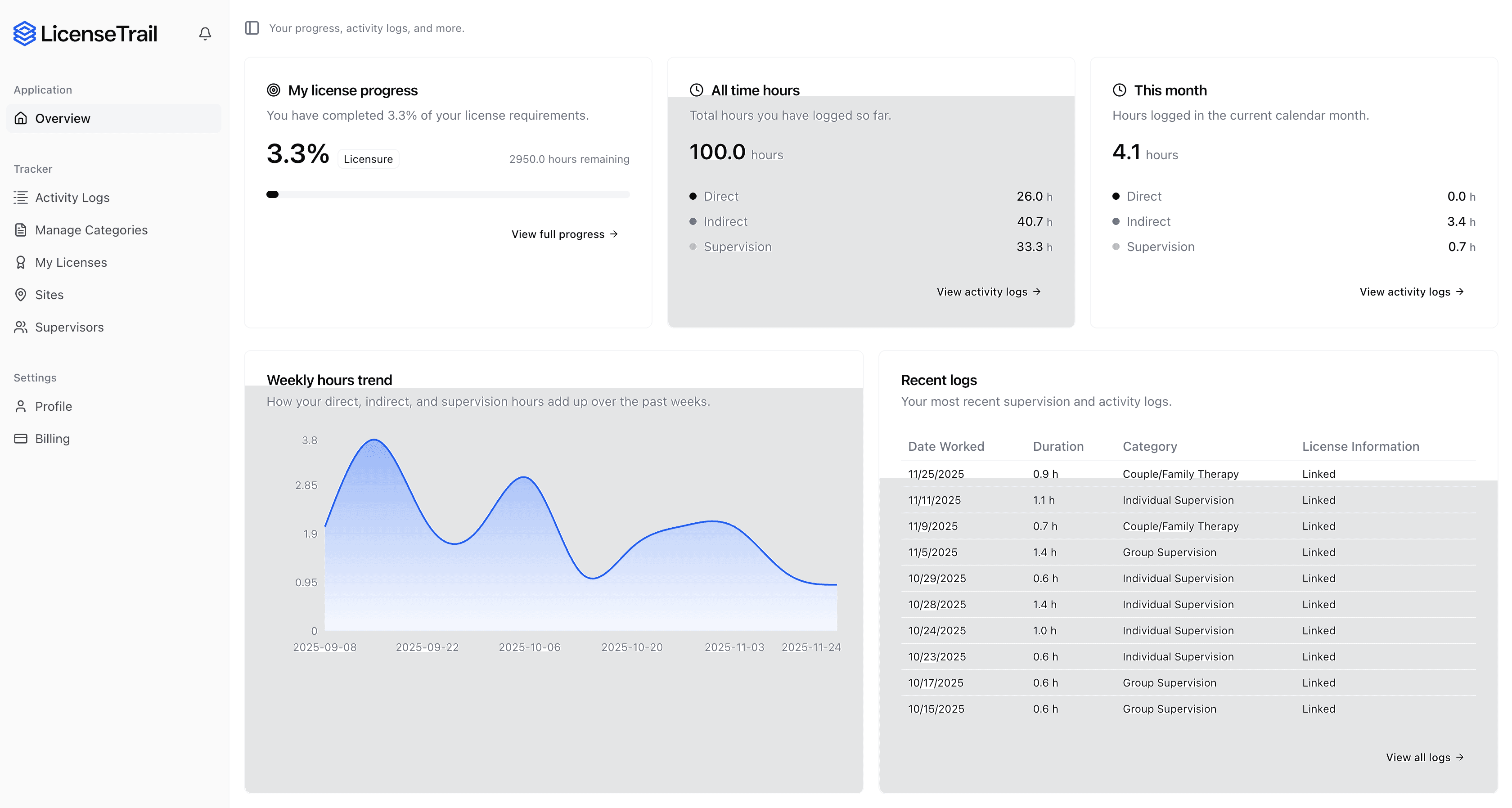
License Trail checks your direct, indirect, and supervision hours against Virginia CSOTP requirements continuously and flags mismatches before you submit.
 Start Tracking for Free
No credit card required · Free plan available
Is your spreadsheet hiding Virginia CSOTP risks?
Stop guessing if your categories match Virginia Board of Psychology requirements. License Trail checks your direct, indirect, and supervision hours continuously and flags mismatches before you submit.
Import or log
Bring your spreadsheet or start fresh
Upload your existing tracking spreadsheet and we'll map every hour into the right Virginia Board of Psychology categories automatically.
Verify against Virginia
Catch mismatches before the board does
License Trail checks your direct, indirect, and supervision hours against Virginia CSOTP requirements continuously.
Export board-ready
One-click clean reports
Generate professional, board-ready reports for supervision meetings and Virginia Board of Psychology submissions in seconds.
No credit card required · Free plan available