
Virginia LSP Requirements: Hours, Exams & Step-by-Step Guide
Stop guessing if your categories match Virginia requirements. License Trail checks your direct, indirect, and supervision hours against LSP requirements continuously and flags mismatches before you submit.
No credit card required · Free plan available
Quick Requirements Overview
- Regulator: Virginia Board of Psychology (18VAC125-20) for Licensed School Psychologist (LSP)
- Education: Master’s in school psychology + ≥60 semester hours/90 quarter hours; program APA/CAEP-accredited or NASP-approved (or alternate qualifying pathway)
- Practicum: Required experiences in school orientation, assessment for intervention, direct intervention, indirect intervention/consultation (no VA-set practicum hour minimum)
- Internship: Must complete internship in APA/CAEP/NASP/APPIC (or equivalent) program (no VA-set internship hour minimum)
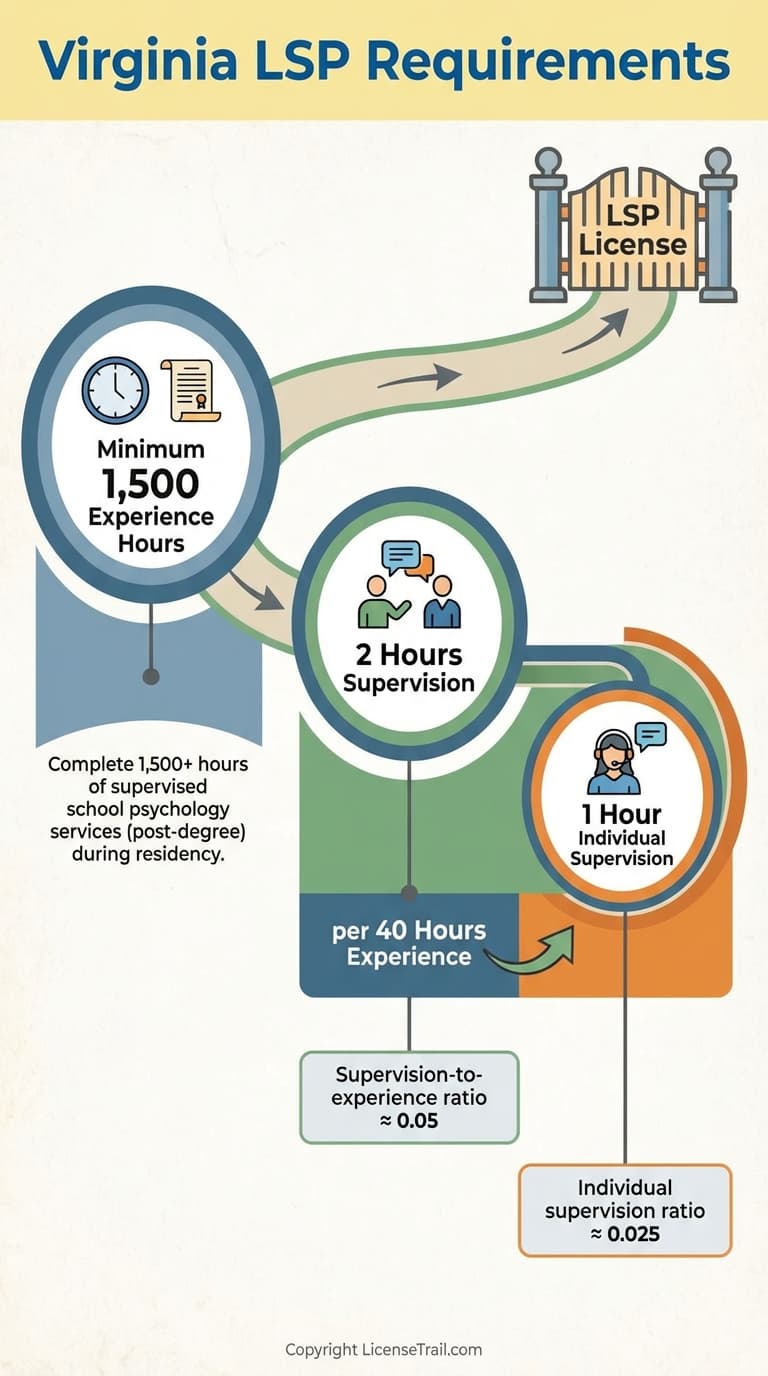
- Post-degree residency: 1,500 hours supervised delivering school psychology services, all after final degree; completed in 12–36 months (extensions possible)
- Residency approval: Must register/obtain Board approval before counting VA hours (supervisory contract, transcript, fee); unapproved hours not accepted
- Supervision minimums: 2 hrs supervision per 40 hrs experience; ≥1 hr individual per 40 (group limits apply); supervisor must be licensed psychologist (clinical psychologist allowed for school psych residents)
- Exam: Pass EPPP Part 1 (Knowledge)
License Details
Procedures
Licensure as a Licensed School Psychologist (LSP) in Virginia is governed by the Virginia Board of Psychology under 18VAC125‑20, Regulations Governing the Practice of Psychology. What follows is a step‑by‑step explanation of the requirements, with emphasis on the types and amounts of hours the Board actually requires, and the language it uses.
1. License category and who regulates it
Virginia has two main credentials related to school psychology:
- Licensed School Psychologist – issued by the Virginia Board of Psychology; this is an autonomous practice license within the “school psychologist” category.(dhp.virginia.gov)
- School Psychologist‑Limited – also issued by the Board of Psychology, but restricted to work within public school settings under the Virginia Department of Education.(dhp.virginia.gov)
This guide focuses on the Licensed School Psychologist (often informally abbreviated “LSP”) under the Board of Psychology, not the VDOE educator license.
The Board’s own description emphasizes that a Licensed School Psychologist is “professionally qualified at the autonomous practice level” and that supervised post‑degree experience is a prerequisite for licensure.(dhp.virginia.gov)
2. Educational requirements
Education requirements are laid out in 18VAC125‑20‑56 (Education requirements for school psychologists).
2.1 Degree level and credit hours
You must have at least:
- A master’s degree in school psychology, and
- A minimum of 60 semester hours (or 90 quarter hours) in graduate study.(law.lis.virginia.gov)
The degree must be from a college or university:
- Accredited by a regional accrediting agency, and
- The program itself must be:
- Accredited by APA (American Psychological Association) or CAEP (Council for the Accreditation of Educator Preparation), or
- Approved by NASP (National Association of School Psychologists),
or you must qualify under an alternate pathway described in subsection B of the regulation.(law.lis.virginia.gov)
2.2 If your degree is not from an APA/CAEP/NASP program
If your master’s degree is not in school psychology from an APA/CAEP accredited or NASP‑approved program, you may still qualify if:(law.lis.virginia.gov)
- You hold a master’s degree in psychology, and
- The program “offers education and training to prepare individuals for the practice of school psychology as defined in § 54.1‑3600” and meets detailed criteria, including:
- Being housed in an institution accredited by an agency recognized by the U.S. Department of Education or the Canadian equivalent.
- Being a recognizable, organized program with an identifiable school psychology faculty and a psychologist responsible for the program.
- Providing an integrated, organized sequence of study with a matriculated body of students and faculty who provide guidance, supervision, and appropriate professional role models.
- Encompassing a minimum of two academic years of full‑time graduate study (or equivalent).
- Having a general core curriculum covering five required areas: psychological foundations, educational foundations, interventions/problem‑solving, statistics and research methods, and professional school psychology.(law.lis.virginia.gov)
2.3 Required practicum experiences
The regulation also states that the program must be “committed to practicum experiences” that include at least:(law.lis.virginia.gov)
- Orientation to the educational process
- Assessment for intervention
- Direct intervention (including counseling and behavior management)
- Indirect intervention (including consultation)
The Board does not assign a specific practicum hour total in the regulation; instead, it specifies the types of experiences the practicum must cover.
3. Internship requirement (pre‑licensure, usually pre‑degree)
In addition to coursework and practicum, candidates for school psychologist licensure must complete an internship.
3.1 How the Board defines the internship requirement
18VAC125‑20‑56(C) states that candidates for school psychologist licensure must have “successfully completed an internship” in a program that is:(law.lis.virginia.gov)
- Accredited by APA or CAEP, or
- Approved by NASP, or
- A member of APPIC, or
- One that meets equivalent standards.
Virginia’s Board of Psychology does not specify a fixed number of internship hours in the regulation. The hour requirements are effectively set by the accrediting/approving body. For example, NASP‑aligned programs typically require at least 1,200 hours of internship; UVA’s Ed.S. program describes its full‑time, year‑long school‑based internship as providing at least 1,200 hours of experience, but that number comes from program/accreditor expectations, not a separate Virginia Board numeric rule.(education.virginia.edu)
So for Virginia licensure purposes:
- You must complete an internship in an accredited/approved program,
- But the Board does not impose its own separate, numeric internship‑hour requirement beyond what those accrediting bodies require.
4. Post‑degree supervised residency: the key hour requirement
The major hour requirement specific to the Virginia Board of Psychology for a Licensed School Psychologist is the post‑degree supervised residency.
4.1 Minimum number of residency hours
Under 18VAC125‑20‑65 (Residency), all candidates for clinical or school psychologist licensure must complete a residency. The regulation states that candidates:(register.dls.virginia.gov)
shall have successfully completed a residency consisting of a minimum of 1,500 hours of supervised experience in the delivery of clinical or school psychology services acceptable to the board.
For school psychologists, there are two key additional points:
- All 1,500 residency hours must be completed after receipt of the final school psychology degree – “School psychologist candidates shall complete all the residency requirements after receipt of their final school psychology degree.”(register.dls.virginia.gov)
- The Board’s School Psychologist webpage reinforces this, explaining that applicants who have completed the degree and internship but do not yet have “1,500 hours of post degree supervised residency experience” must register an initial residency, whereas those who “have earned 1,500 hours of supervised experience in a Virginia Board approved residency” may apply for licensure by examination.(dhp.virginia.gov)
In other words, Virginia requires 1,500 hours total of post‑degree, supervised residency experience, not “1,500 hours of direct experience plus 1,500 hours of supervised experience.” The entire 1,500 hours are, by definition, supervised experience.
4.2 Timeframe for completing residency
The residency must:(register.dls.virginia.gov)
- Consist of at least 1,500 hours, and
- Be completed in no less than 12 months and no more than 3 years of supervised experience.
The Board may allow an extension beyond three years if you can demonstrate extenuating circumstances that prevented completion within the standard window.(register.dls.virginia.gov)
4.3 Registration and Board approval of residency
For experience obtained in Virginia, you cannot simply start counting hours on your own. The regulation requires prior approval:(register.dls.virginia.gov)
- You must register with the Board before beginning supervised post‑degree experience by submitting:
- A supervisory contract (on Board forms)
- The registration of supervision fee (currently $50)(dhp.virginia.gov)
- An official transcript documenting completion of the degree and educational requirements
Experience obtained in Virginia without prior written Board approval will not be accepted toward licensure.(register.dls.virginia.gov)
If your residency hours were gained in another U.S. jurisdiction or in Canada, and that jurisdiction required board approval, Virginia expects you to provide evidence of that jurisdiction’s board approval.(register.dls.virginia.gov)
4.4 What counts as supervision and who can supervise
The residency must include ongoing, formal supervision, with specific ratios and supervisor qualifications:
- There must be a minimum of two hours of individual supervision for every 40 hours of supervised experience.
- Group supervision of up to five residents can substitute for one of those two hours, at a rate of two hours of group supervision equaling one hour of individual supervision, but you must still receive at least one hour of individual supervision per 40 hours.(register.dls.virginia.gov)
Supervisors must:(register.dls.virginia.gov)
- Hold a current, unrestricted psychologist license in the jurisdiction where supervision is being provided, and
- Be licensed in the category in which you are seeking licensure.
- Exception relevant to school psychologists: a resident seeking licensure as a school psychologist may be supervised by a clinical psychologist.
The supervisor must maintain records of supervision, regularly review and co‑sign your case notes, and submit a written evaluation of your performance when the residency is complete.(register.dls.virginia.gov)
4.5 Titles and billing during residency
While you are in residency, you may not represent yourself as a school psychologist. The regulation requires that residents:(register.dls.virginia.gov)
- Use their name, degree initials, and the title “Resident in Psychology” in the category sought (e.g., “Resident in School Psychology”).
- Do not independently solicit clients, bill directly, or otherwise represent themselves as licensed psychologists.
The Board’s webpage further notes that someone who has not passed the exam and has not been issued a School Psychologist license must not provide school psychology services except as a Board‑approved “Resident in School Psychology,” except in certain exempt settings defined in statute.(dhp.virginia.gov)
5. How the Board talks about “types” of hours
Virginia’s regulations for school psychologist residency do not subdivide the 1,500 hours into required minimum amounts of “direct,” “indirect,” assessment, or other categories. The residency requirement is framed as “1,500 hours of supervised experience in the delivery of … school psychology services” with specified supervision ratios, rather than a numerical breakdown of types of activities.(register.dls.virginia.gov)
However, in the regulations for clinical psychology, where pre‑doctoral practicum can count toward residency, the Board defines categories of supervised professional experience. Those definitions give insight into how the Board thinks about hour types:
- “Face‑to‑face direct client services” is defined as treatment or intervention, assessment, and interviewing of clients.(register.dls.virginia.gov)
- “Service‑related activities” are activities such as scoring, report or treatment‑note writing, and consultation related to direct services.(register.dls.virginia.gov)
- “Supporting activities” are time spent under supervision of face‑to‑face and service‑related work, including didactic experiences (labs, seminars) directly related to those services.(register.dls.virginia.gov)
Those specific minimum distributions (e.g., at least one‑quarter of hours in face‑to‑face direct services) are explicitly tied to clinical doctoral practicum hours that may be counted toward residency. For school psychologist candidates, the Board’s current rules do not impose those same category minimums on the 1,500‑hour post‑degree residency, only the total hours and supervision requirements.
6. Examination requirement
To become a Licensed School Psychologist through the Board of Psychology, you must pass:(dhp.virginia.gov)
- The Examination for Professional Practice in Psychology (EPPP) Part 1 – Knowledge, administered by the Association of State and Provincial Psychology Boards (ASPPB) via Pearson VUE.
The Board’s examination FAQ states that all applicants for initial Licensed School Psychologist licensure must sit for and pass EPPP Part 1 – Knowledge. There is no separate Board‑of‑Psychology exam for School Psychologist‑Limited, but that is a different, restricted license.(dhp.virginia.gov)
7. Application routes and fees (briefly)
On the Board’s School Psychologist page, the main pathways are summarized as follows:(dhp.virginia.gov)
- Initial Registration of Residency – for graduates who have the required degree and internship but do not yet have 1,500 hours of post‑degree supervised residency experience.
- Application for Licensure by Examination – for applicants who have completed:
- A qualifying master’s degree in school psychology
- An accredited/approved internship
- 1,500 hours of supervised experience in a Virginia Board‑approved residency, and
- Are now ready to take or have taken the EPPP.
- Application for Licensure by Endorsement – for those who already hold an active, unrestricted, equivalent autonomous school psychology license in another jurisdiction and wish to practice in Virginia.
The application processing fee for a Licensed School Psychologist is currently $200, and the annual license renewal fee is $140.(dhp.virginia.gov)
8. Hour requirements in summary form
Putting the Virginia Board’s requirements together:
-
Graduate Education
- At least a master’s degree in school psychology (or a qualifying psychology master’s meeting Board criteria).
- ≥ 60 semester hours / 90 quarter hours of graduate credit.(law.lis.virginia.gov)
-
Practicum
- Required practicum experiences covering orientation to schools, assessment for intervention, direct interventions (e.g., counseling, behavior management), and indirect interventions (e.g., consultation).
- No specific practicum hour total is set by the Board, but the experiences must be included.(law.lis.virginia.gov)
-
Internship
- Completion of a school psychology internship in a program accredited by APA or CAEP, approved by NASP, or a member of APPIC (or equivalent).
- The Board does not impose an explicit hour number; in practice, accredited programs typically require about 1,200 hours, but that figure is program/accreditation‑driven, not a separate Virginia rule.(law.lis.virginia.gov)
-
Post‑degree Residency
- 1,500 hours total of supervised experience in the delivery of school psychology services.
- All 1,500 hours must be completed after the final school psychology degree.(register.dls.virginia.gov)
- Must occur over at least 12 months and no more than 3 years, absent Board‑approved extension.(register.dls.virginia.gov)
- Requires prior Board registration and approval (supervisory contract, fee, transcript).(register.dls.virginia.gov)
- Must include at least 2 hours of supervision per 40 hours, with no less than 1 hour of individual supervision per 40 hours.(register.dls.virginia.gov)
-
Examination
- Passing score on EPPP Part 1 – Knowledge.(dhp.virginia.gov)
Virginia’s system therefore centers around one major numeric post‑degree requirement: 1,500 hours of supervised residency experience, plus the completion of a qualifying degree, practicum, accredited/approved internship, and the EPPP. There is not an additional, separate 1,500‑hour direct‑service requirement; the 1,500 hours are the total supervised residency hours required by the Board of Psychology for licensure as a Licensed School Psychologist.
Track your LSP hours with confidence
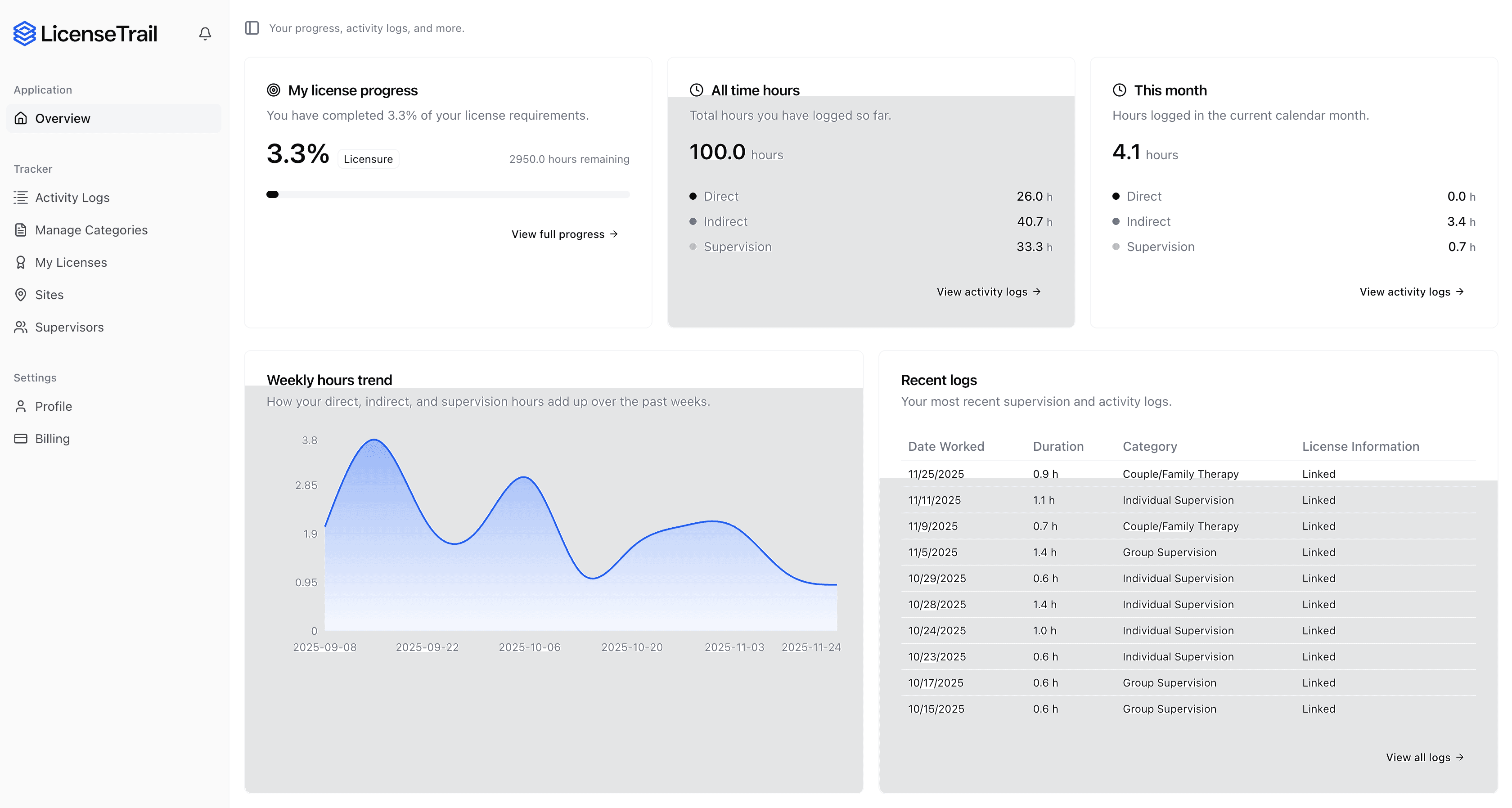
License Trail checks your direct, indirect, and supervision hours against Virginia LSP requirements continuously and flags mismatches before you submit.
 Start Tracking for Free
No credit card required · Free plan available
Is your spreadsheet hiding Virginia LSP risks?
Stop guessing if your categories match Virginia Board of Psychology requirements. License Trail checks your direct, indirect, and supervision hours continuously and flags mismatches before you submit.
Import or log
Bring your spreadsheet or start fresh
Upload your existing tracking spreadsheet and we'll map every hour into the right Virginia Board of Psychology categories automatically.
Verify against Virginia
Catch mismatches before the board does
License Trail checks your direct, indirect, and supervision hours against Virginia LSP requirements continuously.
Export board-ready
One-click clean reports
Generate professional, board-ready reports for supervision meetings and Virginia Board of Psychology submissions in seconds.
No credit card required · Free plan available