
Virginia LPP-AP Requirements: Hours, Exams & Step-by-Step Guide
Stop guessing if your categories match Virginia requirements. License Trail checks your direct, indirect, and supervision hours against LPP-AP requirements continuously and flags mismatches before you submit.
No credit card required · Free plan available
Quick Requirements Overview
- Hold current, unrestricted VA Licensed Psychological Practitioner (LPP) (master’s in psychology/counseling psychology from APA-accredited or board-approved equivalent program)
- Pass EPPP Part 1 (Knowledge) at the master’s level for initial LPP licensure
- Mandatory supervision as LPP until autonomous designation is granted; must provide written patient notice and supervisor contact info
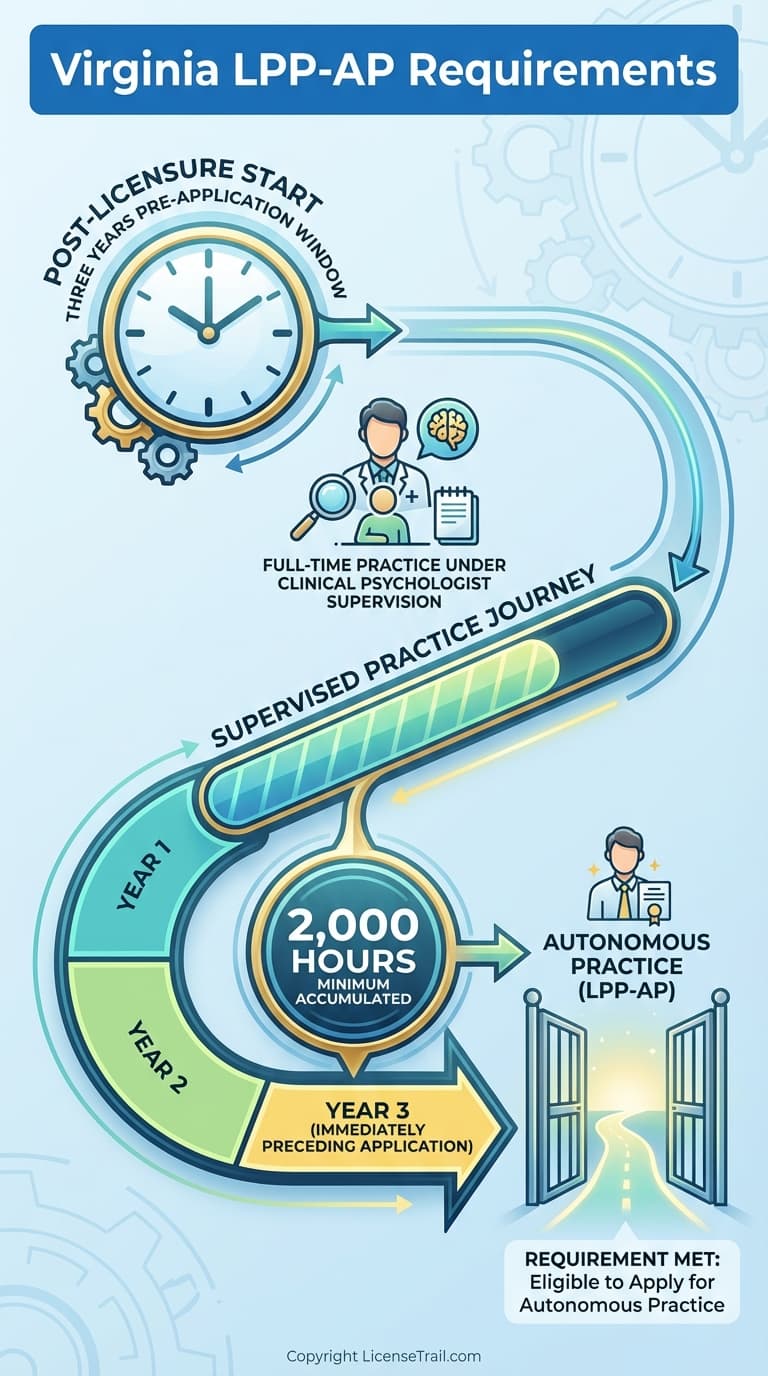
- Complete 1 year full-time post-licensure supervised practice = 2,000 hours, finished within 3 years immediately before applying for autonomous practice
- Supervisor must be a VA-licensed clinical psychologist with ≥2 years post-licensure clinical experience (doctoral-level)
- Apply for LPP-AP and pass EPPP Part 2 (Skills/clinical portion) at the master’s level; score must be within 2 years preceding the autonomous application (unless extension)
- Submit fee ($150) and supervisor attestation verifying the 2,000 hours and competency to practice autonomously
License Details
Procedures
Virginia now offers a master’s‑level psychology license that can move from mandatory supervision to independent practice: the Psychological Practitioner with Autonomous Practice designation. On the Board’s website and exam FAQs this is referred to as a “Licensed Psychological Practitioner‑Autonomous Practice” or “Psychological Practitioner‑Autonomous Practice,” often abbreviated in the field as LPP‑AP. (dhp.virginia.gov)
The path to that autonomous designation has three main pieces:
- Become a Licensed Psychological Practitioner (LPP).
- Complete a defined amount of post‑licensure supervised practice.
- Pass the clinical/skills portion of the national exam and apply for the autonomous designation.
The sections below walk through each requirement, with the Board’s own terminology for hours and supervision.
1. First license: Licensed Psychological Practitioner (LPP)
Education
The education requirement for initial licensure as a psychological practitioner is set out in 18VAC125‑20‑57:
“Each applicant for licensure as a psychological practitioner shall provide evidence of receipt of a master's degree in psychology or counseling psychology from a program accredited by the American Psychological Association, from a program equivalent to those accredited by the American Psychological Association as determined by the board, or from a program accredited by another national accrediting body approved by the board.” (law.lis.virginia.gov)
The enabling statute, § 54.1‑3606.3(B)(1), uses essentially the same language about a master’s degree in psychology or counseling psychology from an APA‑accredited or board‑approved equivalent program. (law.lis.virginia.gov)
Exam requirement for the LPP license
For initial licensure as a psychological practitioner (before autonomous practice), you must pass the academic portion of a national exam:
-
Regulation 18VAC125‑20‑41(C) states:
“Every applicant for licensure as a psychological practitioner shall achieve a passing score as determined by the board for master's degree level psychological practice on the academic portion of the Examination for Professional Practice of Psychology.” (law.lis.virginia.gov)
-
The Board’s “Psychological Practitioner Examination – FAQs” clarifies this is the EPPP Part 1 – Knowledge administered by ASPPB via Pearson VUE. (dhp.virginia.gov)
Once you meet education and exam requirements and are licensed, you hold the title Licensed Psychological Practitioner (LPP).
Mandatory supervision at the LPP stage
By law and regulation, a newly licensed psychological practitioner must practice under supervision unless and until they receive the autonomous designation:
-
§ 54.1‑3606.3(C):
“Every psychological practitioner who meets the requirements of subsection B shall practice under the supervision of a clinical psychologist unless the requirements of subsection D are met. The Board shall determine the requirements and procedures for such supervision.” (law.lis.virginia.gov)
-
18VAC125‑20‑58(A) mirrors this and adds that the supervising clinical psychologist must have “at least two years of clinical experience post‑licensure as a doctoral level clinical psychologist,” and you may not represent that you practice autonomously until the autonomous practice designation is granted. (register.dls.virginia.gov)
The Board’s applicant page further stresses that every psychological practitioner who is not autonomous must inform patients in writing that they cannot practice autonomously and must provide the name and contact information of the supervising clinical psychologist. (dhp.virginia.gov)
2. Post‑licensure supervised experience for autonomous practice
To transition from supervised LPP to LPP‑AP (autonomous practice), Virginia requires a defined amount of post‑licensure supervised practice.
Total hours and time frame
Both the Board’s website and the regulations are specific about the number and type of hours:
-
Board’s applicant page (plain‑language summary)
Under the “Which Application Should I Choose?” table, the Board describes eligibility to apply for autonomous practice this way:
“I hold a current Licensed Psychological Practitioner in Virginia. I have completed a minimum of one year of post‑licensure practice under the supervision of a clinical psychologist with at least two years of post‑licensure clinical practice and accumulated a minimum of 2,000 hours of supervised practice. I want to be approved to sit for the EPPP‑2 examination and provide clinical services autonomously.” (dhp.virginia.gov)
Key elements in that sentence:
- “one year of post‑licensure practice”
- “under the supervision of a clinical psychologist with at least two years of post‑licensure clinical practice”
- “accumulated a minimum of 2,000 hours of supervised practice”
-
Regulatory definition of those hours
18VAC125‑20‑58(C) and (D) set the formal requirements for the autonomous practice designation:
-
The regulation requires:
“Completion of one year of full‑time, post‑licensure practice under the supervision of a clinical psychologist. One year of full‑time, post‑licensure practice, for purposes of this section, is at least 2,000 hours. Such hours must be completed within three years immediately preceding application to the board for autonomous practice authorization.” (register.dls.virginia.gov)
-
It then requires “evidence of one year of full‑time, post‑licensure supervised practice,” documented via a supervisor’s attestation (more on that below). (register.dls.virginia.gov)
-
In other words, for LPP‑AP in Virginia:
- The requirement is 2,000 hours of supervised post‑licensure practice, which the Board equates to:
- “one year of full‑time, post‑licensure practice”
- Those 2,000 hours must be:
- Completed after you are licensed as a psychological practitioner, and
- Completed within the three years immediately preceding your application for autonomous practice.
Type of hours (direct vs. indirect?)
For the autonomous practice requirement, neither the statute nor 18VAC125‑20‑58 break the 2,000 hours into “direct client contact” vs. “indirect” hours. Instead, they describe them broadly as:
- “post‑licensure practice under the supervision of a clinical psychologist,” and
- “2,000 hours of supervised practice.” (dhp.virginia.gov)
The Board’s regulations do not specify a minimum number of direct clinical service hours within those 2,000 hours for autonomous practice. The key legal requirements are:
- Total supervised time: at least 2,000 hours, and
- Nature of the relationship: it must be post‑licensure practice under the supervision of a qualified clinical psychologist (see supervisor qualifications below).
If you see requirements like “1,500 hours direct experience and 1,500 hours supervised experience” in another jurisdiction, that is not how Virginia structures the LPP‑AP requirement. In Virginia, autonomous practice for psychological practitioners is based on 2,000 total supervised post‑licensure hours, not a split into separate direct and indirect hour categories.
Supervisor qualifications and role
The regulations are explicit about who can supervise and what supervision must include (these are part of what turns your hours into “supervised practice” that counts toward autonomous status):
-
Who may supervise:
-
18VAC125‑20‑59(A):
“Supervisors shall be licensed as a clinical psychologist in Virginia.” (register.dls.virginia.gov)
-
18VAC125‑20‑58(A): the clinical psychologist supervisor must have “at least two years of clinical experience post‑licensure as a doctoral level clinical psychologist.” (register.dls.virginia.gov)
-
-
What supervision must include:
18VAC125‑20‑59(B) requires that supervision of post‑licensure practice by a clinical psychologist include at least: (register.dls.virginia.gov)
- Periodic review of patient charts or electronic records.
- Appropriate and regular input on cases, patient emergencies, and referrals.
- Appropriate professional development.
- Management of areas of deficiency if needed.
-
Scope responsibility:
The supervisor is responsible for ensuring that the psychological practitioner “only practices within the scope of the psychological practitioner’s education and training.” (register.dls.virginia.gov)
-
Supervisory agreement:
Before practicing as a non‑autonomous LPP, you must enter into a supervisory agreement with a qualified supervisor, and both parties must keep a copy of all supervisory agreements for three years after supervision ends. (register.dls.virginia.gov)
These supervision standards apply both to your initial LPP practice and to the 2,000 hours that form the basis for autonomous practice.
3. Exam requirement for autonomous practice (LPP‑AP)
After you complete the 2,000 hours of supervised post‑licensure practice, you must pass the clinical/skills portion of the national exam at the master’s level.
Which exam?
Regulation and FAQs align on this point:
-
18VAC125‑20‑41(C) (licensure by examination):
“Every licensed psychological practitioner applying for autonomous practice shall achieve a passing score as determined by the board for master's degree level psychological practice on the clinical portion of the Examination for Professional Practice of Psychology.” (law.lis.virginia.gov)
-
The Board’s “Psychological Practitioner‑Autonomous Practice Examination – FAQs” identify this as the EPPP Part 2 – Skills exam, administered by ASPPB via Pearson VUE, with a limit of four attempts in any 12‑month period. (dhp.virginia.gov)
When you can sit for the exam
According to the same FAQ, you are eligible to sit for EPPP Part 2 – Skills only after you have: (dhp.virginia.gov)
- Accumulated the required supervised experience as a licensed psychological practitioner under appropriate supervision (i.e., the 2,000 supervised post‑licensure hours described above);
- Submitted the Psychological Practitioner‑Autonomous Practice by Examination paper application and supporting documents; and
- Been reviewed and approved by the Board to sit for the exam.
Timing relative to application
18VAC125‑20‑80(B) adds a timing rule specific to autonomous practice:
- A candidate for autonomous practice as a licensed psychological practitioner must achieve a passing score on the clinical portion of the national examination within two years immediately preceding the application for autonomous practice, unless an extension is granted for extenuating circumstances. (register.dls.virginia.gov)
4. Application for the autonomous practice designation
Once you have:
- A current, unrestricted LPP license,
- Completed 2,000 hours (one year full‑time) of supervised post‑licensure practice within the last three years, and
- Passed the clinical portion / EPPP Part 2 – Skills at the required master’s level,
you apply to the Board for authorization to practice autonomously.
What must be submitted
18VAC125‑20‑58(D) spells out the requirements for authorization for autonomous practice: (register.dls.virginia.gov)
-
Fee
- Submission of the fee specified in 18VAC125‑20‑30.
- The Board’s fee schedule lists a specific fee for “Psychological Practitioner – Autonomous Practice” of $150.00 for the autonomous designation. (dhp.virginia.gov)
-
Proof of exam
- Evidence of a passing score for master’s degree level psychological practice on the clinical portion of the EPPP.
-
Evidence of supervised practice
- Evidence of one year of full‑time, post‑licensure supervised practice.
- The evidence must consist of a supervisor attestation that:
- Is signed by the licensed clinical psychologist who served as supervisor for the required supervised practice;
- Specifies that the psychological practitioner is competent to practice in all areas of practice contained on a Board‑provided form; and
- States that, in the supervisor’s opinion, the psychological practitioner “demonstrated sufficient competency to practice autonomously.”
Only after the Board receives and accepts this documentation (and the exam requirement and timing have been met) will the autonomous practice designation be granted.
Resulting license status
Under § 54.1‑3606.3(D) and (F): (law.lis.virginia.gov)
- After verifying completion of the clinical exam and one year of supervised practice, and receiving the fee, the Board “shall issue to the psychological practitioner a new license that includes a designation indicating that the psychological practitioner is authorized to practice independently.”
- The Board also sets the standards of practice for psychological practitioners generally, including those with autonomous practice.
At this point, you hold what is functionally LPP‑AP: a Psychological Practitioner license with an autonomous practice designation, allowing you to practice independently rather than under mandatory supervision.
5. After you obtain LPP‑AP: renewal and ongoing obligations
Renewal and fees
The autonomous practice license is renewed annually:
-
The fee schedule lists “Psychological Practitioner – Autonomous Practice” with:
- Annual renewal fee: $140.00
- Late renewal penalty: $25.00
- Inactive status fee: $70.00
- Reinstatement of expired autonomous license: $270.00 (dhp.virginia.gov)
-
18VAC125‑20‑120 requires all licensees to renew by June 30 of each year, pay the renewal fee, and verify compliance with continuing education requirements. (register.dls.virginia.gov)
A special note in 18VAC125‑20‑120(D): a licensed psychological practitioner who is actively practicing without an autonomous practice designation must attest that they are actively supervised. Once you have the autonomous designation, you are no longer in that category. (register.dls.virginia.gov)
Title and scope protections
- § 54.1‑3606.3(A) makes it unlawful to practice or hold oneself out as a psychological practitioner without a license issued by the Board. (law.lis.virginia.gov)
- Even with an LPP license, until you obtain the autonomous designation you must:
- Practice under a qualified clinical psychologist’s supervision, and
- Tell patients in writing that you cannot practice autonomously and provide your supervisor’s name and contact information. (dhp.virginia.gov)
- After the autonomous designation is granted, your license explicitly indicates that you are “authorized to practice independently”, and the supervisory requirement linked to non‑autonomous practice no longer applies. (law.lis.virginia.gov)
6. Key hour‑related requirements for LPP‑AP in Virginia (summary)
For clarity, the central experience requirements to become a Licensed Psychological Practitioner – Autonomous Practice in Virginia are:
-
License stage:
- You must already hold a current, unrestricted Licensed Psychological Practitioner license in Virginia.
-
Total supervised post‑licensure experience for autonomous practice:
- Minimum of 2,000 hours of supervised practice after LPP licensure.
- Defined in regulation as “one year of full‑time, post‑licensure practice under the supervision of a clinical psychologist,” with “one year of full‑time… practice… at least 2,000 hours.” (register.dls.virginia.gov)
- Those hours must be accumulated within the three years immediately preceding your application for autonomous practice.
-
Type of hours:
- Described by the Board as “post‑licensure practice under the supervision of a clinical psychologist” and “supervised practice.”
- The Virginia regulations do not subdivide these 2,000 hours into separate minimums for “direct client contact” vs. “indirect” activities for the autonomous designation.
-
Supervisor qualifications:
- Supervisor must be a Virginia‑licensed clinical psychologist with at least two years of post‑licensure clinical experience as a doctoral‑level clinical psychologist. (register.dls.virginia.gov)
-
Documentation:
- A supervisor attestation is required, confirming that you completed the supervised practice, are competent in all areas of practice on the Board form, and “demonstrated sufficient competency to practice autonomously.” (register.dls.virginia.gov)
These are the specific, hour‑based and supervision‑based requirements that the Virginia Board of Psychology has adopted for moving from a supervised Licensed Psychological Practitioner to a Licensed Psychological Practitioner – Autonomous Practice (LPP‑AP).
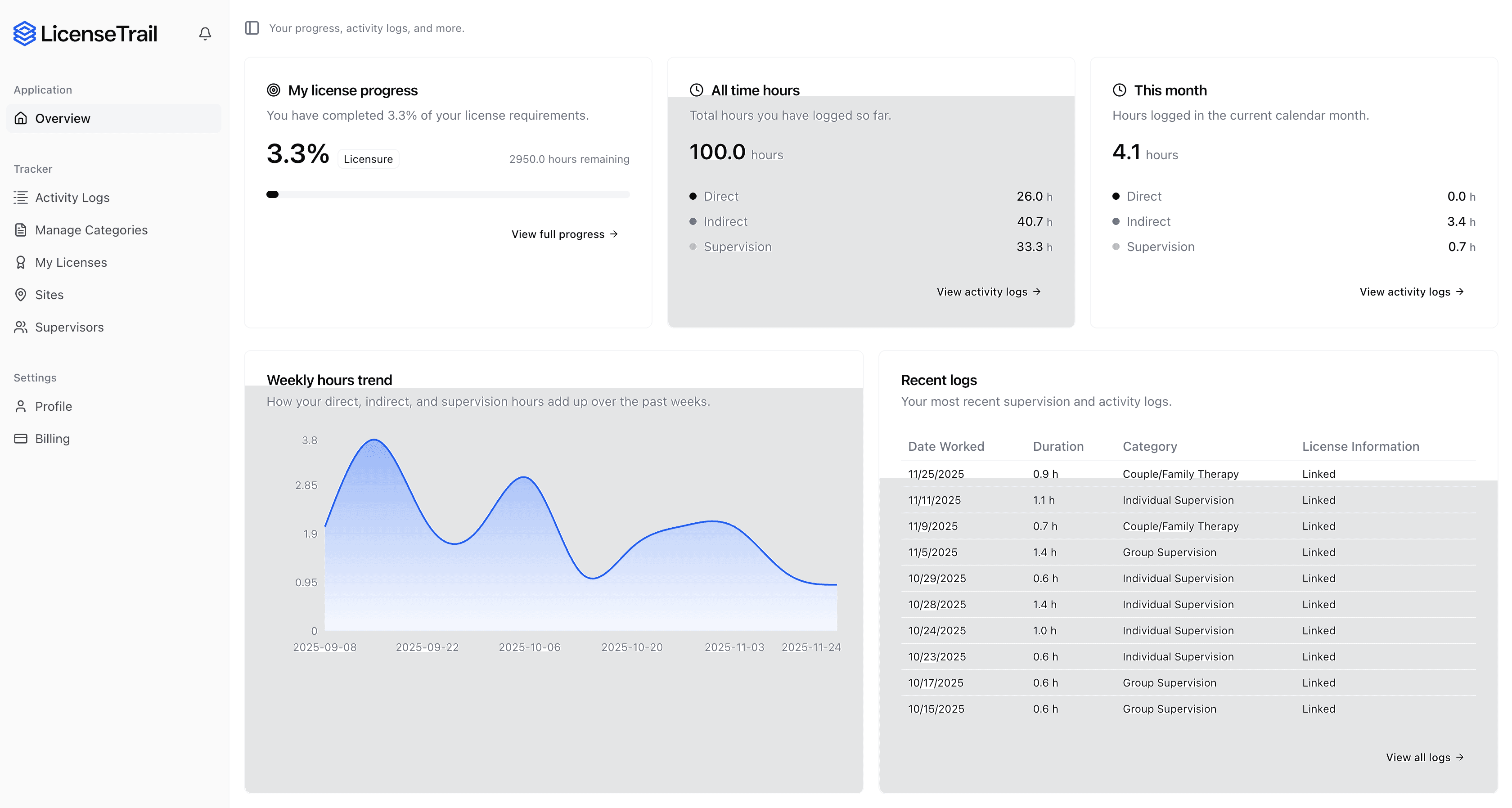
Track your LPP-AP hours with confidence
License Trail checks your direct, indirect, and supervision hours against Virginia LPP-AP requirements continuously and flags mismatches before you submit.
 Start Tracking for Free
No credit card required · Free plan available
Is your spreadsheet hiding Virginia LPP-AP risks?
Stop guessing if your categories match Virginia Board of Psychology requirements. License Trail checks your direct, indirect, and supervision hours continuously and flags mismatches before you submit.
Import or log
Bring your spreadsheet or start fresh
Upload your existing tracking spreadsheet and we'll map every hour into the right Virginia Board of Psychology categories automatically.
Verify against Virginia
Catch mismatches before the board does
License Trail checks your direct, indirect, and supervision hours against Virginia LPP-AP requirements continuously.
Export board-ready
One-click clean reports
Generate professional, board-ready reports for supervision meetings and Virginia Board of Psychology submissions in seconds.
No credit card required · Free plan available