
Virginia LPP Requirements: Hours, Exams & Step-by-Step Guide
Stop guessing if your categories match Virginia requirements. License Trail checks your direct, indirect, and supervision hours against LPP requirements continuously and flags mismatches before you submit.
No credit card required · Free plan available
Quick Requirements Overview
- Effective/Applications: License effective 11/1/2025; applications accepted starting 11/3/2025
- Education: Master’s in psychology or counseling psychology (incl. clinical/counseling/school per Board) from APA-accredited, Board-equivalent, or other Board-approved national accreditor program
- Pre-licensure hours: No stand-alone numeric hours requirement specified outside supervised experience embedded in the qualifying master’s program
- Initial exam: Pass EPPP Part 1 – Knowledge (max 4 attempts/12 months; must pass within 2 years of approval to test unless extended)
- Non-autonomous practice rule: After licensure, must practice under supervision of a VA-licensed clinical psychologist with ≥2 years post-licensure experience; supervisory agreement required before practice and client/public written disclosure required
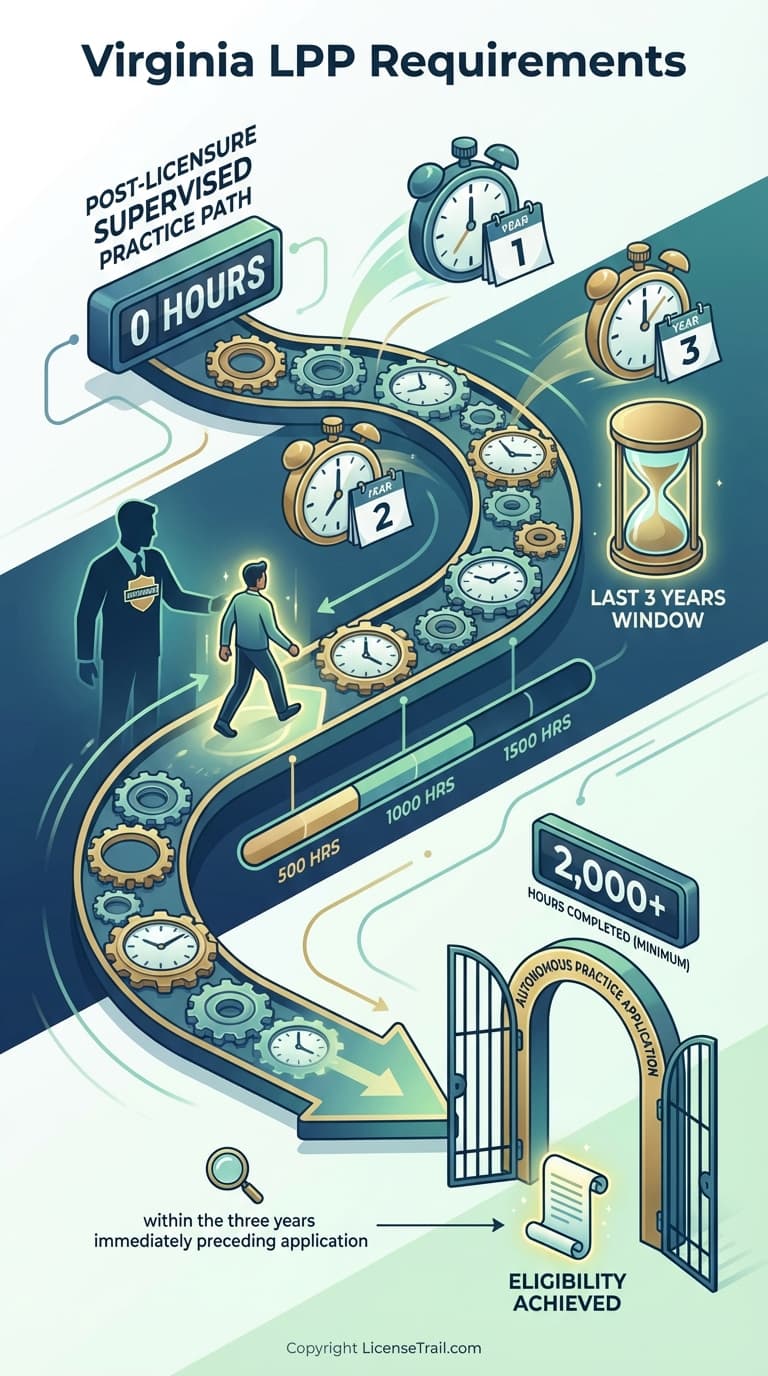
- Autonomous practice eligibility: Hold current unrestricted LPP + pass EPPP Part 2 – Skills + complete 2,000 hours (1 year full-time) post-licensure supervised practice within prior 3 years, with supervisor attestation of competence
- Fees (by exam): $100 currently; increases to $200 after 12/31/2026
License Details
Procedures
Virginia’s Licensed Psychological Practitioner (LPP) – formally titled “psychological practitioner” in law and regulation – is a new master’s‑level psychology license administered by the Virginia Board of Psychology. It became effective November 1, 2025, with applications accepted starting November 3, 2025. (dhp.virginia.gov)
This article walks through what the Board itself requires, with special attention to hours and the exact regulatory language where it exists.
1. What the LPP / Psychological Practitioner Is
Under Virginia law, a “psychological practitioner” is a person licensed under §54.1‑3606.3 who may:
- “diagnose and treat mental and emotional disorders” using counseling, psychotherapy, marital, family, group, or behavioral therapy, and
- “provide an assessment and evaluation” of intellectual/cognitive ability, emotional adjustment, or personality, as related to treatment. (law.lis.virginia.gov)
By statute, you must hold a Board‑issued psychological practitioner license to use this title or practice in this role in Virginia. (law.lis.virginia.gov)
The Board and its announcements refer to this credential in plain language as a Licensed Psychological Practitioner (LPP), but the legal/regulatory title is psychological practitioner. (dhp.virginia.gov)
2. Education Requirements (Master’s Degree)
To be eligible, you must meet both statute and regulation:
2.1 Statutory education requirement
Virginia Code §54.1‑3606.3(B) requires documentation that you have: (law.lis.virginia.gov)
-
A master’s degree in psychology or counseling psychology from:
- an APA‑accredited program,
- a program equivalent to APA accreditation as determined by the Board, or
- a program accredited by another national accrediting body approved by the Board; and
-
Successful completion of the academic portion of a national exam recognized by the Board (the Board uses the EPPP Part 1‑Knowledge for this purpose – see Section 4).
2.2 Regulatory education requirement
The Board’s regulations mirror this in 18VAC125‑20‑57, which states that each applicant must show evidence of receipt of a master’s degree in psychology or counseling psychology from one of those accepted types of programs. (law.lis.virginia.gov)
2.3 Coursework and “supervised experience” within the degree
The Board’s Psychological Practitioner examination page specifies that your master’s program must include coursework in four broad categories: (dhp.virginia.gov)
- General knowledge
- Research methodology and psychometrics
- Profession‑wide competencies
- Supervised experience
The details of required courses and how programs document this are contained in Guidance Document 125‑3: Education for Psychological Practitioner Applicants and in the Areas of Graduate Study form, but those documents do not publicly spell out a specific numeric practicum‑hour minimum (e.g., “600 hours”) in the way doctoral clinical psychology regulations do. Instead, the Board’s standard is that your master’s degree be from an APA‑accredited (or equivalent) psychology program, which itself includes supervised clinical training.
Key point:
For initial LPP licensure, Virginia’s regulations and published FAQs do not prescribe a stand‑alone, numeric pre‑licensure hours requirement (such as “1,500 hours of direct experience”) outside of what is built into your qualifying master’s program.
3. Initial LPP Licensure (Non‑Autonomous Practice)
Once you’ve completed a qualifying master’s program, you pursue licensure by examination as a psychological practitioner.
3.1 Basic eligibility
The Board’s “Psychological Practitioner – By Examination” page describes the first‑time license as for individuals who have: (dhp.virginia.gov)
- A master’s degree in clinical, counseling, or school psychology from an APA‑accredited or Board‑determined equivalent program, and
- Completed the coursework/supervised experience specified in Guidance Document 125‑3.
3.2 Application steps (high level)
The Board outlines the process as: (dhp.virginia.gov)
-
Read:
- Virginia statutes and regulations for psychology
- Psychological Practitioner Licensure Process Handbook
-
Gather documentation, for example:
- Areas of Graduate Study form and syllabi (if needed)
- NPDB Self‑Query report
- Any out‑of‑state license verifications
- Court/board documents for any legal or disciplinary history
-
Submit the online application, selecting:
- Profession: Psychology
- License type: Psychological Practitioner
- Method: Examination
-
Upload supporting documents in the portal.
-
Pay the application fee (currently $100 for Psychological Practitioner by Examination, increasing to $200 after December 31, 2026). (dhp.virginia.gov)
-
Wait for Board review and approval (up to about 30 days from receipt of a complete application). (dhp.virginia.gov)
At this stage, you have applied to be approved to sit for the EPPP Part 1‑Knowledge as an LPP candidate; you are not yet licensed.
4. Examination Requirement for Initial LPP Licensure
For initial licensure as a psychological practitioner, the Board requires: (dhp.virginia.gov)
- Passing the Examination for Professional Practice in Psychology (EPPP) Part 1 – Knowledge.
The Board’s “Examination Information” page (Psychological Practitioner section) notes:
- All applicants must sit for and pass EPPP Part 1‑Knowledge.
- You may take the exam up to 4 times in any 12‑month period.
- You must pass within 2 years of the Board’s approval to sit, unless you obtain an extension for extenuating circumstances.
You become eligible to sit after the Board has: (dhp.virginia.gov)
- Confirmed that you meet the education requirements,
- Received and reviewed your Psychological Practitioner by Examination application and documents, and
- Formally approved you to take the exam and created your account in ASPPB’s Certemy portal.
After you pass EPPP Part 1 and all other application conditions are met, the Board issues your psychological practitioner license. At this point you are an LPP, but you are not yet authorized for autonomous (independent) practice.
5. Supervised Practice as a Newly Licensed LPP (Non‑Autonomous)
5.1 Mandatory supervision
By law and regulation, every psychological practitioner must practice under supervision unless granted an autonomous‑practice designation:
-
Code §54.1‑3606.3(C) states that every psychological practitioner who meets the master’s‑degree and exam requirements “shall practice under the supervision of a clinical psychologist” unless they meet additional independent‑practice requirements. (law.lis.virginia.gov)
-
Regulation 18VAC125‑20‑58(A) repeats that “every psychological practitioner shall practice under the supervision of a clinical psychologist with at least two years of clinical experience post‑licensure as a doctoral level clinical psychologist” unless an autonomous practice designation has been granted. (law.lis.virginia.gov)
5.2 Supervisory agreement and disclosure
Regulations also require: (law.lis.virginia.gov)
- A supervisory agreement must be in place before a non‑autonomous psychological practitioner begins practice (18VAC125‑20‑59(D)).
- The supervisor must be a licensed clinical psychologist in Virginia (18VAC125‑20‑59(A)).
- The supervising clinical psychologist is responsible for:
- periodic review of charts/records,
- input on cases, emergencies, and referrals,
- the LPP’s professional development, and
- managing any areas of deficiency (18VAC125‑20‑59(B)).
- The LPP must communicate in writing to patients and the public that:
- they cannot practice autonomously, and
- they must provide the name and contact information of the supervising clinical psychologist (18VAC125‑20‑58(B)).
Both supervisor and LPP must keep copies of all supervisory agreements for three years after supervision ends. (law.lis.virginia.gov)
5.3 Hours during non‑autonomous practice
For the period after initial licensure but before you qualify for autonomous practice:
- The Board’s core requirement is ongoing supervision, not a set minimum of hours just to remain licensed.
- However, these supervised hours matter if you intend to seek autonomous practice, because they must add up to at least one year (2,000 hours) of full‑time supervised practice (explained in the next section).
There is no published rule that says, for example, “you must complete 1,500 hours of direct client contact and 1,500 hours of indirect work” to hold an LPP license. The only explicit hour threshold in the regulations relates to post‑licensure supervised practice needed for autonomous practice.
6. Autonomous Practice: Hours and Requirements
To practice independently (without mandatory supervision), an LPP must qualify for an autonomous practice designation as a “Psychological Practitioner – Autonomous Practice.”
6.1 Statutory framework
Under Code §54.1‑3606.3(D), a psychological practitioner may practice without supervision after: (law.lis.virginia.gov)
- Successful completion of “the clinical portion of a national exam” recognized by the Board (the Board uses EPPP Part 2 – Skills), and
- Completion of “one year of full‑time experience” of practice under supervision of a clinical psychologist.
Upon receiving documentation of exam and experience plus the required fee, the Board issues a new license with a designation indicating authorization to practice independently.
6.2 Regulatory detail on hours
The Board’s regulation 18VAC125‑20‑58(C) and its applicant page make the hour requirement explicit: (law.lis.virginia.gov)
-
A psychological practitioner with a current, unrestricted license may qualify for autonomous practice upon:
- Achieving a passing score on the clinical portion of the EPPP, and
- Completion of one year of full‑time, post‑licensure practice under the supervision of a clinical psychologist.
-
The regulation defines one year of full‑time, post‑licensure practice as:
- “at least 2,000 hours” of supervised practice, and
- those 2,000 hours must be completed within the three years immediately preceding the application for autonomous‑practice authorization.
The Board’s LPP applicant page phrases this as having:
“…completed a minimum of one year of post‑licensure practice under the supervision of a clinical psychologist with at least two years of post‑licensure clinical practice and accumulated a minimum of 2,000 hours of supervised practice” in order to apply to sit for EPPP‑2 and seek autonomous practice. (dhp.virginia.gov)
6.3 Type of hours
For autonomous practice, Virginia specifies the total amount of supervised practice but does not subdivide those 2,000 hours into categories such as:
- direct face‑to‑face client hours,
- indirect service‑related activities, or
- didactic/supporting activities.
That kind of detailed breakdown appears in the residency rules for doctoral‑level clinical psychologists (e.g., the 1,500‑hour residency with minimum fractions of face‑to‑face and service‑related work), but those residency rules do not apply to the master’s‑level psychological practitioner license. (law.lis.virginia.gov)
In other words:
-
For LPP autonomous practice, the Board’s only explicit numerical requirement is:
- 2,000 hours of supervised, post‑licensure practice, completed within 3 years, under a qualified clinical psychologist supervisor.
-
Within those 2,000 hours, the Board leaves the specific distribution (direct vs. indirect activities) to the supervisor’s judgment, as long as the practice is within the LPP’s education and training and supervision meets the standards in 18VAC125‑20‑59. (law.lis.virginia.gov)
6.4 Supervisor attestation
To obtain autonomous practice, the LPP must submit evidence of supervised practice, consisting of a supervisor attestation that: (law.lis.virginia.gov)
- Is signed by the licensed clinical psychologist who supervised the LPP;
- States that the LPP is competent to practice in all relevant areas on a Board form; and
- Affirms that, in the supervisor’s opinion, the LPP has demonstrated sufficient competency to practice autonomously.
6.5 Examination at the autonomous stage
For autonomous practice as an LPP, the Board requires you to pass EPPP Part 2 – Skills (clinical portion) at the master’s level. The Examination Information page for “Psychological Practitioner – Autonomous Practice” notes: (dhp.virginia.gov)
- You must pass EPPP Part 2‑Skills;
- You can take it up to 4 times in any 12‑month period; and
- You become eligible after:
- Accumulating the required supervised experience as a licensed psychological practitioner,
- Submitting the Psychological Practitioner – Autonomous Practice application and supporting documents, and
- Receiving Board approval to sit for the exam.
7. Putting It Together: Hours and Requirements at Each Stage
Stage 1 – Before licensure (student)
- Hours requirement set by your master’s program, not directly by the Board.
- Program must be APA‑accredited or equivalent and include supervised experience embedded in training. (law.lis.virginia.gov)
Stage 2 – Initial LPP licensure (non‑autonomous)
-
No separate, stand‑alone numeric hours requirement in regulation.
-
Requirements are:
- Qualifying master’s degree and coursework;
- Application and fee;
- Passing EPPP Part 1 – Knowledge;
- Issuance of psychological practitioner license. (dhp.virginia.gov)
-
Practice conditions:
- Must practice under supervision of a clinical psychologist with ≥2 years post‑licensure clinical experience;
- Must have a supervisory agreement in place before practicing;
- Must disclose in writing to clients that you cannot practice autonomously and provide your supervisor’s name and contact information. (law.lis.virginia.gov)
Stage 3 – Autonomous LPP practice
To convert from supervised LPP to autonomous practitioner, you must show all of the following:
- Current, unrestricted LPP license. (law.lis.virginia.gov)
- Supervised experience hours:
- At least one year of full‑time post‑licensure practice, defined as a minimum of 2,000 hours of supervised practice,
- Completed within the 3 years immediately before applying for autonomous practice. (law.lis.virginia.gov)
- Appropriate supervision:
- Under a Virginia‑licensed clinical psychologist with ≥2 years of post‑licensure clinical experience;
- Documented via a supervisor’s attestation of your competence to practice autonomously. (law.lis.virginia.gov)
- Examination:
- Passing score on the clinical portion of EPPP (Part 2 – Skills) at the master’s level. (law.lis.virginia.gov)
- Application and fee for the “Psychological Practitioner – Autonomous Practice” license. (dhp.virginia.gov)
After the Board accepts your supervised hours and attestation and confirms your passing score on EPPP‑2, it issues a new license noting your autonomous‑practice designation.
8. Practical Takeaways About Hours
-
Pre‑licensure:
- Virginia does not currently set a specific number of practicum or internship hours for LPP candidates in regulation. The expectation is that your APA‑accredited (or equivalent) master’s covers adequate supervised experience.
-
Post‑licensure, non‑autonomous:
- You must be continuously supervised, but there is no minimum annual hour requirement just to keep the basic LPP license active.
-
For autonomous (independent) practice:
- The only explicit numeric requirement in statute/regulation is:
- 2,000 hours of supervised, post‑licensure practice
- Completed within three years prior to your application,
- Under a qualifying clinical psychologist supervisor, with an attestation of your competence. (law.lis.virginia.gov)
- The only explicit numeric requirement in statute/regulation is:
There is no Virginia requirement such as “1,500 hours of direct experience and 1,500 hours of supervised experience” for the LPP license. Where Virginia does use such detailed hour categories (e.g., the 1,500‑hour residency for doctoral clinical or school psychologist licensure), those rules are found in 18VAC125‑20‑65 and are explicitly limited to clinical and school psychologist applicants, not to psychological practitioners. (law.lis.virginia.gov)
Track your LPP hours with confidence
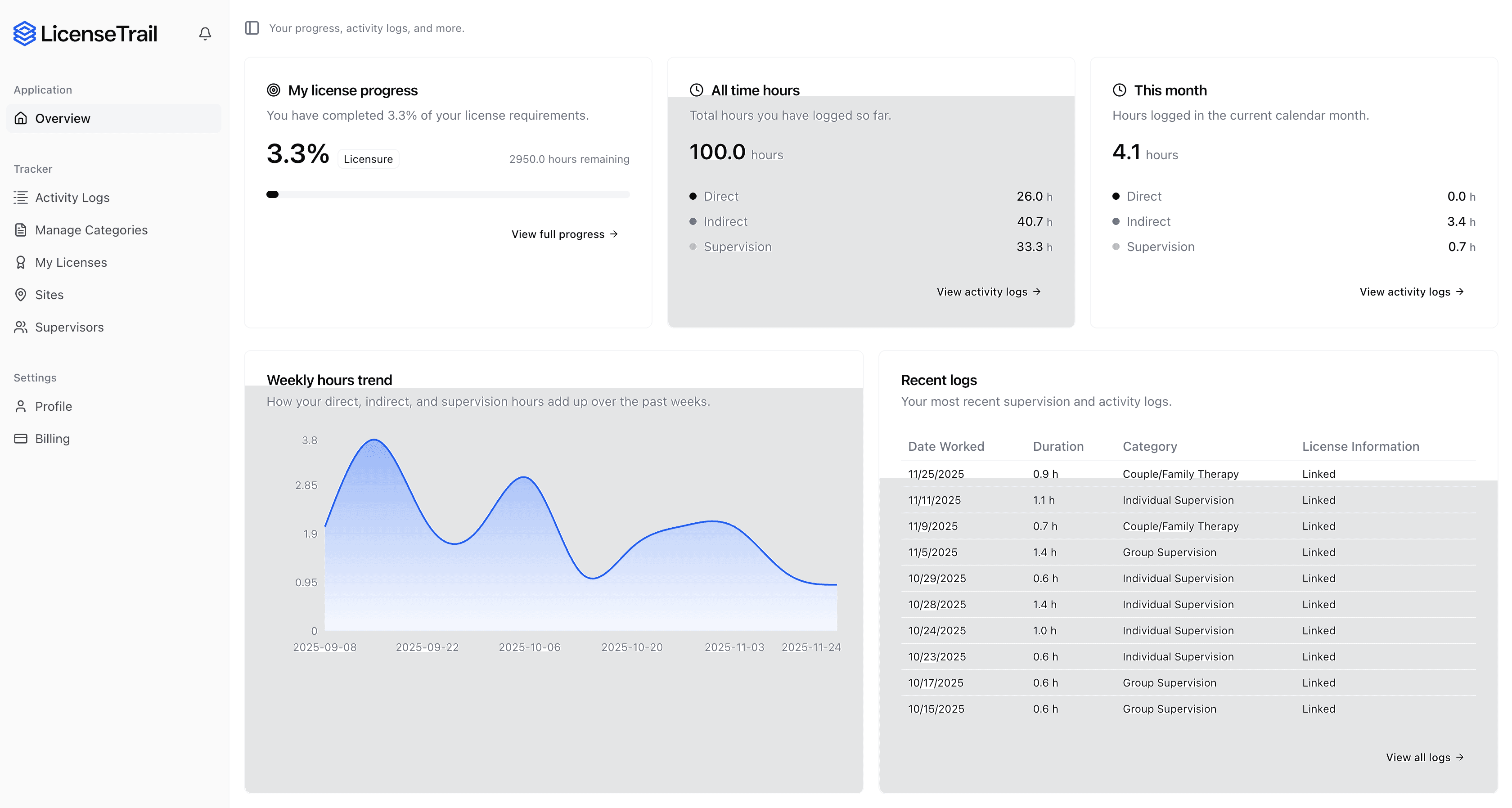
License Trail checks your direct, indirect, and supervision hours against Virginia LPP requirements continuously and flags mismatches before you submit.
 Start Tracking for Free
No credit card required · Free plan available
Is your spreadsheet hiding Virginia LPP risks?
Stop guessing if your categories match Virginia Board of Psychology requirements. License Trail checks your direct, indirect, and supervision hours continuously and flags mismatches before you submit.
Import or log
Bring your spreadsheet or start fresh
Upload your existing tracking spreadsheet and we'll map every hour into the right Virginia Board of Psychology categories automatically.
Verify against Virginia
Catch mismatches before the board does
License Trail checks your direct, indirect, and supervision hours against Virginia LPP requirements continuously.
Export board-ready
One-click clean reports
Generate professional, board-ready reports for supervision meetings and Virginia Board of Psychology submissions in seconds.
No credit card required · Free plan available