
Virginia LCP Requirements: Hours, Exams & Step-by-Step Guide
Stop guessing if your categories match Virginia requirements. License Trail checks your direct, indirect, and supervision hours against LCP requirements continuously and flags mismatches before you submit.
No credit card required · Free plan available
Quick Requirements Overview
- Doctoral degree in clinical/counseling/school psychology from an acceptable (APA/CPA/PCSAS or equivalent) program
- Practicum required: at least 9 semester hours (15 quarter hours) involving assessment/diagnosis/intervention
- Internship required (APA/CPA/APPIC or equivalent) — internship hours do NOT count toward the 1,500-hour requirement
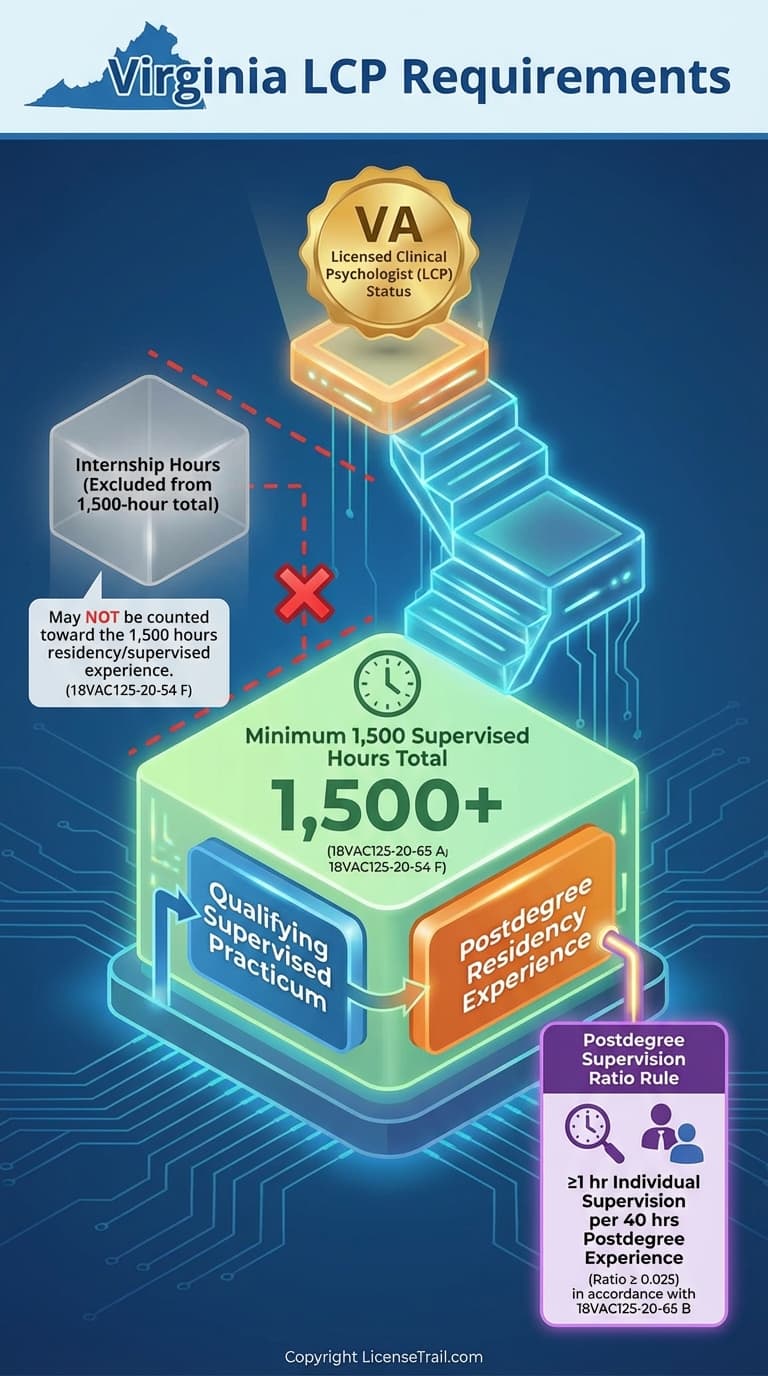
- Core requirement: 1,500 hours supervised experience delivering clinical psychology services (via qualifying doctoral practicum, post-degree residency, or both)
- If using practicum toward 1,500: ≥25% direct face-to-face; ≥50% direct + service-related; supervision 1 hr individual per 8 hrs (group limits apply)
- Post-degree residency (if needed): must be Board-approved in advance in VA; 12–36 months to complete (extensions possible)
- Residency supervision: 2 hrs individual per 40 hrs (group substitution allowed; ≥1 hr individual per 40 hrs minimum)
- During residency, must use title “Resident in Psychology” (not “clinical psychologist”); supervisors must be appropriately licensed and document/evaluate hours
License Details
Procedures
Licensure as a Licensed Clinical Psychologist (LCP) in Virginia is built around a single, clearly defined supervised-experience requirement: 1,500 hours of supervised experience in the delivery of clinical psychology services. Those hours can be met through qualifying doctoral practicum, post-degree residency, or a combination of the two, but internship hours never count toward the 1,500. (law.lis.virginia.gov)
What follows is a step‑by‑step guide that focuses on the exact hour requirements and the Virginia Board of Psychology’s own terminology.
1. Educational foundation
To become licensed as a Clinical Psychologist in Virginia, you must hold a doctoral degree in clinical, counseling, or school psychology from an acceptable program. The Board’s regulation 18VAC125‑20‑54 requires: (law.lis.virginia.gov)
- A program in clinical, counseling, or school psychology that:
- Is appropriately accredited (APA, CPA, PCSAS, or substantially equivalent; timelines differ before/after June 23, 2028).
- Completion of:
- Practicum experiences involving assessment, diagnosis, and psychological interventions, with at least 9 graduate semester hours (or 15 quarter hours) of practicum. (law.lis.virginia.gov)
- An internship meeting Virginia standards (see below).
The practicum and internship are both required for licensure, but only certain practicum and/or residency hours can be used to satisfy the 1,500-hour supervised-experience requirement.
2. Required internship (separate from the 1,500 hours)
Virginia requires a doctoral internship in clinical psychology that meets specific accreditation or equivalency standards. Candidates for clinical psychologist licensure must have completed an internship that is: (law.lis.virginia.gov)
- Accredited by:
- The American Psychological Association (APA), or
- The Canadian Psychological Association (CPA), or
- A member of:
- The Association of Psychology Postdoctoral and Internship Centers (APPIC), or
- The Association of State and Provincial Psychology Boards/National Register of Health Service Psychologists,
- Or an internship that meets “equivalent standards” as determined by the Board.
Key point:
The regulation explicitly states that “Hours acquired during the required internship shall not be counted toward the 1,500 residency hours.” (law.lis.virginia.gov)
So you must do the internship, but it does not reduce the 1,500 supervised-experience hours you must show for licensure.
3. The core supervised-experience requirement: 1,500 hours
For licensure as a Clinical Psychologist, the Virginia Administrative Code and the Board’s own application page align on the central requirement:
-
18VAC125‑20‑65(A):
Candidates “shall have successfully completed a residency consisting of a minimum of 1,500 hours of supervised experience in the delivery of clinical … psychology services acceptable to the board.” (law.lis.virginia.gov) -
The Board’s “Clinical Psychology – By Examination” page states:
“Experience: Have completed, or are in a Board approved Residency to complete, 1,500 hours of supervised practicum or supervised residency experience in the delivery of clinical psychology services.” (dhp.virginia.gov)
In practice this means:
- You must document 1,500 total hours of supervised experience delivering clinical psychology services.
- Those 1,500 hours may be:
- Met entirely through qualifying pre‑doctoral practicum experience,
- Met entirely through a post‑degree residency, or
- Met through a combination of practicum and residency hours.
- Internship hours are excluded and cannot be applied toward these 1,500 hours. (law.lis.virginia.gov)
4. How practicum hours can satisfy the 1,500-hour requirement
4.1 When practicum can count
Regulation 18VAC125‑20‑54(F) allows an applicant “to fulfill the residency requirement of 1,500 hours, or some part thereof … in the doctoral practicum supervised experience,” provided the practicum meets specific criteria. (law.lis.virginia.gov)
The practicum must:
- Be part of an organized sequence of training within the doctoral program. (law.lis.virginia.gov)
- Include three categories of activity:
- Face‑to‑face direct client services – defined by the Board as treatment or intervention, assessment, and interviewing of clients. (law.lis.virginia.gov)
- Service‑related activities – scoring, reporting or treatment note writing, and consultation related to face‑to‑face direct services. (law.lis.virginia.gov)
- Supporting activities – supervised time related to direct and service‑related work (for example, on‑site supervision or didactic seminars directly tied to those services). (law.lis.virginia.gov)
4.2 Required breakdown of practicum hours (when used toward the 1,500)
To have pre‑doctoral practicum hours count toward all or part of the 1,500-hour residency requirement, the Board mandates the following minimum distribution: (law.lis.virginia.gov)
- At least one-quarter (25%) of the hours must be face‑to‑face direct client services.
- At least one-half (50%) of the hours must be in face‑to‑face direct client services + service‑related activities combined.
- The remaining hours may be in any combination of:
- face‑to‑face direct client services,
- service‑related activities, and
- supporting activities.
For a full 1,500 hours satisfied entirely by qualifying practicum, that breakdown translates into:
- At least 375 hours of face‑to‑face direct client services (¼ of 1,500).
- At least 750 hours in the combination of:
- direct client services plus service‑related activities.
- Up to 750 additional hours in any mixture of direct, service‑related, and supporting activities, so long as the above minimums are met.
4.3 Supervision during practicum
When practicum hours are applied toward the 1,500-hour requirement, supervision must meet Board minimums:
- At least 1 hour of individual face‑to‑face supervision for every 8 hours of supervised professional experience spent in direct client contact and service‑related activities. (law.lis.virginia.gov)
- Group supervision:
- Two hours of group supervision (up to 5 practicum students) may be substituted for one hour of individual supervision, but individual supervision must be at least half of the total supervision hours. (law.lis.virginia.gov)
- The practicum hours must be certified by the program’s Director of Clinical Training on the Board’s verification form. (law.lis.virginia.gov)
If your practicum does not reach 1,500 hours, or does not meet those specific category and supervision requirements, you must complete the remainder of the 1,500 hours through a post‑degree residency consistent with 18VAC125‑20‑65. (law.lis.virginia.gov)
5. Post-degree residency hours (if practicum is insufficient)
5.1 Total hours and time frame
If your practicum hours don’t fully satisfy the 1,500-hour requirement, you complete the remaining hours as a Board‑approved residency. The residency regulations specify: (law.lis.virginia.gov)
- A minimum of 1,500 hours of supervised experience in the delivery of clinical psychology services (or the remaining portion needed after counting approved practicum).
- The residency must span at least 12 months and not more than three years.
- The Board may permit an extension if extenuating circumstances prevented completion within three years.
Unlike the practicum rule in 18VAC125‑20‑54(F), 18VAC125‑20‑65 does not break residency hours into specific percentages of direct vs. indirect activities. It requires 1,500 hours of supervised experience in the delivery of clinical psychology services and imposes detailed supervision and registration rules rather than a category breakdown. (law.lis.virginia.gov)
5.2 Registration and approval before starting a residency in Virginia
Virginia is strict about pre‑approval of supervision:
- “Supervised experience obtained in Virginia without prior written board approval will not be accepted toward licensure.” (law.lis.virginia.gov)
- You may not begin the residency until:
- You have completed the required degree, and
- You have registered with the Board by submitting:
- A supervisory contract with your supervisor(s),
- The registration of supervision fee, and
- An official transcript documenting completion of educational requirements. (law.lis.virginia.gov)
If residency hours were obtained in another U.S. jurisdiction or Canada that required prior board approval, you must provide evidence of that jurisdiction’s board approval. (law.lis.virginia.gov)
5.3 Supervision during residency
Residency supervision has its own numeric requirement:
- There must be at least two hours of individual supervision per 40 hours of supervised experience. (law.lis.virginia.gov)
- Group supervision:
- Up to five residents may be in group supervision.
- Two hours of group supervision may substitute for one of the two required individual-supervision hours, but:
- In no case may the resident receive less than one hour of individual supervision per 40 hours of supervised experience. (law.lis.virginia.gov)
Supervisors must:
- Hold a current, unrestricted license in the jurisdiction where supervision is provided.
- Be licensed in the category in which the resident seeks licensure (for Clinical Psychologist applicants, the supervisor is a licensed psychologist; school psychologist residents may be supervised by a clinical psychologist). (law.lis.virginia.gov)
- Provide supervision only in areas where they have demonstrable competence, defined in regulation. (law.lis.virginia.gov)
- Maintain supervision records, regularly review and co‑sign case notes, and submit a final written evaluation of the resident to the Board at the end of the residency. (law.lis.virginia.gov)
5.4 How you must identify yourself during residency
While completing residency hours, you are not permitted to hold yourself out as a licensed psychologist:
- You may not call yourself a clinical psychologist, independently solicit clients, or bill directly as a licensed psychologist. (law.lis.virginia.gov)
- You must use the title:
“Resident in Psychology” (in the licensure category sought), along with your name and degree initials. (law.lis.virginia.gov)
Supervisors or employing institutions may bill for your services if you are properly identified as a resident. (law.lis.virginia.gov)
6. Putting the hours together: common pathways
Because licensure hinges on 1,500 supervised hours (excluding internship), applicants typically fall into one of these patterns:
-
Practicum-heavy pathway
- Doctoral practicum provides 1,500 or more qualifying hours meeting:
- The 25% direct and 50% direct+service‑related distribution, and
- The 1:8 supervision ratio.
- No post‑degree residency hours are needed; you’ve already satisfied the 1,500 hours via practicum.
- Doctoral practicum provides 1,500 or more qualifying hours meeting:
-
Mixed practicum + residency pathway
- Practicum provides some qualifying hours (e.g., 800).
- You complete the remainder (e.g., 700) through a Board‑approved residency after the doctorate, following 18VAC125‑20‑65’s supervision and registration rules.
-
Residency-only pathway (for hour purposes)
- Practicum meets the 9‑credit requirement but ** cannot be used** to fulfill the 1,500 hours (e.g., doesn’t meet distribution or supervision criteria or is too limited).
- You complete all 1,500 hours in a post‑degree, Board‑approved residency over 12–36 months.
In all cases, the Board will look for a total of at least 1,500 hours of qualifying supervised experience across practicum and/or residency, alongside a complete internship that meets accreditation or equivalency standards.
7. Examinations and final licensure steps (brief overview)
Once the education, practicum, internship, and 1,500 supervised hours (via practicum and/or residency) are in place, you apply for licensure by examination:
- The Board’s Clinical Psychology – By Examination page explains that this application is for individuals who:
- Have completed the educational requirements, and
- Have either:
- Completed practicum hours that satisfy the residency requirements, or
- Completed the experience as a Board‑approved Resident in Clinical Psychology, or
- Been approved as a resident and now seek approval to sit for the EPPP (Examination for Professional Practice in Psychology). (dhp.virginia.gov)
You then:
- Take and pass the EPPP in clinical psychology (and any required state‑specific jurisprudence component, per current Board instructions).
- Complete the Board’s application process, including forms like:
- Verification of Pre‑Doctoral Supervised Practicum Hours,
- Verification of Post Degree Supervision, and
- Internship Verification or internship equivalency documentation. (dhp.virginia.gov)
Once all requirements are satisfied and the Board approves your application, you are issued a license as a Licensed Clinical Psychologist (LCP) in Virginia.
Track your LCP hours with confidence
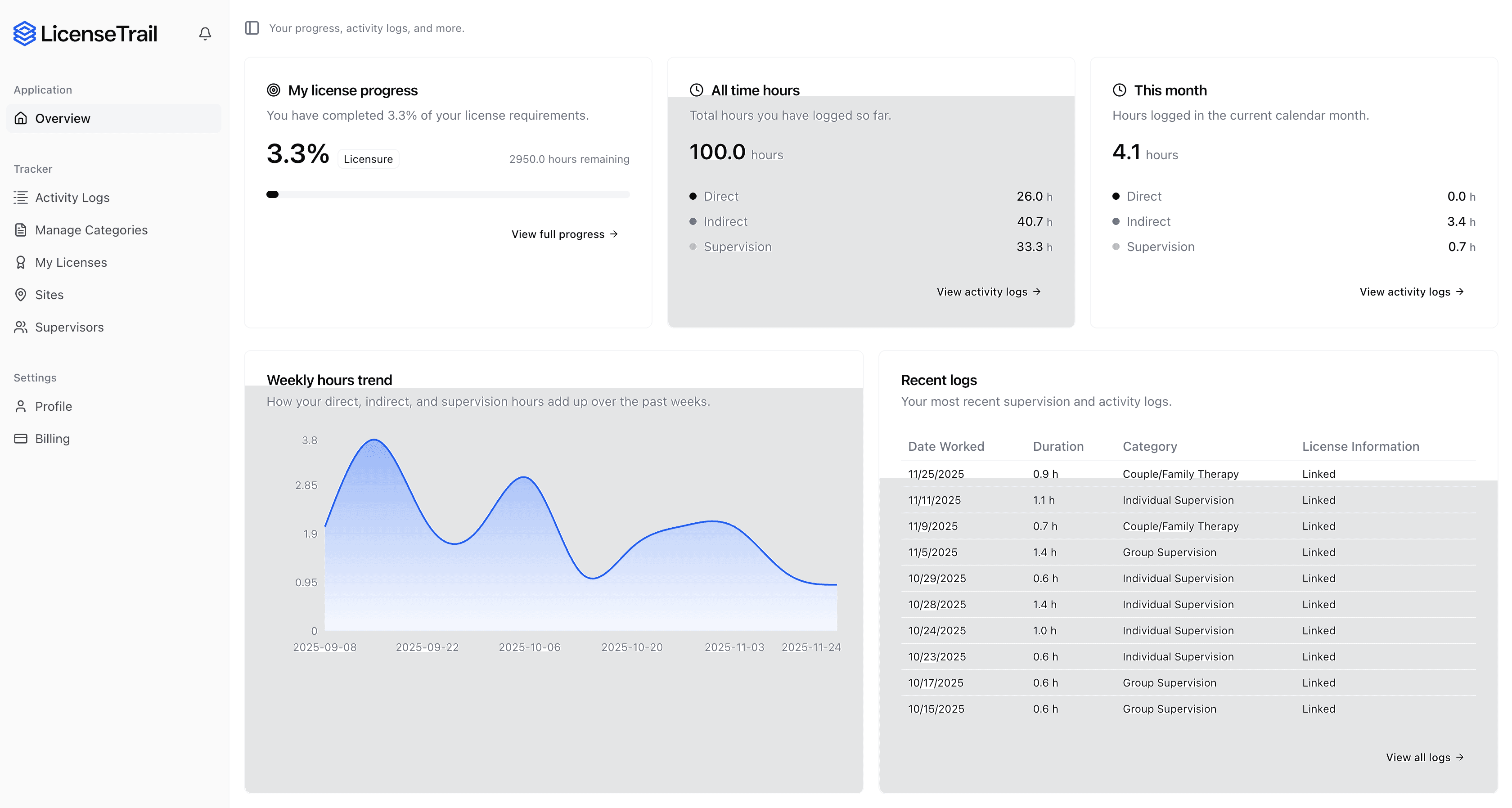
License Trail checks your direct, indirect, and supervision hours against Virginia LCP requirements continuously and flags mismatches before you submit.
 Start Tracking for Free
No credit card required · Free plan available
Is your spreadsheet hiding Virginia LCP risks?
Stop guessing if your categories match Virginia Board of Psychology requirements. License Trail checks your direct, indirect, and supervision hours continuously and flags mismatches before you submit.
Import or log
Bring your spreadsheet or start fresh
Upload your existing tracking spreadsheet and we'll map every hour into the right Virginia Board of Psychology categories automatically.
Verify against Virginia
Catch mismatches before the board does
License Trail checks your direct, indirect, and supervision hours against Virginia LCP requirements continuously.
Export board-ready
One-click clean reports
Generate professional, board-ready reports for supervision meetings and Virginia Board of Psychology submissions in seconds.
No credit card required · Free plan available