
Wisconsin LMFT Requirements: Hours, Exams & Step-by-Step Guide
Stop guessing if your categories match Wisconsin requirements. License Trail checks your direct, indirect, and supervision hours against LMFT requirements continuously and flags mismatches before you submit.
No credit card required · Free plan available
Quick Requirements Overview
- Qualifying master’s/doctorate in MFT (COAMFTE) or approved mental health field with required MFT coursework
- Graduate program must include clinical internship: 300 face‑to‑face hours with individuals/couples/families over ≥8 months (supervised)
- Obtain WI MFT Training License to accrue hours (requires application/fee, qualifying education or enrollment, and supervised position/offer)
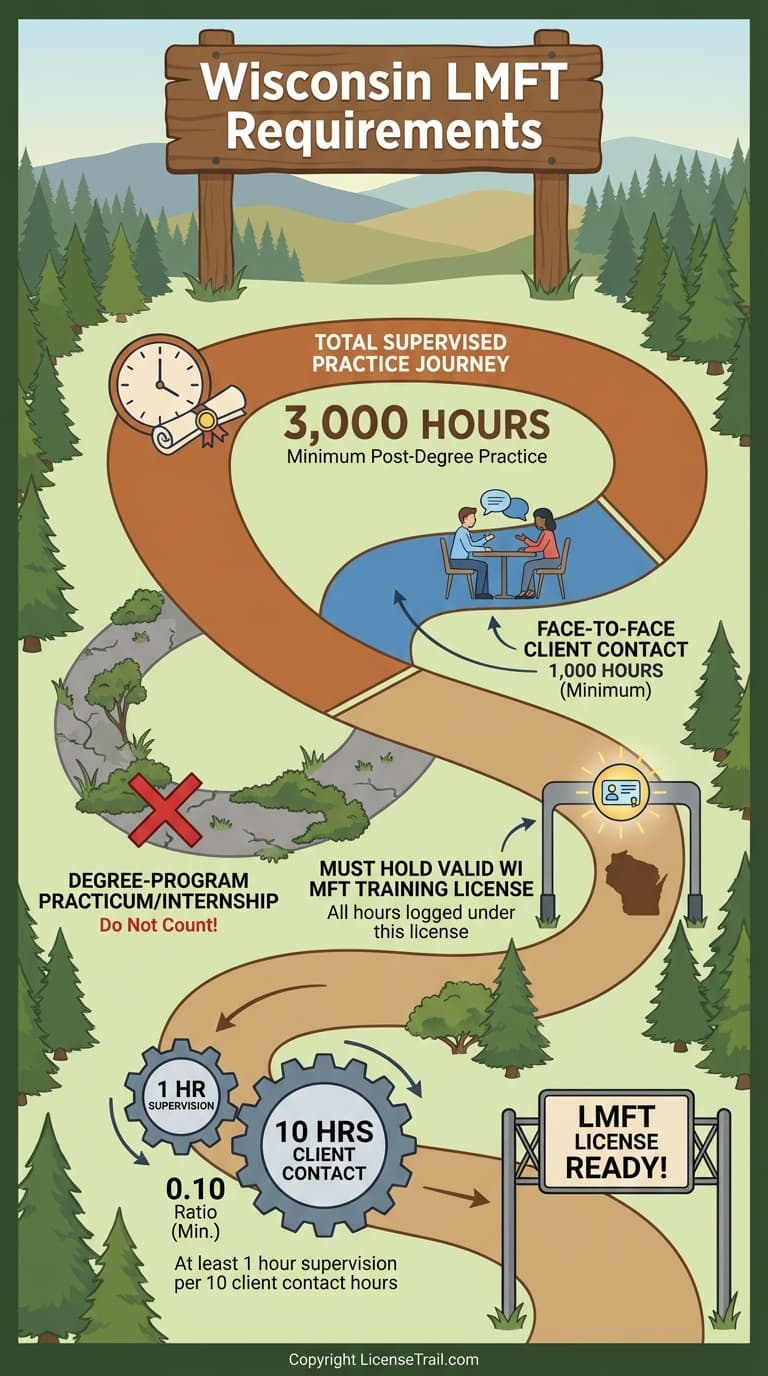
- Post‑degree experience: 3,000 hours of supervised MFT practice, including ≥1,000 face‑to‑face client contact hours (completed while holding training license)
- Supervision ratio: 1 hour face‑to‑face supervision per 10 client‑contact hours; supervisor must meet WI approved qualifications
- Exams: pass AMFTRB National MFT Exam and WI Statutes & Rules (jurisprudence) exam (85% passing noted)
- Apply to DSPS/Board with application/fee, education proof, verified supervised hours, exam results, and required criminal/discipline disclosures
License Details
Procedures
Wisconsin licenses marriage and family therapists through the Marriage and Family Therapy, Professional Counseling, and Social Work Examining Board, housed in the Department of Safety and Professional Services (DSPS). The standard clinical credential is “Licensed Marriage and Family Therapist” (LMFT); most applicants first hold a “Marriage and Family Therapist Training License.”
Below is a step‑by‑step outline of what the Board and its rules actually require, with the Board’s own wording highlighted where it matters.
1. Big‑picture summary of Wisconsin LMFT hour requirements
For initial LMFT licensure by examination, Wisconsin law and administrative code require:
-
Education
- A qualifying master’s or doctoral degree in marriage and family therapy or another approved mental health field, with specific coursework and internship requirements. (regulations.justia.com)
- The program (or equivalent) must include a clinical internship with at least 300 hours of face‑to‑face contact with individuals, couples, and families, over at least 8 months. (regulations.justia.com)
-
Post‑degree supervised practice
- “3,000 hours of supervised marriage and family therapy practice, including at least 1,000 hours of face‑to‑face client contact”. (regulations.justia.com)
- These hours must be completed while holding a valid Marriage and Family Therapist Training License in Wisconsin. (regulations.justia.com)
- All 3,000 hours are supervised; there is not a separate category of unsupervised hours. The only breakdown the Board specifies is:
- At least 1,000 hours = “face‑to‑face client contact.”
- Up to 2,000 hours may be additional client contact plus other professional MFT practice activities under supervision (e.g., documentation, treatment planning, consultation), consistent with the supervisor’s approval and employment duties.
-
Supervision structure
- Supervision must be by an approved supervisor (LMFT with doctoral degree or 5 years’ full‑time practice, psychiatrist, psychologist, AAMFT Approved Supervisor or candidate, or another individual pre‑approved by the section). (regulations.justia.com)
- The supervisor must provide “one hour of face‑to‑face supervision for each 10 client contact hours.” (regulations.justia.com)
-
Examinations
- Pass the Association of Marital and Family Therapy Regulatory Boards (AMFTRB) National MFT Exam. (dsps.wi.gov)
- Pass the Wisconsin Statutes and Rules Examination (online, open‑book jurisprudence exam). (dsps.wi.gov)
-
Application and background review
- Submit the LMFT application, fee, proof of education, verified supervised practice hours, exam results, and documentation about criminal charges/convictions as required by MPSW 16.01(5). (regulations.justia.com)
There is no longer a minimum number of calendar years in which the 3,000 hours must be completed. Earlier code language required “in no less than 2 years,” but that was deliberately removed when the statute changed. (wirules.elaws.us)
2. Educational requirements in detail
2.1. Acceptable degrees
Administrative Code MPSW 16.01(2) requires an LMFT applicant to provide evidence of one of the following: (regulations.justia.com)
- (a) “A master’s or doctorate degree in marriage and family therapy from a program accredited by COAMFTE,” or
- (b) A master’s or doctorate degree in marriage and family therapy, psychology, sociology, social work, professional counseling, or other mental health field that included the coursework required under MPSW 16.02, or
- (c) A foreign degree deemed equivalent to a COAMFTE‑accredited MFT degree, with proof of English proficiency if the education was not in English.
So, someone with a non‑MFT mental health degree may qualify if they can document they meet the specific MFT coursework and internship requirements below.
2.2. Required coursework (“educational equivalent”)
For non‑COAMFTE programs (or to document equivalence), MPSW 16.02 specifies that the program must include at least the following graduate coursework: (regulations.justia.com)
- Foundations of relational/systemic practice, theories and models – at least 6 semester credits (or 8 quarter credits).
- Clinical treatment with individuals, couples, and families – at least 6 semester (or 8 quarter) credits, including evidence‑based practice and crisis intervention.
- Diverse, multicultural or underserved communities – at least 3 semester (or 4 quarter) credits.
- Research and evaluation – at least 3 semester (or 4 quarter) credits focused on MFT research and evidence‑based practice.
- Professional identity, federal and state law, ethics, and social responsibility – at least 3 semester (or 4 quarter) credits.
- Biopsychosocial health and development across the lifespan – at least 3 semester (or 4 quarter) credits.
- Systemic assessment and mental health diagnosis and treatment – at least 3 semester (or 4 quarter) credits.
- Contemporary developments linking MFT with the broader multidisciplinary context – at least 3 semester (or 4 quarter) credits.
2.3. Required clinical internship (pre‑licensure fieldwork)
MPSW 16.02(1)(i) additionally requires: (regulations.justia.com)
- A clinical internship in MFT (or a substantially equivalent field) that includes:
- At least 300 hours of face‑to‑face contact with individuals, couples, and families
- For assessment, diagnosis, and treatment
- Under supervision, in not less than 8 calendar months.
These internship hours are an educational requirement; your 3,000 post‑degree supervised practice hours (see below) must be accumulated after you receive the qualifying graduate degree. (regulations.justia.com)
3. Step one after graduation: get a Marriage and Family Therapist Training License
To accrue the required supervised hours in Wisconsin, you must first obtain the Marriage and Family Therapist Training License.
Under MPSW 16.015, the Board “shall grant a marriage and family therapist training license” to an individual who does all of the following: (regulations.justia.com)
- Submit a completed, signed application form.
- Pay the fee specified in s. 440.05(6), Stats.
- Provide evidence that you either:
- Already meet the education requirements in s. 457.10(2), Stats. (i.e., have the qualifying master’s/doctoral degree), or
- Are enrolled (or will be enrolled) in an approved MFT institute, or
- Hold a graduate degree in an approved mental health field and are enrolled (or will be) in an accredited or Board‑approved MFT master’s/doctoral program. (regulations.justia.com)
- Provide evidence that you:
- Are in a position or have an offer for a position “as a marriage and family therapist in a supervised marriage and family therapist practice,” or
- Are in/hold an offer for a position where you will receive training and supervision equivalent to a supervised MFT practice. (regulations.justia.com)
Key constraints:
- The training license is valid for 48 months and may be renewed at the Board’s discretion. (regulations.justia.com)
- It authorizes you to use the MFT title specified in s. 457.04(5), Stats. and “to practice marriage and family therapy within the practice scope of his or her training or supervision” while it is valid. (regulations.justia.com)
- DSPS guidance explicitly notes that “a marriage and family therapist training license is required to accumulate supervised practice hours for full marriage and family therapist licensure.” (dsps.wi.gov)
4. The core requirement: 3,000 supervised hours and how they are defined
4.1. Exact language on total hours and direct client contact
Both the statute and the administrative code agree on the basic hour requirement.
Statute 457.10(3) states that the applicant must show that, after receiving the qualifying degree, they have engaged in: (law.justia.com)
at least 3,000 hours of marriage and family therapy practice, including at least 1,000 hours of face‑to‑face client contact,
supervised by an approved supervisor (see below).
Administrative Code MPSW 16.04(1) tightens this for in‑state supervised practice and adds a training‑license requirement, requiring: (regulations.justia.com)
3,000 hours of supervised marriage and family therapy practice, including at least 1,000 hours of face‑to‑face client contact, while holding a valid marriage and family therapist training license
before you are eligible for licensure.
So, in the terms you asked for:
- Wisconsin does not split this into “1,500 direct hours + 1,500 supervised hours.”
- Instead, it requires:
- 3,000 total hours of supervised marriage and family therapy practice; and
- Within that 3,000, at least 1,000 hours must be “face‑to‑face client contact.”
All of these 3,000 hours are supervised; there is no separate category of post‑degree, unsupervised experience.
4.2. What counts as “face‑to‑face client contact”?
The Board does not provide a further formal definition in MPSW 16; however, consistent with how it is used in this chapter and across the Board’s rules, “face‑to‑face client contact” means time spent directly providing therapeutic services to clients (individuals, couples, or families) in person or by live interactive means where you and the client are directly interacting.
Practical examples that count:
- Individual, couple, or family therapy sessions
- Intake/assessment interviews
- Crisis intervention sessions
- Any other direct clinical contact where you are functioning in the MFT role
Non‑contact clinical activities (e.g., case notes, treatment planning without the client present, consultation with other professionals, staff meetings) generally count toward the remaining supervised practice hours, but not toward the 1,000‑hour face‑to‑face minimum.
4.3. Supervisor qualifications
MPSW 16.04(2) lists who may supervise your supervised marriage and family therapy practice: (regulations.justia.com)
- An LMFT with a doctorate in marriage and family therapy, or
- An LMFT with the equivalent of 5 years of full‑time MFT practice, or
- A psychiatrist, or
- A psychologist licensed under ch. 455, Stats., or
- An AAMFT Approved Supervisor or supervisor candidate, or
- Another individual, pre‑approved by the MFT section, with demonstrated MFT systems experience.
4.4. Supervision intensity and structure
The supervisor’s responsibilities and the supervision structure are spelled out in MPSW 16.04(3)–(4). Key provisions: (regulations.justia.com)
-
Supervisors must:
- Provide “one hour of face‑to‑face supervision for each 10 client contact hours.”
- Allow the supervisee to perform only services the supervisor can competently perform.
- Be available (or arrange coverage) for emergencies.
- Be legally and ethically responsible for supervised activities and able to interrupt/terminate practice if needed.
-
Group supervision:
- No more than 8 supervisees per supervisor in a group.
- Each supervisee receives one hour of supervision credit per hour of group (only case‑related time counts).
- Multiple supervisors in a single session cannot increase the credited time beyond the actual session length.
5. Examinations required for Wisconsin LMFT
Wisconsin requires two separate exams for LMFT licensure by examination:
-
National MFT Licensing Exam (AMFTRB)
- The DSPS MFT Exam Information page identifies the “Association of the Marital and Family Therapy Regulatory Boards (AMFTRB) Examination” as one requirement. (dsps.wi.gov)
-
Wisconsin Statutes and Rules Examination
- An online, open‑book exam covering state law and administrative code relevant to MFT practice. (dsps.wi.gov)
- Exam content is drawn from:
- Administrative Code chapters MPSW 16, 17, 19, 20
- Wisconsin Statutes chapters 48, 51, 55, 146, 457, 948. (dsps.wi.gov)
- The passing score for the MFT statutes and rules exam is 85%. (dsps.wi.gov)
Under MPSW 16.01(4), you must provide “verification of passage of an examination approved by the marriage and family therapist section to determine minimum competence to practice marriage and family therapy.” In practice, that means the AMFTRB exam plus the Wisconsin statutes/rules exam together. (regulations.justia.com)
6. Final licensing application: LMFT (initial license by exam)
Once you have:
- Completed the qualifying graduate degree and required coursework/internship,
- Held a training license and finished the 3,000 supervised practice hours (1,000 face‑to‑face), and
- Passed both the national MFT and the Wisconsin statutes/rules exams,
you apply for the initial LMFT license by examination.
Under MPSW 16.01, an applicant must submit: (regulations.justia.com)
- Application and fee (under s. 440.05, Stats.).
- Evidence of qualifying education – one of:
- COAMFTE‑accredited MFT master’s/doctorate, or
- Approved mental health degree with coursework meeting MPSW 16.02, or
- Approved equivalent foreign degree (with TOEFL if needed). (regulations.justia.com)
- Evidence of supervised practice:
- Proof that, after the degree, you completed “at least 3,000 hours of marriage and family therapy practice, including at least 1,000 hours of face‑to‑face client contact, while holding a valid marriage and family therapy training license” and that you were supervised by someone meeting MPSW 16.04. (regulations.justia.com)
- DSPS provides specific forms for this, such as the Marriage and Family Therapist Supervised Practice Experience Form (Form 2574). (dsps.wi.gov)
- Verification of exam passage (national MFT exam and statutes/rules exam). (regulations.justia.com)
- Background/discipline documentation, as needed:
- MPSW 16.01(5) requires documentation so the section can determine whether you have certain pending charges or convictions “substantially related to the practice of a marriage and family therapist” under specified anti‑discrimination provisions. (regulations.justia.com)
If all requirements are met, s. 457.10, Stats. directs that “the marriage and family therapist section shall grant a marriage and family therapist license” to that individual. (law.justia.com)
7. Other pathways (briefly)
While your question focused on initial licensure and hours, Wisconsin also provides:
- Reciprocal license (licensure by endorsement) – For those already licensed as MFTs elsewhere, where the other state’s requirements are “substantially equivalent” to Wisconsin’s. (law.cornell.edu)
- Temporary LMFT license – A short‑term license sometimes used when all requirements are met except passing the exam (up to 9 months, renewable once), often described in AAMFT’s Wisconsin resources and DSPS forms. (aamft.org)
In plain terms about the hours
To wrap the core point in the comparative style you asked for:
- Total supervised experience required:
- 3,000 hours of supervised marriage and family therapy practice (all supervised).
- Within that 3,000 hours:
- At least 1,000 hours must be direct, “face‑to‑face client contact.”
- Supervision requirement:
- 1 hour of face‑to‑face supervision per 10 client‑contact hours, provided by an approved MFT or other qualified supervisor.
Wisconsin does not split the requirement into equal parts “direct” vs. “supervised” hours; instead, all 3,000 are supervised, and 1,000 of those must be direct, face‑to‑face clinical work with clients.
Track your LMFT hours with confidence
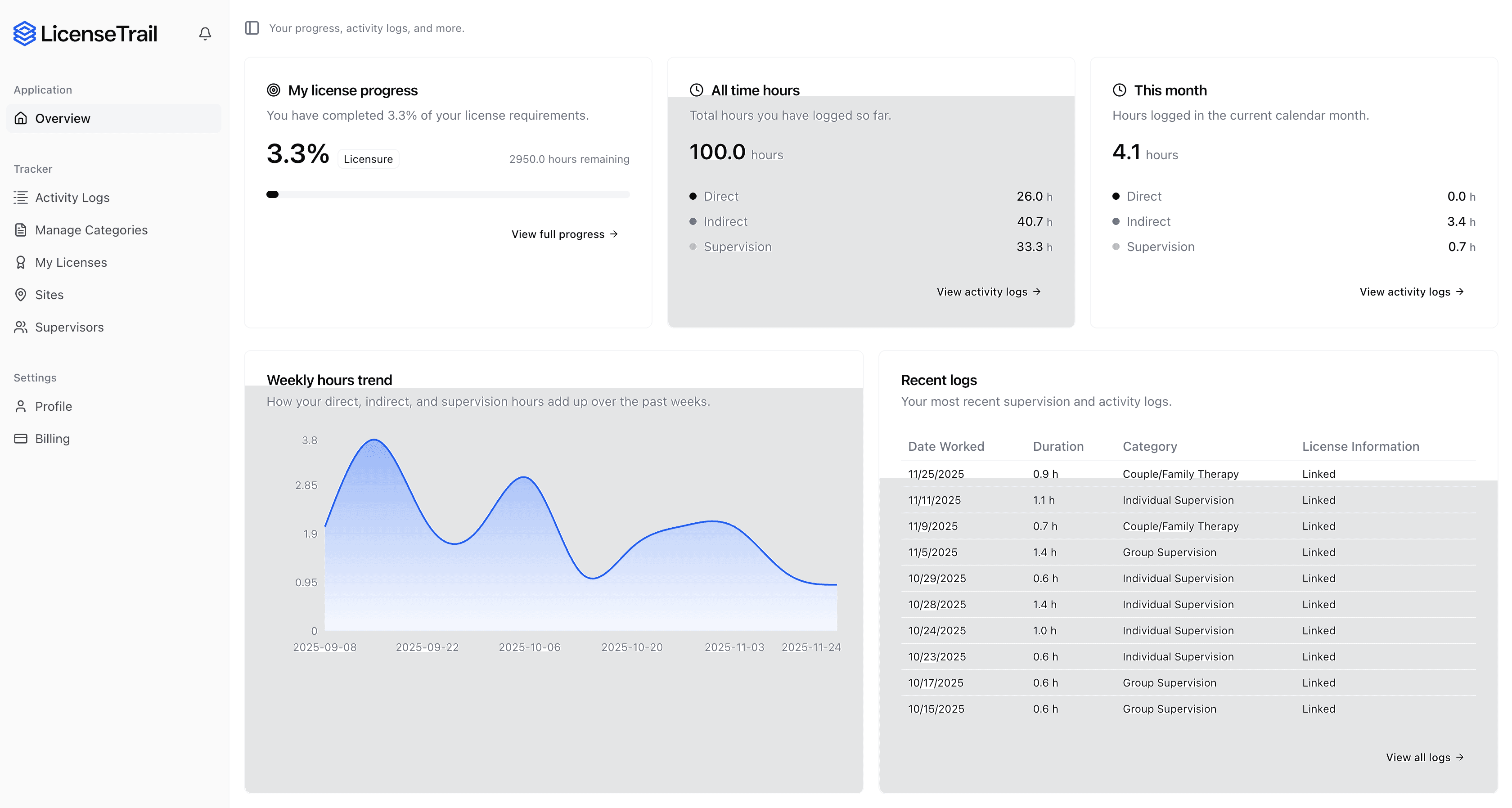
License Trail checks your direct, indirect, and supervision hours against Wisconsin LMFT requirements continuously and flags mismatches before you submit.
 Start Tracking for Free
No credit card required · Free plan available
Is your spreadsheet hiding Wisconsin LMFT risks?
Stop guessing if your categories match Wisconsin Marriage and Family Therapy, Professional Counseling, and Social Work Examining Board requirements. License Trail checks your direct, indirect, and supervision hours continuously and flags mismatches before you submit.
Import or log
Bring your spreadsheet or start fresh
Upload your existing tracking spreadsheet and we'll map every hour into the right Wisconsin Marriage and Family Therapy, Professional Counseling, and Social Work Examining Board categories automatically.
Verify against Wisconsin
Catch mismatches before the board does
License Trail checks your direct, indirect, and supervision hours against Wisconsin LMFT requirements continuously.
Export board-ready
One-click clean reports
Generate professional, board-ready reports for supervision meetings and Wisconsin Marriage and Family Therapy, Professional Counseling, and Social Work Examining Board submissions in seconds.
No credit card required · Free plan available