
Wisconsin ISW Requirements: Hours, Exams & Step-by-Step Guide
Stop guessing if your categories match Wisconsin requirements. License Trail checks your direct, indirect, and supervision hours against ISW requirements continuously and flags mismatches before you submit.
No credit card required · Free plan available
Quick Requirements Overview
- Education: MSW (CSWE-accredited/in-candidacy) or recognized equivalent DSW
- Prerequisite credential: Must hold APSW before accruing ISW supervised hours
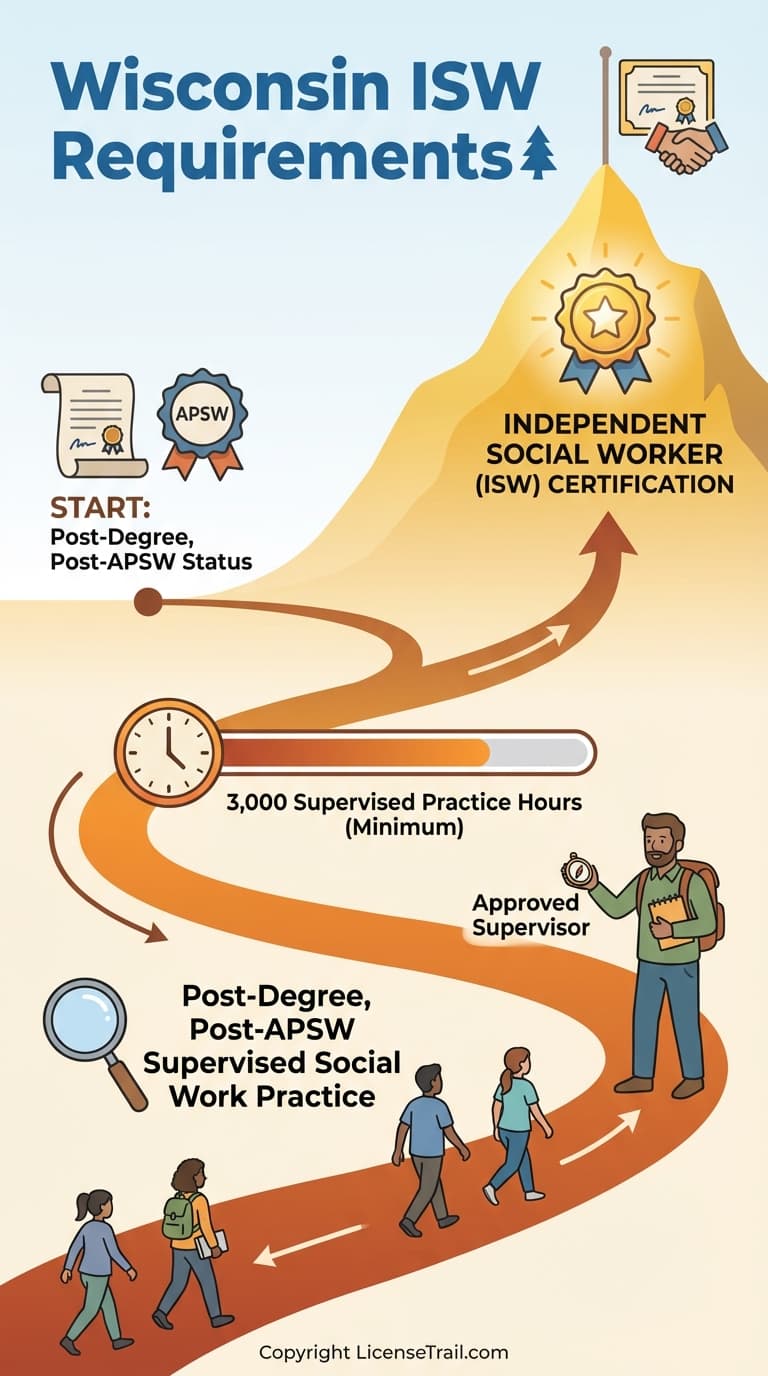
- Supervised experience: 3,000 hours of supervised social work practice over ≥2 years (post-degree & post-APSW)
- Practice content: Experience must include assessment/evaluation, planning/policy development, and intervention (counseling/advocacy/referrals/organizational change)
- Supervision cadence: Face-to-face supervision ≥1 hr/week (may be averaged); group supervision max 6 supervisees
- Supervisor eligibility: LCSW or ISW/CISW (MSW/DSW), or another person pre-approved by the Social Worker Section
- Exams: WI statutes/admin code exam (85%, required if not passed within 5 years) + ASWB exam at level specified by DSPS for ISW (ACSW may substitute for ASWB per rule)
- Application items: DSPS LicensE application/fee + education verification + supervised-hours affidavit + exam proof + verification of credentials held in other jurisdictions (and any conviction documentation as required)
License Details
Procedures
Wisconsin’s Independent Social Worker credential (often abbreviated ISW or CISW) is a master’s‑level social work certificate issued by the Social Worker Section of the Marriage and Family Therapy, Professional Counseling, and Social Work Examining Board. It allows you to practice social work independently (with limits on psychotherapy) and sits between Advanced Practice Social Worker (APSW) and Licensed Clinical Social Worker (LCSW) in the state’s license hierarchy. (regulations.justia.com)
Below is a step‑by‑step guide focused on the exact hour requirements and the board’s own terminology.
1. What the Independent Social Worker (ISW/CISW) may do
Under Wis. Admin. Code MPSW 6.03, a “certified independent social worker” may: (regulations.justia.com)
- “evaluate and intervene in complex difficulties in psychosocial functioning”
- provide intervention plans that may include:
- counseling of individuals, families, and groups
- advocacy
- referral to community resources
- facilitation of organizational change to meet social needs
- practice social work independently
- but may engage in psychotherapeutic activities only under supervision of someone authorized to supervise clinical social work (e.g., an LCSW or other DHS‑authorized clinician).
2. Educational and entry‑level credential requirements
Before you can become certified as an Independent Social Worker, Wisconsin requires:
-
Graduate social work degree
- A master’s degree in social work from a program accredited by (or in candidacy with) the Council on Social Work Education (CSWE), or
- A doctoral degree in social work, from a program the Social Worker Section or CSWE recognizes as equivalent. (regulations.justia.com)
-
Advanced Practice Social Worker (APSW) certification first
Under Wis. Admin Code MPSW 3.07, the 3,000 hours you need for ISW must be accumulated after you: (law.cornell.edu)
- receive your master’s or doctoral degree, and
- receive certification as an Advanced Practice Social Worker.
In practice, the sequence is:
Graduate MSW/DSW → obtain APSW → complete supervised practice → apply for ISW.
3. Required supervised practice hours for ISW
3.1 The core numeric requirement
Both the Wisconsin Administrative Code and DSPS specify the same core requirement.
-
MPSW 3.07(3) requires an affidavit that you have obtained “at least 3,000 hours of social work practice in no less than 2 years under the supervision of a supervisor approved by the social worker section.” (law.cornell.edu)
-
DSPS summarizes this as:
- “Complete 2 years of supervised practice.”
- After education and APSW certification, “engage in at least 3000 hours of supervised social work practice … approved by the Social Worker Section.” (dsps.wi.gov)
So, numerically:
- Total hours required: 3,000 hours
- All 3,000 hours must be supervised
- Minimum time span: “no less than 2 years” (24 months)
- No cap is stated; you may take longer than 2 years if needed.
3.2 Direct vs. indirect hours for ISW
For the Independent Social Worker credential:
- The statutes and rules do not divide the 3,000 hours into “direct” vs. “indirect” categories.
- There is no specified minimum number of face‑to‑face client‑contact hours for ISW in MPSW 3.07 or MPSW 4.01. (law.cornell.edu)
In other words, Wisconsin does not say something like “1,500 hours of direct client contact and 1,500 hours of other supervised experience” for ISW. The only numeric requirement is 3,000 total supervised hours over at least 2 years.
(Contrast: for the Licensed Clinical Social Worker credential, Wisconsin explicitly requires 3,000 hours of clinical social work practice including at least 1,000 hours of face‑to‑face client contact, with DSM diagnosis and treatment of individuals. Those face‑to‑face and DSM requirements do not apply to ISW; they are specific to LCSW. (wirules.elaws.us))
4. What counts as “supervised social work practice”
The board’s definition of the required practice comes from Wis. Admin. Code MPSW 4.01, “Supervised pre‑certification and pre‑licensure social work practice,” which governs both independent and clinical pathways. (law.cornell.edu)
4.1 Content areas your 3,000 hours must include
MPSW 4.01(3) says that a period of supervised practice shall include, but not be limited to, practice in all of the following activities:
- Evaluation and assessment of difficulties in psychosocial functioning of a group or individual.
- Developing plans or policies to alleviate those difficulties.
- Intervention, which may include:
- psychosocial evaluation and counseling of individuals, families, and groups
- advocacy
- referral to community resources
- facilitation of organizational change to meet social needs
At the end of supervision, the candidate must have demonstrated competence in each of these activities to the supervisor. (law.cornell.edu)
Practically, your 3,000 hours can include:
- Direct client work (assessment, case management, counseling within the ISW scope)
- Indirect work linked to client care (documentation, case planning, team meetings)
- System and program work (advocacy, program development)
as long as it falls within “social work practice” and the supervisor is able to attest that you met the MPSW 4.01(3) competencies.
5. Supervision structure and supervisor qualifications
5.1 Minimum supervision frequency
MPSW 4.01(1) lays out the basic structure of supervision for pre‑certification practice (which is exactly what the 3,000 ISW hours are):
- Supervision must consist of “face‑to‑face individual or group sessions of at least one hour duration during each week of supervised practice of social work.”
- The one‑hour‑per‑week requirement may be averaged over the supervision period.
- Supervision may be provided by someone other than your employment supervisor.
- Supervisors must have the training, knowledge, and skill to competently supervise any social work service you undertake and are legally and ethically responsible for your supervised activities. (law.cornell.edu)
If supervision is in a group format, MPSW 4.01(2) caps groups at no more than six supervisees per supervisor and disallows counting time that is primarily social activity. (law.cornell.edu)
5.2 Who may supervise ISW hours
For “applications for licensure as an independent social worker received after November 1, 2002,” MPSW 4.01(5) specifies that supervision may be provided by any of the following: (law.cornell.edu)
- A Licensed Clinical Social Worker with a master’s or doctorate in social work.
- A Certified Independent Social Worker with a master’s or doctorate in social work.
- Another individual approved in advance by the Social Worker Section.
It is important that your supervisor fits one of these categories; otherwise your hours may not be accepted.
6. Exams required for Independent Social Worker certification
There are two exam components at the ISW level:
-
Wisconsin statutes and administrative code exam (open‑book)
- Required if you have not passed it within the last 5 years.
- Minimum passing score: 85%.
- Covers:
- MPSW 1–6, 19, and 20
- Wisconsin Statutes chapters 48, 51, 55, 457, and 938 (dsps.wi.gov)
-
National exam (ASWB)
- The Social Worker Section reviews your application and determines eligibility to sit for the national exam.
- The DSPS ISW exam page states that the examination for this level is the ASWB Bachelors Examination (formerly Basic Level Exam). (dsps.wi.gov)
- You register directly with the Association of Social Work Boards (ASWB).
(For context: at the APSW level Wisconsin uses the ASWB Masters exam, and for LCSW the ASWB Clinical exam; at the ISW level, the state currently references the ASWB Bachelors‑level exam on its website.)
7. Application components: what you must submit
Wis. Admin. Code MPSW 3.07 and DSPS together outline the application package for certification as an Independent Social Worker. (law.cornell.edu)
You must submit:
-
Application and fees
- DSPS application via LicensE for “Social Worker – Independent.”
- Payment of the fee under Wis. Stat. § 440.05(1).
-
Proof of education
- A certificate of professional education signed and sealed by the registrar, dean, or chancellor, showing you graduated with a master’s or doctoral degree in social work. (law.cornell.edu)
- Verification that the program was CSWE‑accredited or in pre‑accreditation status at the time of your graduation (or a foreign‑degree equivalency from CSWE). (law.cornell.edu)
-
Affidavit of supervised practice hours
- An affidavit stating that, after receiving your MSW/DSW and after being certified as an APSW, you obtained at least 3,000 hours of social work practice in no less than 2 years under the supervision of a supervisor approved by the social worker section.
- The practice must meet the supervised‑practice criteria in MPSW 4.01 (content areas, weekly supervision, supervisor qualifications). (law.cornell.edu)
-
Examination verification
You must show either:
- Successful completion of the required examinations, meaning:
- the Wisconsin statutes & code exam
- the national ASWB exam at the level the state specifies for ISW
or
- Proof you have obtained certification from the Academy of Certified Social Workers (ACSW) of NASW, in which case you may not have to take the ASWB exam, provided ACSW sends verification directly to the board. (law.cornell.edu)
- Successful completion of the required examinations, meaning:
-
Credential verifications and background information
- Verification of your social work credential in all jurisdictions where you have ever been credentialed. (law.cornell.edu)
- Any documentation the Section needs to evaluate convictions or pending charges, in line with Wisconsin’s employment and credentialing discrimination statutes. (law.cornell.edu)
8. How this differs from Licensed Clinical Social Worker hours (for comparison)
Because people often confuse the ISW and LCSW hour requirements, a quick comparison is helpful:
-
Independent Social Worker (ISW/CISW)
- 3,000 hours of supervised social work practice
- Spanning at least 2 years
- No specified minimum for face‑to‑face client hours or DSM diagnosis/treatment in the code
- Practice must cover evaluation/assessment, planning, and interventions as defined in MPSW 4.01(3). (law.cornell.edu)
-
Licensed Clinical Social Worker (LCSW)
- 3,000 hours of supervised clinical social work practice in no less than 2 years
- At least 1,000 hours must be face‑to‑face client contact, and a substantial portion (at least 600 hours) must involve DSM‑based diagnosis and treatment of individuals
- Supervision must be by an appropriately qualified clinical supervisor and meet MPSW 4.01 criteria. (wirules.elaws.us)
If you plan to pursue LCSW after ISW, you will need to ensure your post‑graduate supervised practice also meets the clinical, face‑to‑face, and DSM requirements—requirements that are not built into the ISW standard itself.
9. Condensed checklist
To become an Independent Social Worker (ISW/CISW) in Wisconsin under the Marriage and Family Therapy, Professional Counseling, and Social Work Examining Board:
- Earn an MSW or DSW from a CSWE‑accredited (or equivalent) program. (regulations.justia.com)
- Obtain APSW certification.
- Accumulate at least 3,000 hours of supervised social work practice after your graduate degree and APSW, over no less than 2 years, under a board‑qualified supervisor, with at least an average of 1 hour/week of face‑to‑face supervision and coverage of evaluation, planning, and intervention activities as defined in MPSW 4.01. (law.cornell.edu)
- Pass the Wisconsin statutes & code exam (if not passed in the last 5 years). (dsps.wi.gov)
- Pass the required ASWB national exam for the ISW level (or document ACSW certification). (dsps.wi.gov)
- Submit the DSPS ISW application, fees, affidavits, and verifications (education, hours, exams, other credentials, and any required conviction documentation). (law.cornell.edu)
These are the current, board‑defined requirements and hour structures for the Wisconsin Independent Social Worker credential as of late 2025.
Track your ISW hours with confidence
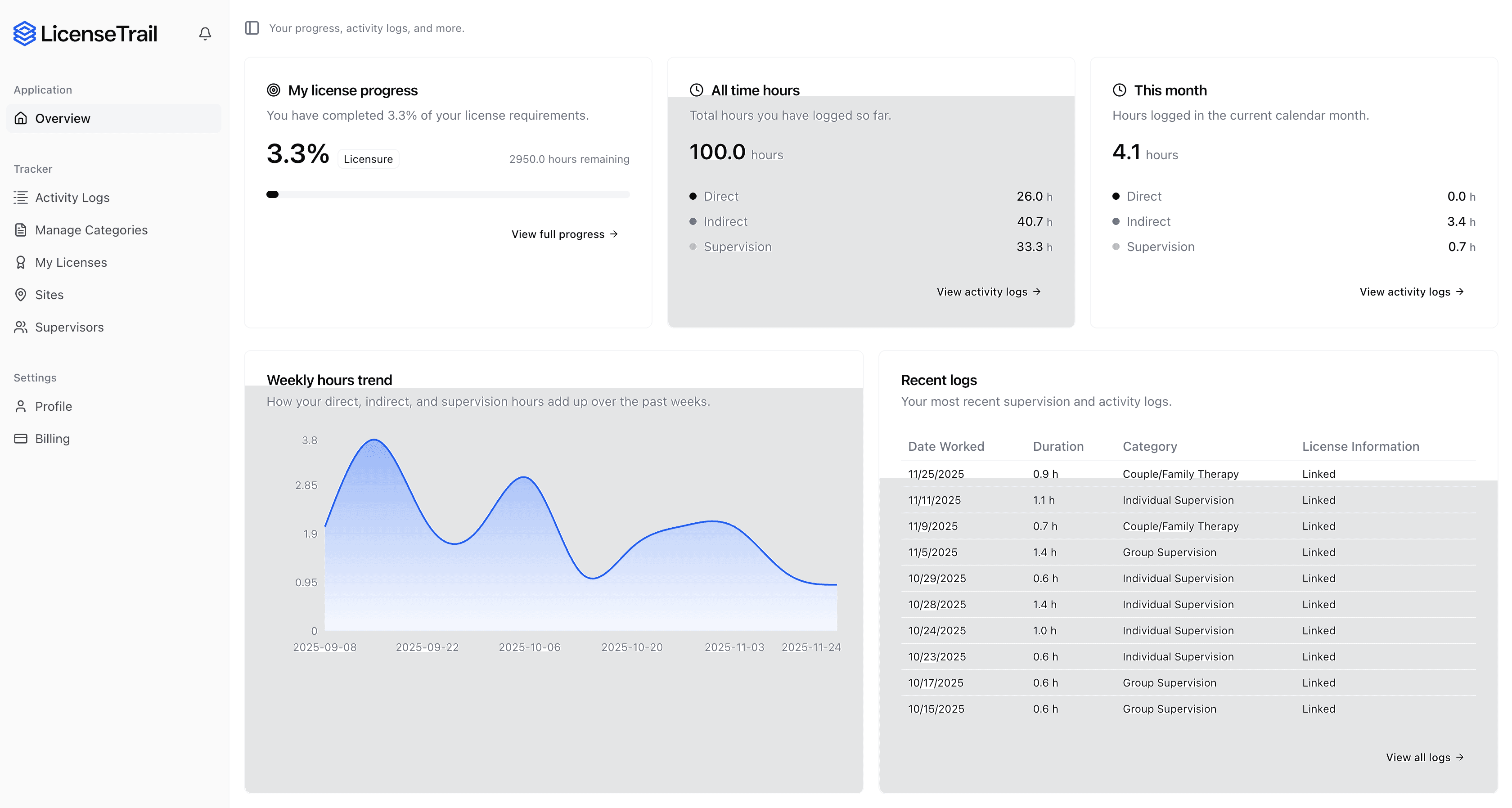
License Trail checks your direct, indirect, and supervision hours against Wisconsin ISW requirements continuously and flags mismatches before you submit.
 Start Tracking for Free
No credit card required · Free plan available
Is your spreadsheet hiding Wisconsin ISW risks?
Stop guessing if your categories match Wisconsin Marriage and Family Therapy, Professional Counseling, and Social Work Examining Board requirements. License Trail checks your direct, indirect, and supervision hours continuously and flags mismatches before you submit.
Import or log
Bring your spreadsheet or start fresh
Upload your existing tracking spreadsheet and we'll map every hour into the right Wisconsin Marriage and Family Therapy, Professional Counseling, and Social Work Examining Board categories automatically.
Verify against Wisconsin
Catch mismatches before the board does
License Trail checks your direct, indirect, and supervision hours against Wisconsin ISW requirements continuously.
Export board-ready
One-click clean reports
Generate professional, board-ready reports for supervision meetings and Wisconsin Marriage and Family Therapy, Professional Counseling, and Social Work Examining Board submissions in seconds.
No credit card required · Free plan available