
Wisconsin LCSW Requirements: Hours, Exams & Step-by-Step Guide
Stop guessing if your categories match Wisconsin requirements. License Trail checks your direct, indirect, and supervision hours against LCSW requirements continuously and flags mismatches before you submit.
No credit card required · Free plan available
Quick Requirements Overview
- Credentialing body: WI DSPS — Marriage & Family Therapy, Professional Counseling, and Social Work Examining Board (Social Worker Section)
- Education: CSWE-accredited (or equivalent) MSW/DSW with clinical concentration + supervised clinical field training
- Field-training substitute (if needed): 1,500 hrs supervised clinical SW experience (≥1 year) in primary clinical setting incl. ≥500 hrs face-to-face (does not replace post-grad hours)
- Prereq credential: Must first hold APSW or ISW certification before LCSW hours count
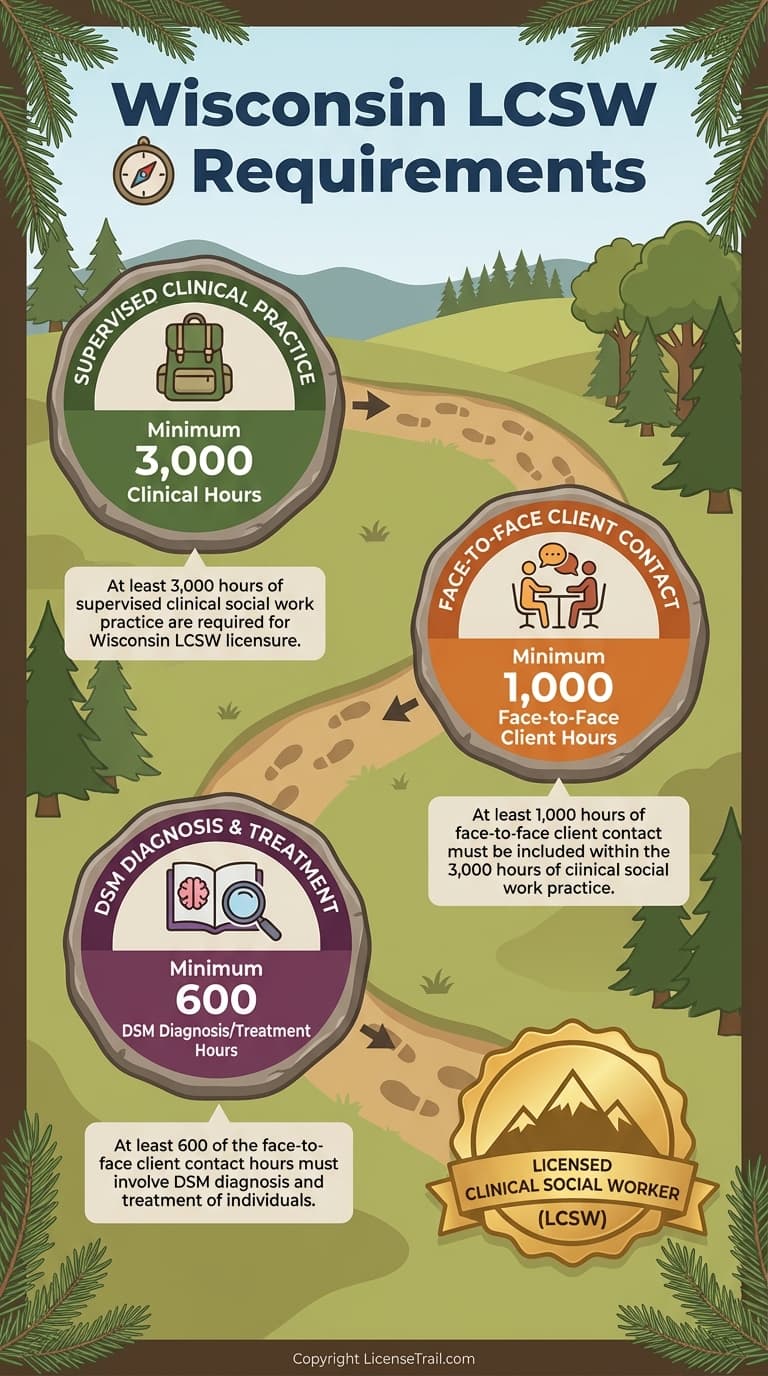
- Post-grad experience: 3,000 hrs supervised clinical SW practice after degree + APSW/ISW; includes ≥1,000 hrs face-to-face, with ≥600 hrs DSM diagnosis & treatment of individuals
- Supervision: All hours under Board-approved supervisor; supervision averages ~1 hr/week (per MPSW 4.01)
- Exams: Pass WI Statutes & Admin Code open-book exam (85%) + ASWB Clinical (or waiver via BCD verification)
- Out-of-state hours: May count if equivalent 3,000 hrs (≥2 years) with required face-to-face/DSM components and acceptable supervision/documentation
License Details
Procedures
In Wisconsin, the Licensed Clinical Social Worker (LCSW) credential is issued by the Marriage and Family Therapy, Professional Counseling, and Social Work Examining Board (Social Worker Section) within the Department of Safety and Professional Services (DSPS). This license authorizes fully independent clinical social work practice, including psychotherapy and DSM-based diagnosis and treatment. (law.cornell.edu)
Below is a structured guide focused on the types of hours required and the exact categories the Board recognizes.
1. Big-picture pathway to LCSW in Wisconsin
To qualify for LCSW in Wisconsin, you must:
- Earn an MSW or DSW with a clinical social work concentration and supervised clinical field training (or approved substitute). (law.cornell.edu)
- Pass the Wisconsin Statutes and Administrative Code Examination (state open‑book exam). (dsps.wi.gov)
- Obtain certification as an Advanced Practice Social Worker (APSW) or Independent Social Worker (ISW).
- Complete at least 3,000 hours of supervised clinical social work practice after the degree and after APSW/ISW certification, with specific hour sub‑requirements (see Section 4). (law.cornell.edu)
- Pass the ASWB Clinical Examination (or qualify via Board Certified Diplomate status). (law.cornell.edu)
- Submit a complete application, including verification of education, supervised hours, exams, and any criminal/disciplinary history. (law.cornell.edu)
The sections below focus on the hour requirements and how the Board defines them.
2. Educational requirement and pre‑degree clinical training
2.1 Degree and clinical concentration
The Board requires either:
- A master’s degree in social work or
- A doctoral degree in social work
from a program that is accredited (or in pre‑accreditation) by the Council on Social Work Education (CSWE), or deemed equivalent by CSWE if foreign. (law.cornell.edu)
For LCSW, DSPS further specifies that you must have had a clinical social work concentration and have completed supervised clinical field training as part of, or in postgraduate studies alongside, that degree. (dsps.wi.gov)
2.2 Alternative to clinical field placement: 1,500 hours
If your degree program did not provide supervised clinical field training, Wisconsin allows a specific hour‑based substitute that the Board describes as “supervised clinical social work experience”:
- Total hours:
- 1,500 hours of supervised clinical social work experience
- Time frame:
- Completed in not less than one year
- Setting:
- Within a primary clinical setting
- Direct client contact requirement:
- At least 500 hours of face-to-face client contact
- Supervision standard:
- Supervised as provided in MPSW 4.01 (the Board’s rule on supervised pre‑certification and pre‑licensure practice). (law.cornell.edu)
This 1,500‑hour option is only to satisfy the education/field training requirement.
Board materials and secondary summaries emphasize that these hours do not remove or replace the separate 3,000‑hour post‑graduate supervised clinical practice requirement (you still must complete the full 3,000 hours described in Section 4, and the hours may not overlap). (publichealthonline.org)
3. State law (open‑book) and national exams
Before (or while) accruing supervised experience, you must complete:
3.1 Wisconsin Statutes and Administrative Code Examination
The Board requires all social work applicants, including LCSWs, to pass an open‑book exam on Wisconsin statutes and administrative code:
- Exam content sources:
- MPSW chapters 1–6, 19, 20
- Wisconsin Statutes chapters 48, 51, 55, 457, 938 (dsps.wi.gov)
- Passing score:
- 85%
This exam is taken online and is designed to ensure you can locate and understand the laws and rules governing social work practice in Wisconsin. (dsps.wi.gov)
3.2 National clinical exam (ASWB Clinical)
For LCSW, the Board must review your application and then determine your eligibility to sit for the Association of Social Work Boards (ASWB) Clinical Examination. (dsps.wi.gov)
- If you are a Board Certified Diplomate (BCD) of the American Board of Examiners in Clinical Social Work, the Wisconsin rule allows you to skip the national exam, provided the Board receives direct verification of your BCD status. (law.cornell.edu)
4. Post‑graduate supervised clinical practice: the 3,000 hours
The core licensing requirement for an LCSW is post‑graduate, supervised clinical social work practice, defined and broken down in Wis. Admin. Code MPSW 3.09(3) and on the DSPS LCSW license page. (law.cornell.edu)
4.1 When the 3,000 hours may start
The rule is explicit that the hours must be accumulated:
- After receiving your master’s or doctoral degree and
- After receiving certification as an Advanced Practice Social Worker (APSW) or Independent Social Worker (ISW). (law.cornell.edu)
Hours worked before you hold APSW or ISW certification do not count toward the 3,000‑hour requirement.
4.2 Total hours and hour types
The post‑degree, supervised experience must meet all of the following:
-
Total clinical social work practice hours
- At least 3,000 hours of clinical social work practice. (law.cornell.edu)
-
Face‑to‑face client contact (direct services)
- Of those 3,000 hours, at least 1,000 hours must be face‑to‑face client contact. (law.cornell.edu)
- “Face‑to‑face client contact” is the Board’s term for direct clinical work with clients (individuals, families, or groups), historically in person and now typically understood to include real‑time telehealth when consistent with state rules.
-
DSM diagnosis and treatment
- Within the 1,000 face‑to‑face hours, a minimum of 600 hours must involve DSM diagnosis and treatment of individuals. (law.cornell.edu)
- In other words:
- 1,000 total face‑to‑face hours, and
- At least 600 of those are specifically DSM diagnostic and treatment work with individuals.
-
Supervision of all 3,000 hours
- All hours must be accumulated under the supervision of a supervisor approved by the Social Worker Section. (law.cornell.edu)
- DSPS explicitly states that the 3,000 hours must include DSM diagnosis and treatment of individuals, not just generic counseling or case management. (dsps.wi.gov)
4.3 Who can supervise and what “supervised practice” looks like
Under MPSW 4.01(6), supervision for LCSW applicants may be provided by: (law.cornell.edu)
- An LCSW with a doctorate in social work
- An LCSW with the equivalent of five years of full‑time clinical social work experience
- A psychiatrist or licensed psychologist (under ch. 455, Wis. Stats.)
- An LCSW with a master’s degree in social work
- Another individual approved in advance by the Social Worker Section
The rule on supervised pre‑certification/pre‑licensure practice (MPSW 4.01) also defines the structure of supervision:
- supervision must include direction of practice in face‑to‑face individual or group sessions with the supervisor,
- these supervision sessions must average at least one hour per week over the supervision period (they can be averaged, not necessarily every single week), and
- supervision must cover core social work tasks such as evaluation/assessment, planning, and intervention (counseling, advocacy, referrals, organizational change). (law.cornell.edu)
This “one hour per week” refers to supervision sessions, not client contact. The 3,000 practice hours are separate and much larger.
4.4 In‑state vs. out‑of‑state supervised experience
-
In‑Wisconsin hours
- Must meet the 3,000 / 1,000 / 600 structure above and comply with MPSW 4.01 supervision rules. (law.cornell.edu)
-
Out‑of‑state hours (credit toward Wisconsin LCSW)
- The Board may grant credit for supervised clinical social work practice completed outside Wisconsin after your social work degree, if:
- the total is at least 3,000 hours of supervised clinical social work practice,
- completed in no less than two years,
- includes at least 1,000 hours of face‑to‑face client contact, and
- includes DSM diagnosis and treatment of individuals,
- all under the supervision of a supervisor acceptable to the Social Worker Section. (law.cornell.edu)
DSPS also notes that supervised clinical social work hours obtained in another state may be accepted toward the 3,000‑hour requirement, subject to these conditions. (dsps.wi.gov)
- The Board may grant credit for supervised clinical social work practice completed outside Wisconsin after your social work degree, if:
5. What counts as “clinical social work practice” for those 3,000 hours?
While the statutes and rules do not give a single checklist of billable activities, they define the scope of practice of an LCSW as providing, without supervision, diagnosis, treatment, and prevention of mental and emotional disorders through interventions like psychotherapy, counseling, referrals, advocacy, and facilitation of organizational change, all based on psychosocial evaluation. (law.cornell.edu)
In practice, hours that typically qualify as clinical social work practice for the 3,000 hours include:
- Direct client therapy (individual, group, family)
- Diagnostic assessment and formulation using the DSM
- Treatment planning, review, and coordination
- Crisis intervention related to mental and emotional disorders
- Clinical documentation, case consultation, and clinically focused collateral contacts (as part of providing treatment)
Purely administrative roles or macro‑practice activities—without a direct clinical, diagnostic, or treatment focus—generally do not count toward the 3,000 clinical hours, and they will not satisfy the 600 hours of DSM diagnosis/treatment requirement.
6. Application and supporting documentation
Wisconsin’s administrative rule on applications for LCSW (MPSW 3.09) and the DSPS LCSW webpage lay out what you must submit. (law.cornell.edu)
6.1 Key items the Board expects:
-
Completed LCSW application and fee (via LicensE).
-
Certificate of professional education, confirming:
- Master’s or doctoral degree in social work,
- Clinical concentration, and
- Completion of supervised clinical field training
or the 1,500‑hour supervised clinical social work experience substitute described in Section 2.2. (law.cornell.edu)
-
Verification of program accreditation by CSWE (or CSWE equivalence for foreign degrees). (law.cornell.edu)
-
Affidavit of post‑graduate supervised clinical experience, documenting:
- At least 3,000 hours of clinical social work practice,
- At least 1,000 hours of face‑to‑face client contact,
- At least 600 hours of DSM diagnosis and treatment of individuals,
- All completed after the degree and after APSW/ISW certification, and
- All under a Board‑approved supervisor and conforming to MPSW 4.01. (law.cornell.edu)
DSPS uses specific forms (e.g., Form 2560: Documentation of Post‑Graduate Clinical Experience – Supervisor’s Affidavit and Form 2771: Summary of Post‑Graduate Experience Hours) to capture this breakdown. (dsps.wi.gov)
-
Verification of examinations
- Proof of passing:
- Wisconsin Statutes and Administrative Code Exam, and
- ASWB Clinical Examination (unless you qualify via BCD). (law.cornell.edu)
- Proof of passing:
-
Verification of all credentials in other jurisdictions where you have ever been credentialed in social work. (law.cornell.edu)
-
Criminal and disciplinary history information, including:
- Any pending charges or convictions that may be substantially related to practice (as referenced in MPSW 3.09(6) and DSPS forms on convictions and pending charges). (law.cornell.edu)
7. Hour requirements at a glance
Putting the Board’s hour categories into a quick reference:
A. Education / clinical training requirement
-
Option 1 (typical path):
- MSW or DSW with clinical social work concentration
- Supervised clinical field training built into the program (law.cornell.edu)
-
Option 2 (field training substitute):
- 1,500 hours of supervised clinical social work experience
- Completed in ≥ 1 year
- In a primary clinical setting
- Includes ≥ 500 hours face‑to‑face client contact
- Supervised under MPSW 4.01
- Does not replace the 3,000 post‑graduate hours; it only substitutes for clinical field training. (law.cornell.edu)
B. Post‑graduate supervised clinical practice (for LCSW)
-
Total hours required:
- 3,000 hours of clinical social work practice
-
Direct client (face‑to‑face) hours:
- At least 1,000 hours of face‑to‑face client contact
-
DSM diagnosis and treatment of individuals:
- At least 600 hours (a subset of the 1,000 face‑to‑face hours) devoted specifically to DSM diagnosis and treatment of individuals
-
Timing constraints:
- All 3,000 hours accrued after the MSW/DSW and after APSW or ISW certification.
-
Supervision requirements:
- All 3,000 hours under a supervisor approved by the Social Worker Section,
- Supervision structured in accordance with MPSW 4.01, including roughly one hour per week of supervisory sessions on average,
- Supervisor must meet the Board’s qualifications for LCSW supervision (LCSW with sufficient experience, psychiatrist, psychologist, or other Board‑approved clinician). (law.cornell.edu)
-
Out‑of‑state experience credit:
- May be accepted if:
- At least 3,000 hours of supervised clinical social work practice,
- Completed in no less than two years,
- Includes at least 1,000 face‑to‑face client contact hours involving DSM diagnosis and treatment of individuals,
- Under an acceptable supervisor, and
- Properly documented for the Board. (law.cornell.edu)
- May be accepted if:
In summary, Wisconsin’s LCSW path is built around two major hour blocks:
- A clinical training block (either embedded field education or the 1,500‑hour supervised clinical experience alternative with 500 face‑to‑face hours), and
- A post‑graduate supervised practice block of 3,000 hours of clinical social work practice, including 1,000 face‑to‑face hours and at least 600 hours of DSM diagnosis and treatment of individuals, all under a Board‑approved supervisor and properly documented for the Social Worker Section.
Track your LCSW hours with confidence
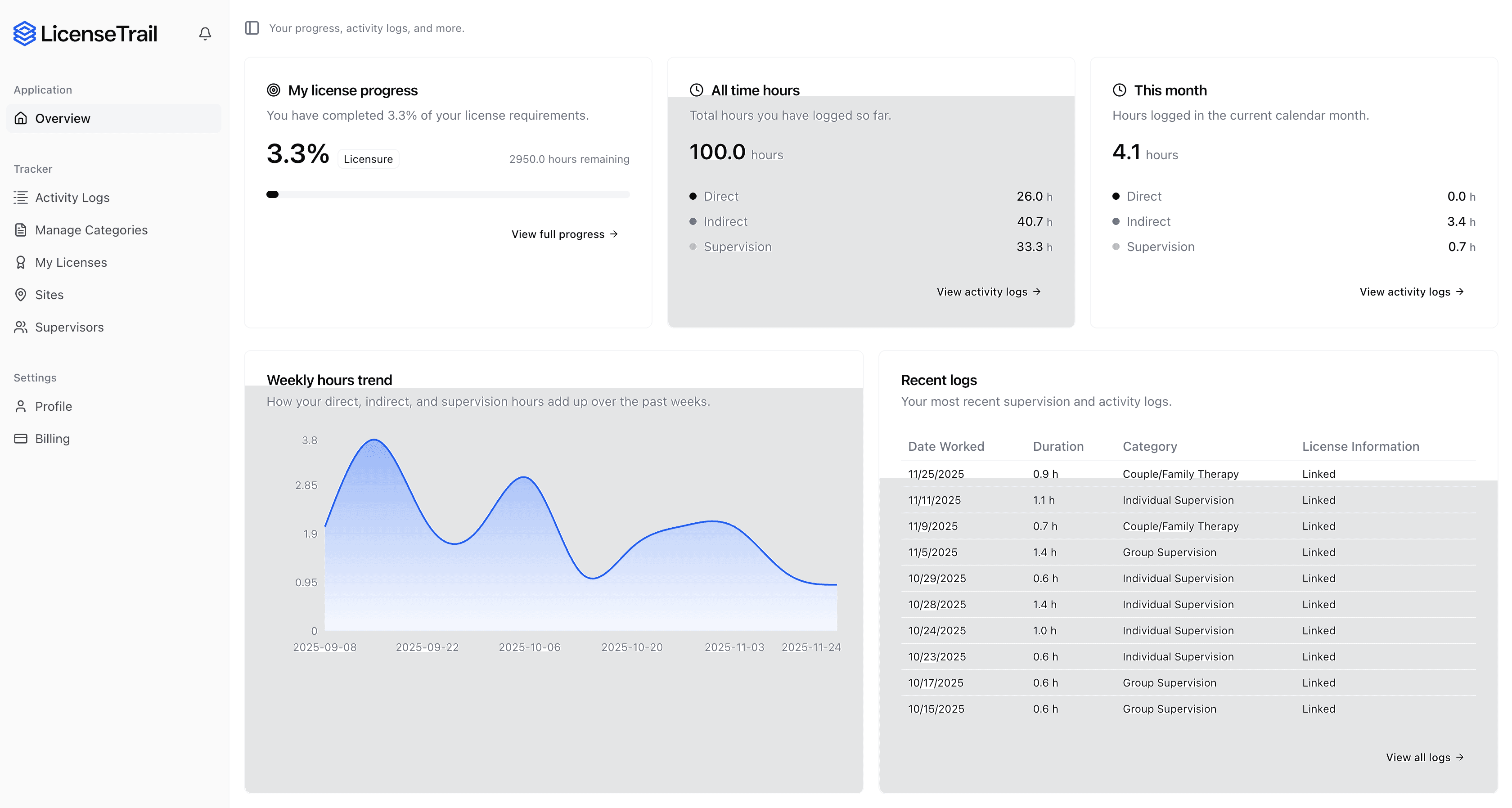
License Trail checks your direct, indirect, and supervision hours against Wisconsin LCSW requirements continuously and flags mismatches before you submit.
 Start Tracking for Free
No credit card required · Free plan available
Is your spreadsheet hiding Wisconsin LCSW risks?
Stop guessing if your categories match Wisconsin Marriage and Family Therapy, Professional Counseling, and Social Work Examining Board requirements. License Trail checks your direct, indirect, and supervision hours continuously and flags mismatches before you submit.
Import or log
Bring your spreadsheet or start fresh
Upload your existing tracking spreadsheet and we'll map every hour into the right Wisconsin Marriage and Family Therapy, Professional Counseling, and Social Work Examining Board categories automatically.
Verify against Wisconsin
Catch mismatches before the board does
License Trail checks your direct, indirect, and supervision hours against Wisconsin LCSW requirements continuously.
Export board-ready
One-click clean reports
Generate professional, board-ready reports for supervision meetings and Wisconsin Marriage and Family Therapy, Professional Counseling, and Social Work Examining Board submissions in seconds.
No credit card required · Free plan available