
Wisconsin CSW Requirements: Hours, Exams & Step-by-Step Guide
Stop guessing if your categories match Wisconsin requirements. License Trail checks your direct, indirect, and supervision hours against CSW requirements continuously and flags mismatches before you submit.
No credit card required · Free plan available
Quick Requirements Overview
- Credential/authority: Wisconsin Certified Social Worker (CSW) certificate issued by DSPS Social Worker Section; permits use of protected title “social worker.”
- Primary eligibility (standard path): BSW/MSW/doctorate in social work from a CSWE-accredited (or pre-accredited) program.
- Exams required: Pass WI Statutes & Administrative Code (jurisprudence) exam (85% passing) and ASWB Bachelors exam.
- Application items: DSPS CSW application + certificate of professional education + CSWE accreditation verification (+ required fee/disciplinary/background disclosures).
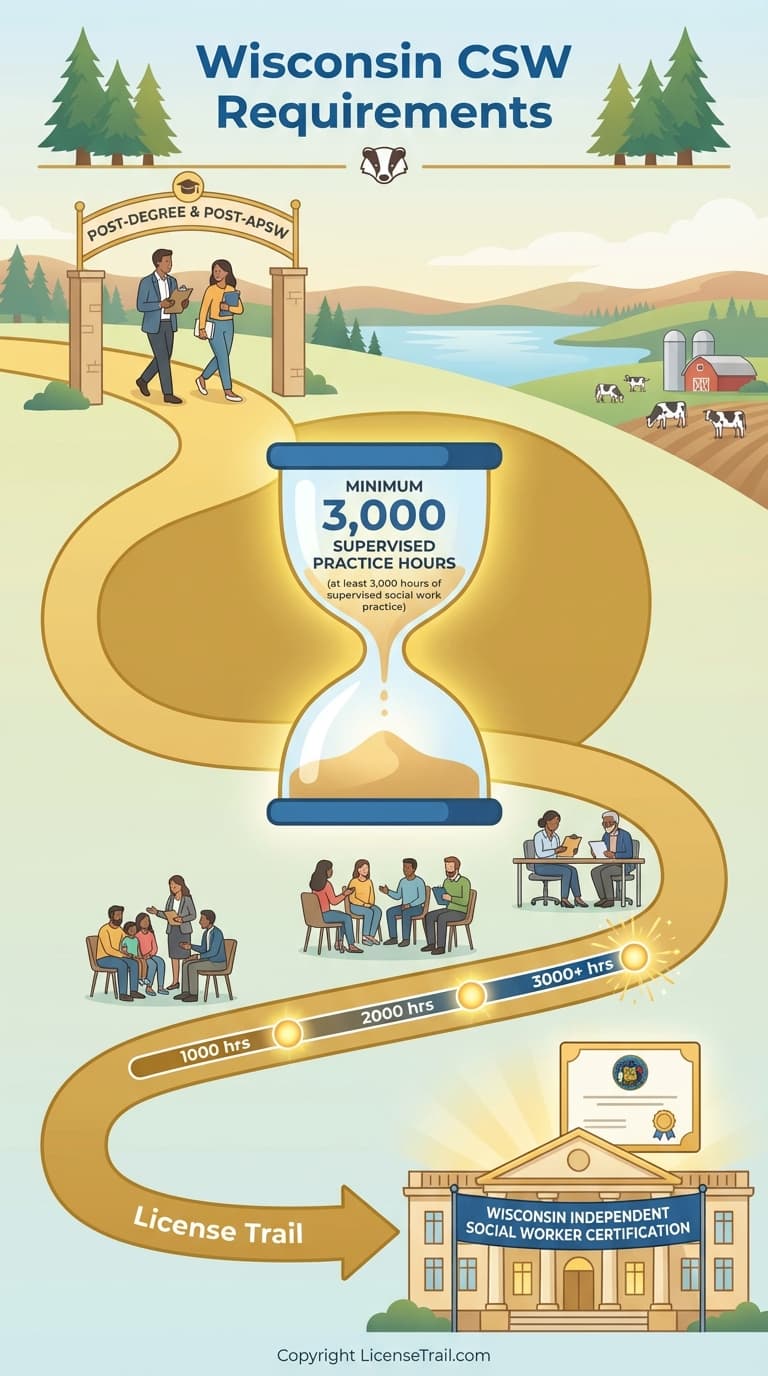
- Hours (standard path): No board-specified post-degree supervised practice hours required for CSW (beyond the degree/program requirements).
- Alternative path (non-CSWE degree): Hold Social Work Training Certificate (SWTC) + meet “degree equivalency.”
- Degree-equivalency coursework (SWTC path): 5 courses (≥ 3 semester/4 quarter hours each; C or better; SW-qualified instructor; ≥3 courses at same institution) across policy (1), generalist methods (3), HBSE (1).
- Hours/supervision (SWTC path): Either 400-hour direct-practice internship (university auspices) or 1 year employment with ≥400 hours face-to-face client contact in ≥12 months, with on-site supervision averaging ≥1 hour/week face-to-face.
License Details
Procedures
In Wisconsin, the credential commonly called “CSW” is the Certified Social Worker certificate issued by the Social Worker Section of the Marriage and Family Therapy, Professional Counseling, and Social Work Examining Board (within the Department of Safety and Professional Services, DSPS). It is the basic-level social work credential that allows you to use the protected title “social worker.” (wi.elaws.us)
There are two main ways to qualify:
- Directly, with a CSWE‑accredited social work degree (no extra post‑degree hours required for CSW).
- Through a Social Work Training Certificate (SWTC) and “degree equivalency”, which does contain explicit hour requirements.
Below is a step‑by‑step guide that separates these paths and spells out the exact hour language used by the Wisconsin rules.
1. Core legal framework for the CSW credential
Under Wisconsin Statutes § 457.08(1), the Social Worker Section “shall grant a social worker certificate” to an individual who: (wi.elaws.us)
- Meets general eligibility requirements in § 457.06 (age, conduct, etc.).
- Submits evidence of having received a bachelor’s, master’s, or doctoral degree in social work from a program accredited (or in pre‑accreditation) by the Council on Social Work Education (CSWE). (wi.elaws.us)
- Passes one or more examinations approved by the social worker section to determine minimum competence to practice as a social worker. (wi.elaws.us)
The administrative rule MPSW 3.01 mirrors this, requiring:
a certificate of professional education … from the school from which the applicant has graduated with a bachelor's, master's or doctoral degree in social work, and
verification that the program was accredited (or in pre‑accreditation) by CSWE. (regulations.justia.com)
Important: Neither § 457.08(1) nor MPSW 3.01 impose a numeric post‑degree supervised‑practice hour requirement for the CSW level. The only explicitly quantified “hours” tied to CSW come into play when someone uses the training certificate / degree‑equivalency path, discussed below.
2. Path 1 – Direct CSWE‑accredited social work degree (most common)
This is the straightforward route used by most BSW/MSW graduates.
Step 1 – Earn a CSWE‑accredited social work degree
You must earn a bachelor’s or higher degree in social work from a CSWE‑accredited (or pre‑accreditation) program: (wi.elaws.us)
- Bachelor of Social Work (BSW)
- Master of Social Work (MSW)
- Doctorate in Social Work (DSW/PhD in social work)
Wisconsin law and code do not assign a specific number of field hours at this level; instead they rely on CSWE accreditation standards and your school’s practicum requirements.
Step 2 – Pass the required examinations
You must complete two exams:
-
Wisconsin Statutes and Administrative Code Examination
- An open‑book jurisprudence exam focused on statutes and rules regulating social work practice.
- Passing score for social work is 85%. (dsps.wi.gov)
-
National ASWB Examination (bachelor level)
- For Certified Social Worker, the board identifies the ASWB Bachelors examination as the national exam for this level. (dsps.wi.gov)
The DSPS Social Worker Exam Information page confirms that the board reviews your application, determines eligibility, and then authorizes you to sit for the national exam. (dsps.wi.gov)
Step 3 – Submit the CSW application to DSPS
Under MPSW 3.01 you must submit: (regulations.justia.com)
- Completed, signed application for certification as a social worker.
- Certificate of professional education from the registrar/dean of your social work program.
- Verification that your program was CSWE‑accredited at the time you graduated.
- Fee and background‑related documents (e.g., “Convictions and Pending Charges” and any required malpractice forms), as referenced by DSPS and statute. (dsps.wi.gov)
Step 4 – Note what hours are not required at CSW level
For applicants who already hold a CSWE‑accredited social work degree, Wisconsin:
- Does not require any additional post‑degree supervised practice hours for the CSW credential.
- The governing statute § 457.08(1) lists only education and exams; it does not contain any language requiring 1,500 hours, 3,000 hours, or any similar supervised practice for CSW (those types of numeric hour requirements appear later for Independent and Clinical levels). (wi.elaws.us)
In other words, if you have a CSWE‑accredited SW degree, your only board‑specified quantitative thresholds for CSW are the exam scores, not practice hours.
3. Path 2 – Social Work Training Certificate & “degree equivalency” (hours are explicit)
If your initial degree is not a CSWE‑accredited social work degree, Wisconsin allows you to reach CSW via a Social Work Training Certificate (SWTC) plus additional coursework and supervised experience. This is where hour requirements come in.
3.1 Training certificate and degree‑equivalency coursework
Under MPSW 3.13(2), to “attain social worker degree equivalency to a bachelor’s degree in social work” and qualify to take the national social work examination, a training certificate holder must: (law.cornell.edu)
-
Complete at least 5 courses, each
- at least 3 semester hours or 4 quarter hours,
- passed with minimum grade of C,
- taught by an instructor with a master’s or PhD in social work,
- using a social work text as the primary textbook (unless otherwise approved).
-
At least three of these courses must be taken at the same institution.
Courses must be distributed across these content areas: (law.cornell.edu)
- Social welfare policy and services – at least one course (3 semester/4 quarter hours).
- Social work practice methods – generalist practice – at least three courses, covering:
- practice with individuals,
- practice with groups and families,
- practice with communities, organizations, and social institutions.
Content must prepare students to engage, assess, intervene, and evaluate client systems of all sizes and incorporate supervision, values/ethics, and cultural competence.
- Human behavior in the social environment (HBSE) – at least one course focusing on human development and social systems across the life span.
These requirements are explicitly described in MPSW 3.13(2) as needed “to attain social worker degree equivalency to a bachelor’s degree in social work.” (law.cornell.edu)
3.2 Required internship or employment hours (pre‑exam)
To qualify to take the national social work examination via the training‑certificate route, you must complete one of two supervised practice options defined in MPSW 3.13(3): (regulations.justia.com)
Option A – Human services internship
You complete:
- “A human services internship of at least 400 hours” that
- was part of your degree program or completed while holding the training certificate, and
- “involved direct practice with clients”, and
- was “supervised by a social worker certified under s. 457.08, Stats., and who has a bachelor's or master's degree in social work and provides direct, on‑site supervision of the intern.”
- “A human services internship shall be under the auspices of an accredited college or university.” (regulations.justia.com)
Type of hours:
- All 400+ hours must be direct practice with clients; the rule does not carve out separate “indirect” or administrative hours toward this total.
Option B – One year of social work employment
You complete:
- “One year of social work employment completed while holding the training certificate, which involved at least 400 hours of face‑to‑face client contact in not less than 12 months,”
- supervised by a certified social worker (under § 457.08) who has a BSW or MSW and “provides direct, on‑site supervision” during your work. (regulations.justia.com)
Type of hours:
- Minimum 400 hours are specifically “face‑to‑face client contact”; again, these are direct client hours, not just time on the job.
3.3 Supervision structure and what counts as supervised practice
For both internship and employment under the training certificate, MPSW 3.13(4) incorporates the general supervision rules in MPSW 4.01. Together they require: (law.cornell.edu)
- Supervision must include the “direction of social work practice in a face‑to‑face individual session of at least one hour duration during each week of supervised practice of social work.”
- This one hour per week may be averaged over the period of supervision.
- Supervision may be provided by someone other than your employment supervisor, as long as they meet the qualification standards.
- Supervisors must have “adequate training, knowledge and skill to competently supervise any social work service that a social worker undertakes,” and are legally and ethically responsible for the supervisee’s activities.
If group supervision is used (more typical for advanced licenses but still governed by MPSW 4.01(2)): (law.cornell.edu)
- No more than 6 supervisees per one supervisor in a group.
- Time that is primarily social activity does not count as supervision.
MPSW 4.01(3) specifies that a period of supervised practice must include at least these activities: (law.cornell.edu)
- Evaluation and assessment of difficulties in psychosocial functioning of individuals or groups.
- Developing plans or policies to alleviate those difficulties.
- Intervention, which “may include psychosocial evaluation and counseling of individuals, families and groups; advocacy; referral to community resources; and facilitation of organizational change to meet social needs.”
Under MPSW 3.13(3m), your supervisor must also certify that—in the course of the 400‑hour internship or 400‑hour employment—you demonstrated competence to: (law.cornell.edu)
- “Engage, assess, intervene, and evaluate” individuals, families, groups, organizations, and communities.
- “Collect, organize, and interpret client data”; “develop mutually agreed upon intervention goals and objectives”; “determine and implement appropriate intervention strategies.”
- Implement prevention interventions, help clients resolve problems, mediate, advocate, facilitate transitions, and evaluate interventions.
- Apply the NASW Code of Ethics and relevant Wisconsin laws and rules.
3.4 Granting the CSW certificate after the training‑certificate route
Once a training‑certificate holder has: (law.cornell.edu)
- Demonstrated social worker degree equivalency via the 5 required courses.
- Completed one of the supervised internship/employment options (400 hours of direct practice or 400 hours of face‑to‑face client contact in one year).
- Passed the national ASWB social work exam and the Wisconsin statutes/rules exam.
Then, under MPSW 3.13(5), “the section shall grant a social worker certificate” (subject to disciplinary screens).
Numeric hours summary for this path:
- 400 hours human services internship involving direct practice with clients, or
- 400 hours of face‑to‑face client contact over at least 12 months of employment,
- plus weekly one‑hour face‑to‑face supervision sessions on average during the supervised period.
Those are the only explicit hour thresholds the board sets for becoming a CSW via the training‑certificate route.
4. How CSW compares to higher‑level Wisconsin social work credentials
To put the CSW hour requirements in context:
- Independent Social Worker (ISW): Statute § 457.08(3)(c) requires “the equivalent of at least 2 years of full‑time supervised social work practice” after the MSW/doctorate, for those seeking independent practice certification. (wi.elaws.us)
- Clinical Social Worker (LCSW):
- Must complete a clinical concentration and supervised clinical field training; if a program did not supply supervised clinical field training, an applicant may substitute “1,500 hours of supervised clinical social work experience” in a primary clinical setting with at least 500 hours of face‑to‑face client contact. (law.cornell.edu)
- Must also complete 3,000 hours of clinical social work practice, including at least 1,000 hours of face‑to‑face client contact, with at least 600 hours involving DSM diagnosis and treatment of individuals, all under an approved clinical supervisor. (law.cornell.edu)
Those larger “1,500 hours / 3,000 hours” figures apply only at the clinical and independent levels, not to the basic CSW credential.
5. Practical takeaway
- If you already hold a CSWE‑accredited social work degree, Wisconsin does not require any specified number of supervised hours beyond your program’s practicum to become a Certified Social Worker (CSW). Your main obligations are the degree itself and passing the state jurisprudence exam plus the ASWB Bachelors exam. (wi.elaws.us)
- If you are coming from a non‑CSWE degree and using the Social Work Training Certificate, you must:
- Complete 5 prescribed social work courses, and
- Complete either a 400‑hour human services internship involving direct practice with clients or one year of employment with at least 400 hours of face‑to‑face client contact, under on‑site supervision with weekly one‑hour face‑to‑face supervisory sessions on average. (law.cornell.edu)
Those are the board‑defined hour requirements that specifically govern the journey to CSW under the Wisconsin Marriage and Family Therapy, Professional Counseling, and Social Work Examining Board.
Track your CSW hours with confidence
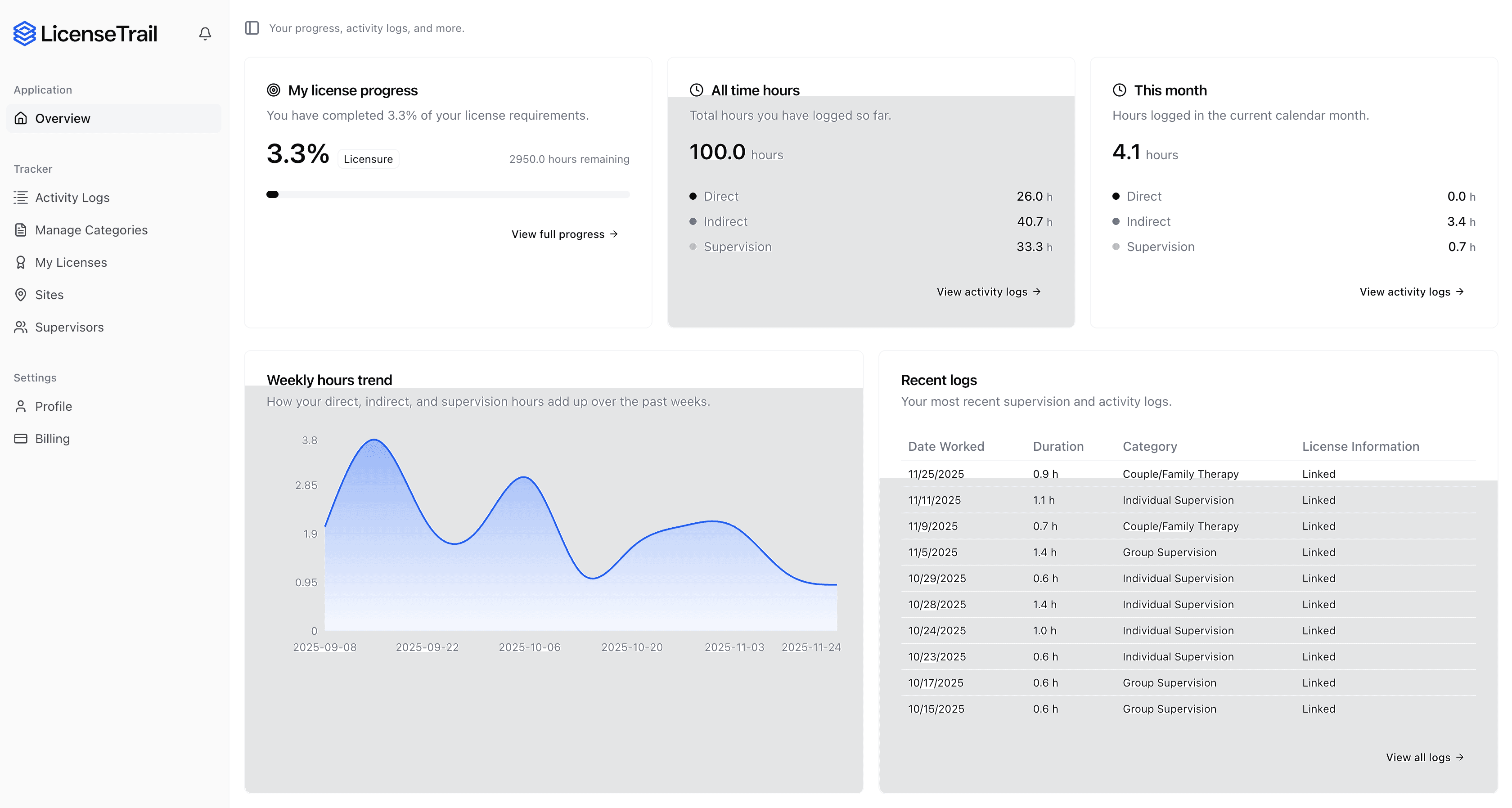
License Trail checks your direct, indirect, and supervision hours against Wisconsin CSW requirements continuously and flags mismatches before you submit.
 Start Tracking for Free
No credit card required · Free plan available
Is your spreadsheet hiding Wisconsin CSW risks?
Stop guessing if your categories match Wisconsin Marriage and Family Therapy, Professional Counseling, and Social Work Examining Board requirements. License Trail checks your direct, indirect, and supervision hours continuously and flags mismatches before you submit.
Import or log
Bring your spreadsheet or start fresh
Upload your existing tracking spreadsheet and we'll map every hour into the right Wisconsin Marriage and Family Therapy, Professional Counseling, and Social Work Examining Board categories automatically.
Verify against Wisconsin
Catch mismatches before the board does
License Trail checks your direct, indirect, and supervision hours against Wisconsin CSW requirements continuously.
Export board-ready
One-click clean reports
Generate professional, board-ready reports for supervision meetings and Wisconsin Marriage and Family Therapy, Professional Counseling, and Social Work Examining Board submissions in seconds.
No credit card required · Free plan available