
Wisconsin LPC Requirements: Hours, Exams & Step-by-Step Guide
Stop guessing if your categories match Wisconsin requirements. License Trail checks your direct, indirect, and supervision hours against LPC requirements continuously and flags mismatches before you submit.
No credit card required · Free plan available
Quick Requirements Overview
- Governing authority: WI DSPS Professional Counselor Section (Wis. Stat. ch. 457; Wis. Admin. Code MPSW 11 & 12)
- Education: Master’s or doctorate in professional counseling, CACREP program, equivalent program (per rules), or approved foreign equivalent (documented via certificate of professional education)
- Training license (LPC-IT): Generally required before accruing WI post-degree hours; requires application/fee, suitability, and supervised clinical placement/offer; valid 48 months (renewable)
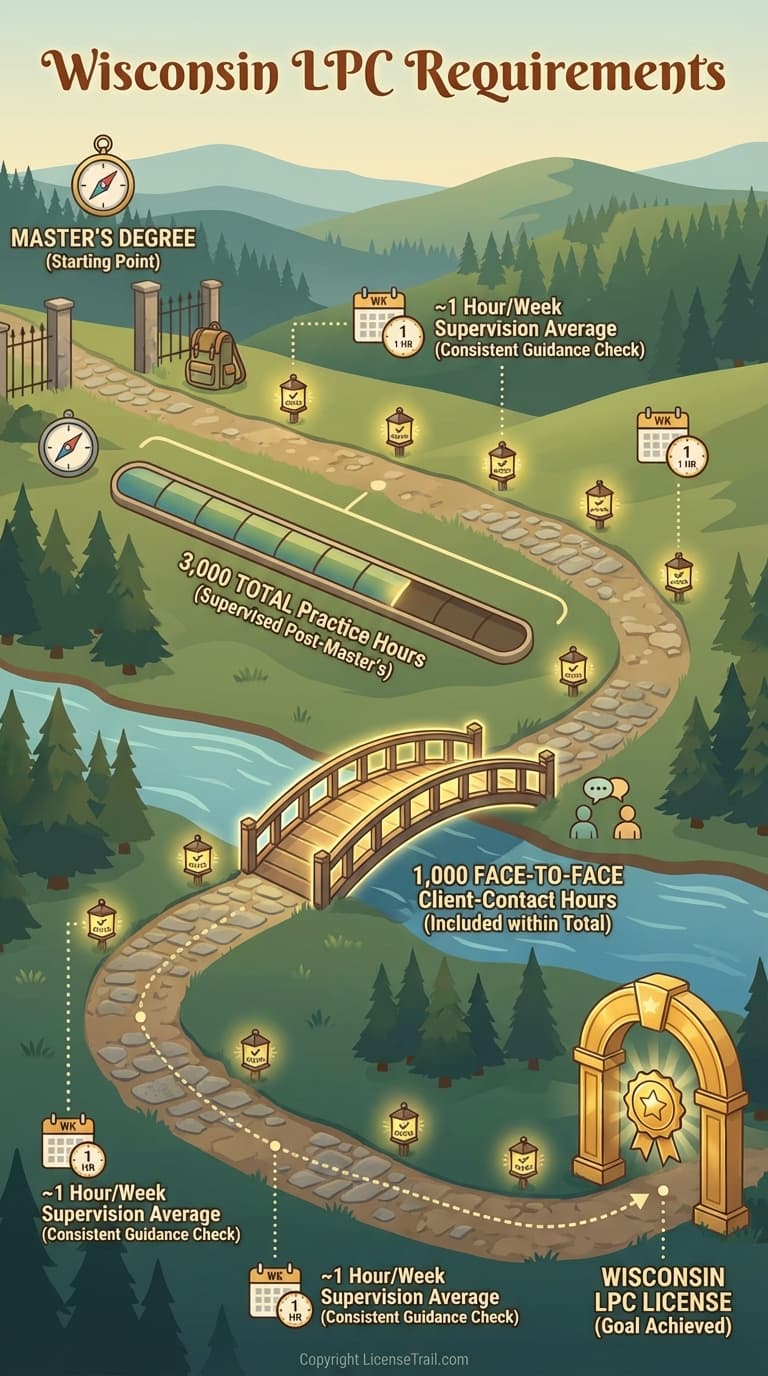
- Supervised experience (Master’s path): 3,000 hours supervised professional counseling practice after degree, including 1,000 face-to-face client contact hours
- Supervised experience (Doctoral path): 1,000 hours full-time supervised professional counseling practice (during/after doctorate); hours outside program require training license
- Supervision rules: Plan to average ~1 hour/week supervision; group supervision max 6 supervisees : 1 supervisor; cannot count “social” time or exceed clock time
- Qualified supervisors: LPC (doctorate) or LPC (≥5 yrs full-time), psychiatrist, WI-licensed psychologist, qualified DVR supervisor, or other pre-approved professional with ≥5 yrs counseling experience
- Exams & documentation: Pass approved national exam (NCE/NCMHCE/CRC or Section-approved); document hours via DSPS affidavit/form; apply and pay via LicensE (WI statutes/rules exam required for reciprocity)
License Details
Procedures
Licensure as a Licensed Professional Counselor (LPC) in Wisconsin is governed by the Professional Counselor Section of the Marriage and Family Therapy, Professional Counseling, and Social Work Examining Board, under Wisconsin Statutes chapter 457 and Wisconsin Administrative Code chapters MPSW 11 and 12. (dsps.wi.gov)
Below is a structured overview of what the Board and statutes actually require, with an emphasis on the exact types of hours and supervision they specify.
1. Regulatory framework and terminology
Key legal sources the Board relies on:
- Wis. Stat. § 457.12 – “Professional counselor license; privilege to practice.” Sets the statutory hour requirements (3,000 total with 1,000 face‑to‑face for master’s; 1,000 total for doctorate) and who may supervise. (law.justia.com)
- Wis. Admin. Code ch. MPSW 11 – “Application for professional counselor licensure.” Details what you must document: degree type, supervised “professional counseling practice” hours, and exam. (law.cornell.edu)
- Wis. Admin. Code ch. MPSW 12 – “Professional counselor supervised practice.” Defines supervised practice requirements and supervisor qualifications. (regulations.justia.com)
The Board’s core terms you will see repeatedly are:
- “Professional counseling practice” – the umbrella term for your post‑degree counseling work that counts toward licensure hours.
- “Face‑to‑face client contact” – the subset of those hours where you are directly meeting with clients (individually, in couples, family, or group format).
- “Supervised clinical professional counseling practice” – the kind of supervised setting you must be in to hold a Professional Counselor Training License.
The Board does not split hours into something like “1,500 direct + 1,500 supervised.” Instead, for a master’s‑level applicant the law requires:
at least 3,000 hours of professional counseling practice, including at least 1,000 hours of face‑to‑face client contact, all of which must be supervised by a qualified supervisor. (law.justia.com)
So all 3,000 hours are supervised; 1,000 of those must be direct, face‑to‑face work.
2. Educational qualification
To apply for full LPC licensure, you must document an approved graduate degree as described in MPSW 11.01(2): (law.cornell.edu)
The Board accepts any one of the following:
- A master’s or doctoral degree in “professional counseling.”
- A CACREP‑accredited degree in one of several specified specialty areas (e.g., clinical mental health counseling, clinical rehabilitation counseling, marriage, couple, and family counseling, or certain CACREP doctoral programs).
- A degree program that is “equivalent” to a professional counseling degree, by meeting the coursework and program requirements in MPSW 14.01 or 14.02 (this is where non‑CACREP counseling or closely related degrees can qualify). (law.cornell.edu)
- A foreign counseling degree that an organization approved by the Section evaluates as equivalent to one of the above, with English proficiency if needed. (law.cornell.edu)
Your school documents this on the Board’s “certificate of professional education” form submitted with your application. (law.cornell.edu)
3. Step one: Professional Counselor Training License (LPC‑in‑Training)
You may not begin accruing Wisconsin post‑degree supervised hours toward LPC unless you hold a Professional Counselor Training License (often called LPC‑IT), except in narrow out‑of‑state situations described later. Both statute and rule emphasize that supervised practice for Wisconsin licensure is done under a training license. (regulations.justia.com)
3.1 Core requirements for the training license
Under MPSW 11.015, the Professional Counselor Section must grant a training license if you: (law.cornell.edu)
- Submit a completed application and pay the fee.
- Satisfy the general licensure suitability requirement in Wis. Stat. § 457.12(1m)(b) (including the conviction‑record standard). (law.justia.com)
- Provide evidence of one of the following:
- You are in a position or have an offer for a position as a professional counselor in a “supervised clinical professional counseling practice”; or
- You are in or offered a position in which, in the Board’s opinion, you will receive training and supervision equivalent to that supervised clinical professional counseling practice. (law.cornell.edu)
A Professional Counselor Training License is valid for 48 months and can be renewed in two‑year intervals at the discretion of the Professional Counselor Section. On renewal, they can require: (regulations.justia.com)
- A written explanation of why more time is needed to complete the required hours,
- Documentation of any continuing education or graduate coursework completed while under the training license, and
- A progress report from your supervisor documenting how you are moving toward completion of the required practice hours.
4. Step two: Supervised practice hours
4.1 Total hours and “type” of hours
The statutory and rule language for master’s‑level applicants is essentially identical:
- After earning a master’s degree, you must complete “the equivalent of at least 3,000 hours of professional counseling practice”,
- That practice must include “at least 1,000 hours of face‑to‑face client contact”, and
- This practice must be supervised by specific types of professionals listed in the statute and in MPSW 12.02. (law.justia.com)
For doctoral‑level applicants:
- After or during a doctorate in professional counseling or its equivalent, you must complete “the equivalent of at least 1,000 hours of full‑time professional counseling practice” under qualified supervision. (law.justia.com)
Some of those doctoral hours may be integrated into the doctoral training itself; any hours completed outside the degree program must still be done under a training license. (law.cornell.edu)
In other words, Wisconsin’s “hour types” for LPC are:
- Total supervised professional counseling practice (post‑degree)
- Master’s route: 3,000 hours (all supervised)
- Doctoral route: 1,000 hours (all supervised)
- Face‑to‑face client contact
- Minimum 1,000 hours within that total, if you are applying with a master’s degree. (law.justia.com)
The Board does not break out the remaining 2,000 hours into a named category like “indirect” or “administrative” hours. They simply must be additional supervised “professional counseling practice”—for example, other clinical services, case management, documentation, and related counseling duties that your supervisor and setting allow. The only quantified “type” distinction in law is the 1,000‑hour face‑to‑face client‑contact minimum within the total. (law.justia.com)
4.2 Where and when the hours must be completed
Rules now focus less on a specific minimum number of calendar years and more on:
- Completing the required hours after receiving the qualifying master’s (for the 3,000‑hour route) or during/after the doctorate (for the 1,000‑hour route); and
- Completing them while holding a valid Professional Counselor Training License, unless the hours were accumulated in another state and meet the Board’s requirements. (law.cornell.edu)
Under MPSW 12.01, any applicant for LPC must complete a period of “supervised practice while holding a valid professional counselor training license” before being eligible for licensure, with a limited exception granting credit for supervised counseling hours completed in another state if those hours meet Wisconsin’s standards. (regulations.justia.com)
4.3 Who may supervise your hours
Supervisor qualifications are detailed in MPSW 12.02 and in Wis. Stat. § 457.12(1m)(c). The supervision of your supervised professional counseling practice may be done by any of the following: (regulations.justia.com)
- A Licensed Professional Counselor with a doctorate in professional counseling.
- A Licensed Professional Counselor with at least five years of full‑time professional counseling experience.
- A psychiatrist.
- A psychologist licensed under ch. 455 (Wisconsin’s psychology statute).
- A supervisor within Wisconsin’s Division of Vocational Rehabilitation who holds an LPC license or has at least five years of full‑time counseling experience. (regulations.justia.com)
- Another individual with at least five years of counseling experience, approved in advance by the Professional Counselor Section. (regulations.justia.com)
The Board explicitly assigns supervisors several responsibilities, including:
- Choosing the frequency, duration, and intensity of supervision to achieve an average of one hour of supervision per week during the supervised practice period. (regulations.justia.com)
- Only allowing supervisees to perform professional counseling services that the supervisor is competent to perform.
- Being legally and ethically responsible for the supervisee’s practice, including the ability to stop or interrupt the supervisee’s practice in specific cases and to terminate the supervisory relationship if needed. (regulations.justia.com)
4.4 Group supervision limits
If supervision is provided in a group format, MPSW 12.04 adds specific limitations: (wirules.elaws.us)
- A supervision group may have no more than 6 supervisees per 1 supervisor.
- Each supervisee earns one hour of supervision credit for each hour the group meets, but time that is “primarily social activity” cannot be counted.
- If a group or individual session is conducted by more than one supervisor, you may not count more hours than the actual clock time of the session.
These rules affect your supervision accounting, but not the 3,000/1,000 hour totals themselves.
4.5 Out‑of‑state supervised hours
Wisconsin will credit supervised professional counseling practice completed in another state if both of the following are true: (wirules.elaws.us)
- The hours otherwise meet Wisconsin’s requirements (including the 1,000 face‑to‑face hours for the master’s route); and
- They were completed under a supervisor acceptable to the Professional Counselor Section.
For such hours, the Board waives the requirement that you held a Wisconsin training license while you completed them.
4.6 Documenting your hours
The Board’s main instrument for documenting your supervised practice for LPC by exam is DSPS Form #2464, “Affidavit of Applicant’s Competencies – Documentation of Clinical Experience Gained Under Training License Supervisor.” (dsps.wi.gov)
Your supervisor completes this affidavit to verify:
- That you engaged in the statutorily required amount of professional counseling practice (3,000 or 1,000 hours, depending on degree),
- That within those hours you achieved at least 1,000 face‑to‑face client‑contact hours if you are applying under the master’s pathway, and
- That your practice occurred under supervision that meets MPSW 12.02’s requirements.
5. Step three: Required examinations
For LPC licensure by examination in Wisconsin, you must pass a national counseling exam and, depending on your route, may also need to pass the Wisconsin statutes and rules exam. (dsps.wi.gov)
5.1 National exam
Under MPSW 11.01(4) and DSPS exam policy, you must achieve a passing score on one of the following: (law.cornell.edu)
- National Counselor Examination (NCE), or
- National Clinical Mental Health Counseling Examination (NCMHCE), or
- Certified Rehabilitation Counselor (CRC/CRCE) examination, or
- Another exam specifically approved by the Professional Counselor Section.
DSPS’s Professional Counselor Exam Information page confirms that applicants for LPC by examination must successfully complete the NCE, NCMHCE, or CRCE. (dsps.wi.gov)
5.2 Wisconsin statutes and rules exam
For LPC by reciprocity, DSPS currently requires passing the Wisconsin Statutes and Rules Examination, which covers: (dsps.wi.gov)
- MPSW 1, 11, 12, 14, and 20, and
- Several chapters of the Wisconsin Statutes, including ch. 457.
The statutes and rules content is exactly what you have been complying with during your supervised practice.
6. Step four: Application for full LPC license
Once education, supervised practice, and exam requirements are met, MPSW 11.01 describes what an LPC applicant must submit: (law.cornell.edu)
- Application and fee under Wis. Stat. § 440.05(1).
- Certificate of professional education, confirming your qualifying master’s or doctoral degree (see Section 2 above).
- Verification of supervised practice, showing either:
- Master’s route: At least 3,000 hours of professional counseling practice, including 1,000 hours of face‑to‑face client contact, all under a valid training license and qualified supervision (with out‑of‑state exceptions). (law.cornell.edu)
- Doctoral route: At least 1,000 hours of full‑time professional counseling practice, under qualified supervision, with any hours outside the doctoral program completed while holding a training license. (law.cornell.edu)
- Verification of a passing national exam score (NCE, NCMHCE, CRC, or other approved exam). (law.cornell.edu)
- Background and conduct documentation sufficient for the Board to determine whether any pending charges or convictions are substantially related to the practice of professional counseling, consistent with Wisconsin’s employment and licensing discrimination laws. (law.cornell.edu)
Applications are now submitted and fees paid through the DSPS LicensE online system. (dsps.wi.gov)
7. Hour requirements at a glance
For clarity, this summarizes the experience‑hour requirements from statute and administrative code for LPC licensure in Wisconsin:
| Pathway | Total supervised “professional counseling practice” hours | Face‑to‑face client‑contact hours (minimum) | License status while accruing WI hours | Supervisor qualifications |
|---|---|---|---|---|
| Master’s degree in professional counseling or equivalent | 3,000 hours after the master’s degree | 1,000 hours minimum of face‑to‑face client contact | Generally must hold a Professional Counselor Training License, with limited credit for qualifying out‑of‑state hours | LPC with doctorate; LPC with ≥5 years full‑time counseling; psychiatrist; licensed psychologist; qualified DVR supervisor; or another individual with ≥5 years experience approved by the Section |
| Doctoral degree in professional counseling or equivalent | 1,000 hours of full‑time professional counseling practice, during or after the doctorate | No separate minimum stated beyond the 1,000 total hours; hours must still be professional counseling practice under supervision | Hours outside the doctoral program must be completed while holding a Professional Counselor Training License | Same as above |
In short, Wisconsin’s Board does not divide hours into two equal halves (such as 1,500 direct plus 1,500 supervised). Instead, the controlling legal language requires:
- Master’s route: 3,000 supervised hours of professional counseling practice, of which at least 1,000 hours are face‑to‑face client contact;
- Doctoral route: 1,000 supervised hours of full‑time professional counseling practice, potentially integrated with the doctoral program, with any additional hours under a training license; and
- All hours must be supervised by professionals who meet MPSW 12.02’s qualifications and are documented to the Board’s satisfaction. (law.justia.com)
Track your LPC hours with confidence
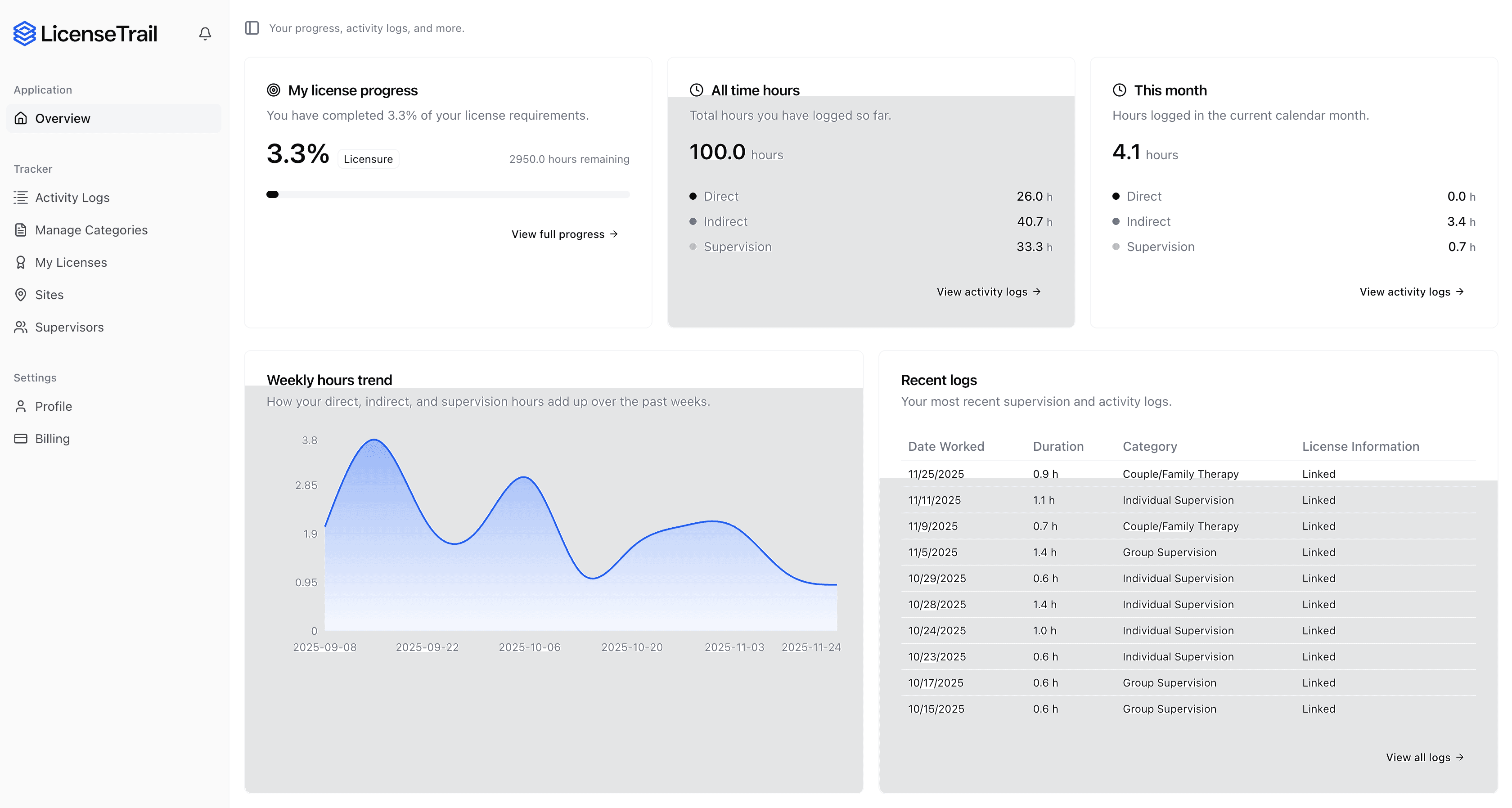
License Trail checks your direct, indirect, and supervision hours against Wisconsin LPC requirements continuously and flags mismatches before you submit.
 Start Tracking for Free
No credit card required · Free plan available
Is your spreadsheet hiding Wisconsin LPC risks?
Stop guessing if your categories match Wisconsin Marriage and Family Therapy, Professional Counseling, and Social Work Examining Board requirements. License Trail checks your direct, indirect, and supervision hours continuously and flags mismatches before you submit.
Import or log
Bring your spreadsheet or start fresh
Upload your existing tracking spreadsheet and we'll map every hour into the right Wisconsin Marriage and Family Therapy, Professional Counseling, and Social Work Examining Board categories automatically.
Verify against Wisconsin
Catch mismatches before the board does
License Trail checks your direct, indirect, and supervision hours against Wisconsin LPC requirements continuously.
Export board-ready
One-click clean reports
Generate professional, board-ready reports for supervision meetings and Wisconsin Marriage and Family Therapy, Professional Counseling, and Social Work Examining Board submissions in seconds.
No credit card required · Free plan available