
Wyoming CAPA Requirements: Hours, Exams & Step-by-Step Guide
Stop guessing if your categories match Wyoming requirements. License Trail checks your direct, indirect, and supervision hours against CAPA requirements continuously and flags mismatches before you submit.
No credit card required · Free plan available
Quick Requirements Overview
- Education/Training: Complete 270 contact hours in addictions counseling (education hours only; no clinical experience-hour requirement for CAPA).
- Education pathways accepted: Meet the 270-hour requirement via NCAC I or IC&RC AODA credential, or an associate’s degree in addiction/SUD counseling (properly accredited), or 270-hour coursework mix.
- 270-hour coursework mix (if used): ≥200 hours addictions-specific (incl. addictions assessment + 6 hours communicable diseases) + ≤70 hours general mental health (must include 30 hours counseling ethics).
- Exam: Pass NCAC Level I (or other Board-approved addictions exam).
- Eligibility: Age of majority; no disqualifying felony/misdemeanor convictions (Board may allow exceptions in public interest).
- Application/Fees: Submit Board application on prescribed forms with required fee and documentation (e.g., transcripts/certifications).
- Timing tied to employment: Must obtain CAPA within 6 months of employment (extension possible).
- Practice limitations/supervision: Must work under a WY-qualified clinical supervisor; scope limited (no diagnosing, treatment recommendations, or primary provider role; interventions mainly education/skill development).
License Details
Procedures
Becoming a Certified Addictions Practitioner Assistant (CAPA) in Wyoming involves meeting very specific education and examination requirements set by the Wyoming Mental Health Professions Licensing Board, but—importantly—does not involve a set number of client-contact or supervised practice hours prior to certification. The only “hour” requirements for CAPA are education/training contact hours, not clinical experience hours.
Below is a breakdown of what the Board actually requires, using the Board’s own statutory and rule language where relevant.
1. How Wyoming Law Defines a CAPA
Wyoming statute defines a “certified addictions practitioner assistant” as a person:
“certified under this act to assist in the practice of addictions treatment, prevention, intervention, referral and followup under the supervision of a qualified clinical supervisor licensed in the state of Wyoming.” (law.justia.com)
The Board’s rules further clarify that a CAPA:
- Assists a licensed mental health professional “in those methods and techniques of addictions assessment and treatment” for which they are qualified by training and experience, under administrative and clinical supervision. (law.cornell.edu)
- Has therapeutic interventions limited to education and skill development activities.
- May not assign diagnoses, make treatment recommendations, or act as a primary treatment provider. (law.cornell.edu)
So CAPA is explicitly an assistant‐level, supervised credential focused on support, education, and skills work, not independent clinical practice.
2. Overview of CAPA Requirements in Wyoming
Under Wyoming Statute § 33‑38‑106(n) and Chapter 4 of the Board’s rules, an applicant for CAPA must: (law.justia.com)
- Complete 270 contact hours of education and training in alcoholism and drug abuse or related counseling subjects (or an equivalent approved pathway).
- Be at least the age of majority.
- Have no felony convictions and no misdemeanor convictions that relate adversely to the practice of addictions therapy or to the ability to practice as a CAPA (with possible exceptions at the Board’s discretion).
- Pass an addictions exam, specifically the NCAC Level I exam (or another exam approved by the Board).
- File an application on the Board’s prescribed form with the required fee, and obtain CAPA certification within six months of the date of employment, unless an extension is granted.
Notably, these provisions do not prescribe any number of clinical “experience hours” (such as 1,500 direct / 1,500 supervised) for CAPA certification. The only hours specified are education/training contact hours.
3. Education and Training: The 270 Contact Hours
3.1 Statutory requirement
The statute requires that a CAPA applicant:
has completed “two hundred seventy (270) contact hours of education and training in alcoholism and drug abuse or related counseling subjects that meet the academic and training content standards established by the board.” (law.justia.com)
The Board’s rules in Chapter 4, Section 4‑3 spell out how this 270‑hour requirement can be met. (law.cornell.edu)
3.2 Three main ways to meet the education requirement
Under 078‑4 Wyo. Code R. § 4‑3, the CAPA educational requirement can be satisfied in one of the following ways:
-
Certification‑based route
- Holding a current National Certified Addictions Counselor Level I (NCAC I) from NAADAC, or
- Holding a current Alcohol and Other Drug Abuse Counselor (AODA) credential from IC&RC. (law.cornell.edu)
-
Degree‑based route
- Completion of an associate’s degree program in addictionology, chemical dependency, substance use disorder counseling, or an equivalently named program, from:
- An institution accredited by the National Addictions Studies Accreditation Commission (NASAC), or
- An institution accredited by a regional or national accrediting body recognized by CHEA. (law.cornell.edu)
- Completion of an associate’s degree program in addictionology, chemical dependency, substance use disorder counseling, or an equivalently named program, from:
-
Coursework‑hours route (explicit 270 contact hours)
- Completion of 270 hours of addictions-specific coursework and/or training, divided as follows: (law.cornell.edu)
- Up to 70 contact hours may be in general mental health subjects, and must include 30 contact hours in counseling ethics.
- At least 200 contact hours must be specifically related to addictions therapy.
- This must include training/education in Addictions Assessment, and
- At least 6 contact hours of specialty training in communicable diseases.
- These categories may be met with college coursework or workshops.
- Completion of 270 hours of addictions-specific coursework and/or training, divided as follows: (law.cornell.edu)
This breakdown is the Board’s own regulatory language and is the authoritative source for the “hour” requirement attached to CAPA.
4. Examination Requirement
For the exam, the Board’s Examination Information page states:
- “Certified Addictions Practitioner Assistant: Per Chapter 4, Section 4 of the Rules you must complete the NCAC Level I examination or other examination as may be approved by the Board.” (mentalhealth.wyo.gov)
Statute § 33‑38‑106(n)(v) also requires that the applicant demonstrate knowledge in addictions treatment by passing a “standard examination,” which may be written or situational, administered as the Board prescribes. (law.justia.com)
In practice, this means:
- You typically apply to the Board first (CAPA by Examination packet).
- The Board approves you to sit for NCAC I (or accepts a qualifying prior score if transferred).
- You must pass within the attempt limits set by the Board.
5. Age and Criminal History Requirements
The statute requires that a CAPA applicant: (law.justia.com)
- Has reached the age of majority in Wyoming.
- Has no felony convictions and no misdemeanor convictions that relate adversely to:
- the practice of addictions therapy, or
- the ability to practice as an addictions practitioner assistant.
However, the Board explicitly reserves the ability to grant exceptions to this bar “if consistent with the public interest.”
While the Board’s website also references fingerprinting instructions and National Practitioner Data Bank checks, the specific mechanics are laid out in separate Board documents and instructions rather than in the CAPA rule itself. (mentalhealth.wyo.gov)
6. Employment, Timing, and Supervision
6.1 Six‑month window from employment
Wyoming statute provides that for CAPA: (law.justia.com)
- “Unless extended, an applicant has six (6) months from the date of employment to become certified.”
- The Board may extend this period for good cause.
In practice, this means individuals hired into roles that require CAPA must complete the application, education, and examination pieces quickly after starting work.
6.2 Required supervision and scope
Both statute and rules emphasize that a CAPA may only practice: (regulations.justia.com)
- Under the supervision of a “qualified clinical supervisor” licensed in Wyoming.
- Under administrative supervision of an employer.
The rules explicitly state:
- The CAPA’s practice “does not include assigning diagnosis, making treatment recommendations, or acting as a primary treatment provider.”
- “Therapeutic interventions are limited to education and skill development activities.”
So even after certification, all clinical work as a CAPA is supervised by a fully licensed mental health/addictions professional.
7. Experience Hours: What Wyoming Does and Does Not Require for CAPA
7.1 No specified clinical experience hours for initial CAPA certification
Reviewing:
- Wyoming Statute § 33‑38‑106(n) (CAPA requirements), (law.justia.com)
- Chapter 4 of the Board’s rules (education requirement and scope of practice), (law.cornell.edu)
- The Board’s own application page for “Certified Addictions Practitioner Assistant by Examination” (mentalhealth.wyo.gov)
there is no requirement that an applicant complete a specific number of:
- “direct client contact hours,” or
- “supervised experience hours”
in order to obtain CAPA certification.
External professional guides summarizing Wyoming law are consistent with this, noting that CAPA certification does not require supervised work hours prior to certification, unlike later licenses such as the Licensed Addictions Therapist (LAT), which requires 3,000 supervised hours including 1,200 face‑to‑face and 100 hours of direct supervision. (publichealthonline.org)
In other words: there is no Wyoming requirement such as “1,500 hours of direct experience and 1,500 hours of supervised experience” for CAPA. The only explicit “hours” for CAPA are education/training contact hours.
7.2 Where “2,000 hours of supervised work experience” appears—and why it matters
The 2,000‑hour requirement appears not in the CAPA subsection, but in the Certified Addictions Practitioner (CAP) subsection of the statute. For applicants seeking the CAP “by experience” route, Wyoming law states that a person with a bachelor’s degree in a human behavioral discipline other than addiction therapy may be certified as a CAP after: (law.justia.com)
- Providing proof of 2,000 hours of supervised work experience as a certified addictions practitioner assistant or equivalent in addiction therapy.
The Board’s forms page confirms this in its description of “Certified Addictions Practitioner by Experience” as requiring a bachelor’s degree “other than a degree in addiction therapy and 2,000 hours of supervised work experience as a certified addictions practitioner assistant or equivalent.” (mentalhealth.wyo.gov)
This is important context:
- Those 2,000 hours are for upgrading to CAP (by experience), not for initial CAPA certification.
- While working toward those hours, a person is practicing at the CAPA level, under supervision.
8. Practical, Step‑by‑Step Path to CAPA in Wyoming
Putting the legal and regulatory requirements into a practical sequence, the path to CAPA usually looks like this:
Step 1 – Choose an education pathway that will meet the Board’s CAPA standard
You can satisfy the education requirement for CAPA by:
- Completing an associate’s degree in addictionology, chemical dependency, substance use disorder counseling, or a similarly named field from a properly accredited institution, or (law.cornell.edu)
- Earning NCAC I or IC&RC AODA counselor certification, or (law.cornell.edu)
- Completing the 270 contact hours of coursework/training with the specific mix required:
- Up to 70 hours in general mental health (with 30 hours in counseling ethics),
- At least 200 hours specifically in addictions therapy, including addictions assessment and 6 hours in communicable diseases. (law.cornell.edu)
Many Wyoming community college and university programs in addictions counseling are structured to meet this requirement directly. (cwc.smartcatalogiq.com)
Step 2 – Secure (or be offered) employment in an addictions setting
Because the statute gives you only six months from the date of employment to become certified as a CAPA (unless extended), most applicants: (law.justia.com)
- Obtain or accept employment contingent upon obtaining CAPA, and
- Start the application process promptly after hire.
Your position must be one in which you can practice under a qualified clinical supervisor and under employer administrative supervision.
Step 3 – Arrange supervision
As a CAPA, you must:
- Work under a Designated Qualified Clinical Supervisor (DQCS) licensed in Wyoming. (law.cornell.edu)
- Typically complete a Supervision Agreement form with your supervisor, as provided on the Board’s website. (mentalhealth.wyo.gov)
This supervision is ongoing; you do not “age out” of supervision at the CAPA level.
Step 4 – Submit the CAPA application to the Board
Use the Board’s “Certified Addictions Practitioner Assistant by Examination” application packet (current version dated February 23, 2024). The Board describes this as intended for: (mentalhealth.wyo.gov)
- Those with an associate’s degree in addictionology, chemical dependency, substance use disorder counseling, or an equivalent program,
- Who are not licensed in another jurisdiction and who have tested or need to test.
With your application, you will:
- Pay the required fee.
- Arrange for official transcripts or documentation of NCAC I / AODA certification or 270‑hour training completion to be sent directly to the Board.
- Complete any fingerprinting/background‐check steps as instructed (via the Board’s fingerprint instructions document). (mentalhealth.wyo.gov)
Step 5 – Obtain Board approval to test and pass NCAC I (or another approved exam)
Once your application is active, the Board:
- Approves you to sit for the NCAC Level I examination, or
- Accepts a transfer of a passing NCAC I/AODA score, if you already tested elsewhere. (mentalhealth.wyo.gov)
You must pass within the attempt limits (three attempts, with a possible fourth if a Board‑approved remediation plan is accepted). (mentalhealth.wyo.gov)
Step 6 – Receive CAPA certification and practice under supervision
After the Board verifies that you:
- Meet the education/270 hours requirement,
- Meet age and criminal history standards,
- And have passed the required exam,
it may consider your credentials “adequate evidence of professional competence” and approve your CAPA certification. (codes.findlaw.com)
You then:
- Practice as a CAPA only under supervision, within the limited scope of education and skills development, and
- May, over time, accumulate supervised hours as a CAPA that can later be used if you pursue Certified Addictions Practitioner (CAP) by Experience, which requires 2,000 hours of supervised work experience as a CAPA or equivalent. (law.justia.com)
9. Key Takeaways on “Hours” for Wyoming CAPA
- Required hours for CAPA are educational, not clinical.
- 270 contact hours of specific education/training are required (or equivalent via degree/NCAC I/AODA).(law.justia.com)
- There is no Wyoming requirement that a CAPA applicant complete a specific number of:
- Direct client contact hours, or
- Supervised clinical experience hours
before obtaining CAPA certification.
- The main “experience hour” figure—2,000 hours of supervised work experience as a CAPA or equivalent—belongs to the CAP by Experience pathway, not the CAPA credential itself. (law.justia.com)
All of these details come directly from Wyoming statutes and Board rules, supplemented by the Board’s own web descriptions. For the most current forms and any procedural changes, it is always wise to check the Wyoming Mental Health Professions Licensing Board’s site immediately before applying.
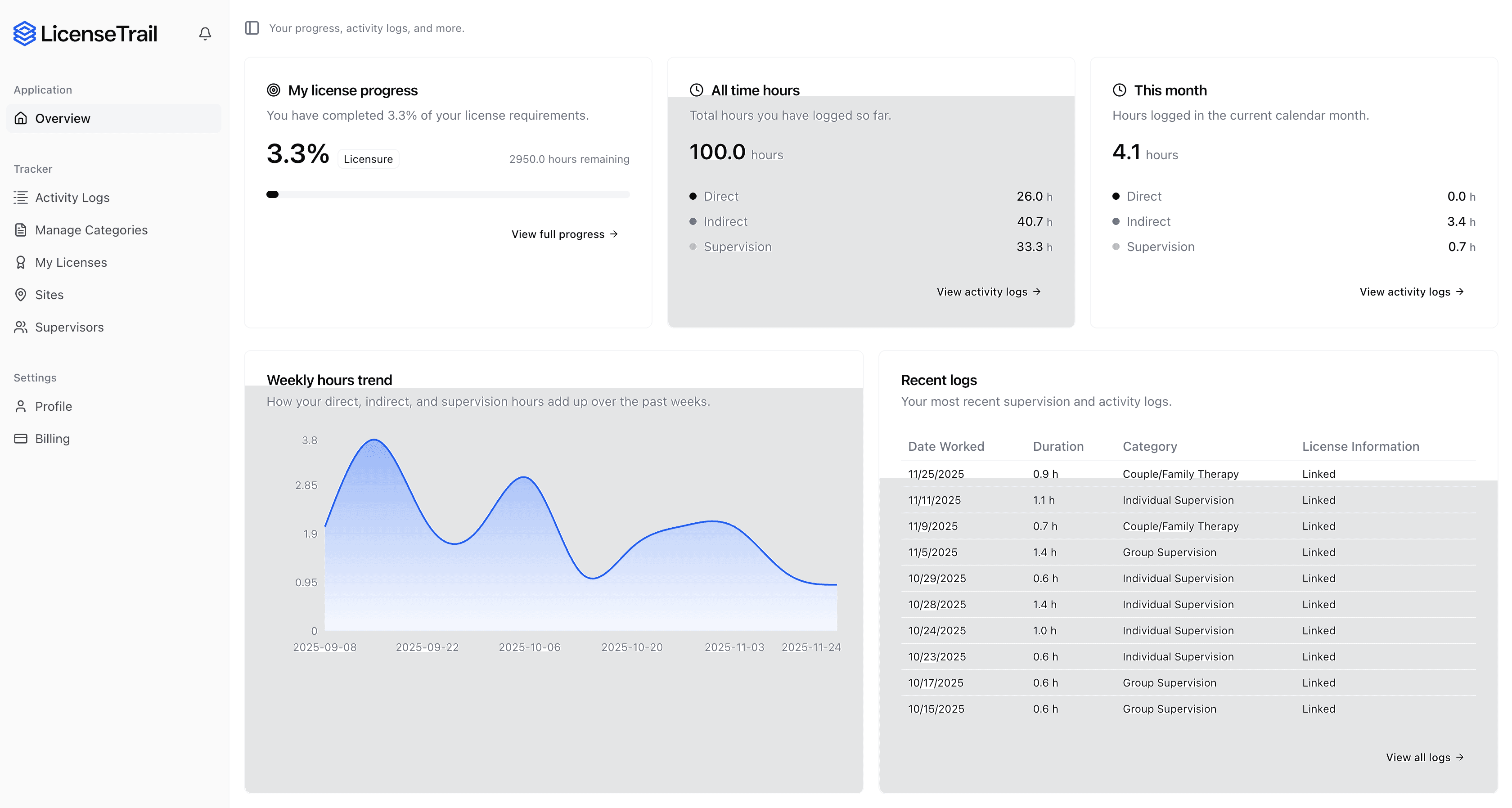
Track your CAPA hours with confidence
License Trail checks your direct, indirect, and supervision hours against Wyoming CAPA requirements continuously and flags mismatches before you submit.
 Start Tracking for Free
No credit card required · Free plan available
Is your spreadsheet hiding Wyoming CAPA risks?
Stop guessing if your categories match Wyoming Mental Health Professions Licensing Board requirements. License Trail checks your direct, indirect, and supervision hours continuously and flags mismatches before you submit.
Import or log
Bring your spreadsheet or start fresh
Upload your existing tracking spreadsheet and we'll map every hour into the right Wyoming Mental Health Professions Licensing Board categories automatically.
Verify against Wyoming
Catch mismatches before the board does
License Trail checks your direct, indirect, and supervision hours against Wyoming CAPA requirements continuously.
Export board-ready
One-click clean reports
Generate professional, board-ready reports for supervision meetings and Wyoming Mental Health Professions Licensing Board submissions in seconds.
No credit card required · Free plan available