
Wyoming CMHW Requirements: Hours, Exams & Step-by-Step Guide
Stop guessing if your categories match Wyoming requirements. License Trail checks your direct, indirect, and supervision hours against CMHW requirements continuously and flags mismatches before you submit.
No credit card required · Free plan available
Quick Requirements Overview
- Practice is entry-level only and must be under a DQCS/qualified clinical supervisor; no diagnosing and not a primary treatment provider
- Eligibility: age of majority; no disqualifying felony/misdemeanor; legal U.S. inhabitant
- Education: Bachelor’s in a human behavioral discipline from a CHEA-recognized accredited institution
- Core coursework: 15 semester credits total (3 credits each in: theories, communication skills, human development, cognitive psychology, abnormal psychology)
- Additional coursework: 24 combined semester credits across: theory/practice, drugs & behavior, special populations/subjects, research/statistics/assessment, ethics/professional issues
- Training: 6 contact hours in communicable diseases (incl. HIV/AIDS)
- Experience (post-bacc, paid): 100 direct client-contact hours (under direct DQCS supervision) + 400 indirect hours in a psychological/human services environment (completed before certification)
- Exam & timing: pass Board-approved exam (includes HS-BCPE; 3 attempts + possible 4th w/ remediation; pass within 5 years); complete requirements within 6 months of employment (extension possible)
License Details
Procedures
Certified Mental Health Worker (CMHW) certification in Wyoming is a state‑regulated credential issued by the Wyoming Mental Health Professions Licensing Board under Wyoming Statutes Title 33, Chapter 38 and Board rules in Chapter 5 of the Wyoming Administrative Code. It authorizes entry‑level mental health practice only under clinical supervision; CMHWs may not diagnose or act as primary treatment providers. (law.justia.com)
Below is a step‑by‑step guide focused on the exact experience hours and other requirements the Board has put into rule.
1. Role and supervision framework
By statute, a Certified Mental Health Worker (CMHW) is certified to apply human services or psychological theory and methods to assessment, treatment, and prevention of psychosocial dysfunction and emotional or mental disorders, under the supervision of a qualified clinical supervisor. CMHW practice does not include assigning a diagnosis or acting as a primary treatment provider. (law.justia.com)
Board rules further describe a CMHW as performing “mental health procedures” consistent with their training and experience, under both administrative supervision (employed by an agency) and a Designated Qualified Clinical Supervisor (DQCS). (law.cornell.edu)
A DQCS / qualified clinical supervisor must be one of the following Wyoming licensees: LPC, LCSW, LMFT, LAT, licensed psychologist, psychiatrist, advanced practice nurse with psychiatric specialty, or physician with addictionology specialty. (law.cornell.edu)
2. General legal and character requirements
Both statute and rules require that a CMHW applicant:
- Has reached the age of majority. (law.justia.com)
- Has no felony convictions and no misdemeanor convictions that relate adversely to practice as a mental health worker or to the ability to practice safely. The Board may grant exceptions if consistent with the public interest. (law.justia.com)
- Is a legal inhabitant of the United States. (law.cornell.edu)
You must also file an application on the Board’s prescribed form and pay the required fee. (law.justia.com)
3. Education requirements (what your degree must contain)
3.1. Degree level and field
Statute: you must hold a baccalaureate degree in a “human behavioral discipline” (e.g., addictionology, counseling, psychology, social work, sociology or a related field) from an accredited program and institution, meeting academic and training standards set by the Board. (law.justia.com)
Board rule (Chapter 5, §5‑3) makes this more specific. You must complete a baccalaureate degree in a human behavioral discipline from a CHEA‑recognized accredited institution, plus required coursework:
3.2. Required core coursework – 15 semester credits
Your transcript must show at least 3 semester credits in each of these five content areas (total 15 credits): (law.cornell.edu)
- Human Services / Psychological Theories – foundational theories in psychology, health, or human services, focused on mental health.
- Communication Skills – methods/techniques of individual or group communication in mental health, addictions, or counseling settings.
- Human Development – social, cognitive, and/or developmental issues across the lifespan.
- Cognitive Psychology – development of cognition and resulting behavior.
- Abnormal Psychology – major categories of abnormal behavior (e.g., anxiety, mood, psychotic, brain, substance‑related, childhood disorders).
3.3. Additional subject coursework – at least 24 combined semester credits
You also need a minimum of 24 combined semester credits spread across all of the following five subject areas (how you distribute within the 24 is flexible, but each area must be represented): (law.cornell.edu)
- Human services / psychological theory or practice
- Drugs and behavior (including psychopharmacology and substance use)
- Special populations or special subjects (e.g., adolescents, families, elderly, diverse populations, program development)
- Research & statistics / assessment (including appraisal and testing)
- Ethical & professional issues (applied ethics, professional standards, client advocacy, etc.)
3.4. Communicable disease / HIV training
Board rules also require 6 additional contact hours of specialty training in communicable diseases, including HIV/AIDS. This can be satisfied via college coursework or workshops, including online options. (law.cornell.edu)
4. Experience requirements – exact hours and how they must be earned
This is where the Board is very specific. Chapter 5, §5‑4 of the rules sets two distinct experience components, all of which must be paid work after you finish the bachelor’s degree: (law.cornell.edu)
- 100 hours of direct contact with identified clients, and
- 400 hours of indirect experience in a psychological/human services environment.
The rule states that these 500 hours must be completed before certification and as paid work experience after completion of the baccalaureate degree. (law.cornell.edu)
4.1. Direct contact hours – 100 hours
- Minimum required: 100 hours.
- Type of contact: direct, face‑to‑face or live service contact with identified clients (not generalized teaching or administrative activity).
- Supervision requirement: must be “under the direct supervision of a DQCS” – i.e., a Board‑recognized qualified clinical supervisor as defined above. (law.cornell.edu)
In practice, this would typically include activities such as intake interviews, psychoeducation groups, skills training sessions, crisis response under supervision, or assisting with treatment interventions directly involving clients. (This description is interpretive; the rule itself uses the more general phrase “direct contact with identified clients.”) (law.cornell.edu)
4.2. Indirect experience hours – 400 hours
- Minimum required: 400 hours.
- Type of contact: “indirect experience in a psychological/human services environment.” (law.cornell.edu)
- These hours usually involve work that supports client care but is not direct service delivery, such as case documentation, coordination with other providers, team meetings, program support, and similar tasks performed in a mental health or human services setting.
4.3. Timing and employment status
- All 100 direct hours and 400 indirect hours must be obtained after you have completed your bachelor’s degree. Pre‑degree practicums or internships do not satisfy this particular experience category. (law.cornell.edu)
- The rule explicitly labels this as paid work experience, so unpaid volunteer hours do not count toward the 500‑hour requirement for CMHW certification. (law.cornell.edu)
The Board’s forms page includes a “CMHW Experience Report” that your supervisor uses to document these hours for the Board. (mentalhealth.wyo.gov)
5. Examination requirement
After meeting education and experience requirements, you must demonstrate knowledge by passing a Board‑approved exam.
Under Chapter 5, §5‑5: (law.cornell.edu)
- The Board accepts the passing score established by the exam provider.
- The Board accepts a passing score on the Human Services–Board Certified Practitioner Examination (HS‑BCPE).
- The Board may approve other examinations as well.
- You normally have three attempts to pass. A fourth attempt may be allowed if the Board approves a remediation plan you submit.
- The exam must have been passed within the five (5) years immediately before you submit your application (or after you receive Board approval to sit for the exam).
Statute echoes that this is a standard examination in “mental health work in general” and that the Board sets specific exam provisions for each discipline. (law.justia.com)
6. Six‑month employment grace period and timing
Both statute and rule give CMHW applicants a limited window once they begin relevant employment: (law.justia.com)
- You have six (6) months from the date of employment to complete all requirements for certification.
- If you fail to complete the requirements within six months, Board rules state you must immediately stop working as a Certified Mental Health Worker. Providing CMHW‑regulated services before applying can lead to denial of the application. (law.cornell.edu)
- The Board may grant an extension of this six‑month grace period “for good cause shown.” (law.cornell.edu)
The rules also emphasize that it is solely the applicant’s responsibility to ensure the Board receives all documentation showing they meet the requirements. (law.cornell.edu)
7. Application process with the Wyoming Board
From the statutes and the Board’s “Application & Forms” page: (law.justia.com)
- Obtain and complete the CMHW application form from the Board’s website (under “Application & Forms” → “Mental Health Worker”).
- Arrange for official transcripts showing your bachelor’s degree and required coursework.
- Have your DQCS complete a CMHW Experience Report, documenting your 100 direct and 400 indirect hours of paid post‑baccalaureate work.
- Request exam verification (HS‑BCPE or other Board‑approved exam) be sent or otherwise documented per Board instructions.
- Submit:
- Completed application,
- Application fee,
- Any required background check materials (Board notes that background checks may add 3–5 weeks),
- Supporting documentation (transcripts, experience verification, exam results, etc.).
- The Board notes typical processing of 2–3 weeks after all materials are received, plus time for the background check. (These time frames are descriptive, not guaranteed.) (mentalhealth.wyo.gov)
By statute, the Board reviews your credentials and may consider them adequate evidence of competence, then recommends approval of certification. (law.justia.com)
8. License class, term, and ongoing status
Board rules on “Class of License and Certification” list Certified Mental Health Worker (CMHW) as its own certification category. (law.cornell.edu)
For all licenses/certifications under this chapter: (law.cornell.edu)
- Initial certifications expire on the certificate holder’s birth date immediately following the second anniversary of the issue date.
- Upon renewal, the certification is valid for two (2) years.
You remain bound by ongoing Board standards of conduct for CMHWs (Chapter 5, §5‑7), and you must continue to practice only under supervision and within the non‑diagnosing, non‑primary‑provider scope described earlier.
9. Summary of hour requirements (as defined by the Wyoming Board)
To become certified as a Certified Mental Health Worker (CMHW) in Wyoming, the board‑defined experience requirements are:
-
100 hours of direct contact
- Direct contact with identified clients.
- Must be under the direct supervision of a Designated Qualified Clinical Supervisor (DQCS).
- Must be part of paid work experience after completion of the baccalaureate degree. (law.cornell.edu)
-
400 hours of indirect experience
- In a psychological/human services environment (indirect client‑related work in a mental health/human services setting).
- Must also be paid work experience after the bachelor’s degree and completed before certification. (law.cornell.edu)
Wyoming does not require thousands of supervised clinical hours for CMHW certification the way it does for independent clinical licenses; instead, it uses this 500‑hour post‑degree, supervised and supervised‑related experience standard, plus the education, exam, and character requirements outlined above.
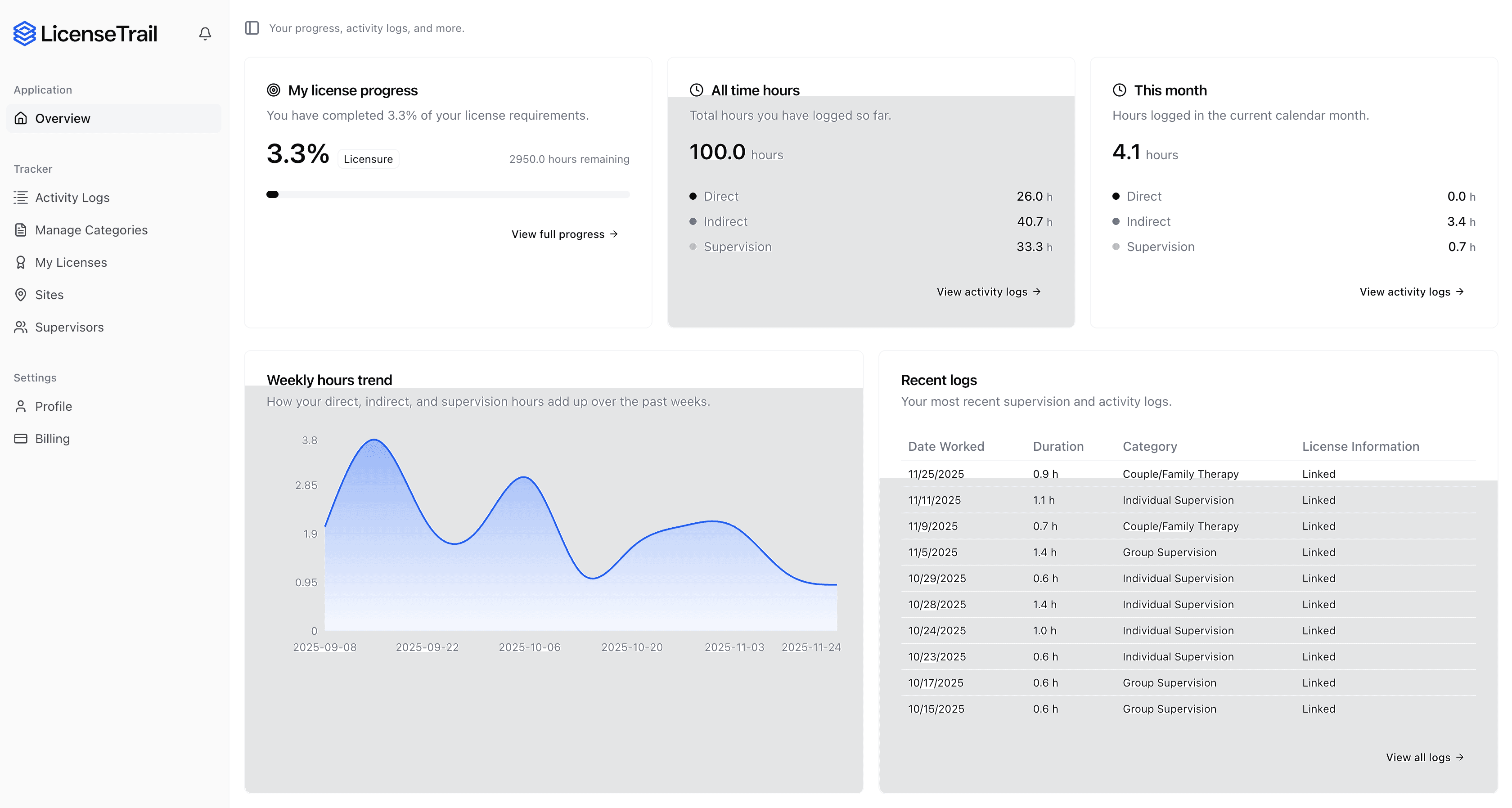
Track your CMHW hours with confidence
License Trail checks your direct, indirect, and supervision hours against Wyoming CMHW requirements continuously and flags mismatches before you submit.
 Start Tracking for Free
No credit card required · Free plan available
Is your spreadsheet hiding Wyoming CMHW risks?
Stop guessing if your categories match Wyoming Mental Health Professions Licensing Board requirements. License Trail checks your direct, indirect, and supervision hours continuously and flags mismatches before you submit.
Import or log
Bring your spreadsheet or start fresh
Upload your existing tracking spreadsheet and we'll map every hour into the right Wyoming Mental Health Professions Licensing Board categories automatically.
Verify against Wyoming
Catch mismatches before the board does
License Trail checks your direct, indirect, and supervision hours against Wyoming CMHW requirements continuously.
Export board-ready
One-click clean reports
Generate professional, board-ready reports for supervision meetings and Wyoming Mental Health Professions Licensing Board submissions in seconds.
No credit card required · Free plan available