
Wyoming PMFT Requirements: Hours, Exams & Step-by-Step Guide
Stop guessing if your categories match Wyoming requirements. License Trail checks your direct, indirect, and supervision hours against PMFT requirements continuously and flags mismatches before you submit.
No credit card required · Free plan available
Quick Requirements Overview
- Must be 18+, legal U.S. inhabitant, and have an acceptable criminal record (no felonies; relevant misdemeanors reviewed/possible exception).
- Education: meet WY MFT education standards OR be ≤6 semester hours short (ethics/orientation + practicum/internship completed); deficiencies must be finished during PMFT.
- Must secure a WY-approved Designated Qualified Clinical Supervisor (DQCS) and submit a supervision agreement approved before PMFT is issued.
- Practice only under DQCS clinical supervision (and employer administrative supervision); use “PMFT” title only for supervised clinical experience; disclose supervised status + DQCS contact info to clients and in advertising.
- PMFT limits: no more than 2 provisional licenses in the MFT discipline; PMFT expires 36 months after issuance (unless extended or converted to LMFT sooner).
- Supervision during PMFT: at least monthly at 1 hour supervision per 20 hours of direct clinical services; acceptable formats include individual/triadic face-to-face or individual distance; groups >2 don’t count as face-to-face.
- Hours toward LMFT (typically while PMFT): 3,000 post-degree supervised clinical hours over 18–36 months (extension possible), incl. 1,200 direct client contact hours with 500 direct couples/family hours; up to 1,800 indirect support hours.
- Supervision hours for LMFT: minimum 100 post-grad clinical supervision hours, including 100 face-to-face individual clinical supervision.
License Details
Procedures
Wyoming’s pathway to practicing marriage and family therapy runs through a provisional license first, called the Provisional Marriage and Family Therapist (PMFT), and then the independent Licensed Marriage and Family Therapist (LMFT) credential. The PMFT license is the status under which you accrue the supervised clinical hours required for full LMFT licensure.
What follows is a step‑by‑step guide grounded in the Wyoming Mental Health Professions Licensing Board’s statutes and rules, with emphasis on how hours and supervision are defined.
1. How Wyoming defines a PMFT and supervised practice
The Board’s rules define a Provisional Marriage and Family Therapist (PMFT) as a person provisionally licensed “to practice couples, marriage and family therapy” for which they are qualified “by virtue of training and experience, under the supervision of a designated qualified clinical supervisor licensed in the state of Wyoming.” (law.cornell.edu)
A Designated Qualified Clinical Supervisor (DQCS) is a Wyoming‑licensed mental health professional (e.g., LMFT, LPC, LCSW, LAT, psychologist, psychiatrist, or certain psychiatric APRNs/physicians) who has been approved to provide clinical supervision. (law.cornell.edu)
Provisional licensure is explicitly described as “a means by which an individual may continue progress, under the supervision of a DQCS and under the administrative supervision of an employer, towards satisfactory completion of the education, experience and examination requirements established in these rules.” (regulations.justia.com)
2. Baseline eligibility to receive a PMFT license
To be granted any provisional license (including PMFT), you must provide evidence to the Board that you: (regulations.justia.com)
- Are of majority age (at least 18).
- Have an acceptable criminal record
- No felony convictions, and no misdemeanor convictions that relate adversely to the practice of counseling, marriage and family therapy, clinical social work, or addictions therapy, or to your ability to practice those disciplines (exceptions are possible “if consistent with the public interest”).
- Are a legal inhabitant of the United States.
- Meet the education standard for marriage and family therapy, or are only slightly deficient:
- You must satisfy the Board’s education requirements for the MFT discipline, or
- You may be up to six (6) semester hours short, as long as you have already completed:
- coursework in professional orientation or ethics, and
- the required practicum/internship. (regulations.justia.com)
- Any course deficiencies must be completed during the term of the provisional license.
- Have a designated DQCS and an approved supervision agreement:
- You must have “someone prepared to act as [your] DQCS” and submit a supervision agreement that must be approved before the provisional license is issued. (regulations.justia.com)
Additional constraints:
- You may not be issued more than two provisional licenses in any one discipline (e.g., no more than two PMFT licenses in your career). (regulations.justia.com)
- The provisional license expires 36 months after issuance, unless extended for good cause, or earlier if you obtain the full LMFT license. (law.justia.com)
3. What you are allowed (and required) to do as a PMFT
Once approved, you may use the title “Provisional Marriage and Family Therapist” only:
- after the Board has actually granted the provisional license, and
- “only in conjunction with activities and services that are part of the supervised clinical experience.” (regulations.justia.com)
Key practice conditions:
-
Strict supervision requirement
- “The provisional licensed … marriage and family therapist … shall be allowed to practice only under the supervision of a qualified clinical supervisor and in accordance with any other restrictions specified by the board.” (law.justia.com)
- Chapter 18 clarifies that all provisionally licensed professionals may only provide services under the clinical supervision of a DQCS and under the administrative supervision of their employer. (law.cornell.edu)
-
Supervised nature must be disclosed to clients
- Your professional disclosure statement must fully disclose the supervised nature of your work, including the name, address, and telephone number of your DQCS. (regulations.justia.com)
- The supervisory relationship and your DQCS’s contact information must also appear on all advertising materials. (regulations.justia.com)
-
Ethical standards
- You must comply with the applicable code of ethics and standards of practice for marriage and family therapy as incorporated in the Board’s rules (Chapter 15). (regulations.justia.com)
4. Supervision structure while you are a PMFT
Wyoming rules are very specific about how supervision is delivered and how it is counted.
4.1 Types of supervision the Board recognizes
Board definitions include: (law.cornell.edu)
- Individual Face‑to‑Face Clinical Supervision – a direct tutorial relationship between a DQCS and one supervisee in person.
- Triadic Face‑to‑Face Clinical Supervision – a direct tutorial relationship with a DQCS and two supervisees simultaneously, provided in the same manner and quality as individual supervision.
- Individual Distance Clinical Supervision – a direct tutorial relationship using phone or audiovisual electronic means.
- Group supervision involving more than two supervisees does not count toward the “face‑to‑face” supervision requirement; supervision “of more than 2 supervisees simultaneously is not permitted to count towards the face-to-face supervision requirement.” (law.cornell.edu)
4.2 Ongoing supervision ratio during provisional practice
While you practice under a provisional license (including PMFT), the Board requires that: (law.cornell.edu)
- Individual or triadic face‑to‑face clinical supervision, or individual distance clinical supervision by a DQCS, must be provided at least monthly at a ratio of:
1 hour of supervision for every 20 hours of direct clinical provision of services.
This ratio applies to “direct clinical provision of services” as defined by the Act and rules, and it is in addition to the total supervisory‑hour minimum you must reach for LMFT licensure (discussed next).
5. The hours you must accrue as a PMFT toward full LMFT licensure
Wyoming does not split post‑degree hours as “1,500 hours direct experience and 1,500 hours supervised experience.” Instead, the rules and statute specify:
5.1 Total supervised hours required
For LMFT licensure, all applicants must complete:
- 3,000 hours of supervised clinical training/work experience in individual, couple, marriage, and family therapy, under the direct supervision of a DQCS. (regulations.justia.com)
The Board’s LMFT chapter requires that:
- These 3,000 hours must:
- Be completed after the award of the graduate degree, and
- Be accrued over no less than 18 months and no more than 36 months, unless the Board grants an extension. (regulations.justia.com)
Statute mirrors this requirement by stating that an LMFT applicant must demonstrate completion of 3,000 hours of “supervised clinical experience” including a minimum of 100 hours of face‑to‑face individual clinical supervision from a qualified clinical supervisor. (law.justia.com)
In practice, these 3,000 hours are almost always completed while holding the PMFT license.
5.2 Breakdown of those 3,000 hours by type
The Board’s rules for LMFT licensure (Chapter 10‑4) break down those hours as follows: (regulations.justia.com)
-
Direct client contact hours – 1,200 hours minimum
- At least 1,200 of the 3,000 hours must be “direct client contact hours.”
- Of those 1,200 direct hours, at least 500 hours must be “direct clinical services to couples and families.”
-
Indirect/ancillary hours – up to 1,800 hours
- The remaining hours (up to 1,800 hours) are indirect clinical work that “supports the direct client contact hours,” such as:
- charting and documentation
- preparation for sessions
- clinical meetings
- trainings
- “other duties of marriage and family counseling.”
- The remaining hours (up to 1,800 hours) are indirect clinical work that “supports the direct client contact hours,” such as:
-
Clinical supervision hours – 100 hours minimum
- You must have a minimum of 100 post‑graduate hours of clinical supervision with a DQCS, as described in Chapter 18. (regulations.justia.com)
- The statute further specifies that the 3,000 hours must include at least 100 hours of face‑to‑face individual clinical supervision from a qualified clinical supervisor. (law.justia.com)
Taken together, the hour requirements for moving from PMFT to LMFT can be summarized as:
- 3,000 hours total supervised clinical training/work experience, all post‑degree.
- Of those 3,000 hours:
- 1,200 hours must be direct client contact, and
- Within those direct hours, 500 hours must be direct clinical services to couples and families.
- Up to 1,800 hours may be indirect/ancillary clinical work that supports client care.
- At least 100 hours must be post‑graduate clinical supervision, including a minimum of 100 hours of face‑to‑face individual clinical supervision with a qualified supervisor, and
- Throughout, you must receive ongoing supervision at no less than 1 hour per 20 hours of direct services, in approved supervision formats.
6. Education and examination in relation to PMFT status
Although your question focuses on hours, it is useful to see how education and testing fit around PMFT status.
6.1 Education
For the marriage and family therapy discipline, the Board expects:
- A master’s or doctoral degree in marriage and family therapy (or equivalent) from a properly accredited or Board‑approved program, including supervised practicum/internship experience. (aamft.org)
Individuals who are slightly short of Wyoming’s detailed coursework standards (by no more than six semester hours, and having already completed ethics and practicum) may still be granted a PMFT license on the condition that they clear those deficiencies during the provisional period. (regulations.justia.com)
6.2 Examination
- The national AMFTRB exam (or another Board‑approved exam) is required for full LMFT licensure. (research.com)
- You do not have to pass the exam before receiving a PMFT license. Provisional licensure exists precisely to allow you to continue progress toward the combined education, experience, and examination requirements.
7. Putting it all together as a practical roadmap
In practical terms, the pathway to PMFT and then LMFT in Wyoming looks like this:
- Complete your MFT graduate education (or be within 6 semester hours of completion, with ethics and practicum done).
- Secure a DQCS willing to supervise you and sign a supervision agreement.
- Apply for the PMFT license through the Wyoming Mental Health Professions Licensing Board, demonstrating age, legal presence, criminal background suitability, and education, plus submitting the supervision agreement.
- Begin practicing as a PMFT, clearly disclosing your supervised status and supervisor information to all clients, and working only under approved clinical and administrative supervision.
- Accrue your post‑degree supervised hours while holding the PMFT license:
- 3,000 total supervised clinical training/work experience hours in individual, couple, marriage, and family therapy,
- including at least 1,200 direct client contact hours, 500 of which are direct couples/family work,
- plus at least 100 hours of post‑graduate clinical supervision (meeting the Board’s 1:20 supervision ratio and face‑to‑face requirements).
- Pass the AMFTRB (or other Board‑approved) exam and then apply to convert your PMFT license to full LMFT status.
Throughout this process, the PMFT license is the vehicle for accruing those supervised hours; it does not have its own pre‑licensure hour requirement separate from the education/practicum you completed in graduate school. The state’s hour requirements are focused on the post‑degree supervised clinical training/work experience and supervision hours described above.
Track your PMFT hours with confidence
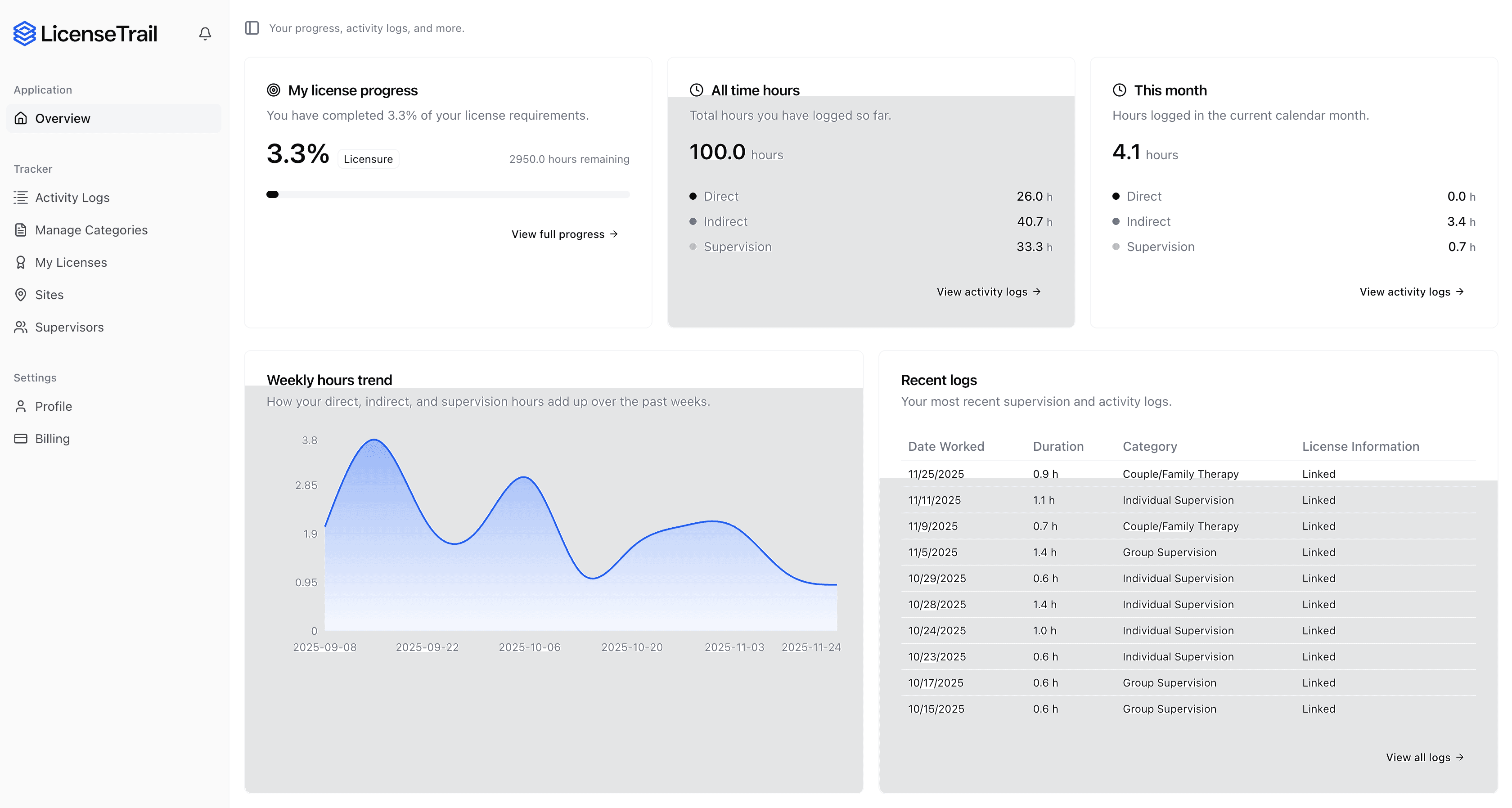
License Trail checks your direct, indirect, and supervision hours against Wyoming PMFT requirements continuously and flags mismatches before you submit.
 Start Tracking for Free
No credit card required · Free plan available
Is your spreadsheet hiding Wyoming PMFT risks?
Stop guessing if your categories match Wyoming Mental Health Professions Licensing Board requirements. License Trail checks your direct, indirect, and supervision hours continuously and flags mismatches before you submit.
Import or log
Bring your spreadsheet or start fresh
Upload your existing tracking spreadsheet and we'll map every hour into the right Wyoming Mental Health Professions Licensing Board categories automatically.
Verify against Wyoming
Catch mismatches before the board does
License Trail checks your direct, indirect, and supervision hours against Wyoming PMFT requirements continuously.
Export board-ready
One-click clean reports
Generate professional, board-ready reports for supervision meetings and Wyoming Mental Health Professions Licensing Board submissions in seconds.
No credit card required · Free plan available