
Wyoming PPC Requirements: Hours, Exams & Step-by-Step Guide
Stop guessing if your categories match Wyoming requirements. License Trail checks your direct, indirect, and supervision hours against PPC requirements continuously and flags mismatches before you submit.
No credit card required · Free plan available
Quick Requirements Overview
- Two-tier path: PPC is provisional status to legally practice only under supervision while accruing hours toward LPC.
- Education: Master’s/doctorate in counseling from CACREP/CORE (or “substantially similar” program); if non-CACREP/CORE: 48 semester hrs (pre‑7/1/2013) or 60 semester hrs (post‑7/1/2013).
- In-degree clinical training: 100‑hr practicum (min 10 weeks) + 600‑hr internship (after practicum) incl. 240 direct service hrs + required weekly individual/triadic and 1.5 hr/week group supervision.
- PPC eligibility basics: majority age, U.S. lawful presence, no disqualifying criminal history; may be within 6 semester hrs of education if ethics + practicum + internship completed.
- Supervisor required before practice: Board-approved Designated Qualified Clinical Supervisor (DQCS) + submitted Supervision Agreement required before license/practice.
- Practice & disclosure limits: Must work under clinical (DQCS) + administrative (employer) supervision; disclose supervised status; DQCS info on disclosure/advertising.
- Post-degree hours toward LPC (while PPC): 3,000 supervised clinical hours in 18–36 months, including 1,200 direct client contact + up to 1,800 indirect support hours; plus 100 post-grad supervision hours; supervision ratio ≥1 hr per 20 direct hours.
- Time/exam constraints: PPC expires at 36 months (extensions for good cause); must pass approved exam (NCE/NCMHCE/CRCC or Board-approved) for LPC.
License Details
Procedures
Wyoming uses a two‑tier system for counseling licensure: you first become a Provisional Professional Counselor (PPC), then complete supervised clinical hours and exams to qualify as a Licensed Professional Counselor (LPC). The PPC credential is specifically designed to let you accrue those supervised hours legally.
Below is a breakdown of what Wyoming’s Mental Health Professions Licensing Board actually requires and how it defines the various hour types.
1. How Wyoming defines a Provisional Professional Counselor (PPC)
In the Board’s rules, a Provisional Professional Counselor (PPC) is:
“A person provisionally licensed under the Act to practice professional counseling for which they are qualified by virtue of training and experience, under the supervision of a designated qualified clinical supervisor licensed in the state of Wyoming.” (law.cornell.edu)
Key points from the provisional license chapter:
- Provisional licensure is “a means by which an individual may continue progress… towards satisfactory completion of the education, experience and examination requirements” for full licensure. (regulations.justia.com)
- The terms “Provisional Professional Counselor” may be used only after the Board grants the provisional license and only for activities that are part of the supervised clinical experience. (regulations.justia.com)
In practice, PPC status is your legal mechanism to provide counseling services only under supervision while you gain the post‑degree hours and pass the licensing exam.
2. Educational prerequisites (what you must already have before PPC)
The Board’s Licensed Professional Counselor chapter (Chapter 11) sets the education standard that PPC applicants must meet (or be very close to meeting):
- You must hold a master’s or doctorate degree in counseling from a CACREP or CORE‑accredited counseling program, or an equivalent counseling program from a regionally/nationally accredited institution that is “substantially similar” to CACREP standards. (regulations.justia.com)
- If your program is not CACREP/CORE, you must show:
- At least 48 semester hours of graduate counseling coursework (for degrees before July 1, 2013), or 60 semester hours for degrees after July 1, 2013. (regulations.justia.com)
- Coursework covering all core areas (helping relationships, assessment, group work, etc.) as laid out in the rule.
Required practicum and internship (within the degree)
The Board explicitly adopts CACREP‑style practicum/internship requirements for counseling programs:
-
Practicum:
- At least 100 clock hours of supervised practicum
- Over a minimum 10‑week academic term (regulations.justia.com)
-
Internship:
- At least 600 clock hours of supervised internship in your program area
- Must start after successful completion of practicum
- Must include at least 240 clock hours of direct service, including group experience
- Weekly individual or triadic supervision (about 1 hour/week) by the site supervisor
- 1.5 hours/week of group supervision by program faculty (regulations.justia.com)
These are university-based clinical hours and do not count toward the 3,000 post‑master’s hours you will later complete as a PPC, but they are part of what makes you eligible for licensure.
3. Eligibility requirements specifically for the PPC license
Chapter 7 (“Provisional License”) sets the general requirements for all provisional licenses, including PPC. You must show the Board that you: (regulations.justia.com)
-
Are of majority age.
-
Have no disqualifying criminal history
- No felony convictions, and
- No misdemeanors that “relate adversely” to the practice of counseling (or the other mental health disciplines), although exceptions may be granted if consistent with the public interest.
-
Are a legal inhabitant of the United States.
-
Satisfy the education requirements for professional counseling (described in Chapter 11).
- The Board may grant a provisional license if you’re short no more than 6 semester hours, provided that you have already completed:
- Professional orientation/ethics coursework, and
- Both practicum and internship. (regulations.justia.com)
- The Board may grant a provisional license if you’re short no more than 6 semester hours, provided that you have already completed:
-
Have a Designated Qualified Clinical Supervisor (DQCS) lined up
- You must submit a Supervision Agreement and receive Board approval before a provisional license will be issued. (regulations.justia.com)
-
Have not already held more than two provisional licenses in this discipline.
- The rules state: “An applicant shall not be issued more than two provisional licenses in any individual discipline.” (regulations.justia.com)
From the Board’s application page, the “Provisional Professional Counselor” application is explicitly:
“intended for those with a master’s degree in counseling who need to pass their examination and earn supervised experience.” (mentalhealth.wyo.gov)
4. What the PPC application itself typically requires
The Board provides the PPC application as a printable form; schools and licensure guides summarize the content. A common, Board‑consistent checklist includes: (phoenix.edu)
- Completed PPC application form with original signature and fee
- Official graduate transcripts sent directly to the Board (mail or secure electronic submission)
- A Professional Disclosure Statement meeting Board requirements (including clear notice that your practice is supervised, and your supervisor’s contact information)
- A Supervision Agreement naming your DQCS and describing the supervision plan (must be approved by the Board before you start seeing clients)
- Proof of lawful presence in the U.S.
- Two fingerprint cards (FD‑258) completed within six months of submission, for state and federal background checks
- Consent to a National Practitioner Data Bank (NPDB) query (the Board queries NPDB on new and renewal applications). (mentalhealth.wyo.gov)
The exact fee amounts can change, so they should be confirmed on the current application form.
5. Practice limitations and supervision while you are a PPC
Several layers of rule and statute govern how you practice under a PPC:
Supervision and disclosure duties
-
You may only practice under clinical supervision and administrative supervision.
Chapter 18 states that “clinical practice shall not be permitted” until documentation of a DQCS has been provided to, and approved by, the Board, and that all provisionally licensed professionals “may only provide services under the clinical supervision of a DQCS and under the administrative supervision of their employer.” (regulations.justia.com) -
You must disclose the supervised nature of your work to clients.
Under Chapter 7:- Your professional disclosure statement must provide clients with “full disclosure of the supervised nature of [your] work,” including your DQCS’s name, address, and phone number.
- Your DQCS’s name, address, and phone number must also appear on all advertising documents. (regulations.justia.com)
-
You must follow the professional code of ethics for counselors as incorporated into Chapter 15. (regulations.justia.com)
Required frequency and ratio of supervision
Chapter 18 sets a minimum ratio between direct clinical services and supervision:
- Provisional licensees (including PPCs) must receive individual or triadic face‑to‑face clinical supervision (or individual distance supervision) by a DQCS at least one (1) hour for every twenty (20) hours of direct clinical provision of services. (regulations.justia.com)
This ratio is separate from, and in addition to, the overall 100‑hour supervision minimum discussed below.
6. The post‑degree supervised experience you complete while holding a PPC
The PPC credential itself does not require you to bring in post‑degree clinical hours at the time of application. Instead, PPC is the status you hold while you complete the supervised experience and exam needed for independent LPC licensure.
The Board’s core supervised‑experience rule is in Chapter 11, Section 11‑4 (“Supervised Training/Work Experience Requirement for Licensure”). It defines both the amount and the types of hours:
Total supervised clinical hours
- You must complete a minimum of 3,000 hours of “supervised clinical training/work experience in professional counseling” under the direct supervision of a DQCS.
- These hours must be completed in no less than 18 months and no more than 36 months, unless the Board grants an extension. (regulations.justia.com)
Direct client contact hours
Within the 3,000 hours:
- At least 1,200 hours must be “direct client contact hours.” (regulations.justia.com)
“Direct client contact” is not exhaustively defined in one sentence, but in practice—and consistent with Board and licensure‑guide explanations—it refers to face‑to‑face (or equivalent synchronous) counseling services with individuals, couples, families, or groups, where you are actively providing assessment, counseling, or psychotherapy. (mentalhealthcounselorlicense.com)
Indirect (supporting) clinical hours
The remaining up to 1,800 hours are indirect clinical work. The rule specifies that:
- “The balance of the remaining indirect hours shall consist of work experience that supports the direct client contact hours, e.g., charting, preparation, meetings, trainings, or the other duties of counseling.” (regulations.justia.com)
So the Board’s breakdown is:
- 3,000 total supervised clinical hours, comprised of
- 1,200 hours of direct client contact, and
- Up to 1,800 hours of indirect/supportive clinical activities.
This is not a 1,500/1,500 split; the Board‑defined split is 1,200 direct / 1,800 indirect within a 3,000‑hour supervised experience.
Required supervision hours (separate from work hours)
In addition to the 3,000 clinical hours:
- You must complete a minimum of 100 post‑graduate hours of clinical supervision with a DQCS. Chapter 11 states:
“An applicant shall have a minimum of one hundred (100) post graduate degree hours of clinical supervision with a DQCS as described in Chapter 18.” (regulations.justia.com)
Earlier versions of the statute likewise required “three thousand (3,000) hours of supervised clinical experience including a minimum of one hundred (100) hours of face‑to‑face individual clinical supervision from a qualified clinical supervisor.” (law.justia.com)
Putting it together:
- 3,000 hours of supervised clinical training/work experience, with:
- 1,200 hours direct client contact
- Up to 1,800 hours indirect/support activities
- At least 100 hours of post‑degree clinical supervision with a DQCS
- Supervision delivered consistent with Chapter 18 (individual or triadic, with at least 1 hour per 20 direct clinical hours).
These supervision hours are not additional work hours; they are time spent in supervision sessions and are tracked separately from direct/indirect service hours.
7. Time limits and extensions for provisional licensure
The Wyoming statute governing mental health professions provides that: (law.justia.com)
- A provisional license expires 36 months after issuance or upon issuance of a full license, whichever occurs first, unless extended.
- The Board may, for good cause shown, grant an extension and may impose additional restrictions.
This 36‑month statutory ceiling aligns with the rule that the 3,000 supervised hours must be completed within 18–36 months. (regulations.justia.com)
In practice, most counselors complete their 3,000 hours and 100 supervision hours while holding a PPC and then use the “Provisional to Full Licensure” application to upgrade to LPC status. (mentalhealth.wyo.gov)
8. Examination requirements tied to PPC/LPC
Exams are not “hours,” but they are part of what you are expected to complete while holding a PPC:
- The Board requires one of the national counseling examinations for both PPC and LPC, as stated in its examination information and in Chapter 11, Section 11‑5:
- National Counselor Examination (NCE),
- National Clinical Mental Health Counseling Examination (NCMHCE),
- Certification Examination of the Commission on Rehabilitation Counselor Certification (CRCC), or
- Another examination approved by the Board. (mentalhealth.wyo.gov)
A PPC is the first level of licensure; to be eligible to apply for the second level (LPC), you must have completed the supervised clinical hours and passed an approved exam. (phoenix.edu)
9. Practical summary of hour‑related requirements
From the Board’s own rules and defined verbiage, Wyoming’s key hour requirements associated with becoming a PPC and progressing to LPC are:
-
Within your counseling degree (education requirement): (regulations.justia.com)
- 100 clock hours of supervised practicum (minimum 10‑week term)
- 600 clock hours of supervised internship, including:
- At least 240 direct service hours
- Weekly individual/triadic supervision
- 1.5 hours/week of group supervision
-
Post‑master’s supervised clinical work while holding a PPC (toward LPC): (regulations.justia.com)
- 3,000 hours total supervised clinical training/work experience in professional counseling, all after the graduate degree, over 18–36 months
- Of these:
- 1,200 hours must be direct client contact hours (therapy/counseling with clients)
- Up to 1,800 hours may be indirect hours that support direct work (charting, case notes, case conferences, preparation, trainings, etc.)
-
Supervision hours and supervision ratio: (regulations.justia.com)
- At least 100 post‑graduate hours of clinical supervision with a DQCS
- Ongoing supervision provided at a minimum of 1 hour of individual or triadic supervision for every 20 hours of direct clinical services
-
Timeframe and license term: (regulations.justia.com)
- 3,000 supervised hours must be completed within 18–36 months
- The provisional license expires after 36 months unless extended for good cause
In other words, Wyoming does not divide the post‑degree requirement into 1,500 direct and 1,500 supervised hours. Instead, the Board’s own language requires:
- 3,000 total supervised clinical hours, with 1,200 specifically designated as direct client contact,
- The remaining hours in indirect but clinically relevant work, and
- 100 hours of clinical supervision by a Designated Qualified Clinical Supervisor, plus strict supervision ratios and disclosure obligations while you hold the PPC license.
Track your PPC hours with confidence
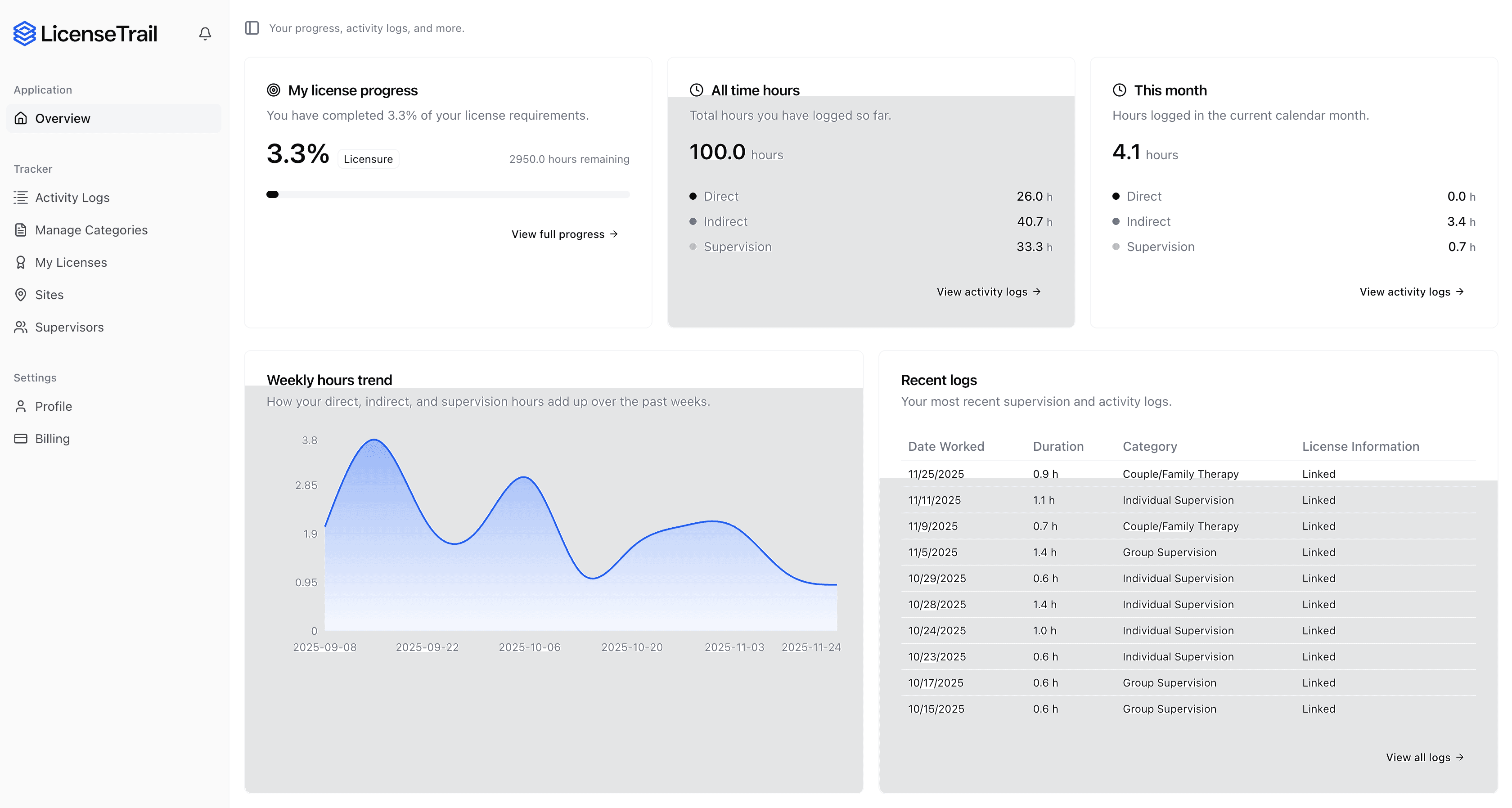
License Trail checks your direct, indirect, and supervision hours against Wyoming PPC requirements continuously and flags mismatches before you submit.
 Start Tracking for Free
No credit card required · Free plan available
Is your spreadsheet hiding Wyoming PPC risks?
Stop guessing if your categories match Wyoming Mental Health Professions Licensing Board requirements. License Trail checks your direct, indirect, and supervision hours continuously and flags mismatches before you submit.
Import or log
Bring your spreadsheet or start fresh
Upload your existing tracking spreadsheet and we'll map every hour into the right Wyoming Mental Health Professions Licensing Board categories automatically.
Verify against Wyoming
Catch mismatches before the board does
License Trail checks your direct, indirect, and supervision hours against Wyoming PPC requirements continuously.
Export board-ready
One-click clean reports
Generate professional, board-ready reports for supervision meetings and Wyoming Mental Health Professions Licensing Board submissions in seconds.
No credit card required · Free plan available