
Delaware LAAT Requirements: Hours, Exams & Step-by-Step Guide
Stop guessing if your categories match Delaware requirements. License Trail checks your direct, indirect, and supervision hours against LAAT requirements continuously and flags mismatches before you submit.
No credit card required · Free plan available
Quick Requirements Overview
- Transitional license for master’s‑prepared art therapists to accrue Board‑approved supervised experience toward LPAT; practice only under approved supervision
- Education: master’s/doctorate in art therapy (≥60 grad credits; AATA‑approved/CAAHEP‑accredited or successor) or allied graduate degree with Board‑equivalent coursework covering 9 core content areas
- Submit: official graduate transcript; if non‑art‑therapy degree, Evaluation of Coursework + course descriptions/catalog proof of 9 areas
- Background/fitness: Delaware + FBI criminal background check; Board review of discipline, impairment, and “substantially related” convictions (no waiver for felony sex offenses)
- Supervision plan required and must be Board‑approved before counting hours; file Planned Direct Supervision + Planned Professional Art Therapy Experience forms (separate forms per site/period as needed)
- Post‑master’s experience to reach LPAT: 3,200 hours over 2–4 consecutive years, including 1,600 supervised clinical hours (1,500 face‑to‑face client art therapy; ≥750 individual) + 100 face‑to‑face supervision (≤40 group; group max 6 supervisees)
- Remaining up to 1,600 hours may be art therapy experience not under Board‑approved direct supervision (cannot count toward the 1,500 client hours or 100 supervision hours; art teaching doesn’t count)
- License term/transition: LAAT valid 2 years; renewable up to 2 times (max 6 years); LPAT requires completion of hours + passing ATCBE exam; notify Board within 30 days of supervision changes
License Details
Procedures
Delaware’s Licensed Associate Art Therapist (LAAT) credential is a transitional license for master’s‑prepared art therapists who are still accruing the supervised experience needed for full Licensed Professional Art Therapist (LPAT) status. It is governed by Title 24, Chapter 30, Subchapter V of the Delaware Code and Section 3000‑8.0 of the Board of Mental Health and Chemical Dependency Professionals’ regulations. (delcode.delaware.gov)
The outline below tracks exactly how the Board describes the education, supervision plan, and post‑master’s hour requirements tied to LAAT and eventual LPAT licensure.
1. How Delaware Defines the LAAT Role
The Delaware Code defines a “licensed associate art therapist” (LAAT) as someone licensed under the chapter who is obtaining “supervised experience” from a Licensed Professional Art Therapist (LPAT) or other Board‑approved mental health professional, for the purpose of becoming an LPAT. (delcode.delaware.gov)
Key consequence: a LAAT may practice art therapy only under approved supervision, and the license exists so you can legally accrue the required post‑master’s experience.
2. Baseline Qualifications You Must Meet Before You Can Be a LAAT
By statute, a LAAT applicant must meet all of the LPAT qualifications except the post‑degree experience and the national certification (ATCB exam). (delcode.delaware.gov)
2.1 Education
You must document one of the following art‑therapy–specific graduate pathways: (delcode.delaware.gov)
-
Master’s or doctoral degree in art therapy
- From an accredited institution,
- With at least 60 graduate credits in an art therapy program that was approved by the American Art Therapy Association or accredited by the Commission on Accreditation of Allied Health Education Programs (or its successor) when the degree was conferred.
-
Graduate degree in an allied field plus equivalent art therapy coursework
- You may qualify with a graduate degree in a related field if, in the Board’s judgment, your graduate‑level coursework is equivalent to a master’s in art therapy.
- Delaware’s regulations specify that a non‑art‑therapy degree must cover nine core content areas (history, theory, techniques, application in different settings, assessment, ethics/legal issues, diversity, standards of practice, and group art therapy). (regulations.justia.com)
The LAAT licensure page requires: (dpr.delaware.gov)
- An official graduate transcript sent directly from the college/university, and
- An Evaluation of Coursework form plus catalog/descriptions if your degree is not in art therapy, demonstrating those nine required areas.
2.2 Character, Fitness, and Background
To qualify, you must: (delcode.delaware.gov)
- Pass a State of Delaware and FBI criminal background check (CBC) through the process specified by the Division of Professional Regulation.
- Have no disqualifying disciplinary history as an art therapist (e.g., license revocations for reasons other than nonpayment, significant sanctions, or ethics violations), subject to Board review.
- Not have an impairment related to drugs, alcohol, or mental incompetence that would limit safe practice.
- Have no criminal conviction or pending charge “substantially related” to art therapy, unless the Board grants a statutory waiver; no waiver is allowed for felony sex offenses.
- Meet any additional requirements the Board sets in its rules and regulations.
These same standards apply to LPAT applicants; LAAT applicants simply skip the experience and ATCB exam portions until later. (delcode.delaware.gov)
3. The Supervised Experience Plan Required for LAAT
The essence of the LAAT is a Board‑approved plan for how you will earn your post‑master’s hours.
3.1 Statutory Requirement for a Plan
The law requires that: (delcode.delaware.gov)
- A LAAT applicant must submit a “plan for supervised experience” to the Board.
- The plan must be approved before you start acquiring the art therapy experience needed for LPAT licensure.
3.2 What the Board’s LAAT Page Requires
The Board’s Associate Art Therapist Licensure page specifies these required forms: (dpr.delaware.gov)
- Planned Direct Supervision form – completed and signed by the approved clinical supervisor(s) who will oversee your direct supervised hours.
- Planned Professional Art Therapy Experience form – completed and signed by the administrative supervisor who can verify the post‑master’s art therapy hours you will obtain when you are not under direct supervision by an approved clinical supervisor.
- If you expect more than one period of experience (e.g., multiple jobs), you need separate forms.
Section 3000‑8.0 of the regulations summarizes this as: LAAT applicants must provide a written plan for acquiring the experience requirements in Regulation 7.3–7.4, signed by a supervisor who meets the Board’s criteria. (regulations.justia.com)
4. How Many Hours You Ultimately Have to Complete (and of What Type)
Although the LAAT license itself does not require that you already have hours completed, the law and regulations are explicit about what you must plan to complete to become an LPAT.
4.1 Total Post‑Master’s Experience
Delaware requires that, after completing your master’s (or equivalent) degree, you must complete: (delcode.delaware.gov)
- At least 3,200 hours of post‑master’s professional art therapy experience,
- Over a period of not less than 2 years and not more than 4 consecutive years.
The Board describes these as “3,200 hours of art therapy” experience that are broken down into:
- 1,600 hours of supervised clinical experience under “professional direct supervision”, and
- Up to 1,600 additional hours of professional art therapy experience that are not required to be directly supervised by a Board‑approved clinical supervisor.
4.2 Breakdown of the 1,600 Directly Supervised Hours
The 1,600 supervised clinical hours must be structured as follows: (regulations.justia.com)
-
1,500 hours of face‑to‑face direct art therapy services with clients
- At least 750 hours must be individual, face‑to‑face client sessions that include direct art therapy services.
- The other 750 hours may be any mix of individual, group, couple, or family art therapy services.
-
100 hours of face‑to‑face professional direct supervision
- At least 100 hours must be face‑to‑face meetings between you and your supervisor.
- These may be in person or via live video conferencing (the Board treats both as “face‑to‑face,” with a cap on how many supervision hours may be via video). (regulations.justia.com)
- Supervision may be:
- Individual supervision – one‑to‑one meetings; you may fulfill all 100 hours this way.
- Group supervision – supervisor with no more than six supervisees; no more than 40 of the 100 hours may be group supervision.
The regulations emphasize that art teaching is not considered art therapy and cannot count toward these supervised experience hours. (regulations.justia.com)
4.3 Additional 1,600 Hours of Art Therapy Experience (Not Under Direct Supervision)
Hours of art therapy you perform without a Board‑approved supervisor (for example, under an administrative or non‑qualifying clinical supervisor) are treated separately: (regulations.justia.com)
- These hours may count toward the total 3,200 hours of post‑master’s professional experience,
- But do not count toward the 1,500 supervised face‑to‑face clinical hours and do not satisfy the 100‑hour direct supervision requirement.
The Associate Art Therapist experience page explicitly notes that art therapy experience “not completed under the supervision” of an acceptable or approved supervisor counts only toward the 1,600 hours of nonsupervised experience, not toward the required 1,500 supervised hours. (dpr.delaware.gov)
5. How the Board Defines the Different Types of Hours
The Board uses specific terms for different categories of hours you must plan to complete:
-
“Supervised art therapy experience” – involves providing face‑to‑face art therapy services with clients and other activities directly related to treatment, in a setting clearly designated to provide clinical art therapy treatment opportunities. (dpr.delaware.gov)
-
“Direct supervised experience” – means face‑to‑face consultation, on a regularly scheduled basis, between you and a LPAT or other Board‑approved behavioral health professional; this is what your 100 supervision hours must consist of. (dpr.delaware.gov)
-
“Face‑to‑face” – includes both in‑person meetings and live video conferencing for services and supervision, subject to limits on total video‑based supervision hours. (regulations.justia.com)
-
“Art therapy services” – statutorily defined to include clinical appraisal and treatment activities during individual, couple, family, or group sessions that use art media and the creative process to address clients’ mental and emotional needs. (delcode.delaware.gov)
These definitions guide what you may legitimately count toward your supervised and total experience.
6. Who May Supervise You (Board’s “Acceptable Supervisors”)
The supervisor listed on your LAAT plan must satisfy the Board’s acceptable supervisor standards in Regulation 7.5. (regulations.justia.com)
6.1 Standard Path: Art Therapy Supervisors
A supervisor is automatically acceptable if they are:
- A Professional Art Therapist licensed in any U.S. state or territory; or
- A person who holds either the Registered and Board Certified Art Therapist (ATR‑BC) or Art Therapy Certified Supervisor (ATCS) credential from the Art Therapy Credentials Board (ATCB). (regulations.justia.com)
6.2 Other Behavioral Health Professionals
The Board may approve other licensed behavioral health professionals as supervisors when they have a clinical specialty essential to your training, such as: (regulations.justia.com)
- Licensed marriage and family therapists
- Licensed professional counselors of mental health
- Clinical psychologists
- Licensed clinical social workers
- Physicians
- Advanced practice registered nurses
When the supervisor is not licensed by the Delaware Board of Professional Counselors of Mental Health and Chemical Dependency Professionals, they must: (regulations.justia.com)
- Have at least two years of post‑licensure practice,
- Have no disciplinary history,
- Provide official verification of their license(s), and
- Attest (on a Board form) that they:
- Have read and understand Delaware’s licensure statutes and regulations, and
- Have the training to provide clinical supervision.
6.3 Supervision Limits
- An acceptable supervisor may have no more than 10 supervisees at a time. (regulations.justia.com)
- You may have more than one supervisor, and all may contribute to your hours.
You must also notify the Board within 30 days of any change in clinical supervision on the Board’s form; changes are subject to Board approval. (regulations.justia.com)
7. Step‑by‑Step: Applying for LAAT in Practice
Putting the statutory and regulatory pieces together, a typical LAAT path in Delaware looks like this:
-
Confirm you meet educational and fitness standards
- Verify that your degree and coursework fit the Board’s art therapy requirements.
- Review your disciplinary and criminal history for any issues that could require a waiver.
-
Create a DELPROS account and start the online application
- Use Delaware’s online licensing system (DELPROS) to begin an Associate Art Therapist application. (dpr.delaware.gov)
-
Arrange supporting documents
- Official graduate transcript sent directly to the Board.
- Evaluation of Coursework and course descriptions if your degree is not explicitly in art therapy. (dpr.delaware.gov)
- State and FBI criminal background checks, following the DPR’s Criminal Background Check Process. (dpr.delaware.gov)
- License verifications from all jurisdictions where you currently hold or ever held a professional license. (dpr.delaware.gov)
-
Secure a Board‑acceptable supervisor (or supervisors)
- Confirm they meet the Board’s art therapy or behavioral health supervisor standards (credentials, years post‑licensure, no discipline). (regulations.justia.com)
-
Complete the two planning forms with your supervisors
- Planned Direct Supervision form (clinical supervisor):
- Outlines how you will obtain at least 1,600 hours of supervised experience, including:
- 1,500 hours of face‑to‑face direct art therapy services (with at least 750 individual sessions), and
- 100 hours of face‑to‑face supervision (≤ 40 group). (regulations.justia.com)
- Outlines how you will obtain at least 1,600 hours of supervised experience, including:
- Planned Professional Art Therapy Experience form (administrative supervisor):
- Describes how you will accumulate up to 1,600 additional art therapy hours not under direct supervision so your total post‑master’s experience reaches 3,200 hours within 2–4 years. (regulations.justia.com)
- Planned Direct Supervision form (clinical supervisor):
-
Submit the LAAT application, fee, and all forms in DELPROS
- Ensure all “attach” and “acknowledge” instructions are followed so transcripts, CBCs, and supervisor forms reach the Board correctly. (dpr.delaware.gov)
-
Await Board approval of your plan and license
- Once approved, you hold a LAAT license and may begin (or continue) accruing supervised experience according to the approved plan.
8. Duration of the LAAT and Transition to LPAT
By law: (delcode.delaware.gov)
- The associate art therapist license is valid for 2 years.
- It may be renewed up to 2 times, giving a maximum of 6 years to complete the required 3,200 hours.
- Once you have:
- Completed the 3,200 post‑master’s hours (with the 1,600/1,500/100 breakdown and 2–4 year time frame), and
- Passed the Art Therapy Credentials Board Examination (ATCBE),
you may apply to the Board for full Licensed Professional Art Therapist (LPAT) licensure. (delcode.delaware.gov)
Regulatory details are current through June 1, 2025, according to the Delaware Administrative Code and the Division of Professional Regulation’s website. Before submitting an application, it is prudent to review the Board’s LAAT, post‑master’s experience, and rules & regulations pages to confirm no recent amendments have changed hour counts or supervision rules.
Track your LAAT hours with confidence
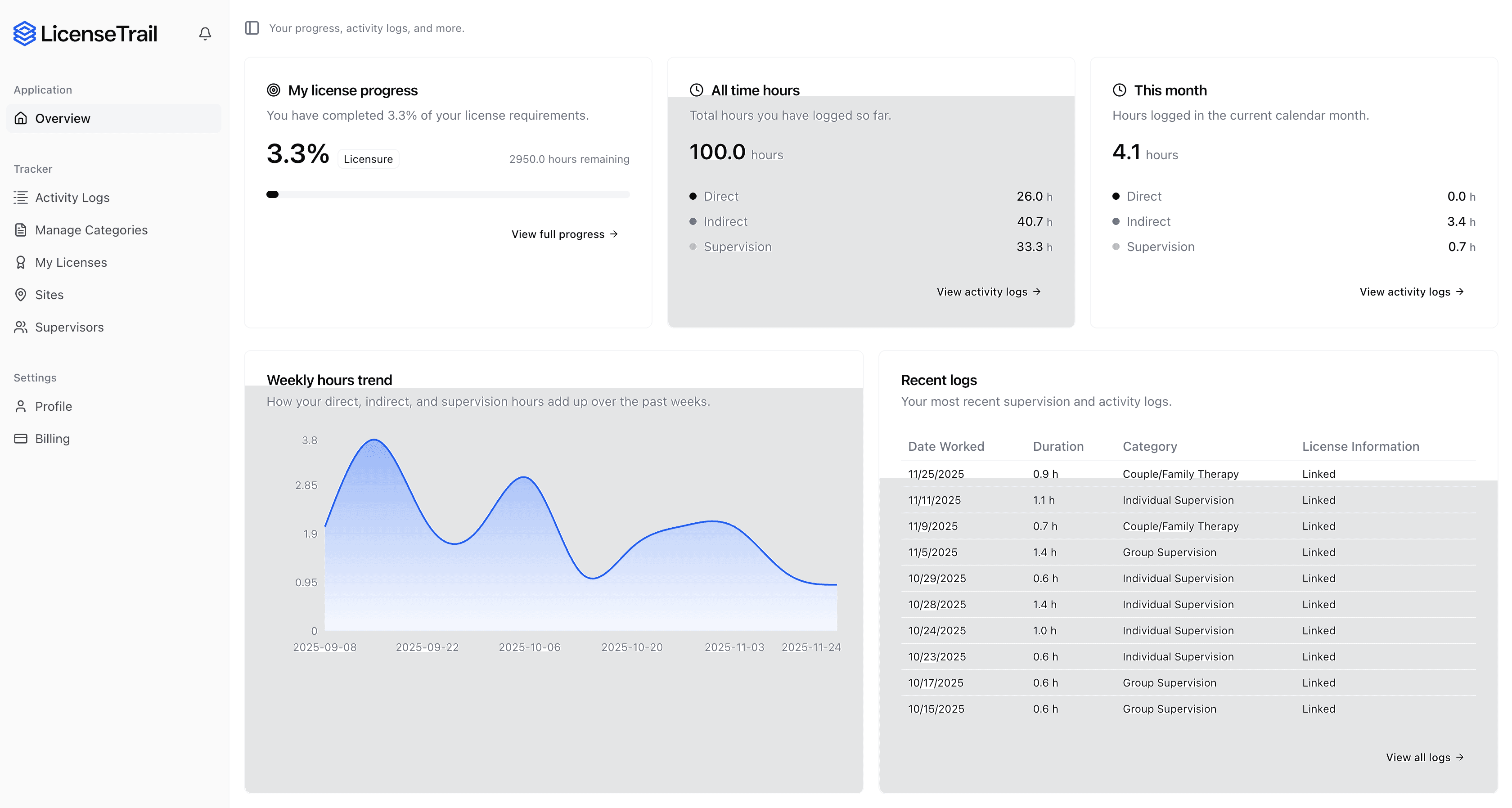
License Trail checks your direct, indirect, and supervision hours against Delaware LAAT requirements continuously and flags mismatches before you submit.
 Start Tracking for Free
No credit card required · Free plan available
Is your spreadsheet hiding Delaware LAAT risks?
Stop guessing if your categories match Delaware Board of Mental Health and Chemical Dependency Professionals requirements. License Trail checks your direct, indirect, and supervision hours continuously and flags mismatches before you submit.
Import or log
Bring your spreadsheet or start fresh
Upload your existing tracking spreadsheet and we'll map every hour into the right Delaware Board of Mental Health and Chemical Dependency Professionals categories automatically.
Verify against Delaware
Catch mismatches before the board does
License Trail checks your direct, indirect, and supervision hours against Delaware LAAT requirements continuously.
Export board-ready
One-click clean reports
Generate professional, board-ready reports for supervision meetings and Delaware Board of Mental Health and Chemical Dependency Professionals submissions in seconds.
No credit card required · Free plan available