
Delaware LACMH Requirements: Hours, Exams & Step-by-Step Guide
Stop guessing if your categories match Delaware requirements. License Trail checks your direct, indirect, and supervision hours against LACMH requirements continuously and flags mismatches before you submit.
No credit card required · Free plan available
Quick Requirements Overview
- Pre‑independent license to practice while accruing post‑master’s experience toward LPCMH; must work under Board‑approved “professional direct supervision.”
- Education: Master’s in Clinical Mental Health Counseling or equivalent meeting CACREP CMHC standards with ≥60 graduate semester credits (official transcript; coursework eval if needed).
- Exam: Pass NCE (or other Board‑accepted national counseling exam).
- Background check: Delaware + FBI criminal background check using Board service code (other checks not accepted).
- Application must include a written supervision/experience plan signed by proposed supervisor; Board must approve plan to issue license.
- Experience plan targets LPCMH: 3,200 hours over 2–4 consecutive years, including 1,600 supervised clinical hours; within that 1,500 face‑to‑face direct counseling (≥750 individual sessions) + 100 face‑to‑face supervision hours (≤40 group; live video allowed up to 50%).
- Supervisor requirements: Board‑acceptable (typically LPCMH; other behavioral health professionals by approval); ≥2 years post‑licensure, supervision CE requirements, and max 10 supervisees at a time.
- License term: valid 2 years, renewable up to 2 times (about 6 years max); supervision changes must be reported to the Board within 30 days.
License Details
Procedures
Delaware’s Licensed Associate Counselor of Mental Health (LACMH) credential is the Board’s pre‑independent license for master’s‑level clinicians who are working toward full licensure as a Licensed Professional Counselor of Mental Health (LPCMH). The LACMH is defined in statute as someone who is “obtaining experience under the professional direct supervision” of an LPCMH or other Board‑approved health professional for the purpose of becoming an LPCMH. (delcode.delaware.gov)
Below is a step‑by‑step guide focused on the official Delaware Board language about hours, supervision, and definitions.
1. Understand what the LACMH license is for
Under Delaware law:
-
A “licensed associate counselor of mental health” (LACMH) is an individual:
- “licensed as an associate counselor of mental health” who is
- “obtaining experience under the professional direct supervision of a licensed professional counselor of mental health or other health professional approved by the Board for the purpose of becoming licensed as a professional counselor of mental health.” (delcode.delaware.gov)
-
The LACMH license:
- Is effective for 2 years and may be renewed up to 2 times (maximum of about 6 years as an associate). (law.justia.com)
- Exists so that you can lawfully practice while you complete the post‑master’s experience required for full LPCMH licensure.
2. Educational and exam requirements you must meet before LACMH
By statute, an LACMH applicant must meet all LPCMH requirements except the experience requirement:
The applicant must “furnish evidence … that such person has met all the requirements established in this subchapter for licensed professional counselors of mental health, except the requirements dealing with required experience.” (law.justia.com)
Practically, this means you need:
-
A qualifying graduate degree
The regulations require:
- A master’s degree in Clinical Mental Health Counseling, documented by an official transcript sent directly to the Board; or (law.cornell.edu)
- If your degree is not in clinical mental health counseling:
- At least 60 graduate semester hours of coursework that:
- Encompasses current CACREP standards for a clinical mental health counseling program, including the specialty standards, practicum, and internship. (law.cornell.edu)
- At least 60 graduate semester hours of coursework that:
The Board’s LACMH page reiterates that you must have an official transcript showing a minimum of 60 graduate credits and, where needed, an Evaluation of Coursework form. (dpr.delaware.gov)
-
Passing a national counseling exam
All applicants must have passed:
- The National Counselor Examination (NCE) or another exam acceptable to the Board. (law.cornell.edu)
-
Criminal background check
- A State of Delaware and FBI criminal background check must be completed using the Board’s specific service code and sent for this purpose; other background checks do not satisfy the requirement. (dpr.delaware.gov)
-
Any required license verifications
- Verification from each state/jurisdiction where you hold or have held a license in a related profession. (dpr.delaware.gov)
3. The experience and supervision you are working toward as a LACMH
Although you do not need post‑master’s hours to obtain the LACMH, you must submit a plan to acquire the LPCMH experience requirements while you hold the associate license.
3.1. LACMH must plan to meet LPCMH experience standards
The LACMH regulation states:
- “LACMH applicants must provide a written plan for acquiring the LPCMH experience requirements in conformity with subsections 2.3 – 2.4 above. The plan must be signed by the applicant’s proposed supervisor.” (law.cornell.edu)
Subsections 2.3–2.4 (the LPCMH rules) define the hours as follows.
3.2. Total post‑master’s counseling hours required: 3,200 hours
For full LPCMH licensure (which you will pursue while an LACMH), the Board requires:
- “All applicants must provide documentation of 3,200 hours of supervised professional mental health counseling … obtained over a period of not less than 2 years and not more than 4 years, at least 1,600 hours of which shall be supervised clinical experience acceptable to the Board.” (law.cornell.edu)
The Board’s own summary uses nearly identical language, stating you must complete at least 3,200 hours of mental health counseling services over at least two but not more than four consecutive years. (dpr.delaware.gov)
So, the big picture requirement is:
- 3,200 total hours of mental health counseling services
- completed in 2–4 consecutive years post‑master’s
- while practicing under an LACMH (or otherwise meeting statutory conditions).
3.3. How those 3,200 hours must be structured
Within those 3,200 hours, Delaware subdivides the hours very specifically.
3.3.1. Supervised clinical experience: 1,600 of the 3,200 hours
- “Of the required 3,200 hours of total experience, 1,600 hours must have been completed under the professional direct supervision of an individual who meets the requirements of subsections 2.5–2.5.3.” (law.cornell.edu)
This “professional direct supervision” is defined in statute and in the Board’s guidance.
Definition – Professional direct supervision
- “Face‑to‑face consultation, on a regularly scheduled basis, between a supervisee and a Licensed Professional Counselor of Mental Health (LPCMH) or other behavioral health professional approved by the Board. The services rendered must be consistent with the supervisee’s education, training and experience.” (dpr.delaware.gov)
Definition – Professional mental health counseling
- “The application of clinical counseling principles, methods or procedures including the diagnosis and treatment of mental and emotional disorders to assist individuals in achieving more effective personal and social adjustment.” (dpr.delaware.gov)
3.3.2. Within the 1,600 supervised hours: 1,500 direct‑service hours
The administrative code further specifies:
- “The 1,600 hours of supervised clinical experience must be fulfilled as follows:
- At least 1,500 of the 1,600 hours must be in the actual provision of face‑to‑face direct mental health counseling services.
- Of the 1,500 hours, at least 750 must be individual face‑to‑face client sessions that include the provision of direct mental health counseling.
- The remaining 750 of the 1,500 may be individual, group, couple, or family counseling, or any combination of those services.” (law.cornell.edu)
In short:
- 3,200 total hours mental health counseling services, of which:
- 1,600 hours = supervised clinical experience under professional direct supervision, including:
- 1,500 hours = actual face‑to‑face direct mental health counseling
- 750 hours = individual face‑to‑face client sessions
- 750 hours = individual, group, couple, or family sessions in any mix
- 100 hours (see next section) = direct, face‑to‑face supervision time
- 1,500 hours = actual face‑to‑face direct mental health counseling
- 1,600 hours = supervised clinical experience under professional direct supervision, including:
3.3.3. Direct supervision time: 100 face‑to‑face supervision hours
Within those 1,600 supervised hours:
- “At least 100 hours must be face‑to‑face professional direct supervision with the applicant’s supervisor.” (law.cornell.edu)
The regulations define how those 100 supervision hours must look:
- Individual supervision
- One‑to‑one, face‑to‑face meetings between supervisor and supervisee
- The entire 100‑hour requirement may be fulfilled by individual supervision. (law.cornell.edu)
- Group supervision
- Face‑to‑face meetings between the supervisor and no more than six supervisees
- No more than 40 hours of group supervision can count toward the 100‑hour requirement. (law.cornell.edu)
The Board’s summary further clarifies that face‑to‑face supervision can be in person or live video, but live video may not exceed 50% of the 100 required hours. (dpr.delaware.gov)
4. Who may supervise you as an LACMH
Your supervision plan and supervision hours only count if the supervisor is acceptable to the Board.
The LACMH regulation ties you directly to the LPCMH supervision standards:
- “Supervisors must be acceptable to the Board. To be acceptable to the Board, the supervisor must meet the requirements of subsections 2.5–2.5.3 above.” (law.cornell.edu)
Under 2.5–2.5.3, an acceptable supervisor is:
- Typically an LPCMH licensed in any U.S. state or territory; (law.cornell.edu)
- A non‑LPCMH behavioral health professional (e.g., licensed marriage and family therapist, psychologist, licensed clinical social worker, physician, advanced practice registered nurse) may be approved if:
- They are licensed,
- Have a specialty or expertise in a clinical competency essential to your training, and
- You provide a “compelling clinical reason” for using that supervisor. (law.cornell.edu)
Supervisors also must:
- Have been in practice at least 2 years post‑licensure without discipline;
- Have at least 3 CEs in clinical supervision within the past 2 years or 12 lifetime CEs in supervision; and
- Supervise no more than 10 supervisees at a time. (law.cornell.edu)
5. Forms and documentation specific to LACMH
On the LACMH application page, the Board lists several required documents that capture your planned hours and supervision:
-
Planned Direct Supervision form
- Must be completed and signed by your approved clinical supervisor(s).
- Lays out how you will complete the 1,600 supervised clinical hours, including the 100 hours of face‑to‑face supervision and the required direct counseling hours. (dpr.delaware.gov)
-
Planned Professional Counseling Experience form
- Completed and signed by an administrative supervisor if you do not have 60 post‑master’s credit hours.
- Describes the post‑master’s clinical counseling hours you will obtain that are not under direct clinical supervision but still count toward the 3,200 total. (dpr.delaware.gov)
-
Direct Supervision Reference Form (used later, for LPCMH)
- Each supervisor submits this directly to the Board to verify you actually completed the supervision as planned and to affirm that you are prepared to practice independently. (law.cornell.edu)
6. Application process overview for LACMH
Once you meet the educational and exam prerequisites and have your supervision plan:
-
Create a DELPROS account and start the online application. (dpr.delaware.gov)
-
Submit:
- Completed Associate Counselor of Mental Health application and fee;
- Criminal background check (State and FBI) using the Board’s service code;
- Official graduate transcript showing at least 60 graduate credits;
- NCE/NCMHCE score verification (or other Board‑accepted exam);
- License verifications from any other jurisdictions;
- Planned Direct Supervision form; and
- Planned Professional Counseling Experience form, if applicable. (dpr.delaware.gov)
-
Board approval of your plan for supervision and experience
- Your LACMH license is issued only after the Board approves the plan for acquiring the required 3,200 hours in conformity with the LPCMH regulations. (law.cornell.edu)
-
Maintain and update supervision
- If your clinical supervision changes, you must notify the Board in writing on the approved form within 30 days; all changes are subject to Board approval. (law.cornell.edu)
7. Ethical and practice obligations as an LACMH
While you are licensed as an LACMH:
- Your practice must conform to the National Board for Certified Counselors’ (NBCC) Code of Ethics.
- A violation of the NBCC Code is grounds for discipline by the Board. (law.cornell.edu)
You must practice under the structure laid out in your approved supervision plan and within the scope of “professional mental health counseling” as defined in Title 24, §3031(4). (dpr.delaware.gov)
8. Summary of the hour requirements in plain language
Putting the Delaware Board’s verbiage into a single snapshot:
-
Goal as an LACMH:
Complete 3,200 hours of mental health counseling services over 2–4 consecutive years that meet the Board’s definition of professional mental health counseling. -
Within those 3,200 hours:
- 1,600 hours must be supervised clinical experience under “professional direct supervision” by a Board‑acceptable supervisor.
- Within those 1,600 supervised hours:
- At least 1,500 hours must be face‑to‑face direct mental health counseling with clients.
- At least 750 of these must be individual face‑to‑face client sessions.
- The other 750 can be individual, group, couple, or family counseling in any mix.
- At least 100 hours must be face‑to‑face supervision with your supervisor (no more than 40 of these in group supervision).
- At least 1,500 hours must be face‑to‑face direct mental health counseling with clients.
These are the experience and supervision standards that your LACMH plan must show you will meet, and that you must ultimately document in order to convert your LACMH to full LPCMH licensure in Delaware.
Track your LACMH hours with confidence
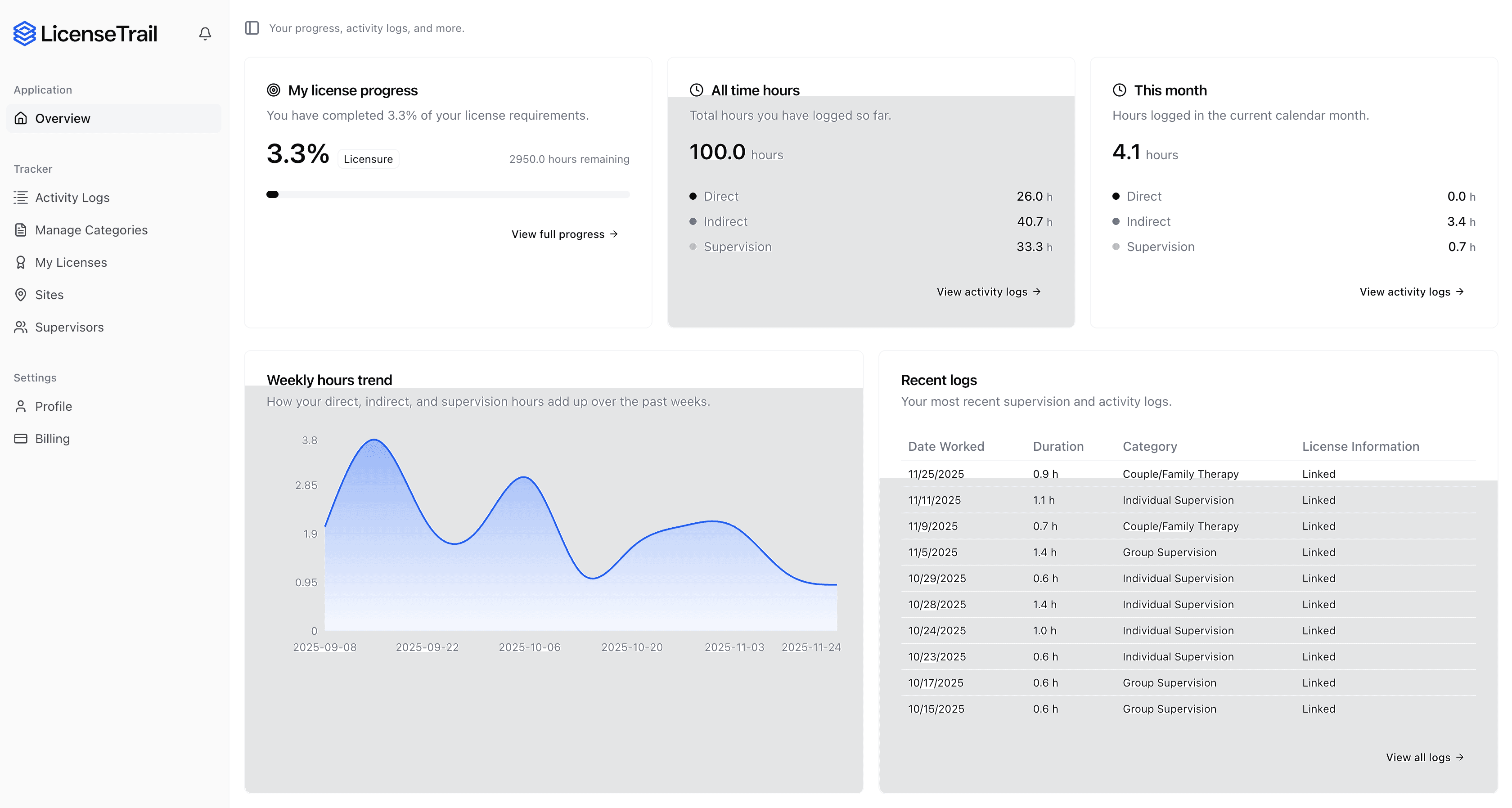
License Trail checks your direct, indirect, and supervision hours against Delaware LACMH requirements continuously and flags mismatches before you submit.
 Start Tracking for Free
No credit card required · Free plan available
Is your spreadsheet hiding Delaware LACMH risks?
Stop guessing if your categories match Delaware Board of Mental Health and Chemical Dependency Professionals requirements. License Trail checks your direct, indirect, and supervision hours continuously and flags mismatches before you submit.
Import or log
Bring your spreadsheet or start fresh
Upload your existing tracking spreadsheet and we'll map every hour into the right Delaware Board of Mental Health and Chemical Dependency Professionals categories automatically.
Verify against Delaware
Catch mismatches before the board does
License Trail checks your direct, indirect, and supervision hours against Delaware LACMH requirements continuously.
Export board-ready
One-click clean reports
Generate professional, board-ready reports for supervision meetings and Delaware Board of Mental Health and Chemical Dependency Professionals submissions in seconds.
No credit card required · Free plan available