
District-of-columbia CAC-I Requirements: Hours, Exams & Step-by-Step Guide
Stop guessing if your categories match District-of-columbia requirements. License Trail checks your direct, indirect, and supervision hours against CAC-I requirements continuously and flags mismatches before you submit.
No credit card required · Free plan available
Quick Requirements Overview
- Authority/issuer: DC Board of Professional Counseling (DC Health/HPLA); governed by D.C. Code + 17 DCMR Ch. 87
- Education (standard route): At least an Associate’s degree in a health/human services field from a USDE-recognized accredited institution
- Required coursework: 10 topics × 3 semester hours each (may be made up via NAADAC‑approved program or accredited college coursework)
- Supervised experience: 500 hours total, including minimum 40 hours in each of 12 specified domains (no separate direct/indirect split)
- Supervision while practicing: CAC‑I must practice under direct supervision; if remote, supervisor must meet 1 hour/week; supervisor must meet §8715 qualifications
- National exam: Must pass NAADAC‑NCC Level I (NCAC I) (typically after education/experience requirements)
- DC jurisprudence exam: Must pass Board’s laws/rules/ethics exam; administered at least 3×/year; after 3 failures, Board‑approved refresher required
- Other application items: Online application, official transcripts, supervised-hours verification, exam verifications, fingerprint background check, ID/photos, fees; title use restricted without authorization
License Details
Procedures
Becoming a Certified Addiction Counselor I (CAC‑I) in the District of Columbia is governed by statute (D.C. Code) and by detailed Board regulations in Title 17 of the D.C. Municipal Regulations (DCMR), Chapter 87. The credential is issued by the D.C. Board of Professional Counseling under DC Health’s Health Regulation and Licensing Administration.
Below is a structured guide focused on the exact hour requirements and the Board’s own regulatory language.
1. What the CAC‑I credential is in D.C.
Under D.C. law, the Board of Professional Counseling “shall certify as an addiction counselor I” a person who meets:
- The general application requirements of subchapter V of the Health Occupations Revision Act (background check, fitness, etc.),
- Either the education or the experience route, and
- A national examination approved by the Board. (law.justia.com)
By statute, a Certified Addiction Counselor I “shall practice addiction counseling under the supervision of an authorized health‑care professional.” (law.justia.com)
In practice, DC Health and the Board treat CAC‑I as a regulated certification that functions similarly to a license but with required ongoing supervision.
2. Step 1 – Meet the education requirement (standard route)
2.1. Degree level
Regulations in 17 DCMR § 8702.1 require that an applicant:
- “has graduated with at least an Associate’s degree in a health or human services field … from an accredited institution whose program is accredited by an entity recognized by the U.S. Department of Education.” (dcrules.elaws.us)
Examples of acceptable fields listed include registered nursing, aging studies, criminal justice, health education, and mental health. (dcrules.elaws.us)
2.2. Required coursework (very specific topics and hours)
That associate’s degree must include the following coursework, each for three (3) semester hours (the regulation calls them simply “three (3) hours” per topic): (dcrules.elaws.us)
- Understanding the dynamics of human behavior and family systems – 3 hours
- Signs and symptoms of substance abuse – 3 hours
- Recovery process, stages of change, relapse prevention, treatment approaches, group dynamics and other adjunctive treatment, recovery support groups, motivational interviewing, and models and theories of addiction – 3 hours
- Ethics, rules and regulations – 3 hours
- Professional identity in the provision of substance abuse services – 3 hours
- Crisis intervention – 3 hours
- Cultural factors and competencies in addiction – 3 hours
- Co‑occurring disorders in interdisciplinary treatment – 3 hours
- Diagnostic and screening criteria in addictions – 3 hours
- Psychopharmacology resources in the treatment of addictions – 3 hours
If some of these courses were not taken as part of the degree, the Board allows them to be made up through a NAADAC‑approved program or coursework from a college/university accredited by an entity recognized by the U.S. Department of Education. (dcrules.elaws.us)
3. Alternative “experience in lieu of education” route
There is a limited pathway based primarily on supervised experience instead of the associate’s degree.
- D.C. Code § 3‑1208.51(a)(1)(B) permits certification if the person “[h]as at least 2 years of documented, supervised experience in the field of addiction counseling” and passes a national examination approved by the Board. (law.justia.com)
- In the regulations, § 8702.2 describes a “certification by waiver as an addiction counselor I,” requiring two (2) years of supervised experience obtained while registered as an addiction counselor, plus passing a national examination approved by the Board. (dcrules.elaws.us)
In practice, most new applicants today use the associate’s‑degree + coursework route. The waiver/experience‑only route has historically been tied to older registration/grandfathering schemes and may not be broadly available to someone entering the field now. (dchealth.dc.gov)
4. Step 2 – Complete the required supervised experience hours
This is the piece where D.C. law is extremely specific about both the number and the type of hours.
4.1. Total hours and supervision requirement
For CAC‑I, 17 DCMR § 8703.1 states:
“An applicant for certification as an addiction counselor I shall have obtained at least five hundred (500) hours of supervised experience, with a minimum of forty (40) hours in each of the following areas: …” (dcrules.elaws.us)
So, for CAC‑I in the District of Columbia:
- Total required experience: 500 hours of supervised experience
- Distribution: The 500 hours must include at least 40 hours in each of 12 specified areas (see below).
There is no separate category of “unsupervised” or “indirect” hours in the D.C. regulation for CAC‑I. Every counted hour is part of those “500 hours of supervised experience.”
4.2. The 12 required content areas (minimum 40 hours each)
The same regulation lists the areas in which those 40‑hour minimums must be met. For CAC‑I, you must have supervised experience totaling at least 40 hours in each of the following: (dcrules.elaws.us)
- Understanding the dynamics of human behavior and family systems
- Signs and symptoms of substance abuse
- Recovery process, stages of change, relapse prevention, treatment approaches, group dynamics and other adjunctive treatment, recovery support groups, motivational interviewing, and models and theories of addiction
- Ethics, rules and regulations
- Professional identity in the provision of substance abuse services
- Crisis intervention
- Substance abuse counseling treatment planning and research
- Counseling skills for individual and group, including motivational interviewing
- Cultural factors and competencies in addiction
- Co‑occurring disorders and interdisciplinary treatment
- Diagnostic and screening criteria in addictions
- Psychopharmacology resources in the treatment of addictions
Because you need 40 hours in each of these 12 domains, the Board is effectively requiring that your supervised experience be broad and competency‑based—not just clock‑time in a single job function.
4.3. Nature of supervision during those hours
While § 8703 defines what the supervised hours must cover, other regulations define how you must be supervised:
- A CAC‑I must practice “only under the direct supervision” of a qualified supervisor. If the agency has multiple locations and a supervisor is not physically present, supervision “may be by communication device,” but the supervisor must meet with the counselor for one hour per week. (dcrules.elaws.us)
- Supervisors must be advanced practice addiction counselors, or certain licensed health professionals (LPC, psychologist, social worker, MFT, MD, or RN) who also either hold a national substance abuse counseling certification, a CAC‑II credential, or have at least one year of substance abuse counseling experience plus 100 hours of didactic training in areas outlined in § 8703.1. (dcrules.elaws.us)
5. Step 3 – Pass the national addiction counseling exam
D.C. regulations explicitly name the required national exam for CAC‑I:
- 17 DCMR § 8704.1 requires that an applicant for addiction counselor I certification take and pass the NAADAC‑NCC Level I examination (National Certified Addiction Counselor Level I).
- The exam is to be taken only after the applicant has satisfied the educational requirements of § 8702.1 and, if applicable, the waiver provisions. (dcrules.elaws.us)
In other words, the Board requires:
- National exam: NAADAC‑NCC Level I (NCAC I)
- Sequence: Complete degree + coursework + supervised experience first, then take the exam.
6. Step 4 – Pass the D.C. jurisprudence examination
On top of the national exam, all addiction counselor applicants in D.C. must pass a District jurisprudence exam.
Under 17 DCMR § 8705:
- Any individual submitting an initial application for CAC‑I (or CAC‑II) “shall receive a passing score on an examination developed by the Board on laws, rules, and ethical standards pertaining to the practice of addiction counseling (the District jurisprudence examination).” (dcrules.elaws.us)
- The Board must administer this exam at least three times per year.
- If an applicant fails three times, they must complete a Board‑approved refresher course before re‑taking it. (dcrules.elaws.us)
Secondary sources note a separate jurisprudence exam fee (recently listed as $125) in addition to the application/certification/background check fees. (counselingschools.com)
7. Step 5 – Submit your application to the DC Board of Professional Counseling
DC Health’s “Addiction Counselors Licensing” and “Professional Counseling Licensing” pages describe the application process and point you to the online portal and supporting documents. (dchealth.dc.gov)
For CAC‑I, the typical application file includes:
- Completed online application (through DC Health’s portal)
- Official transcripts documenting:
- Your associate’s degree in a qualifying health or human services field, and
- The required coursework listed in § 8702.1 (if not obvious from the transcript, you may need a coursework form). (dcrules.elaws.us)
- Documentation of supervised experience:
- Forms or letters showing you completed at least 500 hours of supervised experience, with at least 40 hours in each of the 12 required areas described in § 8703.1. (dcrules.elaws.us)
- Verification of passing:
- NAADAC‑NCC Level I exam
- D.C. jurisprudence examination (dcrules.elaws.us)
- Identity documents and photos:
- Two 2x2‑inch passport‑style photos
- Government‑issued ID copy (counselingschools.com)
- Background check:
- Fingerprint‑based criminal background check via a DC‑approved vendor (dchealth.dc.gov)
- Fees:
- Recent summaries indicate about $240 in Board fees (application, certification, and background check) plus a separate $125 jurisprudence exam fee; always confirm current amounts on the DC Health site, as fees can change. (counselingschools.com)
Applications and supplemental forms are submitted electronically and/or to the Board’s office at 899 North Capitol Street NE, Washington, DC. (dchealth.dc.gov)
8. Step 6 – Understand conditions of practice once certified
Even after you are certified as CAC‑I, you are not an independent practitioner in D.C.
8.1. Mandatory supervision in practice
Regulations on supervision of CAC‑I and CAC‑II are in 17 DCMR § 8715:
- “An addiction counselor I or II shall practice only under the direct supervision of a person meeting the standards of this section.” (dcrules.elaws.us)
- If your agency has multiple locations and no on‑site supervisor, supervision may be by phone or other communication device, provided that the supervisor meets with you one hour per week. (dcrules.elaws.us)
- Supervisors must meet specific qualification criteria, including licensure and specialty experience/certification in substance abuse counseling (advanced practice addiction counselor, LPC with NAADAC/NBCC addiction certification, CAC‑II with specified training, etc.). (dcrules.elaws.us)
8.2. Title protection
D.C. Code makes it unlawful to use titles such as “certified addiction counselor I” or “C.A.C.I.” unless you are authorized under the chapter. (law.justia.com)
9. Hour requirements for CAC‑I in D.C. – concise summary
Putting the numbers and “types” of hours into one place:
-
Education hours (coursework embedded in your degree)
- Ten defined content areas, each requiring 3 semester hours (or equivalent hours) in topics such as human behavior and family systems, signs and symptoms of substance abuse, ethics, crisis intervention, cultural competence, co‑occurring disorders, diagnostic criteria, and psychopharmacology. (dcrules.elaws.us)
-
Supervised experience hours (pre‑certification practice)
- 500 hours total of supervised experience in addiction counseling, not split into “direct” vs. “indirect” categories.
- The regulation requires “at least five hundred (500) hours of supervised experience, with a minimum of forty (40) hours in each” of 12 specified practice areas, which mirror and extend the coursework topics (e.g., treatment planning and research, individual and group counseling skills, crisis intervention, co‑occurring disorders, diagnostic criteria, psychopharmacology). (dcrules.elaws.us)
There is no requirement such as “1,500 hours direct experience and 1,500 hours supervised experience” in the District of Columbia regulations. Instead, the D.C. Board’s rules define a single block of 500 hours of supervised experience that must be carefully distributed across the twelve defined competency areas.
This is the current regulatory framework (as of late 2025) for becoming a CAC‑I with the D.C. Board of Professional Counseling. For any application, it is wise to download the latest regulations and forms directly from DC Health’s site and, if needed, contact the Board using the “Addiction Counselor I applicants” email listed on the Professional Counseling Licensing page. (dchealth.dc.gov)
Track your CAC-I hours with confidence
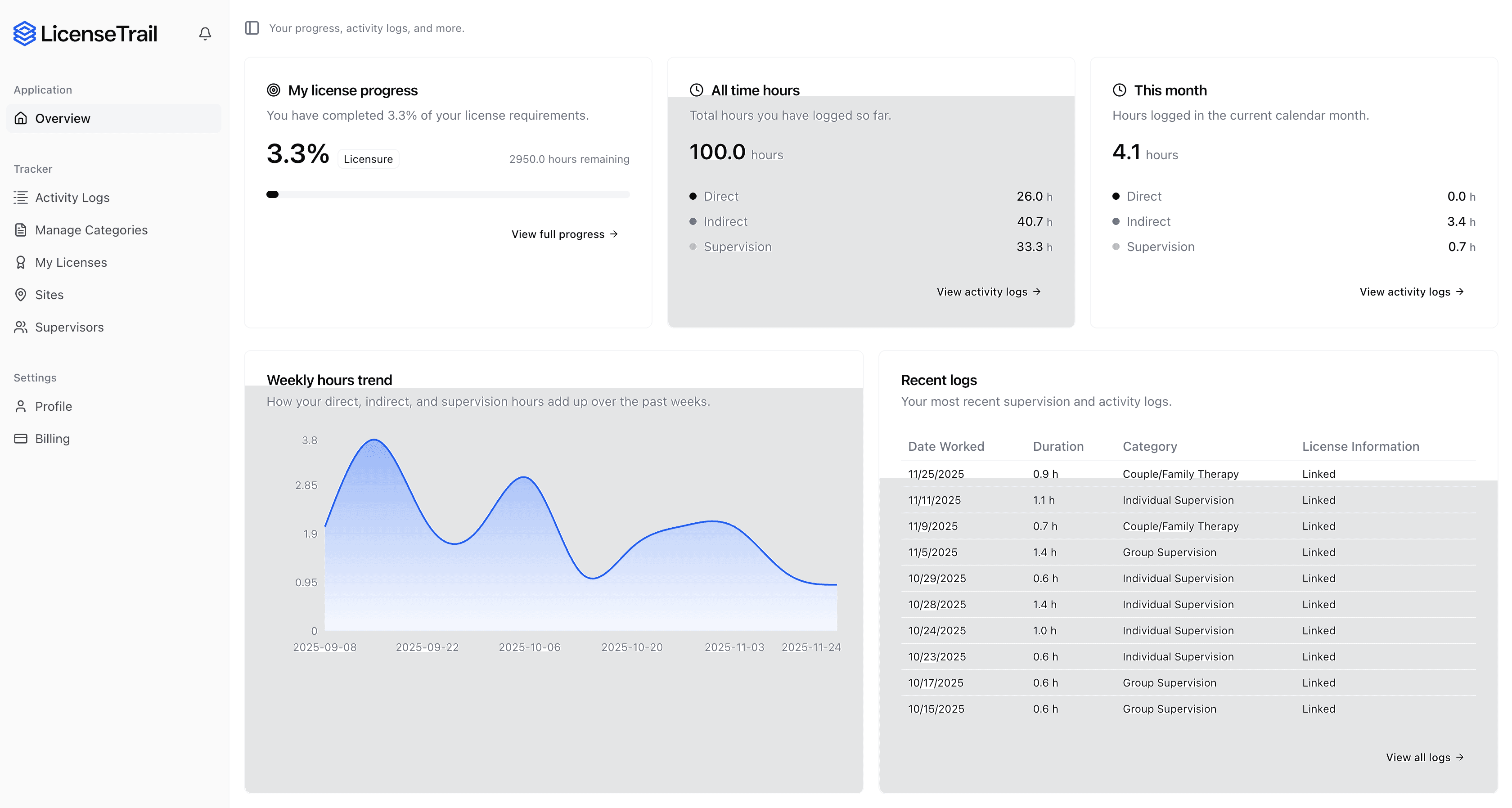
License Trail checks your direct, indirect, and supervision hours against District-of-columbia CAC-I requirements continuously and flags mismatches before you submit.
 Start Tracking for Free
No credit card required · Free plan available
Is your spreadsheet hiding District-of-columbia CAC-I risks?
Stop guessing if your categories match District of Columbia Board of Professional Counseling requirements. License Trail checks your direct, indirect, and supervision hours continuously and flags mismatches before you submit.
Import or log
Bring your spreadsheet or start fresh
Upload your existing tracking spreadsheet and we'll map every hour into the right District of Columbia Board of Professional Counseling categories automatically.
Verify against District-of-columbia
Catch mismatches before the board does
License Trail checks your direct, indirect, and supervision hours against District-of-columbia CAC-I requirements continuously.
Export board-ready
One-click clean reports
Generate professional, board-ready reports for supervision meetings and District of Columbia Board of Professional Counseling submissions in seconds.
No credit card required · Free plan available