
District-of-columbia LGPC Requirements: Hours, Exams & Step-by-Step Guide
Stop guessing if your categories match District-of-columbia requirements. License Trail checks your direct, indirect, and supervision hours against LGPC requirements continuously and flags mismatches before you submit.
No credit card required · Free plan available
Quick Requirements Overview
- Purpose/Scope: LGPC = entry-level license; supervised practice only (no independent practice; cannot bill as payee).
- Education: Master’s (or higher) in counseling/related field, ≥48 graduate semester credits incl. required core content areas + practicum/internship.
- Practicum: 100 hours supervised practicum; ≥40 hours direct client service.
- Internship: 600 hours supervised internship; ≥240 hours direct client service.
- Minimum fieldwork total: 700 hours combined practicum+internship with ≥280 direct-service hours.
- Exam: Pass Board-approved national exam (NCE, NCMHCE, or CRC) and send scores to DC Board.
- Application items (typical): Online application/fee, photos, official transcripts, Coursework Form, Practicum/Internship Form, background check/fingerprints.
- For later LPC upgrade: 3,500 post-master’s hours over 2–5 years incl. 200 supervision hours (≥100 individual) at 1:35 supervision ratio.
License Details
Procedures
In the District of Columbia, the Licensed Graduate Professional Counselor (LGPC) is the entry‑level counseling license issued by the DC Board of Professional Counseling. It allows you to practice only under supervision while you complete the post‑graduate experience needed for full Licensed Professional Counselor (LPC) status. (gsep.pepperdine.edu)
Below is a structured walkthrough of what DC actually requires, with emphasis on the specific hour counts and how the Board defines them.
1. Understand the LGPC role in DC
DC law distinguishes between:
- Licensed Graduate Professional Counselor (LGPC) – for graduates who have completed at least 48 semester hours of graduate counseling education and passed the national exam, but have not yet completed post‑graduate supervised experience. (code.dccouncil.gov)
- Licensed Professional Counselor (LPC) – for counselors who meet the more advanced 60‑credit education standard and have completed substantial supervised post‑graduate hours. (code.dccouncil.gov)
The LGPC is therefore a supervised practice license: you use it while accumulating the supervised post‑graduate hours required for LPC.
2. Meet the degree and coursework requirements
2.1. Degree level and credit hours
For LGPC licensure, DC Code § 3‑1207.10(b) requires that the Board license as a graduate professional counselor a person who: (code.dccouncil.gov)
- Has satisfactorily completed the national examination adopted by the Board (see section 4 below), and
- Possesses a master’s degree or higher in counseling or a related subject from an accredited college or university,
- Consisting of at least 48 semester hours of graduate education.
Schools and licensure disclosures summarizing DC regulations further specify that those 48 credits must cover 10–11 core counseling content areas (e.g., counseling theories, human growth and development, group, appraisal/testing, diagnosis and treatment planning, multicultural counseling, research/program evaluation, professional ethics, etc.) and must include a counseling practicum or internship component. (gsep.pepperdine.edu)
3. Complete the required practicum and internship hours (pre‑licensure)
DC’s LGPC regulations require a university‑approved practicum and internship with specific hour minimums and direct‑service requirements. Schools that map their curricula to DC law quote the District’s language almost verbatim, and align with the Board’s DCMR Chapter 91 rules. (gsep.pepperdine.edu)
3.1. Total field experience hours during the degree
To qualify for an LGPC, you must have completed:
- 100‑hour face‑to‑face supervised practicum, followed by
- 600‑hour face‑to‑face supervised internship,
- Both in a university‑approved counseling setting. (gsep.pepperdine.edu)
This is 700 total supervised field hours during your graduate program.
3.2. Required “direct service” (client‑contact) hours
Within those 700 hours, DC is specific about direct service to clients:
- Practicum (100 hours total):
- At least 40 hours must be direct service to clients (e.g., individual, group, couples, or family counseling).
- Internship (600 hours total):
- At least 240 hours must be direct service to clients. (gsep.pepperdine.edu)
So, minimum direct‑service hours during your master’s program:
- 40 (practicum) + 240 (internship) = 280 hours of direct client contact
The remaining hours in both practicum and internship may be indirect (e.g., case notes, case conferences, trainings, team meetings, outreach) and supervision time, as allowed by your program and site.
3.3. Supervision during practicum and internship
Programs complying with DC requirements structure fieldwork so that you receive regular individual/triadic and group supervision from qualified supervisors:
- Typically 1 hour per week of individual or triadic supervision on site, plus
- Additional group supervision from program faculty. (faithiu.edu)
Exact supervision distribution can vary by program, but DC expects documentation (through the LPC and LGPC Practicum/Internship Form) showing that the 100/600 hour totals and the direct‑service minimums have been met in settings acceptable to the Board. (dchealth.dc.gov)
4. Pass the national counseling examination
DC law requires that LGPCs “satisfactorily complete the national examination adopted by the Board.” (code.dccouncil.gov)
The Board accepts one of the following: (counselingdegreesonline.org)
- NCE – National Counselor Examination
- NCMHCE – National Clinical Mental Health Counseling Examination
- CRC – Certified Rehabilitation Counselor Examination
Your official passing score must be sent directly to DC Health/Board of Professional Counseling by the testing body.
5. Assemble and submit the LGPC application
Using DC Health’s online licensing portal, you apply as a Graduate Professional Counselor by Examination (unless you qualify for some form of endorsement). The DC application package and checklists outline what must be submitted. (dchealth.dc.gov)
Common requirements include:
- Online application for LGPC
- Application fee (amount listed in current fee schedule on the DC Health site)
- Two recent passport‑type photos
- Official graduate transcripts (sent directly to the Board)
- Coursework Form for LPC and LGPC – documents that your 48 graduate credits cover the required content areas
- LPC and LGPC Practicum/Internship Form – completed by your program or site to verify:
- 100‑hour practicum (≥40 direct hours), and
- 600‑hour internship (≥240 direct hours), in acceptable counseling settings
- Proof of passing the national exam (NCE, NCMHCE, or CRC)
- Criminal background check and any required fingerprints
- Any other documentation requested in the LGPC examination checklist (e.g., explanations of disciplinary or criminal history, if applicable)
The Board reviews the complete package and determines eligibility for LGPC licensure.
6. Scope of practice and supervision as an LGPC
Once issued, the LGPC license permits you to practice only under supervision; you are not allowed to practice independently.
DC’s regulations clarify that “only a licensed professional counselor may engage in independent practice.” A graduate professional counselor may not: (dcregs.dc.gov)
- Provide counseling services on their own responsibility without the administrative and professional control of an employer or clinical supervisor; or
- Directly bill clients and receive payment as the payee for services rendered.
In practical terms, as an LGPC you must:
- Work in settings where you have an approved clinical supervisor, and
- Practice under a supervised practice arrangement that meets DC’s rules (documented via the Board’s Request for Supervised Practice Form when required). (dchealth.dc.gov)
7. Know the post‑graduate supervised experience you’ll need later for LPC
Although not required just to obtain the LGPC, DC ties the LGPC to a clear set of post‑master’s supervised experience requirements you must ultimately meet for LPC licensure. Multiple state‑licensure resources summarizing DC regulation 17‑9105 and related rules consistently describe these numbers. (counselingdegreesonline.org)
7.1. Total supervised experience hours
To move from LGPC to LPC, you must complete:
- 3,500 hours of post‑master’s supervised professional counseling experience,
- In not less than 2 years and not more than 5 years.
These 3,500 hours are actual counseling work (paid or unpaid) in settings acceptable to the Board.
7.2. Required supervision hours within the 3,500 hours
Within those 3,500 hours, DC carves out a specific supervision requirement:
- 200 hours of clinical supervision in total, which must:
- Follow a minimum ratio of 1 hour of immediate supervision for every 35 hours of counseling practice, and
- Include at least 100 hours of individual (one‑on‑one) supervision (the remaining up to 100 hours may be group supervision, if allowed by the Board).
This means your hours break down conceptually as:
- 3,500 total counseling hours, including:
- 200 hours of “immediate” clinical supervision (≥100 individual), and
- 3,300 hours of other supervised counseling work (direct client care and related professional duties), all under approved supervision.
“Supervision,” as summarized from DC‑focused licensure guidance, is defined as directed, post‑graduate experience in professional counseling under supervision in a work setting – not just casual consultation. (onlinecounselingprograms.com)
7.3. Who can supervise
DC allows supervision to be provided by:
- A District‑licensed Professional Counselor (LPC), and for portions of the hours,
- Other qualified licensed mental health professionals (e.g., psychologist, psychiatrist, licensed clinical social worker), consistent with DC’s supervision rules and forms. (counselingdegreesonline.org)
However, at least 200 supervision hours must be under an appropriately qualified supervisor in line with Board rules; supervision arrangements are documented on the Post Graduate Supervised Experience Form and Supervision Calculation Form. (dchealth.dc.gov)
8. Summary of hour requirements relevant to LGPC applicants
Putting the numbers together:
Pre‑licensure (during master’s program) – required to qualify for LGPC
-
Education:
- Master’s degree (or higher) in counseling or related field
- ≥ 48 graduate semester hours, including required counseling core content areas (code.dccouncil.gov)
-
Practicum and Internship (field experience):
- 100‑hour supervised practicum (face‑to‑face, university‑approved)
- ≥ 40 hours direct client service
- 600‑hour supervised internship (face‑to‑face, university‑approved)
- ≥ 240 hours direct client service
- Total minimum: 700 hours field experience, including ≥ 280 hours of direct service (gsep.pepperdine.edu)
- 100‑hour supervised practicum (face‑to‑face, university‑approved)
These are the only hour counts you must document to obtain the LGPC itself.
Post‑licensure (after you are an LGPC) – required later for LPC
While you hold your LGPC and practice under supervision, you must accumulate, for eventual LPC licensure:
- 3,500 hours of post‑master’s supervised professional counseling experience over 2–5 years, including:
- 200 hours of clinical supervision, of which
- ≥ 100 hours individual (one‑on‑one) supervision, and
- Supervision provided at a minimum 1:35 ratio (one hour supervision for each 35 hours of counseling work). (counselingdegreesonline.org)
- 200 hours of clinical supervision, of which
DC regulations do not split these 3,500 post‑graduate hours into explicit “direct” vs “indirect” numerical subtotals the way some other states do (e.g., “1,500 direct + 1,500 supervised total”). Instead, they emphasize total counseling hours plus the supervision‑hour minimums and ratio.
In practice, your path in DC is:
- Complete a 48‑credit counseling master’s with the 100/600 practicum‑internship structure and required direct‑service hours.
- Pass NCE, NCMHCE, or CRC.
- Submit the LGPC application package with your forms, transcripts, exam scores, and background check.
- Receive your LGPC and work only under approved supervision (no independent practice).
- Accrue 3,500 supervised post‑master’s hours following DC’s supervision rules, then apply for LPC.
Track your LGPC hours with confidence
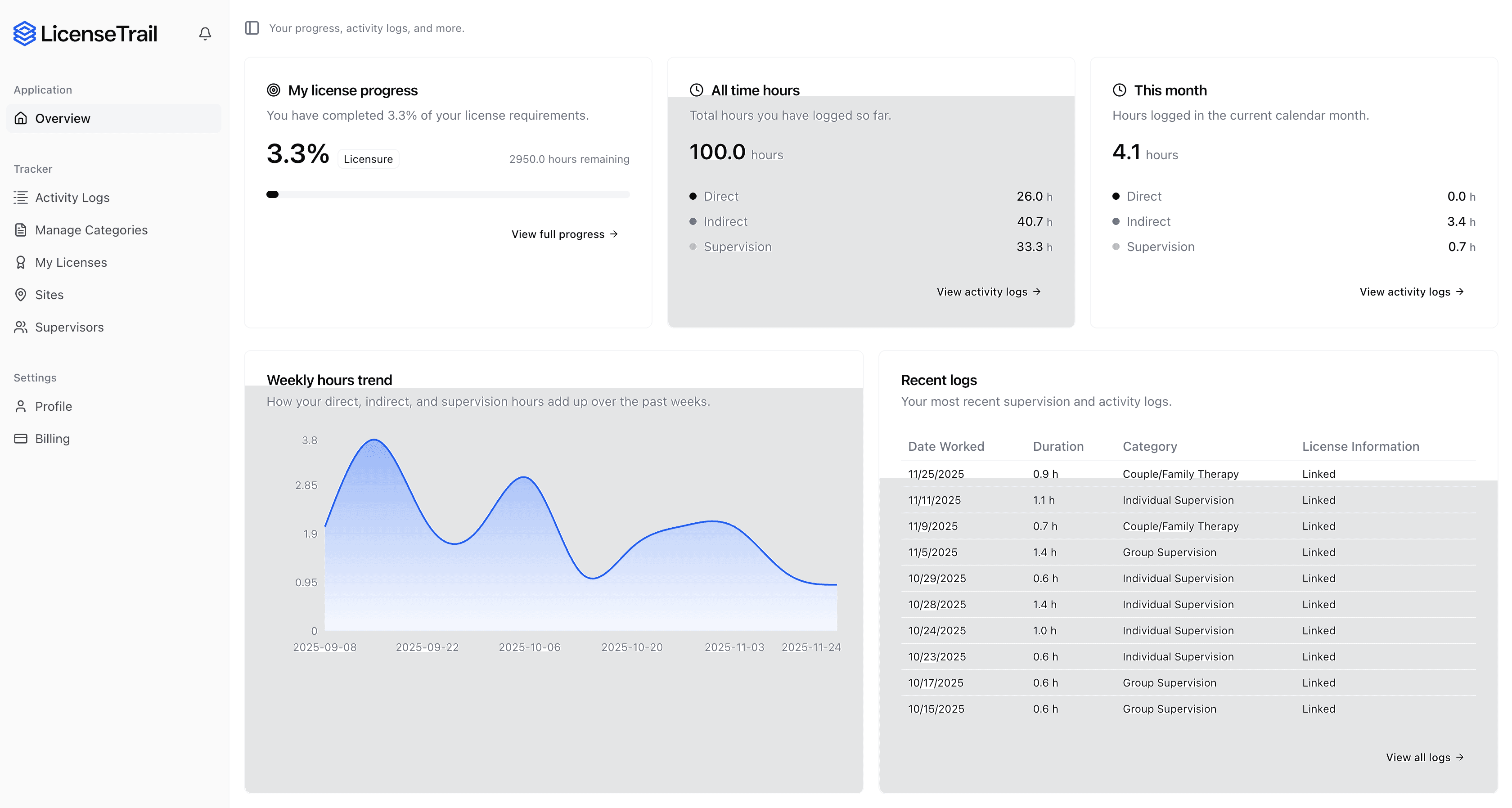
License Trail checks your direct, indirect, and supervision hours against District-of-columbia LGPC requirements continuously and flags mismatches before you submit.
 Start Tracking for Free
No credit card required · Free plan available
Is your spreadsheet hiding District-of-columbia LGPC risks?
Stop guessing if your categories match District of Columbia Board of Professional Counseling requirements. License Trail checks your direct, indirect, and supervision hours continuously and flags mismatches before you submit.
Import or log
Bring your spreadsheet or start fresh
Upload your existing tracking spreadsheet and we'll map every hour into the right District of Columbia Board of Professional Counseling categories automatically.
Verify against District-of-columbia
Catch mismatches before the board does
License Trail checks your direct, indirect, and supervision hours against District-of-columbia LGPC requirements continuously.
Export board-ready
One-click clean reports
Generate professional, board-ready reports for supervision meetings and District of Columbia Board of Professional Counseling submissions in seconds.
No credit card required · Free plan available